B2B Appointment Setting: To Build or to Outsource?
Businesses that sell products or services to other businesses (B2B) require an effective appointment setting process to meet potential customers and convert them into paying clients. However, deciding whether to build an in-house appointment setting team or to outsource the process can be challenging. Appointment setting, when done correctly, may completely transform any business. A sales representative who can continuously replenish their sales funnel with new qualified opportunities is priceless. The Importance of B2B Appointment Setting It first establishes a foundational degree of product-market fit. People that you are trying to reach out to are probably unfamiliar with you or your business, so they could be hesitant to pick up the phone. But the issue you are resolving for them is critical enough for them to attend the meeting. Second, it could provide you with some predictability. Every firm must have a high quality appointment setting strategy. You should be aware of how many meetings correspond to what production level once you’ve put it into practice. How many of such encounters are required to sign a new client? This degree of certainty enables you to make expansion plans. According to research by Sirius Decisions, it typically takes 8 to 12 calls to reach a prospect. Almost all businesses engage in appointment setting to some extent. Most certainly, the owner, salesmen, or someone in charge of income is cold-calling net new prospects. It’s possible that there isn’t an appointment setting team or that no one is in charge of it full-time. When this occurs, the attempt to schedule appointments or do outreach may be irregular. In this article, we’ll explore the pros and cons of each approach to help you determine which option is the best fit for your B2B company. Building an In-house Appointment Setting Team Building an in-house appointment setting with decision makers team involves hiring employees and investing in the infrastructure required to manage the process internally. When it comes to B2B sales, building an in-house appointment setting team can be a effective way to generate qualified leads (sales qualified or marketing qualified) and set up meetings with potential clients. By developing an in-house team, you can have complete control over the process, ensuring that your team understands your product, target audience, and industry-specific language. The first step in building an in-house appointment setting team is to identify your needs. Start by determining the volume of calls and appointments you need to make and how many staff members you require to handle them. Then, create a job description that outlines the skills and experience needed to succeed in this role. When building an in-house appointment setting team, it’s crucial to hire the right people. Look for individuals with a proven track record in appointment setting, preferably with experience in B2B sales. They should be able to understand your product and communicate its value to potential clients. Once you’ve hired your team, provide them with adequate training. This should include both product and sales training to help them understand your product and target audience. Consider investing in ongoing training to keep your team up to date with the latest sales techniques and product updates. To ensure that your team is meeting your expectations, it’s essential to set goals and metrics. This will help you track the number of calls made, appointments set, and deals closed. Use this information to identify areas for improvement and make necessary changes to your sales process. To streamline your appointment setting process, invest in the right technology. This might include a customer relationship management (CRM) system, lead generation tools, and appointment scheduling software. This will not only help your team work more efficiently but also provide you with valuable data to make informed decisions about your sales process. Must Read: Avoid Making These B2B Appointment Setting Mistakes — Or Your Sales Funnel Will Collapse Here are the benefits and drawbacks of this approach: Benefits Full Control: By building an in-house team, you have complete control over the process, including the quality of the team, the message, and the data. Tailored to Your Needs: Your team can be trained to meet your unique needs, ensuring that they understand your product, target audience, and industry-specific language. Tailored to Your Needs: Data and Knowledge Retention: An in-house team allows you to retain customer data and knowledge, which can be used to develop sales strategies and improve the product. What is appointment setting and you should outsource it? Drawbacks High Cost: Building an in-house team can be costly in terms of recruitment, training, and infrastructure. Additionally, you’ll need to manage salaries, employee benefits, and taxes. Limited Capacity: You’ll need to ensure that you have enough staff to handle a high volume of calls and appointments. Time-consuming: The process of recruiting, training, and managing an in-house team can be time-consuming, taking time away from other essential business activities. While building an in-house team may require more resources and time, the benefits can be well worth the investment in the long run. Outsourcing Appointment Setting Outsourcing appointment setting involves partnering with a third-party provider to manage the appointment setting process on your behalf. Outsourcing appointment setting can be a smart move for businesses looking to generate more leads and set up meetings with potential clients. By outsourcing this task, businesses can save time and resources while benefiting from the expertise of professional sales teams. When outsourcing appointment setting, businesses can benefit from the expertise of professional sales teams. These teams are trained to identify high-quality leads and have the skills and experience to set up meetings with potential clients. They also have access to the latest sales techniques and technology, ensuring that they are using the most effective methods to generate leads. Outsourcing appointment setting can be a cost-effective solution for businesses. Rather than investing in the resources required to build an in-house team, businesses can pay for the services of an outsourced team on an as-needed basis. This can save businesses time and money while still achieving their sales goals. By
What is Appointment Setting and Why Should You
Outsource it?

B2B appointment setting is the process of scheduling appointments between to businesses for the purpose of discussing potential business opportunities. This could include meetings between companies to discuss sales, marketing, or strategic partnerships. The goal of B2B appointment setting is to initiate productive conversations between businesses, in order to increase sales and build strong business relationships. Successful B2B lead generation company always gives the appointment setting service with high success rates. Setting up appointments is thought to be one of the hardest parts of growing a business and the most common reason that stops a business from growing.  Without initially conversing with a prospect, selling won’t even be feasible. This is particularly true for start-ups and small enterprises because growth isn’t feasible without successful sales. To sum it up, setting appointments is an important responsibility where a business provides a first image to a prospect by any forms of communication in order to pique their interest, which will ultimately result in a legitimate sale and development along the road. There are several reasons why a business might choose to outsource its B2B appointment setting efforts. Some of the most common reasons include a lack of internal resources, a lack of in-house expertise, and the need to focus on core business functions. In this blog, we’ll explore these reasons in more detail and discuss why outsourcing B2B appointment setting can be a valuable investment for any business. Before we proceed, lets see what do appointment setters do? Must Read: Debunking 7 Common Misconceptions About Outsourcing Appointment Setting  What Do Appointment Setters Do? Appointment setters are professionals who specialize in scheduling appointments between businesses. They play a crucial role in the sales process, as their main responsibility is to initiate productive conversations between businesses that can lead to increased sales and stronger business relationships. The following are some of the key tasks and responsibilities of appointment setters: Lead Generation: Appointment setters are responsible for generating leads and identifying potential business opportunities. They do this by researching target companies, identifying decision-makers, and determining the best time to schedule appointments. Cold Calling: Cold calling is one of the primary methods appointment setters use to schedule appointments. They make outbound calls to potential clients, introduce themselves and the company they represent, and pitch the value of a meeting. Qualifying Leads: Before scheduling an appointment, appointment setters must qualify leads ( Marketing qualified leads or Sales qualified leads ) to ensure that they are a good fit for the company. This includes verifying the company’s size, budget, and decision-making process. Scheduling Appointments: Once a lead is qualified, appointment setters will schedule appointments with decision-makers at the target company. They are responsible for coordinating the date, time, and location of the appointment, as well as any additional logistics. Follow-Up: Appointment setters are also responsible for following up with leads to ensure that appointments are kept. This includes sending reminders and rescheduling appointments as necessary. Data Management: Appointment setters must keep accurate records of all appointments, leads, and contacts. They must also update this information regularly to ensure that it is up-to-date. Reporting: Appointment setters must provide regular reports to their manager or supervisor to provide an update on their progress. These reports may include details on the number of appointments scheduled, the conversion rate of leads to appointments, and any other relevant metrics. Appointment setters play a critical role in the sales process by scheduling appointments and initiating productive conversations between businesses. They are responsible for lead generation, cold calling, qualifying leads, scheduling appointments, following up, data management, and reporting. By outsourcing appointment setting, businesses can leverage the expertise of specialized appointment setters to improve their sales results and strengthen their business relationships. Must Read: Outsourcing B2B Appointment Setting In A Nutshell Why should you consider outsourcing Appointment Setting? Lack of Internal Resources: One of the primary reasons businesses choose to outsource their B2B appointment setting efforts is a lack of internal resources. Many businesses simply don’t have the staff or the time to devote to this task, and outsourcing can provide a more cost-effective solution. By outsourcing B2B appointment setting, businesses can save time and resources, as they can focus on their core business functions without having to worry about this additional task. Lack of In-House Expertise: Another reason businesses choose to outsource B2B appointment setting is a lack of in-house expertise. This is particularly true for businesses that are new to the market or are just starting to build their customer base. By outsourcing this function, businesses can leverage the expertise of a specialized B2B appointment setting service that has the knowledge and experience needed to effectively schedule appointments and initiate productive conversations. Cost-Effective Solution: Outsourcing B2B appointment setting can be a cost-effective solution for businesses of all sizes. By outsourcing this function, businesses can reduce their overall labor costs, as they won’t need to hire additional staff or train existing staff on appointment setting techniques. Furthermore, outsourcing can provide a more scalable solution, as businesses can adjust their appointment setting needs based on the volume of appointments they need to schedule. Focus on Core Business Functions: One of the biggest benefits of outsourcing B2B appointment setting is that it allows businesses to focus on their core business functions. By outsourcing this function, businesses can free up internal resources and time that can be devoted to other areas of the business that require more attention. This can include things like product development, customer service, or marketing efforts. Improved Sales Results: Outsourcing B2B appointment setting can also lead to improved sales results. By partnering with a specialized B2B appointment setting service, businesses can leverage their expertise and experience to effectively schedule appointments and initiate productive conversations. This can result in increased sales, stronger business relationships, and better opportunities for future business growth. Time: Your internal sales representative likely only has eight hours each day to complete the extensive tasks that make up his or her work. Your internal sales representative will have a lot more time

Outsourcing B2B Appointment Setting In A Nutshell

Outsourcing is a common practice in many industries, including the B2B sector, and is used by businesses to handle a variety of tasks, including appointment generation. A report by Grand View Research found that the B2B outsourcing market was valued at $163.2 billion in 2020 and is expected to grow at a compound annual growth rate (CAGR) of 7.5% from 2021 to 2028. This growth is due to the increasing demand for cost-effective and efficient business solutions, particularly in the wake of the COVID-19 pandemic. Now that you understand outsourcing is effective and beneficial, lets consider outsourcing appointment setting. Finding quality, engaged sales leads can be a difficult effort for a salesperson. To maintain your sales funnel and boost ROI for your company, outsourcing lead generation and appointment-setting efforts is crucial. Outsourcing appointment generation is a service offered by third-party companies that specialize in booking appointments for businesses. This can include scheduling appointments for customer consultations, sales meetings, service appointments, or any other type of appointment that a business requires. The objective of outsourcing appointment generation is to free up time and resources for businesses so they can focus on other critical tasks, while also improving the quality of appointment setting through the use of specialized expertise and technology. The process of outsourcing appointment generation typically starts with a business defining its needs and objectives. This includes the type of appointments to be scheduled, the desired frequency of appointments, the target customer base, and any specific requirements for the appointment setting process. Once the objectives are defined, the business can then choose an outsourcing company that specializes in appointment generation and has a proven track record of success. The outsourcing company typically uses a combination of advanced technology and expertise to handle the appointment scheduling process efficiently and effectively. This can include appointment scheduling software, customer relationship management (CRM) systems, and data analytics tools. The appointment generation company also has a team of trained professionals who specialize in booking appointments and can provide a high level of customer service. Outsourcing appointment generation is a practice that has been growing in popularity among businesses in recent years. In this blog, we will delve into the benefits of outsourcing appointment generation, the different models available, and best practices for outsourcing the process. Must Read: Three Focus Areas for Outstanding Appointment Setting Advantages of Outsourcing Appointment Generation: Cost-Effective: Since there is no need to engage and train an internal team, outsourcing appointment generating may be a financially advantageous choice for firms. When compared to the cost of employing and training staff to do the activity internally, engaging an appointment generation company is usually less expensive. Improved Quality: Companies that specialize in appointment generation have the experience and knowledge required to execute the process accurately. They frequently have the capacity to deliver services of a higher calibre than an internal staff, improving client interactions and elevating client satisfaction. Saving time: Businesses can use the time saved by outsourcing appointment setting to concentrate on other priorities. Businesses can free up time for other crucial duties by outsourcing the process, which eliminates the time and effort needed to handle appointment scheduling internally. Access to Cutting-Edge Technology: Appointment generation businesses frequently have access to cutting-edge technology that can expedite and improve the process. This comprises tools for data analytics, customer relationship management (CRM) systems, and appointment scheduling software. Flexibility: Outsourcing appointment generation allows businesses to scale up or down their appointment scheduling needs as required, without having to worry about the cost or logistics of hiring or laying off employees. Improved accuracy: Outsourcing companies have systems and processes in place to ensure accurate scheduling, reducing the risk of missed appointments or scheduling conflicts. Focus on core competencies: By outsourcing appointment generation, businesses can focus on their core competencies and improve overall productivity. Different Models of Outsourcing Appointment Generation: B2B (Business to Business): In this model, the B2B lead generation company works with businesses to schedule appointments for their customers. B2C (Business to Consumer): In this model, the appointment generation company works with consumers to schedule appointments for them. Hybrid Model: The hybrid model combines elements of both the B2B and B2C models. In this model, the appointment generation company may work with both businesses and consumers to schedule appointments. Best Practices for Outsourcing Appointment Generation: Define the Objectives: Before outsourcing the appointment generation process, it is important to clearly define the objectives and goals of the process. This will help to ensure that the outsourcing company has a clear understanding of what is expected and can provide the desired results. Choose the Right Outsourcing Company: It is important to choose an outsourcing company that has a proven track record of success in appointment generation. The company should have a strong reputation, good customer reviews, and a commitment to quality service. Establish Clear Communication: Clear communication is key to the success of any outsourcing relationship. It is important to establish regular communication with the outsourcing company to ensure that the process is running smoothly and that the desired results are being achieved. Monitor Performance: Regular monitoring of the performance of the outsourcing company is crucial. This can be done through regular reports, performance metrics, and customer feedback. Conclusion Outsourcing appointment generation can be a cost-effective and efficient way for businesses to handle the appointment scheduling process. The ability to do what you do best i.e, CLOSE, is by far the biggest advantage of outsourcing your appointment setting operations. You have the time to concentrate on the ones that will put money in your pocket while the top of the funnel is buzzing. By outsourcing the process, businesses can free up time and resources, improve the quality of service, and access advanced technology. When outsourcing appointment generation, it is important to define the objectives, choose the right outsourcing company, establish clear communication, and regularly monitor performance. If you’re looking for a company to handle you Appointment Setting operations, feel free to get in touch with ONLY B2B. We have flexible

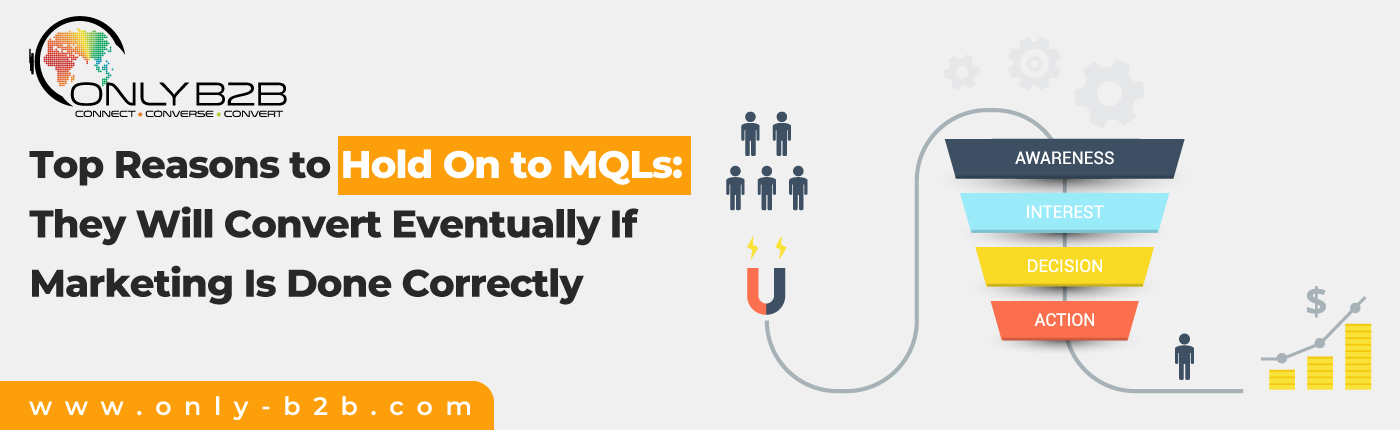
Top Reasons to Hold On to MQLs: They Will Convert Eventually If Marketing Is Done Correctly

Regardless of industry, generating leads is a top goal for B2B businesses. Getting leads is quite simple, but getting marketing-qualified prospects that are likely to convert is more difficult. To achieve this, marketers must invest more time in their research and create an efficient lead generation funnel. Prospects with a high likelihood of converting into sales leads and then customers are known as MQLs.  The requirements for qualifying these leads vary from business to business, but often include tracking activities like: MQLs aren’t prepared to work with a sales rep just yet. On the other hand, they have already started the customer journey. They are aware of your company, interested in your products, and starting to recognize that your solutions could be able to solve their issues. B2B marketers should nurture MQLs after identifying them in order to gain their confidence and persuade them. Content marketing is the key technique used by businesses to cultivate MQLs. Marketers facilitate the conversion of MQLs into customers by nurturing them and not letting them leave. “If you just serve up the MQLs,” says HubSpot VP of Operations, “then Sales spends less time hunting for those MQLs in their regular process, and more time selling to the real gems you offer, thereby closing more transactions.” But transforming MQLs into customers may be a time-consuming and laborious process; it is not a one-time, short-term activity. In fact, 95% of MQLs visit your website to do research because they aren’t yet ready to speak with a sales representative. Since 70% of these leads will eventually make a purchase, you shouldn’t disregard MQLs that aren’t ready to make a purchase just yet. According to a Frost & Sullivan research, the majority of marketers are aware of this fact, with over 70% of them concurring that it often takes three to six months to close agreements with MQLs. Why, therefore, should B2B marketers hold on to MQLs and refuse to let go even if it takes months for them to convert? Must Read: MQL to SQL Conversion Rate The Top 4 Reasons Why, If Your Marketing is Done Properly, MQLs will Eventually Convert are Discussed Below. 1. You are aware of what your leads want. MQLs are prospects who have already made actions that indicate interest in your offerings, even if they are at the top of the funnel. They could have gone to your website and downloaded information, registered for a webinar or email newsletter, or even gotten in touch with you to ask for further information or a product demonstration. MQL activities, in any event, provide you a hint as to what they are interested in or the product they plan to buy. They not only suggest interest, but also show that MQL is aware of your solutions and that they are thinking about your products. You may get an indication of what these leads could be looking for by looking at several MQL indicators, such as: Using this data, you can execute a more focused lead nurturing campaign that improves your prospects’ chances of converting. 2. You already own MQLs’ contact information. You will have a list of names, contacts, and even job titles of your MQLs if you employ lead capture forms to gather leads. Using this intent data, you may execute campaigns to develop those leads until they are prepared to make a purchase. Email marketing initiatives are among the most effective methods to do this. The following advice will help you conduct an efficient email campaign: Sort your MQLs:  Your leads will differ depending on the size of the business, the gender, the age, the job title, the location, the interests, and the stage of the buyer’s journey at which they are at. Your lead nurturing efforts may suffer if you run a single nurturing campaign for all prospects. Must Read: Conversion of MQLs to SQLs by Integrating Sales and Marketing Efforts Implement Automation for your email campaigns:  After segregating your leads, automate your email campaigns to improve your email marketing strategies. By automating your marketing, you’ll be less likely to lose out on potential customers. Additionally, it gives you the ability to schedule emails so that your leads get and see them at convenient times. You can also use marketing automation to track customer behavior, so these aren’t the only things it enables you to accomplish. This makes it possible for you to monitor email open rates, click-through rates, and visitor behavior on your website. Must Read: Do’s and Don’ts of Email Marketing Make your emails more unique:   When you send customized marketing emails to your leads, automation and segmentation perform effectively. Through the use of dynamic content, you may accomplish this quickly by creating a single email and then customizing various elements according to the recipients. For instance, if you are writing emails for a travel company, keep the message the same but change the header graphic to reflect the location of your leads. Make your customer buying process unique: Automate your customer journeys to effectively nurture your leads. The simplest method to achieve this is to identify the activities or behaviors that your prospects take as triggers, then utilize those triggers to send them emails automatically depending on those actions or behaviors. Must Read: How To Become An Expert At Generating MQLs! Incorporate a strong call to action: To increase MQL conversion, finish your emails with a strong call to action. Use a variety of touchpoints in addition to email advertising to nurture your leads. According to a survey by Aberdeen, a B2B transaction might require over 10 contact points to complete. By varying your touch points and making sure they are pertinent to your leads’ purchasing cycles, you can keep prospects intrigued. Your nurturing programs should contain the following fantastic contact points: 3. MQL Behavior Can Be Followed Throughout The Buyer Journey MQLs will be at the deliberation stage when you look at the buyer’s journey. They already know what the issue is, and they are evaluating potential remedies to determine which one might

Potential B2B Marketing Predictions and Trends for 2026

Once again, it’s that time of year. You guessed it, right? Season for trends & predictions has arrived! We’ve had a busy year at ONLY B2B. Our attention in 2025 was on: Your business relies on generating qualified leads and making sales. So what lead generation tactics will bring you the most leads in 2026. Here are the top 7 B2B lead generation strategies for 2026. Must Read: Account based marketing tactics Strategies For Generating B2B Leads In 2026 In general, B2B businesses prioritize producing high-quality leads above a large volume of leads. Additionally, B2B businesses do this through long-term organic lead creation techniques. indicating that companies are utilizing internally produced assets to expand their operations. For instance, unpaid media like as blogs, emails, and information that has been optimized for search engines are becoming more popular. Why? Companies are trying to maximize their marketing budgets when markets slow down. In contrast to the first few months of COVID-19, most businesses are not completely reducing their marketing spending. Instead of spending less on paid content marketing and advertising, B2B organizations are making the most of their budgets by concentrating their efforts on methods that naturally attract leads to their website. So let’s go into the top 7 lead generation tactics for 2026. 1. Content Marketing The old saying “content is king” is still relevant today. The fuel for lead generation is content. Because of this, 46% of companies want to boost their spending on content generation. Why? You benefit from content marketing because: How can content aid in lead generation? Your audience is passively nurtured by it. DemandGen claims that before ever connecting with a business, 44% of potential customers watch three to five pieces of information. At the same time, content marketing costs 62% less and produces three times as many leads than outbound marketing. This does not imply that you should abandon all efforts or that outbound marketing is no longer effective. LinkedIn and cold calling are still effective B2B marketing strategies. Establishing your content machine and strategy should be a top goal for 2026 if you haven’t yet done so, merely publish corporate news, or write content without a purpose or a plan. The best-performing content forms for B2B businesses in 2025 were research papers, ebooks, blogs under 3,000 words, and virtual events like webinars or online courses. Choose one of these material types if you’re unclear where to begin in order to benefit the most in 2026. 2. Search Engine Optimization (SEO) Make sure to optimize the content you write for your website for search engines. For B2B businesses, SEO is still one of the greatest lead generating strategies. HubSpot claims that one of the best ways for B2B businesses to get leads is through SEO. With regard to return on investment, it is considered one of the greatest marketing channels. And in 2026, 88% of B2B businesses want to keep investing in SEO or even expand it. By investing in SEO, you may outperform your rivals, increase organic traffic, and increase website conversions. Create a list of keywords that you want your business to be recognized for to get started with SEO. These words ought to accurately describe your business, your goods, and your services. If you own a design and branding business, for instance, you could wish to become well-known for phrases like “design agency,” “branding agency,” and more generic terms like “branding.” Then, carry out keyword research and better comprehend search intent using an SEO tool like Ahrefs. Next, create content ideas using these keywords, related phrases, and frequently asked questions. However, don’t compromise quality for SEO. Brands that write with the reader in mind and offer value are rewarded by the Google algorithm above those who only write for search engine rankings. Must Read: Top 7 Advantages of B2B Marketing Plan 3. Social Selling Another effective lead-generation tactic for 2026 is social selling, which involves leveraging social media to expand your sales funnel and produce leads. Because you are ultimately marketing to a human, regardless of your sector or product. Given how crucial social media is to everyone’s life, B2B businesses must use these platforms to connect with their customers where they are most engaged. Businesses that prioritize social selling have a 51% higher chance of exceeding their sales targets. And 78% of B2B enterprises that employ social selling outperform those that don’t. When we refer to social selling, we do not, however, imply bombarding users of LinkedIn or Facebook with messages about your product or links to Calendly urging them to schedule a demo. Social selling is a long-term endeavour. Through engagement and interaction with prospects on social media sites, it entails gaining their trust and credibility. Any of the following can be used in social selling: Start with LinkedIn if you’re not sure which platform to use. The organic social media site used and preferred by B2B content marketers, according to the Content Marketing Institute, is LinkedIn. The lowest ranking was given to Facebook, with 37% of B2B marketers claiming that it is useless. 4. Email Marketing When compared to other digital media strategies, email marketing yields one of the greatest returns on investment and offers the highest click-through rate, whether it be through newsletters, promotional emails, welcome emails, event reminders, or follow-up emails. Which explains why email newsletters are used to provide information by three out of four B2B marketers. Additionally, email marketing will keep expanding well into 2026. Email marketing is a welcome alternative now that third-party cookies are no longer used, privacy is becoming increasingly important, and data usage is done with consent. It’s not only affordable, but it’s also simple to make adjustments and track progress using data like open, click-through, and reply rates. It is also a permitted method of marketing. In other words, recipients have elected to receive these updates, which they are always free to read or opt out of. Whether you’re not sure where to begin, see if you can send simple emails using your CRM software. Choose an email marketing

Building the Best Path for B2B Sales Using the Buyer’s Journey

Over the past few years, there has been a significant transformation in the B2B buyer’s journey. Today’s decision-makers have access to an enormous quantity of information, which has led to a more independent research process. As a result, marketing and sales representatives have less opportunities to interact with prospects. Only 17% of the buyer’s cycle for B2B buyers involves meetings with solution providers, according to a Gartner analysis. In addition, Gartner projects that by 2025, 80% of B2B sales contacts would only occur through digital channels, since millennials favor a sales process that is free of sellers. However, the “vendor-free” aspect is really a fantasy. The goal of inbound marketing methods is to persuade potential customers that they are making the right decisions. When prospective customers are certain of what they want, outbound actions step forward to deliver them with additional tools that confirm those decisions. In other words, prospects are free to roam while businesses leave a tray of delights for them to follow in the current condition of the B2B buyer’s journey funnel. Selling is still going on, although there is less pressure from potential purchasers. Let’s examine the buyer’s journey notion in more detail and how your brand can use it to close more purchases. Must Read: Driving Growth with B2B Purchase Intent Data: Unlocking the Power of Buyer Insights What Is a Buyer’s Journey? The active research process a potential customer undertakes each time a recognized need necessitates the acquisition of a solution is known as the buyer’s journey. B2B marketers and sales representatives can promote their products as a wise choice for the prospect by being aware of how this experience might be altered. The steps in the typical B2B purchasing process that lead to a transaction are as follows: Problem Identification: How can the business handle a specific scenario? Solution Analysis: What product might be able to fix the issue? Requirements Setup: What aspects need to be obligated to the solution? Choosing a supplier: Which businesses provide the required solution? Validation Process: How do these suggestions for solutions address our needs? Consensus decision: Who would be the final decision-makers and make the final call? The marketing and sales teams must, however, come to an understanding regarding the kind of prospect who is most suitable to take that route before paving asphalt for the B2B buyer’s journey road. Each lead generation effort must start with the development of buyer personas and ideal customer profiles (ICPs). Finding the person who is actually in charge of the B2B decision-making process must still be taken into account before moving on to the next stage of prospect development. Must Read: 35 Closed-Ended Questions To Ignite Your Sales Strategy – And When to Use Them Aspects of the B2B Buyer’s Journey Forbes claims that a typical enterprise buying group comprises of six to ten decision-makers who are each given at least four pieces of information to support the suitability of the solution they have selected. But many B2B prospecting strategies fail frequently because advertisers and vendors mistakenly believe that targeting C-level executives will increase conversion rates. They manage the budget that will finance the selected course of action, correct? Yes, but not quite. The buying process is somewhat influenced by a variety of persons. Each of these are capable of carrying out one or more of the ensuing buying tasks: Individual contributors will be responsible for implementing the solution to meet the defined need. Their managers, who will convey their satisfaction (or lack thereof) to the highest levels, will benefit the most from their insights. Team leaders or directors typically see a problem that needs to be fixed or perceive an opportunity to boost performance by adopting a certain tool. They will be the ones to specify the product’s requirements. These are the individuals in charge of incoming information control. They may be VPs in charge of sifting through all relevant information before making a crucial decision, or they may be assistants to senior executives. A junior or mid-level manager contributes more to the purchasing process. The decision-influencer, who is typically a member of the user crew, is in charge of conducting the initial study on a product or service. The people who present the evidence that affects the decision-makers’ ultimate choice are the decision-influencers. Although these C-level stakeholders have the last say in whether deals are signed, they are rarely involved in the initial phases of the buyer’s journey, which require research. Their communication routes are frequently clogged, their schedules are frequently overbooked, and inside advisers frequently have more influence over them than outside ones. Even if buying occupations can serve as a reference to define a particular person’s position, responsibilities might change at any time. Even the individuals performing them have the potential to change their focus or quit entirely, which would require the cycle to restart. All roles are crucial to the B2B buyer’s journey, but there are major differences in the best times to reach each one, the messages that could pique their interest, and the kinds of information they will consume. For this reason, utilizing all phases of the buyer’s journey is essential to producing more high-quality leads. Must Read: Tips for Preventing Data Decay in B2B Sales What Are the Stages of the B2B Buyer’s Journey? The fact that B2B purchase procedures are non-linear is one of their toughest features. Prior to moving on to the actual purchase step, prospects flit back and forth between the various stages, verifying their initial impressions and weighing a number of choices. To that end, understanding each step of the buyer’s journey and how to approach it helps sales and marketing teams map out the various points of contact with prospects and prepare their resources and action plans for the subsequent contact touch. The stages of the B2B buyer’s journey that are the most typical, along with the recommended kinds of content for each: 1. Awareness The first stage of the buyer’s journey starts when a potential customer acknowledges they have a problem that needs

Introducing B2B SaaS: Business Solution

Introducing B2B SaaS: Business Solutions The B2B SaaS market is rising, so it’s obvious why the benefits are difficult to overlook. There are many benefits to switching to SaaS, including decreased expenses and improved flexibility. And it’s obvious that this trend is here to stay because 80% of firms want to make all of their systems SaaS by 2025. This guide is for you if you’re new to the B2B SaaS world. We’ll go over all you need to know about B2B SaaS, including its fundamentals and advantages. You can get the data you need to decide whether B2B SaaS is appropriate for your company if you’re thinking about switching to SaaS. What Exactly Is B2B SaaS? Software-as-a-service (SaaS) companies that offer software services to businesses online are referred to as B2B SaaS companies. These solutions give businesses the tools they need to run more effectively while boosting sales through the use of cutting-edge cloud-based technologies. In this evolving landscape, ask yourself, what if you designed your B2B SaaS GTM for today? Consider that your company wishes to develop a sales call plan template for your staff. Previously, you would have had to buy and install a customer relationship management (CRM) system on your servers. The system would then need to be set up and your employees trained on how to utilize it. With B2B SaaS, all you need to do is create an online account with a service provider to access the software right away. What Are B2B SaaS vs. B2C SaaS? In contrast to B2C SaaS, which is created for consumers, B2B SaaS is software that is particularly created for usage by businesses. Among the most significant variations are: Source: Cience 1. B2B SaaS applications are typically more complex. B2B software must have a tonne of features and be able to manage complicated procedures. For instance, a B2B sales platform must be able to handle customer connections, track sales data, and produce reports. B2C SaaS, on the other hand, might only need a basic e-commerce platform. 2. B2B SaaS is built for teamwork. B2B software needs to be built with features like lead management, permissions, and comments so that teams may use it. This makes it possible for teams to collaborate on projects from anywhere. B2C software, on the other hand, is created for private use. 3. B2B SaaS sales are typically more logical. B2B SaaS purchase decisions are typically made by a team that takes the purchase’s logic into account. They’ll consider items like cost, features, and compatibility with their current systems. B2C software, on the other hand, is frequently bought impulsively, motivated by feelings like the desire for the newest and greatest technology. Market & Growth of B2B SaaS The B2B SaaS market is expanding quickly globally. By 2023, the market is anticipated to grow to $208 billion, according to Statista. This rise is being fueled by a number of sources, including: Artificial Intelligence AI tools are being used by businesses to complete tasks more quickly and effectively. AI is being used in a variety of ways to enhance corporate operations, from marketing to customer service. You may utilize AI to automate processes like lead generation and client segmentation with a SaaS-based CRM platform. This can free up your sales team’s time to work on other projects and aid in the development of your marketing initiatives. In fact, AI-powered automation is becoming a cornerstone of B2B SaaS demand generation, enabling companies to scale outreach and personalize engagement more efficiently. Must Read: B2B Lead Generation Strategies: Ways To Drive Leads And Grow Your Business Replacement of on-premise technologies SaaS solutions are being used by more and more companies to replace their on-premise infrastructure. This is due to SaaS’s superior affordability, adaptability, and scalability over conventional software platforms. For instance, adopting B2B lead generating software can make it easier for you to generate high-quality leads than using a traditional marketing strategy. Expansion of cloud computing The need for cloud-based solutions has been fueled by the expansion in mobile device usage around the world, including laptops, tablets, and smartphones. Users anticipate having access to their data and applications from any location. You may satisfy this desire by offering your teams a cloud-based solution that they can access from any device with a SaaS system. Top 5 B2B SaaS Benefits After discussing the fundamentals of B2B SaaS and the factors contributing to its rise, let’s look at five major advantages of utilizing SaaS systems in your company: 1. Lower costs The ability to assist organizations cut expenses is one of the main benefits of B2B SaaS. An initial licence price, installation fees, and setup fees must be paid when buying a typical software system. There are no up-front charges while using SaaS; instead, you merely pay a monthly or yearly membership price. For small organizations or start-ups that might not have the significant upfront cost to invest in a traditional software system, this might be a significant advantage. Pay-as-you-go models are also available with SaaS platforms, so you only pay for what you use. A 2022 UpCity research found that 27% of small firms increased their spending on business software, with the pandemic playing a significant role in the increase. However, B2B SaaS can be a more economical choice than investing in conventional software, which you might not fully utilize. 2. More adaptability According to estimates, 37% of businesses use cloud-based solutions because of their adaptability. It can be difficult and time-consuming to deploy the programme on your own servers when using traditional approaches. You can immediately begin utilizing the programme with SaaS. This implies that you can start using the system right away without having to go through a drawn-out setup procedure. 3. Greater scalability A Deloitte global technology leadership study found that 70% of CIOs are drawn to cloud-based SaaS because of its scalability and agility. As your organization expands, SaaS systems may expand and alter since they are made to be scalable. For instance, you may easily add new users

How To Make The Most From Your Customer Acquisition Marketing

The ultimate marketing goal is to acquire new customers. The objective of any marketing initiatives is to increase sales and attract new clients. As a result, the majority of companies devote a sizable amount of their marketing budgets to customer acquisition. Check out the top industries’ client acquisition expenses here: Source: Razorpay This picture makes it quite evident that companies spend more money on custom inorganic acquisition techniques like advertising than on natural techniques. But regrettably, even after spending millions on customer acquisition, businesses still struggle to find new consumers. There are numerous causes for it, including: Customers in the digital age are evolving, in short. They are not influenced by the appealing advertisements. In fact, they support completing extensive research before making any purchases. They only purchase from the company that can provide them with customised solutions after that. Your conventional customer acquisition marketing methods are therefore no longer effective. In order to maximise output, you must redesign your customer acquisition process. And that’s what we’ll talk about today. You can refresh your product marketing techniques with the advice in this piece to better serve today’s consumers. Let’s get going. 7 Strategies to Maximize Return on Investment from Customer Acquisition Marketing The entire process of guiding a stranger into your sales funnel and turning them into a customer is known as customer acquisition. As a result, it’s crucial to plan your customer acquisition marketing methods to increase sales on a shoestring budget. Here’s how you can strengthen your attempts to acquire customers through marketing: 1.Commence gathering intent data The greatest place to begin your client acquisition strategy is with intent data. You can more effectively target your audience and lower client acquisition costs with the aid of this data. In actuality, Google ranks websites based on search intent. You may find out from the user intent data what people are genuinely looking for online and how your goods or services can benefit them. Generally, there are three techniques to gather information on user intent: First-party intent data:  The user’s interactions with your website, social media platforms (LinkedIn, Instagram, Facebook, Twitter), and emails are used to acquire this data. Second-party intent data:  Second-party data refers to user information gathered from other websites. Your second-party intent data, for instance, will be the user’s involvement on other websites where you have posted a guest blog. Third-party intent data: This information is gathered from all relevant sources. You must commit significant resources to this project because it is quite large-scale in order to gather third-party intent data. Reverse IP lookup, bidstream data from advertising, and widgets are frequently used by marketers to gather this information. In accordance with your client acquisition strategy, you can use any type of intent data. All you need to do is utilise the appropriate technologies, such as Only-B2B, Leadfeeder, ZoomInfo, KickFire, and many others, to gather user intent data. These platforms are examples of effective buyer intent data tools that can optimize your marketing efforts. Must Read: A Guide to Using Intent Data in Your ABM Program 2. Identify Your Target Market Audience The next stage is to define your audience after gathering the user intent data, through methods like website behavior tracking, social media listening, and lead scoring. Understanding how to collect B2B intent data is crucial at this stage. By implementing various methods like surveys, website analytics, and social media engagement, you can gather a richer set of data. This combined data will help you identify the people who can relate to your goods and services. Your preliminary research will then be significantly more targeted and effective. You should use this data to further divide your audience into more manageable categories so that you can tailor your customer acquisition marketing techniques. Your audience can be divided up according to age, demographics, interests, and other variables. By doing so, you can save money and customise your marketing strategy. Using this tactic, you can target certain people based on their preferences and areas of interest. Your customer acquisition rate will be significantly increased if you only target a certain set of people with your emails or advertisements. Must Read: Best Account Based Marketing Tactics 3. Select the Best Customer Acquisition Strategy You can reach potential clients through a variety of marketing platforms in the current digital era, including: All of these marketing channels currentlybene have a high success rate. In actuality, the return on investment for email marketing is 122% and the organic reach on social media is 5%. Which marketing method for customer acquisition is best for you, though? Your decision on the best marketing channel is influenced by a number of factors, including: Take Dropbox and HubSpot as an example. Similar professional and B2B clients make up the customer bases of both brands. However, they are still having trouble with the same client acquisition strategy. The majority of HubSpot’s users come from organic reach. To expand their business, they use social media, targeted keywords, and other natural avenues. Organic growth, in comparison, did n’t work for Dropbox. Most of Dropbox’s early growth came from its referral programme. As a result, you should initially investigate all relevant client acquisition marketing channels before concentrating solely on those that produce the best results. 4.Improve Your Audience Control You need to nurture and utilise a potential customer once they’ve entered your customer acquisition cycle. And content marketing is the ideal choice for that aim. You may develop your online brand genre when you consistently create material on your website. Your brand will start to become recognisable to people in your sector. Gaining recognition can help you acquire the trust of customers even more. In other words, content marketing will easily attract, keep, and convert your customers. Additionally, content marketing is the most affordable way to bring in new clients. And as we all know, content is the ideal area to include outbound links and SEO keywords. You can swiftly fuel your customer acquisition marketing with well-written content if you have a talented copywriter on

How Businesses Can Get Ready for a Recession in 2022

Everyone can hear the air sparking with tension as recession fills the skies with gloomy clouds. Google Trends shows that “how to prepare for recession 2022” is more popular, indicating that Americans are starting to question how their daily lives may be impacted in the coming months. Nevertheless, the American economy is no baby when it comes to handling this kind of circumstance. The National Bureau of Economic Research’s data show that since World War II, the U.S. stock market has experienced recessions 14% of the time. The present crisis, according to CBS experts, is the result of the impact of rising interest rates, high inflation, and energy costs due to the conflict in Ukraine as well as a downturn in China’s economy. Therefore, it is plausible to assert that a bear market, also known as a hibernating condition, may be about to begin. The B2B environment approaches economic crisis, so now is a fantastic time to look more closely at the potential effects that lie ahead, what businesses can do to prepare for them, and how to capitalize on a downturn.  How to Make It Through a Bear Market: If a corporation is unprepared, bear territory might be frightening. This is a dangerous situation since bear markets frequently coincide with high unemployment rates and economic recessions. However, astute investors discovered a way to profit in a bear market by exploiting the decline in stock prices. A bear market, as used colloquially, is when an index, like as the S&P 500, the Dow Jones Industrial Average, or even a single company, has dropped by at least 20% from a recent high over a prolonged period of time.  According to Investopedia, a combination of the ongoing COVID-19 pandemic’s repercussions on the global economy and a sudden pricing war between Saudi Arabia and Russia in the oil markets are the direct causes of the impending bear market. Even more terrifying, the American economy has seen several bear assaults throughout the years: The current bear market is alerting us to the impending storm, in contrast to the setting of a bull market, which is marked by optimism, investor confidence, and anticipation that excellent outcomes would continue. Fortunately, there is still time for firms to strengthen their plans. How to Make It Through a Recession: We at Only-B2B have invested a lot of effort in researching the possible effects of a recession on businesses and creating a B2B marketing playbook that enables firms to respond quickly. According to our data, although it is true that many marketing departments would curtail or even stop their activities out of fear, a sizeable portion of astute marketers will use it as an opportunity to set their brands apart from the competitors. Direct implications of the recession on B2B businesses: A recession is difficult to survive. Pipeline expansion will continue to be the key issue in 2022, according to Marketing Charts. The following problems were also cited by leaders in sales and operations: Source: Marketing Charts Here are some other pertinent learnings from previous pandemics and recessions on what to anticipate in this next situation: However, market turbulence recurs often. “If the future is anything like the past, it is quite probable that the economy will grow over the long term and that financial markets will generate attractive returns for the patient, diversified investors,” says Jeff Sommer, economist and editor at the New York Times. Small businesses may not experience as severe of a recession’s consequences as larger companies. A Bloomberg story, however, reveals that analysts anticipate one to start in the middle of 2023. The greatest thing B2B businesses can do right now is to restock their emergency supplies, maintain a positive work environment, and have faith in the stability of their customer bases. But the market is prone to unrest on a regular basis. Jeff Sommer, economist and editor at the New York Times, forecasts: “If the future is anything like the past, it is highly likely that the economy will grow over the long term and that financial markets will produce handsome returns for the patient, diversified investors.” Small businesses may not experience as severe of a recession’s consequences as larger companies. A Bloomberg report, however, reveals that analysts anticipate one to start in the middle of 2023. The greatest thing B2B businesses can do right now is to restock their emergency supplies, maintain a positive work environment, and have faith in the stability of their customer bases. Must Read: 6 B2B Lead Generation Strategies to follow in 2022 How to use B2B marketing to stave off a recession: There is no getting around the fact that B2B marketers will face more pressure. High-end prospects are now well aware on the operation of their data footprint and the benefits of data-based B2B lead generating tactics. Your sales development representatives’ (SDRs) ability to access a pitch call will be made more difficult by the recession, which is putting everyone’s necks under pressure. Remember that all businesses are competing for consumers’ attention, which means that the cleverest marketers will continue to discover methods to use the present situation to their advantage. Only-B2B’s marketing specialists have examined and verified that developing your brand in the following ways is a wonderful method to break down the “not-now” wall even the most anxious customers are already erecting: Credibility: Help your clients by honestly assessing the situation. This often entails relying on reliable databases to support whatever plan is going to be put to the test; intuition and sentiments should be set aside when making crucial business decisions. Reliability: The key to success is connection. Daily communication should priorities frequent, direct, and transparent input from both parties. Both the left and right hands are aware of what the other is doing. Be willing to extend invitations to your clients from other social groups in case such groups might offer them worthwhile commercial chances in a downturn. Affection: Outbound communication should be intimate and natural. In these turbulent times, concluding a contract is more akin to beginning

Best Practices and Examples for Call to Action in Cold Emails

Any B2B outbound marketing campaign must include email as a key component. According to a Databox report, cold email is the most successful strategy for outreach (36 %), followed by cold calling (only 18 %). While the average open rate of emails is very high (21.3%), other industries have a response rate of only 1%. Consider this: out of a hundred emails sent, only twenty-one will be viewed by the receivers. Only four or five of the twenty-one will receive a response. So, what could entice individuals to respond to your emails more frequently? Is it a well-described product, a joke in the email’s opening phrase, or a hilarious GIF attached? In general, all of these features are vital in creating a decent cold email template, but the success of an email is determined by how many people actually perform the desired action, or as it’s known in sales call to action, (CTA). Must Read: The do’s and don’ts of email marketing What Constitutes A Powerful Call To Action? Some businesses assume that by including a green button with large terms like Subscribe, Buy Now, Read More, or Get a Discount, they’ve done everything they can and their CTA email is ready to go. In actuality, these phrases have lost their impact on users. We’ve become indifferent to numerous things that worked perfectly well 10 years ago after receiving 121 business emails per day. Nowadays, our brain filters out all the irrelevant data and focuses just on the text’s primary message. Fortunately, CTAs haven’t lost their enchantment. A well-written email with a well-crafted CTA line at the conclusion can persuade your potential customer to take a certain action. Let’s look at some of the top call-to-action methods and examples for cold email outreach to see how to achieve it. Best Practices For Call To Action For A Cold Email After years of experience in outbound lead generation and more than 1M emails sent, our specialists have put together five significant things (and a bonus tip) every salesperson should know when writing an email CTA. Find Out Whether The Topic You’re Emailing About Has Any Interest. When writing a call to action for your cold email template, keep in mind that your offer must entice and should be relevant to your clients. “The only method on earth to influence other people is to talk about what they want and teach them how to obtain it,” according to Dale Carnegie in his renowned book How to Win Friends and Influence People. With cold emails, it’s not much different. Your CTA must pique your prospect’s interest (or not) and encourage them to explore it. And if you do, they will notify you by doing the requested action. Finally, why would you want your salespeople to waste time qualifying a lead that isn’t even interested in your product? The likelihood of converting such a lead is quite slim. Even if they do, there’s a good chance that none of you will benefit from this partnership. And in B2B, having only mutually beneficial arrangements is in your best interests. In this scenario, a decent email call-to-action can be: 2. Be Inquisitive. Nothing is more unappealing than a chilly email template that is impersonal and has a dull CTA on a large green button at the bottom. If you want to get someone’s attention, you have to be truly interested in what they need. You are more likely to receive reciprocal attention if you show interest in your possibility. Asking questions is the most effective approach to demonstrate your interest. These don’t have to be tied to business in any way. Inquiring about their hometown’s weather, for example, may be a fantastic ice-breaker before boarding the CTA. Must Read: The 6 Important Metrics To Measure Your Email Marketing Campaign 3. Only Use One Call To Action. You should determine what action you want your prospects to do before creating a CTA in a cold email. Do you want them to sign up for your newsletter? Do you want to buy something? Or how about reading the most recent blog post? Determine what you want them to accomplish and include it in your CTA. But keep in mind that you can’t have it all. You just need to respond to one call to action. The math is straightforward: zero CTA = no actions; one CTA equals one action; two or more CTA equals zero actions once again. This does not preclude you from including many CTA links and buttons in a single cold email. You can, but only if they’re all for the same thing. Don’t make your prospects confused by asking them to complete many things in a single email. Less is more when it comes to cold email CTAs. 4. Before Sending Anything, Get Permission. Given that phishing emails account for 91% of all cyber assaults, it’s no wonder that your prospects dislike clicking on links or downloading files from someone they don’t know. As a result, the primary goal of your first cold email should not be to sell a product but to build a strong, trusting connection with the prospect. This desire should be reflected in your CTA. Consider your prospect’s safety; it’s just the right thing to do. A simple line like this is a wonderful email call-to-action example when asking for permission. 5. Do Not Always Request A Thirty-Minute Call. Your prospect’s time is the most precious resource he or she can provide. When comparing email marketing vs cold calling, it’s essential to approach each method with respect for the prospect’s time and preferences. And, certainly, the goal of most cold emails is to set up a meeting and sign a contract. Would you ask a complete stranger for half an hour of their life to pitch them something they would not even be interested in if it wasn’t about sales? A far better strategy is to pose a broad question that necessitates arranging a meeting, such as: When would be the best time for us to talk about [Client

Fast-track your revenue generation with Pay-for-Performance marketing campaigns.