

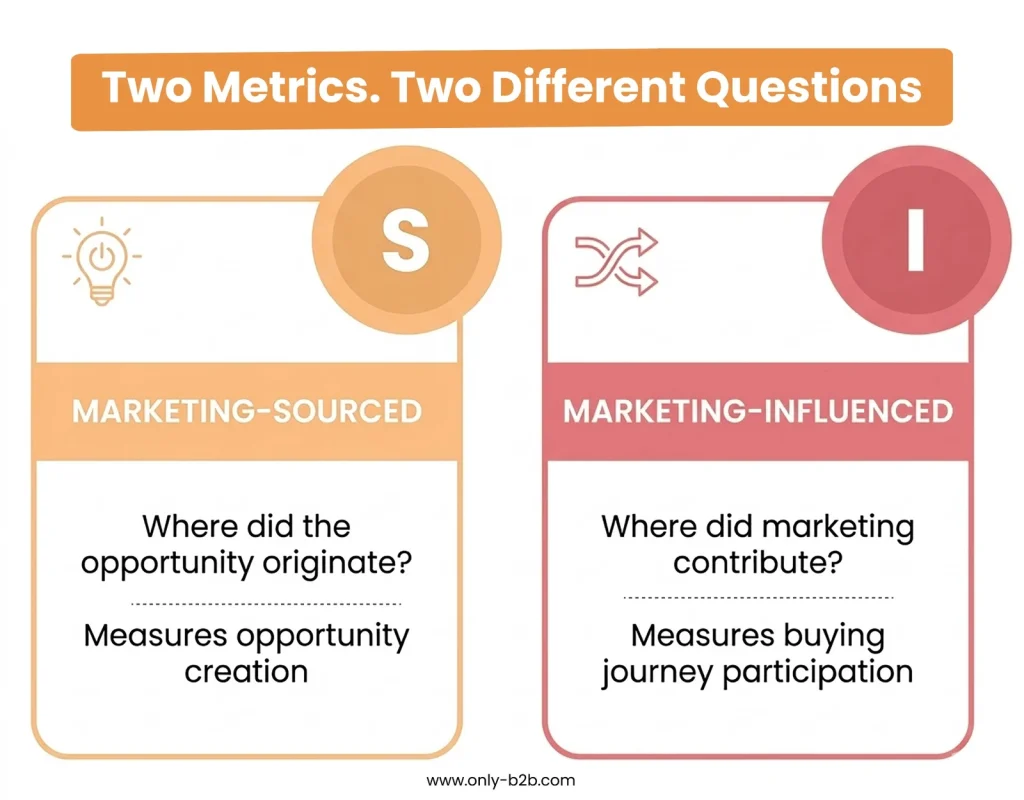
Two pipeline reports can show different marketing contributions and still be correct. One might show $800,000 in marketing-sourced pipeline; another might show $1.2 million in marketing-influenced pipeline for the same opportunity cohort. These illustrative figures answer different questions.
One credits marketing for opportunities it originated. The other includes opportunities with qualifying marketing participation before or during the sales process.
Disagreement begins when leadership expects both reports to answer the same question. This becomes harder to resolve as buyers research independently, involve multiple stakeholders, and engage sales at different stages.
6sense’s 2025 Buyer Experience Research found that 94% of buying groups ranked preferred vendors before first contact, while their preliminary favorite ultimately won 77% of the time. These findings help explain why measuring marketing only at opportunity creation provides an incomplete view.
Credible reporting requires clear definitions, consistent qualification rules, and a way to reconcile overlapping pipeline values.
Marketing-Sourced vs Marketing-Influenced Pipeline: Definitions
The distinction starts with the question each metric answers.
Marketing-sourced pipeline measures the value of opportunities that originated through marketing under an agreed source rule. That rule might use the first qualifying response, lead acquisition source, or a documented opportunity-origin classification.
Marketing-influenced pipeline measures the full value of distinct eligible opportunities with at least one qualifying marketing interaction associated with the buying journey, regardless of the opportunity’s source.
This article uses full opportunity values to measure coverage. Fractional attribution, which distributes credit among campaigns or channels, is a separate reporting approach.
A sales-sourced opportunity can become marketing-influenced when relevant buying-group members participate in qualifying webinars, content campaigns, or events.
| Term | Meaning |
|---|---|
| Marketing-sourced pipeline | Opportunity value originating through marketing under the agreed source rule |
| Marketing-influenced pipeline | Opportunity value associated with qualifying marketing participation |
| Opportunity source | The recorded origin of an opportunity under the organization’s agreed classification |
| Campaign influence | A qualifying campaign interaction associated with an opportunity |
| Attribution window | The period during which interactions can qualify for source or influence credit |
Source establishes origin. Influence establishes qualifying participation. Neither measure automatically proves that marketing caused the deal or its progression.
Why B2B Pipeline Reports Disagree
Different reports often reflect different rules.
One report may use the first known contact interaction. Another may use the campaign that generated the first qualified lead. A third may count qualifying campaign responses from any stakeholder associated with an opportunity.
Differences commonly arise from:
- Source fields: Original source, latest source, and opportunity source may contain different values.
- Contact roles: Some reports include only the primary contact; others include multiple buying-group members.
- Campaign rules: One team counts registrations, while another requires attendance or a defined response.
- Attribution windows: A 90-day lookback can produce different results from a 180-day window.
- Stage timing: One report captures pipeline at opportunity creation; another includes subsequent marketing activity.
- CRM hygiene: Missing associations, duplicate contacts, and incomplete opportunity records distort results.
Separate legitimate model differences from data-quality problems.
A different source convention or lookback window can legitimately change the result. Missing contact roles, duplicated opportunities, or incorrectly mapped campaigns require correction.
For example, reports using different documented windows may both be valid. Reports applying the same rules to the same opportunity snapshot should reconcile. An unexplained difference requires investigation.
What Counts as Marketing-Sourced Pipeline?
Marketing-sourced pipeline answers: Which opportunities originated through marketing under our agreed rule?
Suppose a prospect discovers a company through organic search, submits a resource request, and later books a consultation. If the initial response meets the source criteria and connects to the resulting opportunity, that opportunity can qualify as marketing-sourced.
The same principle applies to qualifying opportunities originating through paid campaigns, webinars, events, content syndication, or other B2B demand generation channels.
However, the first recorded marketing interaction should not automatically receive source credit.
An anonymous website visit followed months later by a sales-generated opportunity does not necessarily establish marketing origin. The earlier activity needs reliable identity resolution and evidence connecting it to the relevant buying initiative.
Teams should compare the available source conventions before selecting one.
| Convention | How source is assigned | Limitation |
|---|---|---|
| First qualifying response | Earliest identifiable response meeting the agreed threshold | May miss earlier anonymous research or existing relationships |
| Lead creation | Acquisition channel recorded when the person becomes a lead | An imported or outbound-created record may not represent demand origin |
| Opportunity creation | Agreed originating channel or campaign recorded when the opportunity opens | Can favor late-stage responses if earlier evidence is not preserved |
Document which convention governs opportunity reporting. Preserve the supporting evidence and define how exceptions are resolved.
Marketing-sourced revenue requires an additional filter: use the relevant closed-won opportunities and an agreed revenue measure. Open pipeline value should not be labeled revenue.
What Counts as Marketing-Influenced Pipeline?
Marketing-influenced pipeline captures qualifying marketing participation across opportunities from different sources.
Consider an opportunity originating through an SDR’s outbound outreach. During evaluation, the buying group attends a product webinar, requests a comparison guide, and engages with a relevant case study.
The opportunity remains sales-sourced. It can also qualify as marketing-influenced if those interactions meet the agreed rules and connect to that opportunity.
Buyers continue engaging with marketing after an opportunity enters the CRM. A structured B2B lead nurturing strategy can support these ongoing interactions, while influence reporting records the participation that meets the organization’s criteria.
However, participation is not proof of causation. A qualifying webinar attendance does not establish that the webinar caused the opportunity to advance.
Influence should also require more than a recorded campaign association. An email delivery, passive impression, or incidental website visit should not automatically qualify.
The objective is to identify documented marketing interactions that meet a defined engagement threshold and relate to an eligible buying journey.
How to Calculate Sourced and Influenced Pipeline
The calculations become straightforward once eligibility, source, influence, and valuation rules are agreed.
Marketing-Sourced Pipeline Value
Add the values of distinct eligible opportunities classified as marketing-sourced.
Marketing-sourced pipeline = Sum of eligible marketing-sourced opportunity values
Marketing-Influenced Pipeline Value
Add the values of distinct eligible opportunities with at least one qualifying marketing interaction.
Marketing-influenced pipeline = Sum of eligible marketing-influenced opportunity values
Count an opportunity once within this metric, even when several contacts or campaigns qualify.
Sourced and Influenced Overlap
Identify opportunities appearing in both groups and sum their values once.
Overlap = Sum of opportunity values classified as both sourced and influenced
Percentage Contribution
Use the same total eligible pipeline denominator for both calculations.
Marketing-sourced contribution (%) = Marketing-sourced pipeline ÷ Total eligible pipeline × 100
Marketing-influenced contribution (%) = Marketing-influenced pipeline ÷ Total eligible pipeline × 100
These percentages describe pipeline coverage. They do not measure incremental revenue caused by marketing.
Illustrative Calculation
Assume a month-end snapshot contains $2,000,000 in eligible open pipeline.
Use distinct opportunity IDs, unweighted amounts in USD, and the same snapshot values across every calculation.
| Metric | Calculation | Result |
|---|---|---|
| Marketing-sourced contribution | $800,000 ÷ $2,000,000 × 100 | 40% |
| Marketing-influenced contribution | $1,200,000 ÷ $2,000,000 × 100 | 60% |
| Distinct marketing coverage | $800,000 + $1,200,000 − $500,000 | $1,500,000 |
| Distinct marketing coverage percentage | $1,500,000 ÷ $2,000,000 × 100 | 75% |
| Neither sourced nor influenced | $2,000,000 − $1,500,000 | $500,000 |
The remaining $500,000 is outside both marketing measures under these rules. Its source may still be known to be sales, a partner, or another channel.
This example measures open pipeline at a point in time. It does not measure pipeline created during the month.
If using fractional attribution, report allocated campaign credit separately. Do not mix fractional credit with full opportunity values.
Set the Rules Before Running the Report
The most important reporting decisions happen before the dashboard is built.
Teams need operational definitions that specify what qualifies, when it qualifies, and who owns the rule.
The following rules are illustrative policy choices. The engagement thresholds and windows are not industry benchmarks.
| Rule | Illustrative definition | Accountable owner |
|---|---|---|
| Qualifying touch | Attended webinar, recorded event conversation, or identified content response; exclude impressions and email delivery | Marketing operations |
| Campaign status | Use controlled statuses such as Registered, Attended, and Responded; membership alone does not qualify | Marketing operations |
| Minimum engagement | At least 15 minutes of webinar attendance or another documented campaign-specific threshold; exclude bots, staff, and test activity | Marketing operations |
| Source window | Evaluate eligible originating interactions in the 90 days before opportunity creation; preserve historical acquisition source separately | RevOps |
| Influence window | Evaluate qualifying interactions from 180 days before creation through the earlier of the reporting snapshot or opportunity closure | RevOps |
| Opportunity association | Connect the contact to the account and relevant buying initiative using a contact role or other documented evidence | Sales operations |
| Counting and value | Count each opportunity ID once per metric using the same cohort, amount snapshot, and currency | RevOps |
| Exceptions | Record evidence and approval for ambiguous origins, recycled opportunities, and disputed matches | Sales leadership |
Marketing, sales, and RevOps should approve these rules together.
Also define whether the originating marketing response can qualify as influence. If it can, an opportunity may appear in both groups without any additional marketing activity after creation.
Changing rules between reporting periods requires documentation and an assessment of whether earlier comparisons need to be restated.
How Buying Groups Complicate Pipeline Attribution
A B2B opportunity can involve several stakeholders whose interactions occur across different channels.
Gartner reported in May 2025 that 74% of B2B buyer teams demonstrated unhealthy conflict. Buying groups reaching consensus were 2.5 times more likely to report a high-quality deal.
These findings provide context for the complexity of buying groups. They do not establish the causal impact of individual marketing touches.
A technical evaluator may read an integration guide. A finance stakeholder may attend a webinar. An executive may request a case study while the original champion speaks with sales.
These interactions may relate to the same purchase.
A credible account attribution process should:
- Match leads and contacts to the correct account.
- Maintain contact roles or equivalent opportunity associations.
- Connect qualifying campaign interactions to the relevant buying initiative.
- Resolve anonymous activity only when matching is sufficiently reliable.
- Count each opportunity once within each measure.
Reliable lead-to-account matching helps establish which company a contact belongs to. Opportunity association then requires an additional decision: which buying initiative does the activity relate to?
Account membership alone is insufficient when an account has several active opportunities.
Match the interaction to the relevant product, project, contact role, and timing. If the connection is ambiguous, retain it as account engagement until sales or RevOps validates the opportunity association.
Anonymous research should remain a separate engagement signal until a reliable identity and opportunity connection exists. A broader dark funnel attribution approach can help teams examine less visible buying activity without assigning unsupported opportunity credit.
CRM Fields and Governance Required for Credible Reporting
Reliable attribution depends on preserving the information needed to explain and reproduce the report.
The following fields can live across linked CRM objects. They do not all need to sit directly on the opportunity record.
| Field or linked record | Reporting purpose |
|---|---|
| Original source | Preserves the earliest known acquisition origin |
| Source detail | Identifies the specific channel, campaign, or interaction |
| Opportunity source | Records the agreed opportunity-origin classification |
| Campaign membership and status | Records participation and whether it meets qualification rules |
| Contact roles | Connects buying-group members to the opportunity |
| First and latest touch dates | Support timing checks |
| Opportunity creation date | Establishes the reference point for source and influence windows |
| Influence status | Records whether influence criteria were met |
| Opportunity ID and account ID | Provide stable keys for deduplication and matching |
| Contact ID and opportunity association | Connect the stakeholder to the relevant buying initiative |
| Opportunity amount and currency | Support consistent value totals |
| Stage and close date | Determine eligibility and whether activity occurred before closure |
| Touch timestamps and status history | Validate engagement qualification and timing |
| Snapshot date and rule version | Allow the report to be reproduced and changes explained |
Do not overwrite original source when a contact engages with a later campaign.
Preserve the historical acquisition source, the agreed opportunity source, and subsequent qualifying interactions as separate records or fields.
Campaign naming and channel mapping should remain consistent. Otherwise, the same activity can appear under different channels across reporting periods.
Before trusting the dashboard, review the underlying records using relevant CRM data quality metrics. Complete source fields are useful only when their values, timestamps, and associations are also accurate.
Attribution Edge Cases B2B Teams Must Resolve
Some situations require explicit policies because more than one classification may initially appear reasonable.
The following recommendations should be applied within the organization’s agreed source convention.
| Edge case | Recommended rule | Trade-off |
|---|---|---|
| Outbound-created contacts | Record outbound as acquisition source when appropriate; assign opportunity source using the documented origin rule. Later qualifying marketing can earn influence | CRM record creation alone cannot establish who originated the buying initiative |
| Prior content touches | Count identifiable, qualifying interactions within the relevant window and connected to the initiative | Earlier or untrackable brand exposure remains outside measured credit |
| Partners and referrals | Preserve documented partner or referral origin; add qualifying marketing influence separately | Marketing support does not increase marketing-sourced totals |
| Events and content syndication | Distinguish registration or lead delivery from verified response, attendance, or another agreed engagement | Stricter qualification reduces reported coverage but improves defensibility |
| Anonymous research | Retain as engagement until reliable identity matching and opportunity association are established | Some real marketing participation remains uncredited |
| Recycled opportunities | Retain source for the same reopened initiative; create a new opportunity only for a documented new buying initiative | Requires review to prevent duplicate pipeline and artificial new sourcing |
For outbound-created contacts, distinguish record creation from demand origin. A contact imported by sales may already have a qualifying marketing response associated with the same initiative.
For recycled opportunities, document whether the buyer is resuming the original project or starting a genuinely different purchase. Reopening a record should not automatically create new marketing-sourced pipeline.
How to Prevent Double Counting and Inflated Claims
A common reporting mistake is adding sourced and influenced pipeline together.
Consider a $200,000 opportunity originating through marketing. It later receives qualifying marketing engagement and appears in the influenced report.
Both reports contain its value, but the organization still has only $200,000 in pipeline.
Use this relationship:
Distinct pipeline covered by either measure = Sourced pipeline + Influenced pipeline − Overlap
Even the deduplicated figure represents coverage under the reporting rules. It should not be labeled incremental pipeline caused by marketing.
Keep overlap visible. It identifies opportunities meeting both definitions.
Reconcile Pipeline into Mutually Exclusive Groups
The earlier $2,000,000 example can be divided into four groups.
| Pipeline group | Value | Share of total |
|---|---|---|
| Marketing-sourced only | $300,000 | 15% |
| Both sourced and influenced | $500,000 | 25% |
| Marketing-influenced only | $700,000 | 35% |
| Neither sourced nor influenced | $500,000 | 25% |
| Total eligible pipeline | $2,000,000 | 100% |
Marketing-sourced pipeline is $300,000 + $500,000 = $800,000.
Marketing-influenced pipeline is $500,000 + $700,000 = $1,200,000.
Distinct marketing coverage is $300,000 + $500,000 + $700,000 = $1,500,000.
Keep Unattributed Source Separate
Unattributed pipeline means the opportunity’s source is unknown or insufficiently supported. It is a separate dimension from marketing coverage.
| Source completeness | Value | Share of total |
|---|---|---|
| Known source | $1,800,000 | 90% |
| Unknown or insufficiently supported source | $200,000 | 10% |
| Total eligible pipeline | $2,000,000 | 100% |
In this illustrative dataset, $100,000 of unknown-source pipeline is influenced-only and $100,000 falls into neither marketing group.
An opportunity can have an unknown origin while still having documented marketing participation. Therefore, do not add unattributed pipeline as a fifth category in the marketing-coverage breakdown.
A Clear Sourced-and-Influenced Pipeline Dashboard
An executive dashboard should make the relationship between the measures easy to assess.
Use the same eligible opportunity cohort and value snapshot throughout.
| Dashboard metric | Illustrative value | Interpretation |
|---|---|---|
| Total eligible open pipeline | $2,000,000 | Denominator for both contribution percentages |
| Marketing-sourced pipeline | $800,000 / 40% | Includes opportunities in the overlap |
| Marketing-influenced pipeline | $1,200,000 / 60% | Includes opportunities in the overlap |
| Sourced and influenced overlap | $500,000 | Appears in both marketing measures |
| Distinct marketing coverage | $1,500,000 / 75% | Sourced plus influenced minus overlap |
| Neither sourced nor influenced | $500,000 / 25% | May include known sales, partner, or other sources |
| Unattributed source | $200,000 / 10% | Separate source-completeness measure |
| Stage and deal-size breakdowns | Opportunity count and value | Shows where coverage sits across the pipeline |
Display the reporting snapshot date, eligible stages, amount basis, currency, source convention, qualification rules, attribution windows, rule version, and last reconciliation date.
Label pipeline created during a period separately from open pipeline at a point in time.
Closed-won revenue also requires its own clearly defined view. Open pipeline and realized revenue should not be presented as interchangeable measures of marketing’s financial contribution.
Pair coverage with relevant B2B conversion metrics, such as opportunity-to-win rate and stage progression. This helps leadership assess outcomes alongside marketing participation, while preserving the limits of what attribution can prove.
How to Segment Pipeline Contribution
A company-wide percentage can hide differences in how marketing supports opportunities.
Useful reporting dimensions include:
- Channel: Organic search, paid media, email, events, referrals, and content syndication.
- Campaign: Initiatives associated with opportunity origin or qualifying participation.
- Content asset: Resources connected to qualifying buying activity.
- Region: Differences across geographic markets.
- Segment: SMB, mid-market, and enterprise opportunities.
- Persona: Stakeholder groups participating in marketing activity.
- Opportunity stage: Creation, evaluation, negotiation, and other defined stages.
Only segment where opportunity count and value support a decision.
Show counts alongside pipeline value, flag groups dominated by one large deal, and combine reporting periods where appropriate.
Some dimensions overlap. Multiple personas or campaigns may relate to the same opportunity, so their full-value influence totals may exceed the overall pipeline total.
Deduplicate opportunity IDs before aggregating these views. If leadership wants allocated channel credit instead, provide a separately labeled fractional attribution report.
When using these findings for B2B demand generation budget allocation, consider costs, conversion, sales-cycle timing, and data completeness alongside sourced and influenced value. Coverage percentages alone are insufficient to determine the next spending decision.
A Monthly Pipeline Attribution Governance Cadence
Attribution should operate as an ongoing reporting discipline.
A practical monthly review includes:
- Reconcile CRM records: Check missing sources, duplicates, campaign associations, and opportunity relationships.
- Review exceptions: Resolve disputed origins, partner opportunities, and recycled initiatives.
- Validate qualification: Confirm that counted interactions meet engagement and timing rules.
- Document changes: Record revisions to windows, fields, campaign criteria, and opportunity associations.
- Restate comparisons: Recalculate earlier periods where possible when definitions change, or clearly flag the break in comparability.
Assign specific responsibilities so exceptions have a clear resolution path.
| Owner | Monthly responsibility |
|---|---|
| Marketing | Validate campaign statuses, engagement thresholds, and channel mapping; document evidence for qualifying touches |
| Sales | Validate opportunity source, buying initiative, and contact roles; review partner and recycled-opportunity exceptions |
| RevOps | Deduplicate records, enforce windows, reconcile totals, maintain rule versions, and publish the approved snapshot |
| Marketing and sales leadership | Resolve policy disputes and approve definition changes |
Keep attribution governance consistent with the qualification and ownership definitions in your MQL-to-SQL handoff SLA. A campaign response, an accepted lead, and a qualified opportunity represent different events and should remain distinguishable in reporting.
Retain the approved report snapshot and its rule version. Otherwise, later CRM updates can change historical totals without explaining why.
Worked Example: Reporting One B2B Opportunity
Consider an illustrative $300,000 enterprise software opportunity.
Its value is measured in USD at the 31 October snapshot. Assume the organization uses:
- A first-qualifying-response source rule.
- A 90-day source window before opportunity creation.
- An influence window from 180 days before creation through the earlier of the snapshot or opportunity closure.
- A policy allowing originating marketing responses to qualify as influence.
The following timeline connects three stakeholders to the same buying initiative.
| Date | Activity and association | Reporting treatment |
|---|---|---|
| 5 September | IT Director arrives through organic search and submits an integration-guide form; identity and account are confirmed | First qualifying marketing response and source candidate |
| 12 September | SDR contacts the IT Director about the same project | Sales follow-up does not overwrite the earlier qualifying origin |
| 20 September | Sales creates the $300,000 opportunity and adds the IT Director as a contact role | The original response falls within the 90-day source window |
| 1 October | Finance Director attends 25 minutes of a webinar; sales confirms their role on the opportunity | Qualifying influence within the defined window |
| 15 October | Operations VP submits a case-study request for the same project and is associated with the opportunity | Additional qualifying influence; opportunity remains counted once |
| 31 October | Opportunity remains open at $300,000 | Use the same value snapshot across all measures |
All three marketing responses meet this example’s engagement rules and connect to the opportunity.
The September response establishes marketing source. The October interactions also provide evidence of marketing participation after opportunity creation.
| Classification | Opportunity value |
|---|---|
| Total opportunity pipeline | $300,000 |
| Marketing-sourced pipeline | $300,000 |
| Marketing-influenced pipeline | $300,000 |
| Sourced and influenced overlap | $300,000 |
| Distinct pipeline covered by either measure | $300,000 |
The opportunity appears in both marketing measures, but its distinct pipeline value remains $300,000.
Now assume a different sequence: SDR outreach is the first qualifying origin, with no earlier qualifying marketing response. The stakeholders then engage with marketing during evaluation.
Under the same rules:
| Classification | Sales-sourced alternative |
|---|---|
| Marketing-sourced pipeline | $0 |
| Marketing-influenced pipeline | $300,000 |
| Sourced and influenced overlap | $0 |
| Distinct marketing coverage | $300,000 |
An SDR creating the opportunity record does not automatically establish sales source when earlier qualifying marketing evidence exists. Source follows the agreed origin rule and documented sequence.
Conclusion: Report Both Within One Governed System
Marketing-sourced pipeline identifies where opportunities originate under an agreed rule. Marketing-influenced pipeline captures qualifying marketing participation across eligible opportunities.
Both measures become useful when they share consistent CRM records, clear qualification criteria, and reconciled reporting totals.
Keep overlap visible, distinguish unknown sources from absent marketing participation, and separate pipeline coverage from claims of causal impact.
The objective is to produce numbers that marketing, sales, and RevOps can explain consistently—and leadership can use to assess channel priorities and investment.
Contact Only-B2B to discuss your demand-generation goals and pipeline measurement requirements, including source definitions, qualifying marketing touches, CRM associations, and reporting expectations.

Vikas Bhatt is the Co-Founder of ONLY B2B, a premium B2B lead generation company that specializes in helping businesses achieve their growth objectives through targeted marketing & sales campaigns. With 10+ years of experience in the industry, Vikas has a deep understanding of the challenges faced by businesses today and has developed a unique approach to lead generation that has helped clients across a range of industries around the globe. As a thought leader in the B2B marketing community, ONLY B2B specializes in demand generation, content syndication, database services and more.