
HubSpot notes that email marketing databases can naturally decay by about 22.5% each year.
This means a reliable database your team built can quietly become less useful long before the next campaign launches.
The problem is rarely limited to old email addresses. Missing titles weaken segmentation. Outdated employment data sends outreach to the wrong people. Duplicate records distort account coverage, while incomplete associations create routing errors.
By the time campaign performance exposes these issues, the budget is already being spent.
That is why database health needs to be assessed before launch. The goal is not simply to determine how many records exist in the CRM, but whether those records are reliable enough to support targeting, routing, outreach, reporting, and sales follow-up.
A structured set of CRM data quality metrics can help teams identify those weaknesses before campaign spend begins.
What Is a B2B Database Health Score?
A B2B database health score is a structured assessment of how reliably CRM records can support the work they are expected to do.
This matters because a database can look complete while still being operationally weak.
A contact may have a name, company, title, email address, and phone number populated in the CRM, yet the person may have left the company, the email may no longer work, or the contact may be attached to the wrong account.
A useful assessment looks at five dimensions:
- Accuracy
- Completeness
- Freshness
- Uniqueness
- Contactability
Together, they answer a more important question than:
“How much data do we have?”
The better question is:
“Can we trust this data enough to use it for a specific campaign, workflow, or revenue decision?”
That is where CRM data quality metrics become useful. They turn a vague concern about “dirty data” into measurable conditions that marketing, sales, and operations can discuss in the same language.
Why Measure CRM Data Quality Before a Campaign?
Campaign problems are often diagnosed after launch because that is when the symptoms become visible.
Bounce rates rise. Leads are routed incorrectly. Segments contain the wrong people. Duplicate records receive overlapping communication. Sales teams question where the list came from. Reporting becomes harder to reconcile.
The underlying problem may have existed long before the campaign.
Poor data quality can affect campaign execution at several points simultaneously.
An outdated job title can move a contact into the wrong persona segment.
A duplicate record can receive the same communication twice while splitting engagement history across separate profiles.
An incomplete or incorrect account association can send an otherwise valid lead into the wrong sales territory.
Missing firmographic information can remove qualified companies from an intended segment.
Invalid or unavailable contact details can reduce the usable audience after campaign planning is already complete.
The effect extends beyond campaign performance.
Once sales teams repeatedly encounter incorrect records, they often begin verifying information themselves or stop relying on CRM data altogether. That creates additional manual work and reduces confidence in the CRM as a shared operating system for revenue teams.
A pre-launch B2B database audit gives teams a chance to identify these weaknesses while they can still be corrected.
The Five Dimensions of B2B Database Health
A practical database health assessment should separate different types of quality rather than compressing everything into one vague “clean” or “unclean” label.
The five dimensions below measure different questions about the database:
- Accuracy: Is the information correct?
- Completeness: Is enough information available to support the required decision?
- Freshness: Is the information still current?
- Uniqueness: Does each record accurately represent a distinct person or organisation?
- Contactability: Can and should the record be used through the intended communication channel?
A database may perform strongly in one dimension while remaining weak in another.
For example, a contact record may be completely populated but outdated. Another may be accurate and current but unavailable for outreach because the contact has opted out.
That is why the individual components matter just as much as the final database health score.
1. Data Accuracy: Is the Record Correct?
Accuracy asks whether the information stored in the CRM reflects reality.
For contacts, this can include:
- Current employment status
- Job title and seniority
- Business email address
- Phone number
- Location
- Company association
- Relevant persona or function
For accounts, accuracy may include:
- Company name
- Industry
- Employee range
- Operating region
- Ownership structure
- Technology environment
- Other fields used for targeting or routing
The important distinction is between populated and correct.
A title field containing “VP Sales” is complete. But it is only accurate if the person is still in that role.
This is why contact verification should focus on fields that influence the campaign. If a campaign depends heavily on seniority, title accuracy matters more than an unrelated field that happens to be populated.
Consider Verification Evidence and Confidence
Accuracy should also account for the evidence used to validate a field.
Teams can record factors such as:
- The source used for verification
- The date the information was last verified
- Whether multiple reliable sources agree
- The reliability of the verification source
- Whether conflicting information exists
For example, a job title recently confirmed through an authoritative company source may carry greater confidence than information imported from an older third-party dataset.
Recording verification source and date can make data accuracy easier to audit and help teams decide which records need additional validation before campaign launch.
2. Data Completeness: Does the Record Support Action?
Completeness is often treated as a simple percentage of filled fields.
That is useful up to a point, but it misses the question that matters operationally:
Does the record contain enough information to support the decision the team needs to make?
Consider a campaign targeting IT leaders at companies above a particular employee threshold.
A record without job function, seniority, company size, or account association may technically exist in the database but still be unusable for reliable segmentation.
This is why required CRM fields should be defined around decisions rather than an arbitrary desire to fill more columns.
A useful completeness measure can focus on critical fields for the campaign:
Completeness Rate = Records with all required fields populated ÷ Records assessed × 100
The required fields will change by use case.
A demand generation campaign, territory assignment process, account-based marketing program, and customer expansion campaign may all require different information.
More populated fields do not automatically mean better data.
The useful question is whether the record contains enough information to support the work attached to it.
3. Data Freshness: Is the Record Still Current?
Freshness asks how recently a piece of information was verified or meaningfully updated.
This dimension is particularly important because different fields decay at different speeds.
A person’s job title may become outdated relatively quickly compared with a company headquarters address.
Employee count may remain useful for a longer period, while an intent signal may lose relevance within a much shorter window.
Using one universal freshness rule for every field creates unnecessary work in some areas and insufficient maintenance in others.
A better approach is to establish field-specific thresholds based on volatility and business risk.
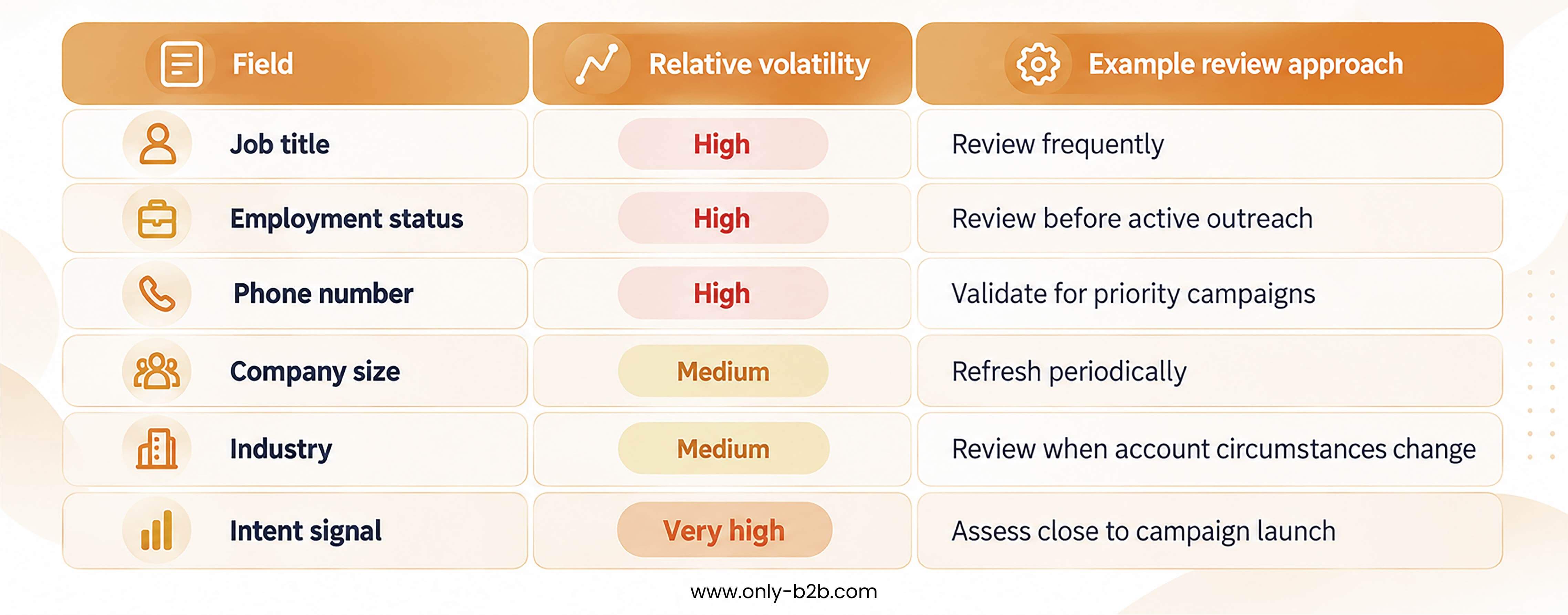
These are operating examples rather than universal rules.
The exact thresholds should reflect your business, campaign type, data sources, targeting requirements, and the consequences of using outdated information.
This is why data freshness is better understood as a management decision than a single database-wide percentage.
The right question is not simply:
“How old is this record?”
It is:
“How old can this particular field be before it becomes unreliable for the decision we are making?”
4. Uniqueness: Are Duplicate Records Distorting the CRM?
Two contact records for the same person can split engagement history, create duplicate outreach, distort reporting, and make ownership unclear.
Duplicate accounts can create similar problems at a larger level, particularly when subsidiaries, parent companies, acquisitions, rebrands, or renamed organisations are involved.
This is where identity resolution becomes important.
A useful duplicate assessment should look separately at:
- Duplicate contacts
- Duplicate accounts
- Contacts attached to the wrong account
- Multiple records representing the same individual
- Multiple account records representing the same organisation
- Conflicting account associations
The impact of duplicate records is not limited to database size.
Duplicates can distort attribution, routing, lead ownership, engagement history, account coverage, and campaign measurement.
The goal is therefore not simply to reduce the number of records.
It is to make sure the CRM represents the underlying business reality accurately enough for teams to act on it.
5. Contactability: Can and Should the Team Reach This Record?
A contact can be accurate, complete, fresh, and unique while still being unsuitable for outreach.
Contactability brings two different questions together:
Can the team technically reach this person through a usable channel?
And:
Is the organisation permitted to use that channel for the intended communication?
Contactability checks can include:
- Valid business email
- Reachable phone number
- Usable communication channel
- Suppression status
- Applicable consent or lawful-basis status
- Bounce history
- Opt-out status
- Do-not-contact status
- Relevant jurisdictional requirements
This distinction matters because a technically valid email address does not automatically mean the record is available for every type of marketing communication.
Marketing requirements can vary by jurisdiction, communication method, type of business contact, applicable privacy rules, and how the data was obtained.
For example, data protection and direct-marketing requirements may require organisations to consider lawful basis, consent where applicable, objections, opt-outs, suppression lists, and other restrictions when processing personal information for B2B marketing.
A database health assessment should therefore separate contact information quality from communication eligibility.
Otherwise, a campaign can appear healthy on paper while containing records that should not enter the intended audience.
How to Calculate a B2B Database Health Score
Once the five dimensions are measured, they can be combined into a weighted score.
A simple model is:
Database Health Score = (Accuracy × Weight) + (Completeness × Weight) + (Freshness × Weight) + (Uniqueness × Weight) + (Contactability × Weight)
Each component is first converted into a percentage.
For example, a business might assign:
- Accuracy: 30%
- Completeness: 20%
- Freshness: 20%
- Uniqueness: 15%
- Contactability: 15%
The weights should reflect campaign risk.
If the campaign depends heavily on precise persona targeting, accuracy and completeness may carry more weight.
If the campaign involves large-scale outbound communication, contactability may deserve greater emphasis.
If the program is account-based, account identity and association quality may require additional weighting.
Worked Database Health Score Example
Assume a campaign database receives the following component scores:
| Dimension | Score | Weight | Weighted Result |
|---|---|---|---|
| Accuracy | 92% | 30% | 27.60 |
| Completeness | 85% | 20% | 17.00 |
| Freshness | 78% | 20% | 15.60 |
| Uniqueness | 95% | 15% | 14.25 |
| Contactability | 88% | 15% | 13.20 |
| Overall Database Health Score | 87.65% | ||
The calculation becomes:
Database Health Score = (92 × 0.30) + (85 × 0.20) + (78 × 0.20) + (95 × 0.15) + (88 × 0.15)
Database Health Score = 27.60 + 17.00 + 15.60 + 14.25 + 13.20
Database Health Score = 87.65%
The database therefore receives an overall health score of 87.65% under this model.
However, teams should not make a launch decision from the overall number alone.
In this example, freshness is the weakest component at 78%. If the campaign depends heavily on current employment status, recent intent, or rapidly changing contact information, that weakness may still require remediation.
The overall score tells you how healthy the database is.
The components tell you why.
How to Interpret Your Database Health Score
There is no universal database benchmark that makes an entire CRM “healthy.”
A score that is acceptable for one campaign may be insufficient for another.
Instead, organisations can establish internal readiness bands based on their own risk tolerance and campaign requirements.
| Example Score Range | Operating Status | Interpretation |
|---|---|---|
| 90–100% | Ready | Database meets the defined quality requirements for the campaign, with no material weakness in a critical dimension. |
| 75–89% | Usable With Remediation | Database may support the campaign after targeted corrections to weak fields, segments, or records. |
| Below 75% | Not Ready | Data-quality weaknesses could materially affect targeting, communication, routing, reporting, or eligibility. |
These ranges are illustrative operating examples, not universal industry benchmarks.
Your organisation may use different thresholds depending on the campaign.
Ready
The database meets the minimum quality requirements for the intended campaign, with no material weakness in a critical dimension.
Usable With Remediation
The database can support the campaign after targeted corrections.
The overall score may look reasonable, but specific segments, fields, or records require attention before launch.
Not Ready
The database contains quality issues significant enough to undermine targeting, communication, routing, measurement, or compliance.
The important point is that the threshold should be linked to campaign risk.
A highly targeted executive campaign may require stronger accuracy and freshness than a broad awareness program.
A campaign using strict territory routing may place greater weight on account association and location.
A campaign with significant communication or regulatory requirements may require contactability and suppression checks to pass independently of the overall score.
A health score should therefore support a decision, not become a vanity metric.
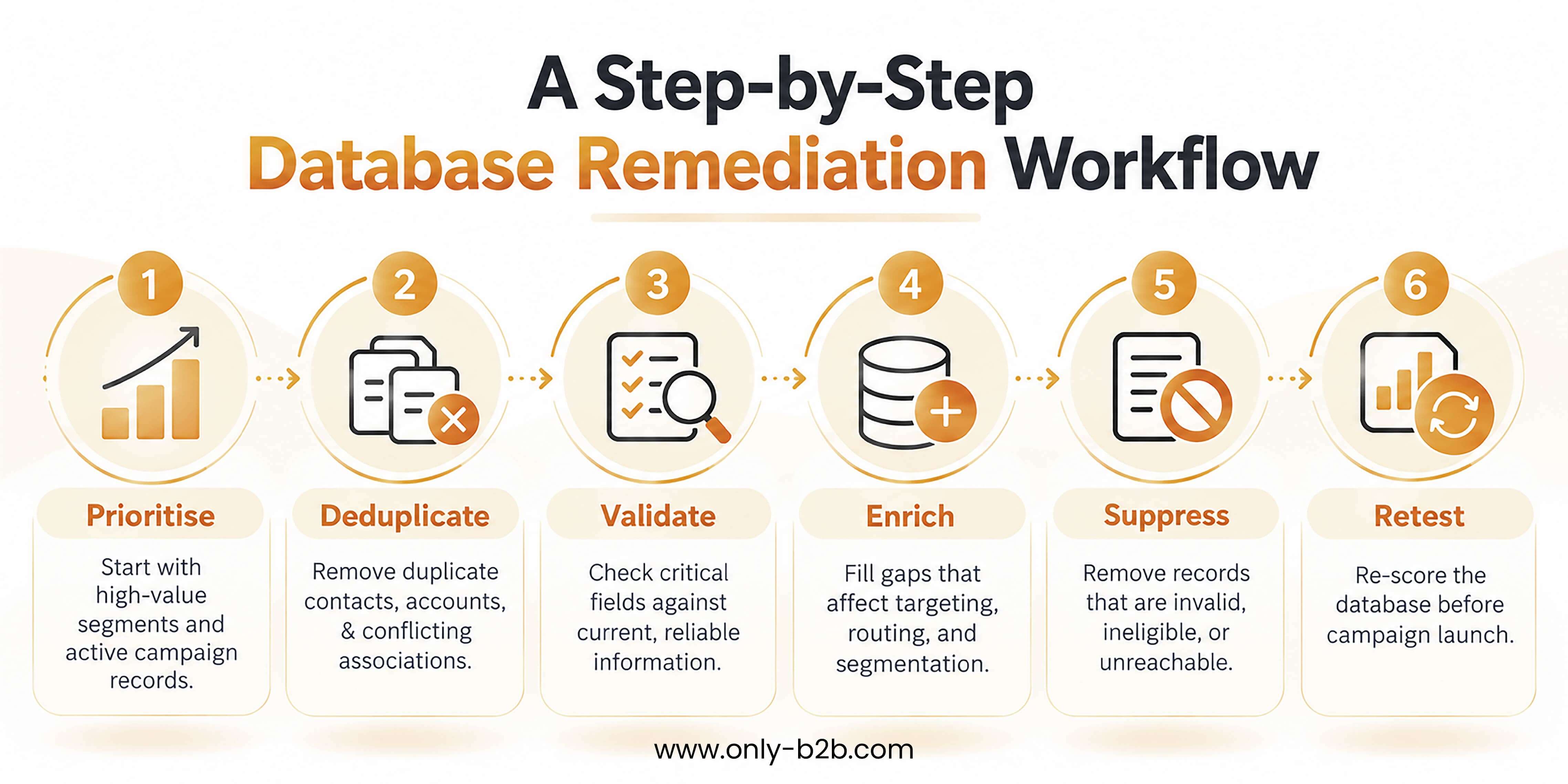
A Step-by-Step Database Remediation Workflow
Once weak areas are visible, remediation should follow the value and risk of the records involved.
The exact owner will depend on your organisation, CRM architecture, team structure, and governance model, but assigning responsibility helps prevent issues from remaining unresolved.
| Step | What to Do | Typical Owner |
|---|---|---|
| Prioritise | Identify high-value segments, active campaign records and strategic accounts | Campaign Owner / Marketing Operations |
| Deduplicate | Resolve duplicate contacts, accounts and conflicting associations | CRM Admin / RevOps |
| Validate | Check critical contact, employment, account and communication fields | Data Operations / RevOps |
| Enrich | Fill important gaps required for targeting, routing or personalisation | Data Operations / Marketing Operations |
| Suppress | Exclude invalid, ineligible, opted-out or restricted records | Marketing Operations / Compliance |
| Retest | Recalculate component scores and campaign readiness | RevOps / Campaign Owner |
1. Prioritise the Records That Matter Most
Start with:
- Active campaign segments
- Strategic accounts
- High-value prospects
- Records that directly affect routing
- Records that influence critical reporting
Cleaning the entire CRM in one exercise may sound comprehensive, but it can consume significant resources without improving the campaign that is about to launch.
2. Deduplicate
Resolve duplicate contacts and accounts, establish merge rules, and preserve the most reliable engagement history.
Account relationships should also be checked so that contacts are associated with the correct organisation.
3. Validate
Check critical contact, employment, account, and communication fields against current, reliable information.
Record the verification date and source where practical.
4. Enrich
Fill important gaps where additional information is required for segmentation, routing, account prioritisation, or personalisation.
A structured B2B data enrichment process can help teams fill high-value information gaps without collecting fields simply because they are available.
Do not enrich fields merely because they can be collected.
Prioritise information that supports an actual business decision.
5. Suppress
Remove or exclude records that should not enter the campaign because of:
- Invalid contact information
- Opt-outs
- Do-not-contact requests
- Suppression rules
- Communication restrictions
- Other eligibility conditions
6. Retest
Recalculate the component scores after remediation.
This final step is easy to overlook.
A database cleansing workflow is incomplete if the team cleans records but never measures whether the intervention actually improved campaign readiness.
How Often Should B2B Data Be Audited?
There is no single audit frequency that works for every CRM field.
A useful operating model combines different review frequencies according to field volatility, campaign importance, and business risk.
| Data Type | Relative Volatility | Example Audit Approach | Typical Owner |
|---|---|---|---|
| Employment status | High | Validate before active outreach or priority campaigns | Data Operations |
| Job title and seniority | High | Review frequently for active segments | Data Operations / Marketing Ops |
| Business email | High | Validate before important outbound campaigns | Marketing Ops / Data Operations |
| Phone number | High | Validate for priority calling programs | Sales Ops / Data Operations |
| Company size | Medium | Refresh periodically or before segmentation-sensitive campaigns | RevOps |
| Industry | Medium | Review when account circumstances change | RevOps |
| Account association | High | Review before routing or ABM campaigns | CRM Admin / RevOps |
| Intent signal | Very high | Assess close to campaign activation | Marketing Operations |
| Suppression / opt-out status | Critical | Check immediately before campaign execution | Marketing Operations / Compliance |
These frequencies are examples rather than universal requirements.
High-volatility fields may need to be checked before important campaigns.
Active prospect segments may require more frequent validation.
Broader firmographic information can often be reviewed periodically.
Strategic accounts may receive deeper reviews when major business events occur.
The same principle applies to ownership.
Data governance should define:
- Who owns each important field
- Who can change it
- Which sources are accepted
- What happens when conflicting information appears
- How validation is documented
- When the record must be reviewed again
A B2B database audit should therefore become part of revenue operations rather than a cleanup project that happens only after campaign performance declines.
FAQs on B2B Database Health
What is a database health score?
A database health score is a composite measure of how accurately, completely, freshly, uniquely, and contactably CRM records support a defined business use case.
It helps teams evaluate whether data is reliable enough for a particular campaign, workflow, or revenue decision.
What is a good B2B database health score?
There is no universal score that makes every B2B database healthy.
A suitable threshold depends on the campaign, the fields involved, the potential impact of inaccurate data, and the organisation’s risk tolerance.
Teams should define internal readiness thresholds and evaluate critical dimensions individually rather than relying only on the overall score.
How large should a database audit sample be?
The appropriate sample depends on database size, campaign risk, and how much variation exists across the data.
A small, homogeneous dataset may be assessed more directly.
A large CRM can be sampled across important segments, regions, sources, age bands, account types, and record types rather than relying on one overall sample.
Should every CRM field be included in the score?
No.
Scoring every available field can create a complicated metric without improving decision quality.
Focus on fields that influence segmentation, routing, outreach, reporting, compliance, qualification, or another clearly defined business decision.
Should data quality be measured at the contact or account level?
Both can matter.
Contact-level quality affects reachability, persona targeting, and communication.
Account-level quality affects territory assignment, account prioritisation, segmentation, lead-to-account matching, and reporting.
The appropriate level depends on the campaign and revenue process.
How often should B2B CRM data be audited?
Audit frequency should reflect how quickly the relevant fields change and how important they are to the campaign.
High-volatility fields such as employment status, job title, communication information, and intent signals may require more frequent review.
More stable firmographic fields can often be assessed periodically.
Priority campaign audiences should be reviewed before launch even when broader CRM maintenance already occurs.
What tools can be used to assess CRM data quality?
The appropriate tools depend on the CRM environment and the type of data issue being evaluated.
Teams may use CRM reporting and validation rules, duplicate-management tools, email verification systems, enrichment providers, data-quality platforms, identity-resolution solutions, and internal governance processes.
The tool itself does not define data quality.
Teams still need to establish which fields matter, what evidence is acceptable, how frequently information should be reviewed, and what thresholds determine campaign readiness.
Who should own database quality?
Database quality is usually a shared responsibility across the teams that create, use, and maintain CRM data.
Depending on the organisation, responsibility may involve:
- Marketing Operations
- Sales Operations
- Revenue Operations
- CRM administrators
- Data teams
- IT
- Compliance or privacy teams
The important requirement is clear ownership for individual fields, validation rules, remediation processes, and ongoing monitoring.
Score Database Health Before Spending Campaign Budget
Campaign readiness starts earlier than campaign setup.
Before deciding whether a database is large enough to support a campaign, teams need to know whether the records are reliable enough to support the decisions the campaign requires.
A useful database health score creates that visibility.
It shows where records are accurate, where information is missing, where data has aged, where identities have become distorted, and where communication eligibility needs attention.
The objective is not to create the largest possible database.
It is to know whether your data is fit for the work you are about to ask it to do.
Is Your CRM Ready for the Next Campaign?
Identify gaps in accuracy, completeness, freshness, uniqueness, and contactability before they affect targeting, routing, outreach, or campaign spend.
Request a Database Health Assessment
Vikas Bhatt is the Co-Founder of ONLY B2B, a premium B2B lead generation company that specializes in helping businesses achieve their growth objectives through targeted marketing & sales campaigns. With 10+ years of experience in the industry, Vikas has a deep understanding of the challenges faced by businesses today and has developed a unique approach to lead generation that has helped clients across a range of industries around the globe. As a thought leader in the B2B marketing community, ONLY B2B specializes in demand generation, content syndication, database services and more.