

“Bad lead” is one of the most common pieces of feedback in B2B lead generation, and one of the least useful.
It tells a vendor that something went wrong, but not whether the problem was inaccurate data, poor ICP fit, the wrong contact, timing, duplication or an internal follow-up issue.
Without that distinction, the same problems keep returning. A useful B2B lead rejection reasons framework turns vague feedback into structured evidence that marketing teams and vendors can actually learn from.
The first step toward better vendor output is therefore simple: make rejection specific enough to learn from.
What Is a B2B Lead Rejection Taxonomy?
A lead rejection taxonomy is a controlled set of reason codes used to consistently describe why a lead is rejected, disqualified, or moved into nurture.
Think of it as a shared language between sales, marketing, operations and external lead-generation vendors.
Turn Vague Lead Feedback Into Actionable Data
Instead of recording a generic reason like “Not a good lead,” use structured reason codes that show exactly why the lead did not progress.
Hard to analyse, compare or use for future optimisation.
Three Outcomes That Should Not Be Mixed Together
Each outcome tells sales and marketing something different about the lead.
Rejection
The lead does not meet the agreed criteria for the current sales or marketing process.
Disqualification
There is a clear reason the lead should not progress further.
Nurture
The lead may still be relevant, but timing or readiness does not support immediate sales engagement.
Why Standardized Rejection Reasons Improve Lead Quality
A rejection taxonomy changes lead feedback from individual opinion into usable operational data.
That has four implications.
1. It improves targeting
If 30% of rejected leads from a campaign come from companies below the required employee range, the problem may sit in the targeting criteria.
If most rejected contacts have the correct company profile but hold junior roles, the account targeting may be right while persona targeting is weak.
Without standardized codes, these patterns stay buried inside CRM notes.
2. It creates vendor accountability
Vendor performance becomes easier to evaluate when rejection reasons can be connected to the source.
Instead of telling a vendor that lead quality is poor, you can say that a specific proportion of submitted records fall outside agreed company-size, geography or seniority criteria.
That gives the vendor something concrete to correct.
This is especially valuable when several vendors operate against the same ICP. Consistent lead rejection codes make it possible to compare patterns without relying on subjective feedback.
3. It improves sales trust
Sales teams are more likely to trust marketing qualification when they can see that rejected leads are being analysed and acted upon.
The goal is to understand why leads are being rejected and whether those reasons are within marketing’s control.
4. It strengthens the sales feedback loop
Forrester’s research highlights a broader issue here. Its research found a significant gap between leadership perceptions of sales and marketing alignment and the views of the professionals working inside those functions.
A structured rejection process cannot solve alignment by itself. It can, however, give the two teams a shared evidence base.
That is what makes a sales feedback loop useful. Feedback becomes part of the operating system rather than a complaint that appears in a weekly meeting.
The Core B2B Lead Rejection Categories
A practical taxonomy does not need dozens of reasons.
It needs enough structure to separate the causes that lead to different decisions.
A useful starting point has six major categories:

The important principle is that the reason code should point toward an owner.
If the reason can only be described as “bad lead,” nobody knows who should respond.
Data-Quality Rejection Reasons
The first category concerns whether the lead is usable at all.
Common invalid lead reasons include:
- Invalid or unreachable contact information
- Unverifiable company information
- Missing mandatory fields
- Non-compliant records
- Fraudulent or suspicious submissions
These are fundamentally different from qualification problems.
If an email address is invalid, changing the ICP will not fix it. If a company cannot be verified, improving persona targeting will not solve the issue.
This is where data validation becomes important.
A vendor or internal acquisition team should have clear standards for what constitutes a valid record before the lead reaches sales. Required fields, company verification, contact verification and compliance checks should be defined before campaign launch.
Otherwise, sales becomes the final quality-control layer for problems that should have been filtered earlier.
There is also a useful reporting distinction here.
If invalid data is concentrated with one vendor, the issue may be sourcing or verification.
If invalid data appears across every source, the problem may sit in the underlying acquisition or enrichment process.
The taxonomy makes that distinction visible.
ICP and Persona Rejection Reasons
Fit-related rejection is usually more nuanced.
A lead may be a real person at a real company with accurate contact details and still be wrong for the campaign.
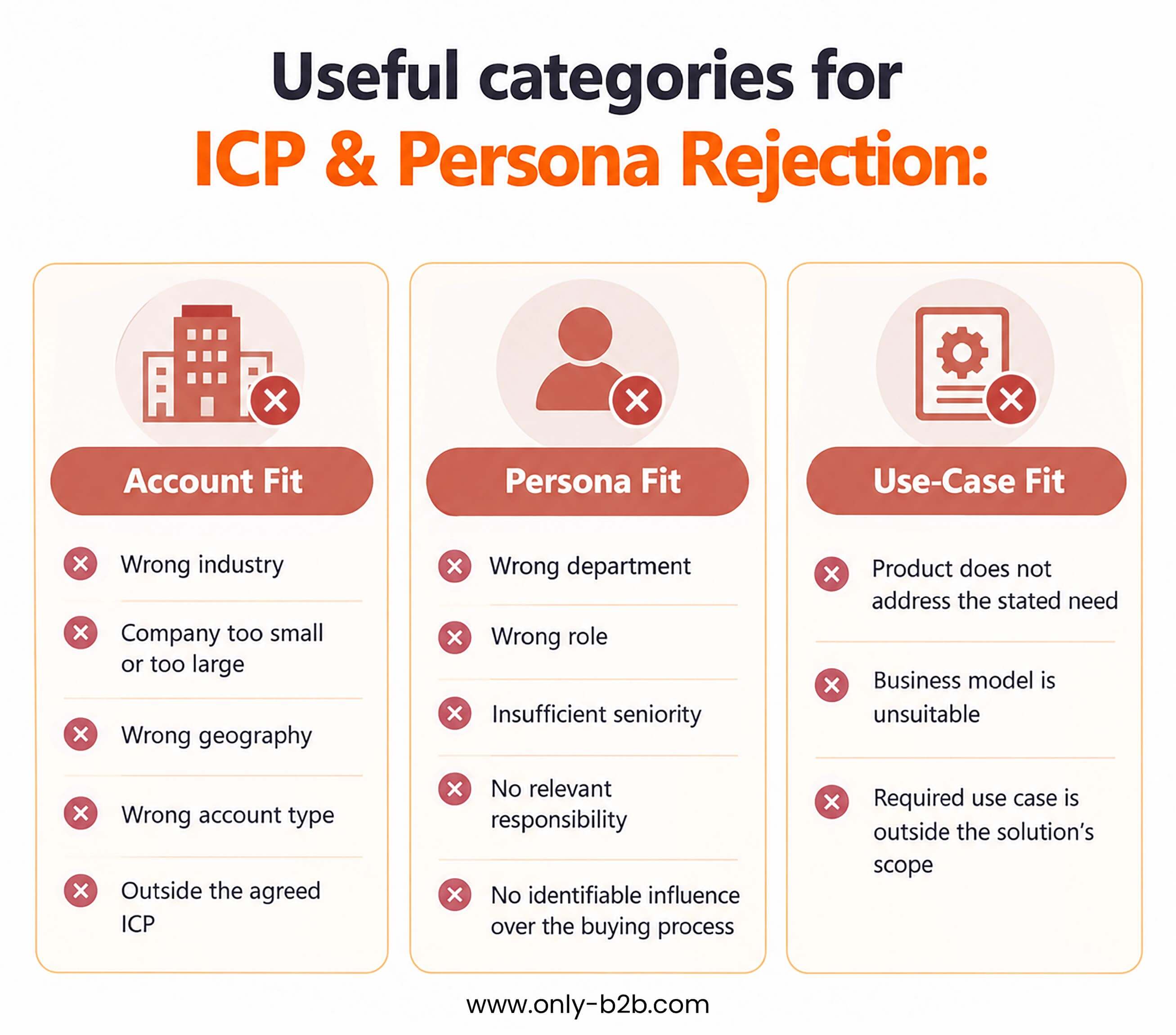
This is where ICP mismatch should be treated carefully.
An account can technically fit an ICP while still being commercially irrelevant for a particular campaign.
For example, a company may meet the industry and employee-count criteria but have no use case for the product being promoted.
That is why a strong taxonomy goes beyond firmographics.
It captures the difference between “this company looks right” and “this company has a relevant reason to engage.”
Timing and Buying-Readiness Rejection Reasons
This is one of the most likely categories to be misclassified.
A prospect says they are interested but have no current project.
This might be a good account at the wrong point in the buying journey.
Useful lead readiness categories include:
- Future implementation
- Budget readiness
- Research or educational interest
- Defined timeline
- Nurture requirement
- Active project status
This distinction matters because B2B buying cycles rarely fit neatly into campaign windows.
Gartner’s research has highlighted the increasingly digital and nonlinear nature of B2B buying, making buying context an important part of how organizations understand their target accounts and journeys.
A prospect researching a problem for next year’s budget should not necessarily be treated as equivalent to a prospect who has no relevance to the problem at all.
The first belongs in a nurture status. The second may belong in disqualification.
When those outcomes are combined under “not ready,” the organization loses useful information about future demand.
Internal Process Reasons That Should Not Be Blamed on the Lead
Consider these examples:
- Lead routed to the wrong salesperson
- Follow-up happened too late
- Duplicate outreach occurred
- No contact attempt was made
- Lead was assigned to an inactive territory
- Qualification was inconsistent
- Sales did not receive sufficient context
These are reasons for process failure.
They should not be counted in the same bucket as poor targeting.
Imagine a campaign generates 100 leads and 20 are marked “unqualified.” After review, eight were never contacted and five were routed incorrectly.
The campaign did not produce 20 poor leads.
It produced seven leads with a qualification issue, while 13 were affected by internal execution.
That distinction changes the decision completely. This is also why lead routing errors deserve their own category. If a valid lead is sent to the wrong owner, improving vendor targeting will not solve the underlying problem.
How to Store Rejection Reasons in the CRM
A taxonomy only becomes useful when it is built into the workflow.
At minimum, each rejected lead should capture:
| CRM Field | Purpose |
|---|---|
| Primary reason | Main rejection category |
| Subreason | Specific cause |
| Evidence | Information supporting the decision |
| Owner | Person or team responsible for review |
| Rejection date | Establishes when the decision occurred |
| Next action | Rejection, correction, reassignment, or nurture |
This creates a more useful set of CRM rejection codes than a free-text comments box.
Free text still has a place for context, but it should supplement structured fields rather than replace them.
The design principle is simple: make the easiest option the most useful option.
If they can select a clear reason and add evidence where necessary, the process becomes much easier to maintain.
Building a Closed-Loop Lead Feedback Process
Turn Lead Rejections Into Continuous Improvement
A lead rejection taxonomy becomes valuable when the information flows back to the teams that can change targeting, qualification, routing, or sourcing.
Sales Submits the Rejection Code
The rejection is recorded in the CRM along with supporting information and context.
Marketing Audits the Pattern
Marketing reviews trends across source, campaign, segment, persona, and rejection reason instead of focusing on isolated complaints.
The Vendor Receives Structured Feedback
Feedback becomes specific and measurable, such as geography mismatch, seniority mismatch, or invalid contact rates.
Targeting or Qualification Changes
Vendors adjust sourcing, marketing refines campaign criteria, and sales operations updates routing or qualification rules where needed.
What went wrong?
Tells the supplier where the problem occurred.
What should change next?
Gives the supplier evidence they can use to improve how the next set of leads is produced.
The other gives them evidence they can use to change how the next set of leads is produced.
Lead Rejection Metrics That Reveal Root Causes
A single rejection rate rarely tells you enough.
A better reporting model breaks rejection down by:
- Lead source
- Vendor
- Campaign
- Account segment
- Geography
- Persona
- Salesperson
- Primary rejection reason
- Time period
Suppose Vendor A has a 22% rejection rate and Vendor B has 18%.
That alone does not tell you which vendor is producing better leads.
Vendor A may have more timing-related rejections, while Vendor B may have more invalid data.
Those are different problems with different commercial implications.
This is why rejection rate should be treated as a diagnostic metric rather than a standalone performance score.
Look at the distribution underneath it.
A useful reporting view might ask:
- Which rejection reasons are increasing?
- Which vendors have unusually high rates for specific reasons?
- Which campaigns generate strong account fit but weak persona fit?
- Which sales teams reject more leads because of timing?
- Which problems are external, and which are internal?
That is where lead quality reporting becomes more useful than a simple accepted-versus-rejected dashboard.
Common Lead Rejection Taxonomy Mistakes
FAQs
Who should own the rejection taxonomy?
Marketing operations or revenue operations can typically own the taxonomy structure, while marketing and sales should jointly define the actual criteria. Vendors should also understand the codes that relate to their campaigns.
How many lead rejection codes should a company have?
The taxonomy should be detailed enough to identify meaningful root causes while remaining simple enough for consistent sales usage. Start with major categories and add subreasons only when the data shows they are useful.
Should invalid leads be counted in vendor performance?
Yes, but separately from fit and readiness issues. Invalid records usually point toward data sourcing or validation, while fit and timing may reflect targeting or qualification decisions.
What happens when a vendor repeatedly produces rejected leads?
Look at the pattern before changing vendors. If the same specific rejection reason appears repeatedly, share the evidence and determine whether targeting, sourcing or qualification can be corrected.
How often should lead rejection data be reviewed?
Operational teams can monitor it continuously, while formal pattern reviews can happen monthly or quarterly depending on campaign volume.
Turn Rejected Leads into Better Campaign Decisions
When every rejection has a clear reason, sales feedback becomes evidence. Marketing can see where targeting is drifting. Vendors can understand exactly what needs to change. Operations can identify routing and qualification problems that have nothing to do with lead sourcing.
The value of a rejection taxonomy is therefore not better reporting for its own sake.
It is better decision-making.
A lead marked with a consistent, evidence-backed reason tells the next campaign where to look more carefully. That is how lead feedback becomes part of the growth system rather than another complaint about lead quality.
Want to identify where your lead acceptance process is breaking down? Conduct a lead-quality and acceptance-process audit to turn rejection patterns into clear improvement areas.

Vikas Bhatt is the Co-Founder of ONLY B2B, a premium B2B lead generation company that specializes in helping businesses achieve their growth objectives through targeted marketing & sales campaigns. With 10+ years of experience in the industry, Vikas has a deep understanding of the challenges faced by businesses today and has developed a unique approach to lead generation that has helped clients across a range of industries around the globe. As a thought leader in the B2B marketing community, ONLY B2B specializes in demand generation, content syndication, database services and more.