

Most content syndication campaigns start with good intent but lose precision before they even go live. The real difference in performance goes beyond the vendor or the channel; it is the clarity of the brief that shapes every decision that follows.
In Business Services & Consulting, the average lead invalidation rate is 26.4%, illustrating how unclear qualification criteria and missing validation requirements can quickly reduce usable lead volume.
When targeting, funnel intent, and qualification rules are clearly defined upfront, the entire system works with direction instead of interpretation. That early alignment quietly determines whether the campaign produces meaningful pipeline signals or just high-volume noise.
In B2B demand generation, outcomes are often decided in the planning stage long before the first lead is ever generated. Hence, it is important that briefs are precise.
What Is a Content Syndication Campaign Brief?
A B2B content syndication brief is not a document for documentation’s sake. It is the operational agreement between marketing and the vendor on what “good lead” looks like.
If you haven’t selected a partner yet, first compare B2B content syndication providers on audience source, targeting, validation, pricing, and reporting, then give each shortlisted vendor the same campaign brief.
At its core, the brief defines five things:
- Who is being targeted
- What is being offered
- Why the campaign exists
- How leads are qualified
- How success is measured
In more practical terms, it aligns ICP targeting, content assets, filters, delivery rules, and reporting expectations into a single system.
Without this structure, vendors optimize for volume. With it, they optimize for relevance.
This is where most content syndication campaign setup issues begin. Teams assume alignment exists because a campaign is live. In reality, alignment only exists when it is explicitly written down and agreed upon.
A strong brief does not add complexity. It removes interpretation gaps.
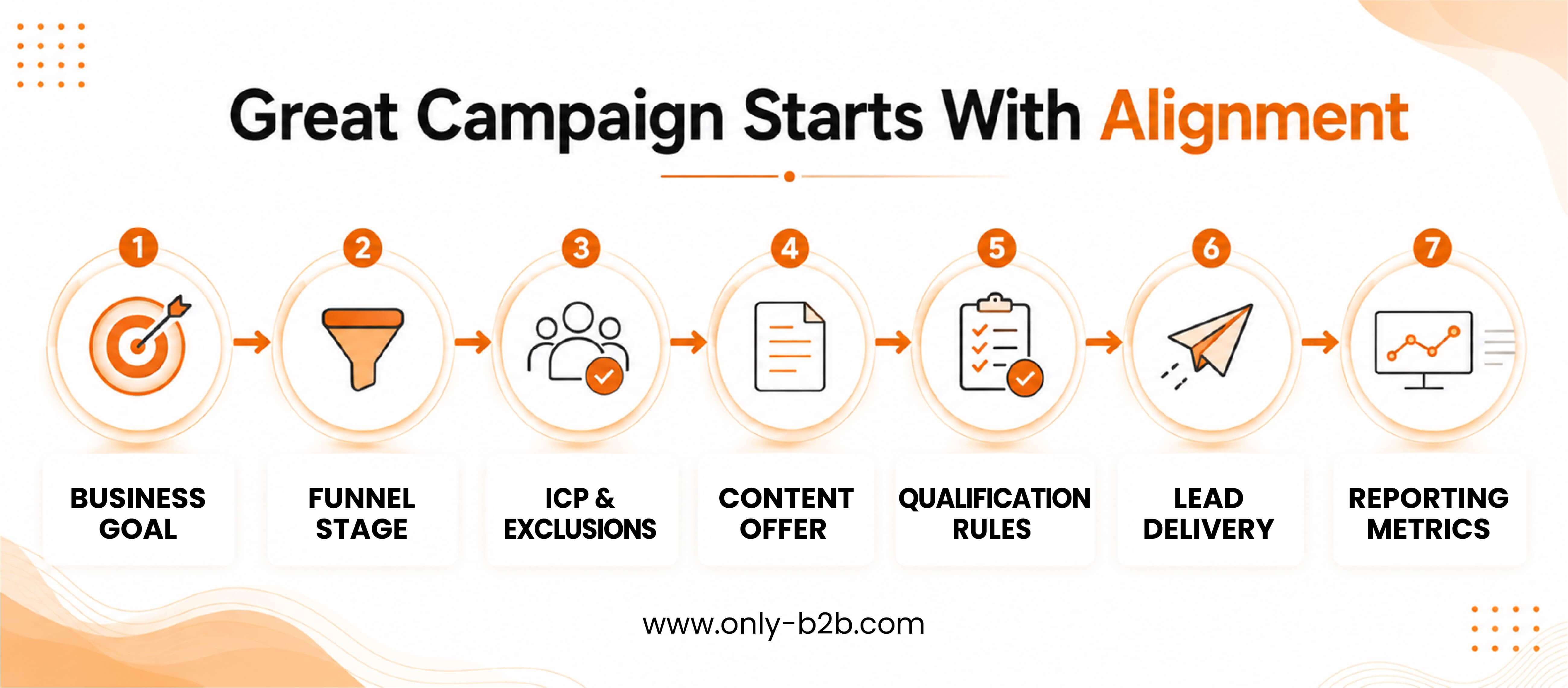
Start With the Business Goal and Funnel Stage
Every campaign begins with intent, but not every team defines it clearly.
Before any targeting or asset decisions are made, the brief should clearly define the business goal and the funnel stage it is designed to support.
The business goal includes what the organization is trying to achieve, such as pipeline creation, MQL growth, account penetration, or opportunity acceleration.
Funnel stage defines where the campaign sits in the buyer journey, whether it is early awareness, mid-stage consideration, or late-stage conversion support.
This clarity matters because it directly influences how vendors source and qualify leads. A top-of-funnel awareness campaign prioritizes reach and engagement signals, while a conversion-focused campaign demands stricter filters and higher intent thresholds.
There is a meaningful difference between:
- Awareness expansion
- MQL capture
- SQL acceleration
- Account engagement
Each one changes how vendors should source, filter, and prioritize leads.
A campaign designed for MQL volume will not behave the same as one designed for pipeline influence. Yet many briefs treat them as interchangeable.
Funnel stage clarity also prevents internal misalignment later. Sales expectations, marketing reporting, and vendor performance all depend on this first decision.
If the goal is unclear, everything downstream becomes negotiable. And negotiable systems rarely produce consistent outcomes.
Define ICP, Target Accounts, and Exclusions
ICP definition is often where precision is assumed but not enforced.
A strong ICP targeting framework goes beyond industry and company size. It includes:
Firmographics (industry, revenue, employee size)
Define the structural fit of an organization. They help ensure the campaign focuses on companies that can realistically buy, adopt, and scale the solution.
Technographics (tools, platforms, stack maturity)
Identify whether the prospect environment is compatible with your solution. It prevents wasted effort on accounts that lack the required infrastructure or readiness.
Geography and market maturity
Ensure messaging and offers align with regional buying behavior, compliance needs, and market readiness levels.
Seniority and job function
Clarify who the real decision-makers and influencers are, ensuring outreach reaches individuals with actual authority or impact.
Buying committee roles
Map multiple stakeholders involved in a purchase, improving relevance across different personas in the same account.
Clear exclusion criteria
Define who should not be targeted, preventing irrelevant leads that distort performance and waste budget.
Exclusions are as important as inclusions. In many campaigns, poor lead quality is not caused by wrong targeting, but by missing boundaries.
For example, including SMB segments in an enterprise motion does not just dilute results. It distorts reporting, inflates volume, and creates false confidence in performance.
Target account lists should also be explicitly defined when applicable. If account-based intent is part of the strategy, vendors need clarity on whether they are supporting named accounts or broader category capture.
This is where account filters, contact filters and segmentation logic must be documented, not assumed.
Document the Asset, Offer, and Conversion Path
Every B2B content offers strategy carries implicit expectations. The brief makes them explicit.
Vendors need to understand:
What the asset is (whitepaper, report, webinar, demo, etc.)
Define the format of engagement and sets expectations for the type of audience interaction. A technical whitepaper attracts different intent than a product demo or webinar.
What problem it solves
This clarifies the buyer pain point being addressed. It ensures the campaign attracts users with relevant challenges rather than generic interest.
Why it is valuable to the target audience
You need to explain the unique insight, data, or outcome the asset provides. It helps vendors position the offer in a way that drives meaningful engagement.
What the user receives after conversion
Define the immediate value exchange, such as access to insights, consultation, or product walkthroughs. It shapes lead quality expectations.
What happens post-download or registration
Outline the follow-up journey, including nurturing, sales outreach, or automation flows, ensuring alignment between marketing and sales.
A landing page or lead magnet is not just a capture mechanism. It is a framing device for intent.
If the offer is generic, lead quality will reflect that. If the value proposition is unclear, engagement will be shallow.
This is also where conversion path clarity matters. A webinar registration behaves differently from a gated research report. Treating them the same in a content syndication campaign brief leads to inconsistent expectations between marketing and vendors.
The goal is not just to generate leads. It is to generate informed intent signals that sales can actually use.
Set Lead Qualification Rules Before Launch
Lead qualification is where most misalignment becomes visible.
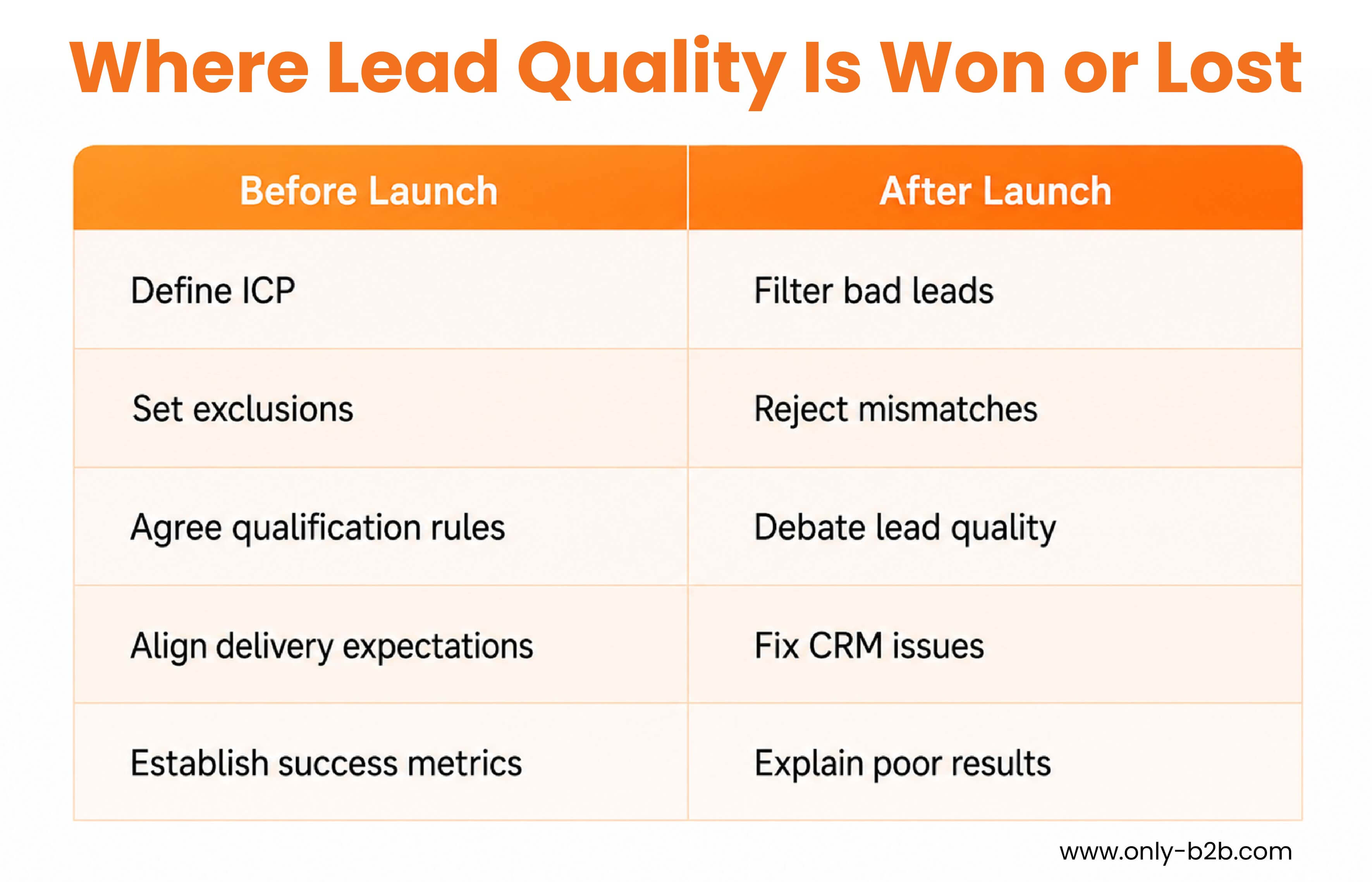
A strong brief defines lead qualification filters before the campaign begins, not after performance review.
This includes:
Job title and seniority thresholds
Leads must match the decision-making level required for meaningful sales conversations.
Company size and industry fit
Ensure alignment with ICP and prevent irrelevant or low-value accounts from entering the funnel.
Geographic eligibility
Makes sure that compliance, messaging relevance, and alignment with sales coverage regions.
Required fields for qualification
Define the minimum data needed to validate a lead, improving usability for sales teams.
Consent and compliance requirements
Makes sure legal and regulatory standards are met, protecting both brand and data integrity.
Duplicate suppression rules
Prevent repeated entries that inflate volume and distort performance reporting.
Disqualification logic
Define clearly what makes a lead invalid, ensuring consistency in evaluation across vendors and systems.
Without these filters, vendors optimize for delivery volume, not relevance.
It is also important to define what “qualified” means in operational terms. A lead is not qualified because it exists. It is qualified because it meets agreed criteria.
This is where data validation and duplicate suppression become critical. Without them, CRM systems absorb noise that later gets misinterpreted as pipeline activity.
A well-defined qualification layer protects both sides. Vendors know what to deliver. Marketing knows what to expect. Sales receives fewer but more usable signals.
Specify Lead Delivery and Handoff Requirements
Even high-quality leads lose value if delivery is inconsistent.
A lead delivery format should be defined with the same precision as targeting.
This includes:
CRM fields required
These ensure every lead enters the system with complete and usable data, reducing manual cleanup and improving sales readiness.
File format or API structure
This defines how data is transmitted, ensuring compatibility between vendor systems and internal CRM infrastructure.
Delivery frequency (daily, weekly, real-time)
This determines how quickly leads reach sales, directly impacting response time and conversion potential.
Routing rules by region, segment, or product line
These ensure leads are automatically assigned to the correct sales teams, reducing delays and misrouting.
SLA expectations for delivery and ingestion
These set clear timelines for when leads should be delivered and processed, ensuring accountability across stakeholders.
This is where lead routing often breaks down. If sales systems are not aligned with vendor output, even good leads can stall before follow-up.
Handoff is not just technical. It is operational timing. A 24-hour delay in high-intent segments can materially reduce conversion probability.
The brief should also define ownership after delivery. Who validates, who routes, and who responds. Without this clarity, accountability becomes fragmented.
A strong system does not just generate leads. It moves them cleanly into action.
Define Reporting, Pacing, and Optimization Cadence
Reporting is often treated as retrospective. In strong systems, it is directional.
A campaign reporting structure should define:
What metrics matter (MQLs, SQLs, pipeline influence)
These determine what success looks like and ensure all stakeholders evaluate performance using the same benchmarks.
How often performance is reviewed
This ensures timely visibility into campaign health and prevents issues from compounding unnoticed.
What constitutes acceptable lead quality thresholds
These set minimum performance standards, helping identify when adjustments are needed.
This ensures insights are actionable and continuously improve targeting and delivery quality.
What triggers optimization changes
This defines when and how campaigns should be adjusted based on performance signals.
Pacing also matters. A front-loaded campaign behaves differently from a steady-state one. Without pacing expectations, vendors may prioritize speed over consistency.
Optimization cadence is where performance improves over time. But only if feedback loops are structured.
This is where lead acceptance rate becomes a key signal. If acceptance is low, the issue is rarely volume. It is usually misalignment in targeting or qualification logic.
Strong reporting does not just measure output. It explains behavior.
Common Content Syndication Brief Mistakes
Most content syndication mistakes are not execution errors. They are definition errors.
The most common include:
Each of these creates friction later in the cycle. Vendors are forced to interpret intent. Sales is forced to filter noise. Marketing is forced to defend outcomes that were never clearly defined.
The pattern is consistent. When the brief is unclear, every stakeholder compensates differently. And compensation is not strategy.
Content Syndication Campaign Brief Template
A practical campaign brief template does not need to be complex. It needs to be complete.
A structured version includes:
- Business Objective: Demand generation goals, MQL goals, or pipeline goals that define what success looks like.
- Funnel Stage: Awareness, consideration, or conversion focus that determines targeting and messaging depth.
- ICP Definition: Firmographics, technographics, exclusions that ensure precise audience targeting.
- Target Accounts (if applicable): Named accounts or segment rules that guide account-based execution.
- Content Asset: Type, value proposition, conversion path that shapes engagement quality.
- Qualification Rules: Job roles, company fit, validation criteria that define lead quality standards.
- Delivery Requirements: CRM fields, format, SLA, routing rules that ensure smooth operational flow.
- Reporting Structure: Metrics, cadence, optimization process that enables performance tracking and improvement.
This structure is not about control. It is about reducing interpretation gaps before they become performance issues.
Better Briefs Create Better Leads
A content syndication campaign brief is often treated as administrative work. In practice, it is the earliest point of performance design.
Most issues attributed to vendors, channels, or lead sources can be traced back to how the campaign was defined. Not how it was executed.
When the brief is clear, vendors do not need to guess. Sales does not need to filter excessively. Marketing does not need to over-explain results.
The system becomes more predictable, not because it is simplified, but because it is aligned. And in B2B demand generation, alignment is usually the difference between activity and pipeline.

Vikas Bhatt is the Co-Founder of ONLY B2B, a premium B2B lead generation company that specializes in helping businesses achieve their growth objectives through targeted marketing & sales campaigns. With 10+ years of experience in the industry, Vikas has a deep understanding of the challenges faced by businesses today and has developed a unique approach to lead generation that has helped clients across a range of industries around the globe. As a thought leader in the B2B marketing community, ONLY B2B specializes in demand generation, content syndication, database services and more.