

How often does a syndicated lead look promising in the dashboard, only to go quiet once sales reaches out?
Content syndication continues to prove its value as a demand generation channel. In fact, 61% of B2B marketers using content syndication met their lead generation goals.
Yet many organizations invest heavily in generating interest only to lose momentum in the hours and days that follow. That is where most syndication programs lose value.
The issue is rarely the channel, but usually the absence of a thoughtful content syndication follow-up strategy that connects early interest with meaningful engagement.
A follow-up strategy turns a content request into a relevant next step, helping teams respond with context instead of outreach. In B2B, where buyers research before speaking to vendors, follow-up is not a final step. It is the moment that decides whether interest becomes qualified pipeline.
What Is a Content Syndication Follow-Up Strategy?
Many teams think of follow-up as the email or call that simply comes after a content download. In reality, it is much more.
A follow-up strategy defines how marketing and sales respond to the signal a buyer has already given. For syndicated leads, that matters because the first interaction usually happens on a third-party publication, not your own website.
The buyer has shown interest in a topic, not necessarily your company, which means the follow-up has to bridge that gap carefully.
An effective content syndication follow-up strategy connects three functions:
- Marketing continues educating buyers with relevant messaging instead of assuming immediate purchase intent.
- SDRs interpret engagement in the context of the original content instead of treating every lead as cold.
- Sales enters the conversation only when enough context exists to make the discussion worthwhile.
Seen this way, follow-up is less about pushing buyers through a funnel and more about reducing uncertainty between curiosity and commitment. When organizations treat it as a connected system, the experience feels more coherent to the buyer and more useful to the sales team.
That coherence matters because syndicated leads are often early-stage by design. They may not be ready for a direct pitch, but they are ready for a relevant next step. The best follow-up strategies recognize that distinction and build a path that feels natural for the prospect.
Why Most Syndicated Lead Follow-Up Breaks Down
The most common mistake made with syndicated lead is treating every new contact like someone who requested a demo.
Downloading an industry guide usually means the buyer is researching a challenge, comparing approaches, or gathering information for a broader buying group. It does not automatically signal urgency.
Treating All the Leads Same
Yet many organizations respond with the same sequence: a generic email, a sales call with little context, an immediate meeting request, and repeated reminders. None of these acknowledge why the buyer engaged in the first place.
This is where syndicated lead follow-up loses momentum. The outreach starts from the company’s desired outcome rather than the buyer’s current situation. Speed matters, but speed without relevance only delivers the wrong message faster.
Lost Buying Context
Leads from cybersecurity content, cloud infrastructure research, and compliance guides often receive identical outreach even though their motivations differ. The content topic becomes campaign attribution instead of buying context.
Message Fatigue
Buyers who engage with syndicated content are often still in research mode, which means they are sensitive to tone. If the follow-up feels overly aggressive, overly promotional, or disconnected from the original topic, they disengage quickly. A strong first response should feel like a continuation of the research journey, not an interruption.
The first interaction establishes credibility. Buyers respond to outreach that shows the sender understands what they were researching and what kind of help would actually be useful next.
Segmenting Syndicated Leads by Buying Intent
The B2B buyers interacting with your content are on different steps of the buying journey.
Some buyers are exploring a category. Others understand the problem and are evaluating approaches. Some are comparing vendors before presenting recommendations internally. Recognizing those differences creates more meaningful content syndication lead nurture.
Educational Intent
Educational intent usually appears early in the buying process. These buyers want perspective more than products, so conversations should expand understanding rather than move straight to your solution.
They may respond better to a short summary of key trends, a related article, or a practical framework than to a meeting request.
Problem Aware
Problem-aware buyers know the challenge and want practical ways to address it, which makes examples, implementation considerations, and risk reduction more valuable than promotional messaging. At this stage, the follow-up should help them think through the implications of solving the problem, not just the existence of the problem itself.
Comparison Stage
Comparison-stage buyers are validating decisions. They need help with differentiation, stakeholder alignment, and expected outcomes, not more introductory content. They are often looking for confidence, not education, so the follow-up should be concise, specific, and grounded in business value.
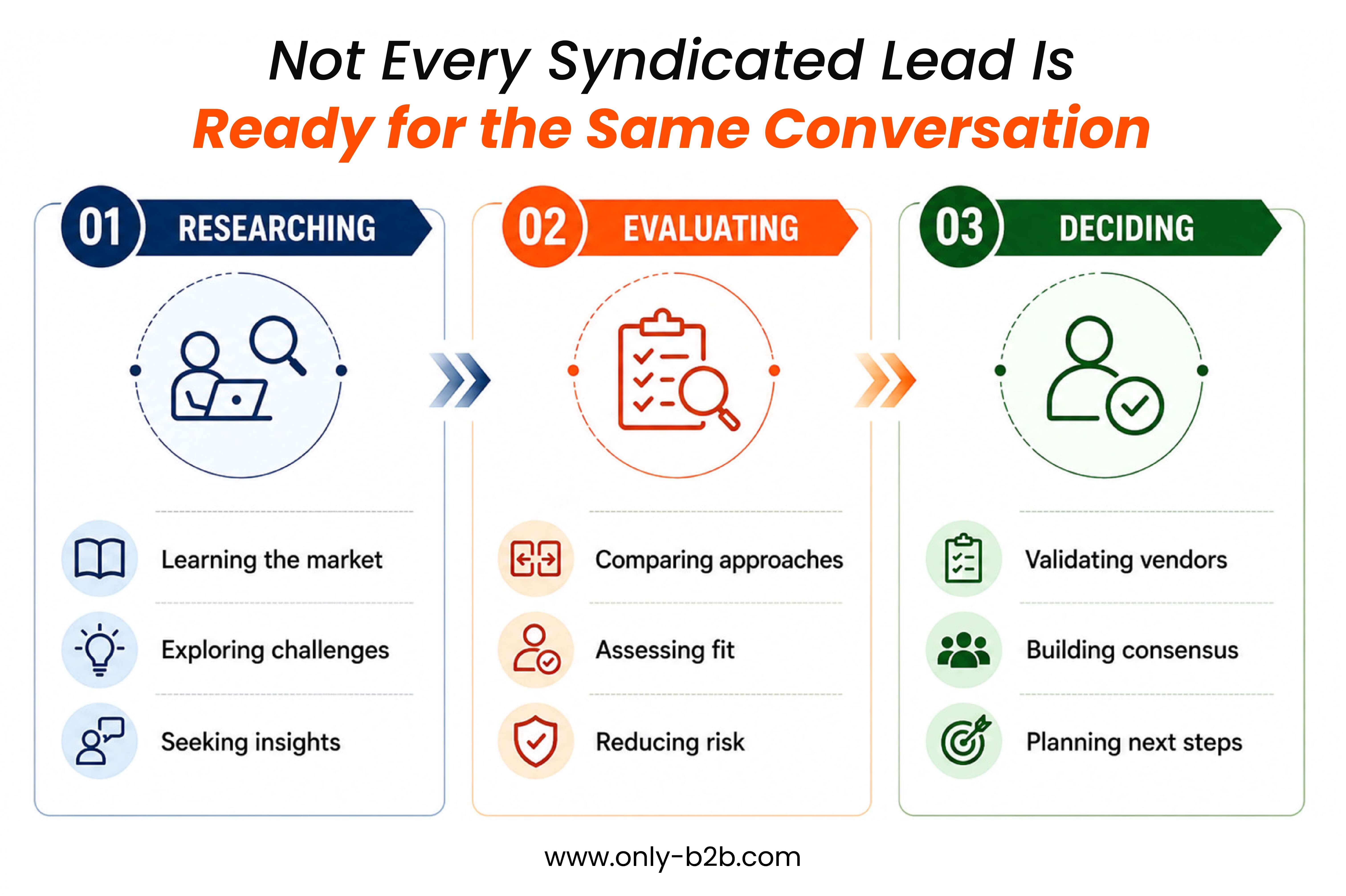
Intent segmentation should combine multiple signals: the downloaded asset, role, industry, company profile, prior engagement, and account-level activity. Together, these create a more reliable picture of buyer readiness than any single action.
It also helps to consider the buying committee. A single download may come from one person, but the real opportunity may involve several stakeholders with different priorities. A finance leader, an operations manager, and a technical evaluator may all engage with related content for different reasons. Good segmentation accounts for that complexity instead of assuming one lead equals one buyer.
A 14-Day Follow-Up Sequence That Builds Sales Conversations
An effective follow-up sequence should continue the buyer’s journey, not compress it.
The first 14 days are especially important because they set the tone for the relationship. This is the period when interest is still fresh, but trust has not yet been established. The goal is not to force a meeting immediately. The goal is to create enough relevance that a conversation feels useful when it does happen.
Day 01:
Acknowledge the original engagement and reinforce the value of the resource they requested. Add one relevant insight that extends the discussion without asking for another commitment.
This could be a short observation about the trend they were researching, a practical takeaway from the asset, or a related question that helps frame the challenge more clearly.
Day 03-04:
Share additional perspective tied to the same business challenge. This should deepen understanding, not promote capabilities. Research, practical observations, and industry patterns usually perform better than product messaging.
If the original content focused on a pain point, this follow-up can introduce a common mistake companies make when trying to solve it.
Day 06-07:
SDR outreach becomes appropriate if it reflects the buyer’s context. The message should reference the content, recognize why someone in that role might have explored it, and invite discussion without assuming urgency. That creates a more effective B2B lead follow-up because it respects the buyer’s pace.
A strong outreach note might ask whether the topic is currently under review, whether the buyer is comparing approaches, or whether they are simply gathering information for later planning.
Day 09-10:
The sequence should shift from direct outreach to value reinforcement. This is a good time to share a related asset, a short case example, or a practical checklist that helps the buyer evaluate the issue more clearly. The purpose is to stay useful without becoming repetitive.
Day 12-14:
Marketing and sales should review engagement together. Has the buyer interacted with more content? Have other stakeholders from the same company shown interest? Has activity expanded across related topics? These signals often reveal intent more clearly than repeated outreach.
If engagement is growing, the next step may be a more tailored sales conversation. If it is flat, the lead may need to remain in nurture until additional signals appear. Either way, the sequence should create clarity, not pressure.
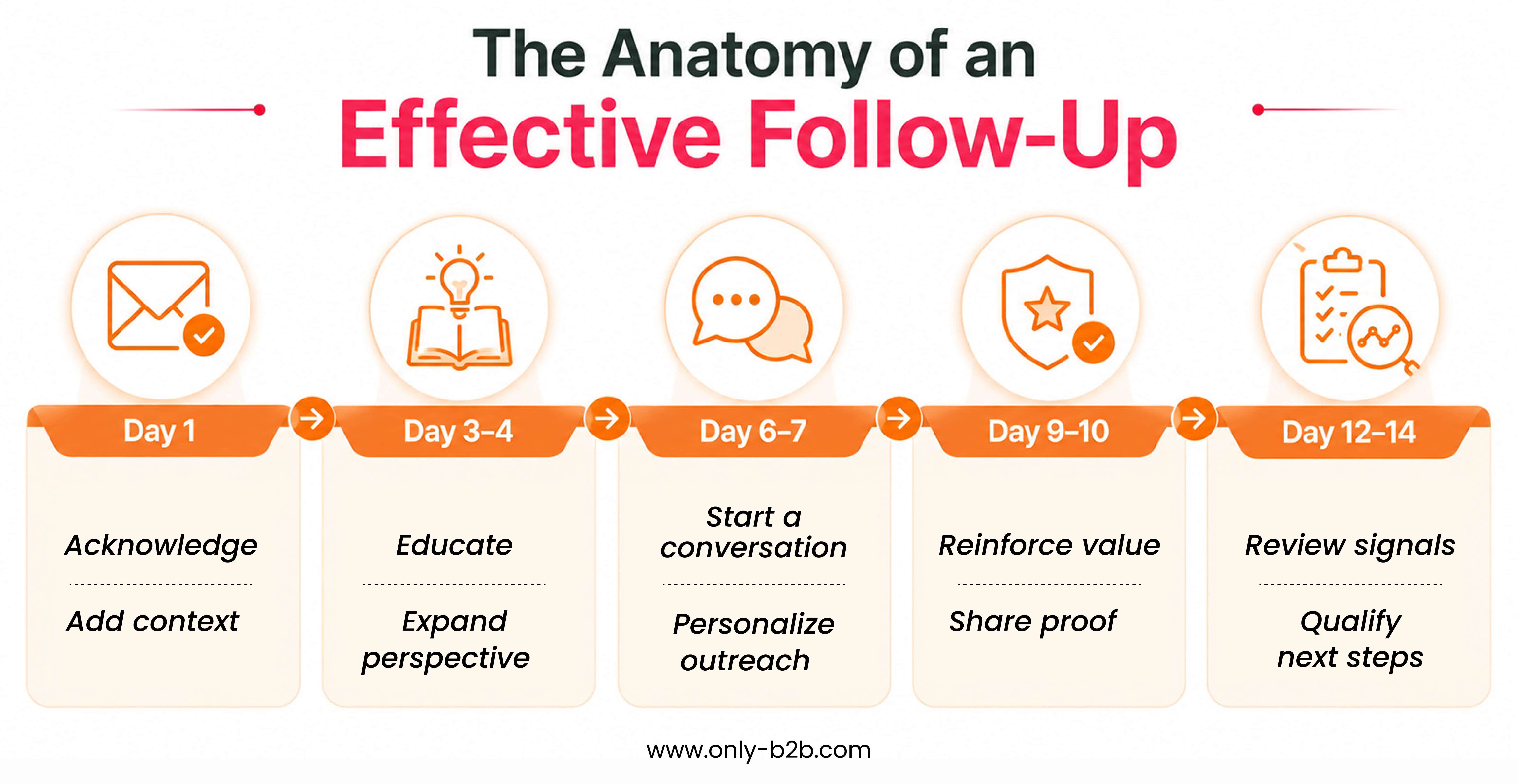
Consistency matters more than persistence. Every touchpoint should add something new. If it simply repeats the last message, it creates fatigue instead of momentum.
What Sales Needs Before Reaching Out
Sales conversations are stronger when representatives inherit context, not just contact details. Unfortunately, many organizations still pass only basic demographic information during the sales handoff.
A better process includes the content viewed, the business challenge it addressed, how recent the engagement was, what else the buyer explored, whether others from the account engaged, and whether any prior conversations already exist.
That context changes the quality of outreach. SDRs can begin with informed observations instead of broad qualifying questions. They can continue a conversation instead of starting one from scratch.
It also helps sales understand the likely stage of the buyer. Someone who downloaded a high-level industry guide may need a different approach than someone who engaged with a more technical or solution-oriented asset. Without that distinction, sales risks sounding disconnected from the buyer’s actual priorities.
Good follow-up depends on internal alignment as much as external communication. Marketing provides context, sales uses it, and neither function succeeds alone.
When Should a Syndicated Lead Become an MQL, SAL, or SQL?
Lead stages often become administrative labels instead of meaningful indicators of progress. That creates friction between marketing and sales, especially when each team defines the terms differently.
The transition from MQL to SQL should reflect increasing confidence, not just more activity.
- A Marketing Qualified Lead means the buyer matches the target audience and shows relevant interest.
- A Sales Accepted Lead means sales has reviewed the context and agrees the lead is worth pursuing.
- A Sales Qualified Lead should only come after meaningful interaction confirms business alignment.
This matters because qualification should measure conversation quality, not marketing output. When leads move too quickly, sales questions lead quality, marketing questions sales follow-up, and pipeline quality suffers.
Shared qualification criteria solve that problem by aligning expectations before handoff. The goal is not to move more leads through stages. It is to make sure each stage reflects real progress.
It is also worth remembering that not every engaged lead should move immediately into sales. Some leads need more education, more stakeholder involvement, or more time before they are ready. A disciplined qualification model protects sales time while preserving future opportunity.
Metrics That Reveal Follow-Up Quality
Many dashboards still focus on lead volume. That shows activity, but not effectiveness.
A better approach measures progression.
- Reply rate shows whether outreach resonates.
- Meeting rate shows whether buyers see enough value to continue.
- Conversion from marketing-qualified to sales-qualified opportunities shows whether marketing and sales interpret intent consistently.
- Opportunity creation is the clearest sign that follow-up is contributing to pipeline, not just activity.
Together, these metrics provide a better view of content syndication ROI because they measure what happens after the lead is delivered.
The conversations behind the numbers matter too.
- Which messages earn responses?
- Which assets drive stronger engagement?
- Which industries need different timing?
- Which SDR approaches create better discussions?
Those patterns improve future programs more than simply increasing lead volume.
It can also be useful to track time-to-first-response, number of touches before engagement, and the percentage of leads that re-engage after the initial sequence. These indicators help teams understand whether the follow-up process is creating momentum or simply generating noise.
Build a Syndication Program Sales Actually Wants
Content syndication should not be judged by lead delivery alone. It should be judged by whether it creates real sales conversations.
That requires changing how success is defined. A lead in the CRM is not the end result. A meaningful business conversation is. The strongest programs treat follow-up as part of the campaign, not as an afterthought.
The result is not just more meetings. It is better meetings with people who are ready for them. At Only B2B, we believe qualified content syndication leads should arrive with the context needed for meaningful follow-up, because the value of syndication is determined not by the download itself, but by what happens next.

Vikas Bhatt is the Co-Founder of ONLY B2B, a premium B2B lead generation company that specializes in helping businesses achieve their growth objectives through targeted marketing & sales campaigns. With 10+ years of experience in the industry, Vikas has a deep understanding of the challenges faced by businesses today and has developed a unique approach to lead generation that has helped clients across a range of industries around the globe. As a thought leader in the B2B marketing community, ONLY B2B specializes in demand generation, content syndication, database services and more.