You might think you have found the right account: you know the company, industry, revenue band and even have a named contact in the CRM.
Everything looks promising until you realise you are missing the executives and decision-makers who have the greatest influence over the deal.
Gartner reports that B2B buying groups typically involve six to ten decision-makers. One contact, no matter how enthusiastic, rarely represents the full path to purchase.
The account appears covered, but the opportunity still depend on a single relationship while the people who control the budget, evaluate the technology, own adoption or manage procurement remain out of view.
That is the missing layer in account-based growth which makes moving from account coverage to buying group coverage crucial.
What Is Buying Group Mapping in B2B?
Buying group mapping is the process of identifying the people involved in a purchase, understanding their roles and influence, and connecting those insights to the account and opportunity so sales and marketing can act on them.
A buying group is not the same as a persona or a single decision-maker.
A buying group represents the actual people involved in a specific commercial decision.
One person may control the budget. Another may define requirements. A third may evaluate the technology. Someone else may own adoption, while procurement or legal determines whether the agreement can be completed.
This matters because B2B purchases rarely follow a simple path from one buyer identifying a need to one person signing a contract. Decisions are shaped by multiple stakeholders across functions and levels of seniority.
Buying group mapping makes that decision network visible.
The scale of the buying group can be larger than a single persona suggests. Forrester found that an average B2B purchase involves 13 people, with 89% of purchases involving two or more departments.
A champion may strongly support your solution but lack budget authority. A technical evaluator may have concerns that never reach the account executive. An operational owner may question adoption. Procurement may enter late and reopen commercial discussions just as the team expects to close.
Why Buying Group Coverage Matters
This is the risk of single-threaded sales. Progress looks real because one relationship is active, but the opportunity depends on someone who may not control the outcome.
The same problem affects marketing. When teams personalise content around the one visible contact, they may address that person’s priorities while overlooking finance, IT, operations, procurement or other stakeholders involved in the decision.
Coverage matters for forecasting. An opportunity with one engaged contact should not carry the same confidence as one with several validated stakeholders across critical buying roles.
The issue is not contact volume. It is whether the right people are represented, reachable and relevant to the decision.
The Roles Your Buying Group Map Should Cover
The exact buying group varies by product, industry and deal size, but several roles appear consistently.
Economic Buyer
The person who controls or significantly influences the budget and is accountable for the business outcome.
Champion
The stakeholder who actively wants the solution to succeed and can create internal momentum, navigate the organisation and connect the solution to business priorities.
Technical Evaluator
The person assessing integration, security, architecture, implementation and technical risk. In technology purchases, this stakeholder may have veto power without owning the budget.
Operational Owner or User
The person who understands the current workflow and will be affected by implementation and adoption. Their support can significantly influence whether the solution succeeds internally.
Procurement
The function responsible for purchasing processes, commercial negotiations, vendor requirements and contracting.
Legal or Compliance
Stakeholders responsible for contractual, regulatory, privacy, risk or governance considerations.
Blocker or Competing Influence
Someone who may not have a formal buying role but can delay, redirect or prevent the decision.
The goal is not to force every account into the same template. It is to identify the roles that can approve, influence, accelerate, delay or block the purchase.
How to Calculate a Buying Group Coverage Score
Counting contacts is not enough. Coverage depends on whether the required buying roles are represented.
A practical approach is to measure buying group completeness by comparing assigned members with the number required for each role.
Role Completeness % = Assigned Members ÷ Required Members × 100
If one of two required decision-makers is identified, that role is 50% complete. Once the requirement is met, it reaches 100%.
Calculate the overall score by averaging the completeness percentages across all defined roles:
Buying Group Completeness % = Sum of Role Completeness Scores ÷ Number of Defined Roles
For example, role scores of 100%, 100%, 50% and 0% produce an overall score of 62.5%.
This highlights which roles are covered and where gaps remain. Keep coverage separate from engagement: identifying the right people does not mean they are actively involved. Engagement should be measured independently through stakeholder activity, role weighting and recency.
Buying Group Coverage Scorecard
Consider a strategic software opportunity with six critical roles:
Buying Group Coverage Scorecard
See which critical buying roles are covered and where commercial risks remain.
Swipe horizontally to view the complete scorecard →
| Buying Role | Status | Confidence | Coverage |
|---|---|---|---|
| Economic Buyer | Identified, not engaged | Medium | Not validated |
| Champion | Active relationship | High | Strong |
| Technical Evaluator | Identified and engaged | High | Covered |
| Operational Owner | Missing | None | Adoption risk |
| Procurement | Identified, not contacted | Low | Commercial risk |
| Legal/Compliance | Missing | None | Late-stage risk |
A basic contact count might suggest this account is reasonably covered.
The scorecard tells a different story.
The team has a strong champion and technical relationship, but the economic buyer is not engaged, the operational owner is missing, and procurement and legal remain uncertain.
Presence is not the same as coverage.
How to Find Missing Decision-Makers
Finding missing stakeholders does not mean adding every relevant employee from a database. It means combining multiple signals.
Step 1: Start with the CRM. Existing contacts, meeting participants, reporting relationships, previous opportunities and internal referrals can reveal connections that are not obvious from the account record.
Step 2: Look beyond job titles and examine functions and responsibilities. Titles vary significantly between organisations, while responsibilities often provide a clearer indication of influence.
Step 3: Use data enrichment to identify likely stakeholders across finance, IT, security, operations and procurement. But treat enriched data as a starting point, not proof.
Step 4: Intent data can provide another signal. If multiple people from the same account are researching related topics or engaging with different content, that may indicate broader buying activity.
Step 5: Use account research to understand organisational changes, leadership moves, technology investments, strategic initiatives and other developments that may change who influences the decision.
The objective is to identify the people whose involvement can change the probability, pace or outcome of the deal.
Which Missing Contacts Should You Prioritise?
Not every coverage gap deserves equal attention. Prioritise missing stakeholders based on four factors:
1. Buying influence: A missing economic buyer or technical evaluator may represent greater risk than a peripheral user.
2. Deal stage: Early-stage opportunities may require business and problem owners. Later stages may require procurement, legal and implementation stakeholders.
3. Account intent: A high-intent account with weak coverage deserves more immediate attention than a low-intent account with theoretical coverage.
4. Account value: Strategic accounts justify deeper research and stronger multithreading than lower-priority opportunities.
This changes the question from:
“Which accounts have the most contacts?”
to:
“Which missing relationship creates the greatest commercial risk?”
Turning Buying Group Data Into ABM Action
A buying group map has little value if it remains a research document.
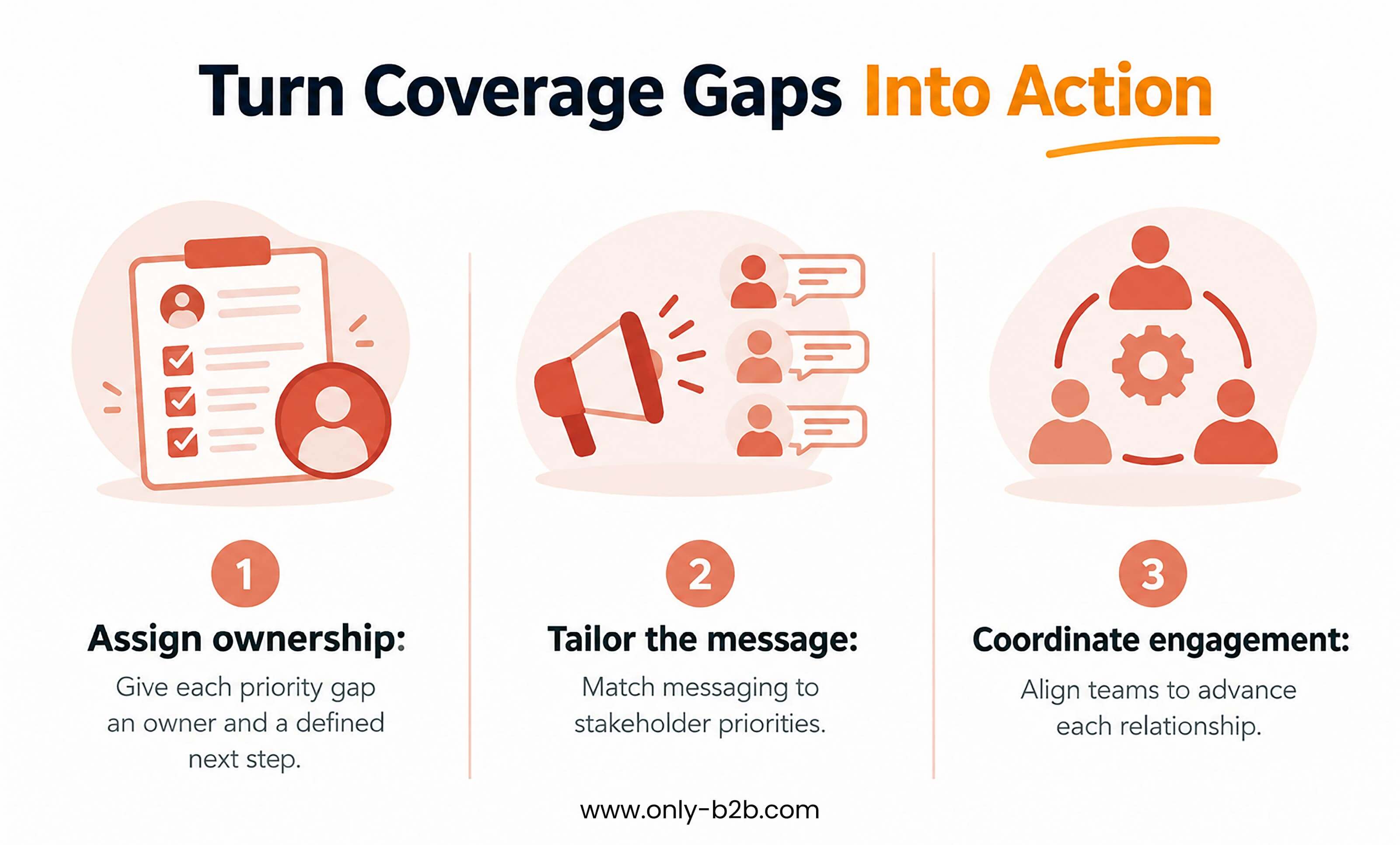
Ownership: Every priority coverage gap should have someone responsible for addressing it across sales, marketing, customer success or leadership.
Role-specific relevance: Different stakeholders care about different outcomes. Economic buyers may need a business case. Technical evaluators need evidence around integration and risk. Users need to understand workflow and adoption. Procurement needs clarity around commercial and implementation considerations.
Coordinated engagement: Sales might use a champion to secure an introduction. Marketing can support with relevant content. A technical expert can join an evaluation. Leadership can engage when executive alignment matters.
This is where ABM becomes more than account targeting. You are not simply reaching more people at an account. You are coordinating around how that account makes a decision.
Metrics That Show Coverage Is Improving
Buying group coverage should be measured as a commercial capability, not a database exercise.
Track:
- Coverage rate: Percentage of target accounts with required roles identified.
- Role completeness: Percentage of critical buying functions represented.
- Multithreaded opportunities: Opportunities with meaningful relationships across multiple buying roles.
- Contact confidence: Percentage of mapped contacts with validated roles and current information.
- Engagement by role: Whether different stakeholder groups are engaging, rather than only the original contact.
- Opportunity progression: Whether broader stakeholder coverage is associated with healthier movement through the funnel.
- Data freshness: How recently critical account and stakeholder information was validated.
These metrics do not guarantee revenue. They help teams understand whether an opportunity is genuinely supported inside the account.
Common Buying Group Mapping Mistakes
Buying Group Coverage Checklist
Before considering an account adequately covered, confirm that you have:
- Defined the critical buying roles for the opportunity
- Identified the likely economic buyer and champion
- Mapped technical and operational stakeholders
- Identified procurement and legal requirements where relevant
- Validated contacts rather than relying on titles alone
- Recorded confidence levels for key stakeholders
- Prioritised missing relationships by commercial risk
- Assigned ownership for major coverage gaps
- Connected buying group information to the CRM opportunity
- Aligned messaging to different stakeholder priorities
- Set minimum coverage standards for strategic opportunities
- Established a process to refresh account information
FAQs
What tools support buying group mapping?
CRM platforms, account intelligence, enrichment tools, intent data, sales engagement platforms and organisational research can all contribute. However, no tool can reliably determine the complete buying group without human validation.
Who owns buying group coverage?
Ownership can be shared across sales, marketing and revenue operations, but accountability should remain clear. The account owner should ultimately know where the coverage gaps are and what is being done about them.
Should every account have the same coverage requirement?
No. Coverage standards should reflect account tier, deal complexity, value and buying process. Strategic enterprise opportunities generally require deeper coverage than simpler purchases.
Does better coverage guarantee higher win rates?
No. Buying group coverage does not replace product value, positioning or execution. Its purpose is to reduce blind spots and help teams understand the decision they are trying to influence.
Turn Account Coverage Into Revenue Coverage
A target account list tells you where you want to grow. It does not tell you whether the account is reachable, understood or commercially accessible.
That requires visibility into the people shaping the decision.
Buying group mapping helps revenue teams move beyond account presence and understand the actual decision network: who influences the purchase, who controls the budget, who can block progress, where relationships are weak and what needs to happen next.
The value is not in creating a longer contact list. It is in creating a clearer picture of the decision.
When the right stakeholders are identified, sales can build beyond a single champion. Marketing can create more relevant engagement. Revenue operations can measure coverage more accurately. Leadership can assess pipeline with greater confidence.
An account is not covered because it has contacts.
It is covered when the people who can shape the decision are known, relevant, reachable and connected to a coordinated plan.

Vikas Bhatt is the Co-Founder of ONLY B2B, a premium B2B lead generation company that specializes in helping businesses achieve their growth objectives through targeted marketing & sales campaigns. With 10+ years of experience in the industry, Vikas has a deep understanding of the challenges faced by businesses today and has developed a unique approach to lead generation that has helped clients across a range of industries around the globe. As a thought leader in the B2B marketing community, ONLY B2B specializes in demand generation, content syndication, database services and more.