Why is marketing a SaaS product very challenging in 2026? Not because your product isn’t good. Not because your ads aren’t running. Not because your team isn’t working hard.
But because buyers aren’t buying the way they used to.
Buying committees are bigger. Decision cycles are longer. And high-intent accounts stay in the shadows until they have already narrowed their shortlist.
ABM in SaaS marketing in 2026 is a breakthrough, and undoubtedly the most promising way to drive a predictable pipeline and increase deal value – especially for SaaS businesses selling into mid-market and enterprise segments.
In this guide, you’ll learn what’s changing in ABM, why it matters specifically for SaaS companies, and how to build a modern ABM motion that actually drives revenue (not just engagement).
Table of Contents
- 1 Why SaaS ABM Needs a Fresh Playbook in 2026
- 2 What’s Changing in ABM in 2026
- 3 The SaaS ABM Playbook (2026 Edition)
- 4 Best ABM Channels for SaaS in 2026
- 5 ABM Tools & Tech Stack Recommendations
- 6 ABM Roadmap for SaaS Teams (Pilot → Scale)
- 7 Conclusion: What the Best SaaS Teams Will Do Differently in 2026
Why SaaS ABM Needs a Fresh Playbook in 2026
1) What’s broken in lead-based SaaS marketing
Lead-based demand generation worked once when:
- buyers filled forms early,
- one or two decision-makers controlled the deal, and
- the market wasn’t overcrowded.
In 2026, most SaaS categories are saturated. Buyers prefer self-research. They actively compare vendors. And this all happens before they ever engage with sales.
Gartner notes that 75% of B2B buyers prefer a rep-free experience. Meaning they want to stay anonymous until they’re ready. Gartner+1
The result? Marketing spends money generating leads that:
- don’t match the ICP,
- aren’t in the right buying stage, or
- don’t have full buying group support.
What’s even worse? Attribution becomes messy because the buying journey is fragmented across channels.
2) Buying groups + long sales cycles make SaaS harder
Gartner research commonly describes buying groups in complex B2B deals as large committees (often 6–10 decision-makers).
ABM cannot rely on “one persona messaging” anymore. Essentially, your marketing has to influence an entire buying group, not just one lead.
3) Why ABM is now the default SaaS growth motion
ABM flips the traditional model:
Instead of marketing → leads → sales → deals,
ABM is:
accounts → buying groups → engagement → pipeline → revenue.
And it works.
Forrester’s 2024 findings show that ABM accounts consistently report larger deal sizes than non-ABM accounts across regions. Globally, one-third of organizations saw an 11%–20% uplift, and nearly another third saw 21%–50% increases in deal size.
SaaS companies need to build on high ACV, retention, and expansion, making sure outcomes are the baseline for your 2026 ABM strategy.
What’s Changing in ABM in 2026
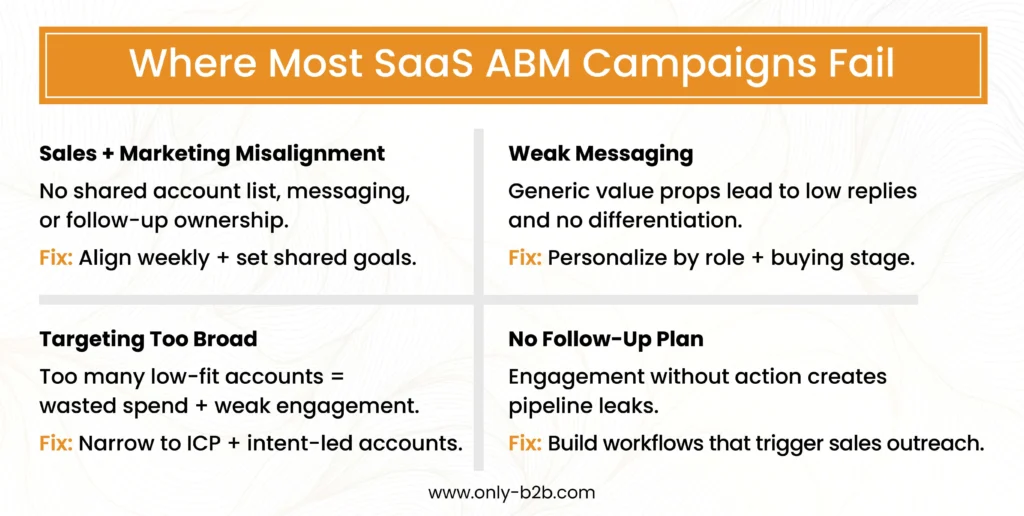
Here’s where many SaaS companies get stuck: they turn back to ABM using an outdated playbook.
ABM in 2026 is different from ABM in 2020. And if your ABM program isn’t built around today’s buyer behavior, you’ll no doubt be active but without impact.
The first major shift is intent-led targeting.
Earlier, SaaS companies started ABM with static account lists. A revenue team would choose 500 accounts, assign them into tiers, and build campaigns around those lists.
Sounds perfect in theory. But it ignores a major reality: not every account is in-market at the same time.
In 2026, ABM is increasingly powered by intent signals. Data reflects which accounts are actively researching the problems you solve.
What is this data about? It could mean keyword activity, review site engagement, competitor comparisons, or content consumption patterns.
The goal is no longer “target accounts we want.” The goal is “target accounts that are ready.”
The second shift is buying group orchestration.
Today, ABM success depends on how well you engage a committee. That means you’re not simply building one campaign per account; you’re building a motion that influences different stakeholders at different points in their journey.
The third change is AI-driven personalization.
AI is making personalization faster, but it also raises the bar. Buyers can spot when personalization is lazy, automated, or irrelevant.
So how do you use AI effectively? Use it to improve consistency and scale while keeping messaging grounded in real value.
Personalization is truly a game-changer. It can drive meaningful revenue lift, which is why it remains a priority across B2B strategies.
Finally, privacy and first-party data are reshaping ABM execution.
As targeting becomes more restricted and cookie-based personalization fades, SaaS marketers are turning to first-party data: website engagement, CRM history, webinar participation, and product usage signals.
These insights collectively help you personalize and prioritize accounts without relying solely on third-party tracking.
The biggest operational shift is that ABM is becoming truly multi-channel.
In 2026, LinkedIn is still important, but it’s not enough. Because SaaS buyers move across search, review platforms, communities, webinars, and partner ecosystems. That’s why ABM has to follow them across those channels with consistent messaging, strong sequencing, and coordinated follow-up.
The SaaS ABM Playbook (2026 Edition)
Here’s the modern ABM playbook SaaS teams can follow.
Step 1: Define a modern ICP
A 2026 SaaS ICP is no longer just:
- industry,
- company size,
- geography.
You also need:
- technographics (tools they use),
- pain-point signals,
- trigger events (funding, expansion, compliance needs),
- intent signals (what they’re researching right now).
Example:
A cybersecurity SaaS targeting accounts using AWS + handling regulated data could build an ICP that prioritizes:
- healthcare, fintech, SaaS,
- 500 employees,
- compliance activity (SOC2, HIPAA),
- intent signals around “zero trust,” “data loss prevention,” etc.
Step 2: Build a tiered account list
Tiering makes ABM scalable.
A common structure:
- Tier 1 (1:1 ABM): 20–50 accounts → highly personalized campaigns
- Tier 2 (1:few ABM): 100–200 accounts → segment-based personalization
- Tier 3 (1:many ABM): 500+ accounts → programmatic targeting + intent routing
Step 3: Identify buying groups
Don’t just build a persona list- build a buying group map.
For SaaS, buying groups typically include:
- VP/Director of the function (business owner)
- IT / security lead
- Finance/CFO team
- Procurement
- Operations leader
Step 4: Build message pillars by role + intent
Your messaging must match two things:
- the role,
- the buying stage.
A simple model:
- Early stage: problem education + category framing
- Mid stage: differentiation + proof points
- Late stage: ROI + implementation assurance
Step 5: Select channels
Choose channels based on:
- target account behavior,
- buying stage,
- tier.
Tier 1 should get:
- personalized outreach,
- executive engagement plays,
- account-specific content.
Tier 2 and 3 should lean on:
- intent-based ads,
- content syndication,
- automated workflows.
Step 6: Build ABM workflows and follow-ups
This is where ABM wins or fails. Engagement without follow-up is wasted spend.
A strong ABM workflow includes:
- engagement signals routed to sales,
- SDR sequences triggered by intent spikes,
- retargeting + content nurture loops,
- follow-up offers (webinar, demo, assessment).
Best ABM Channels for SaaS in 2026
Here are the channels SaaS ABM teams should prioritize.
1) LinkedIn + Programmatic Ads
LinkedIn remains one of the best platforms for persona-based targeting and retargeting, but it works best when layered with intent. If you know an account is in-market, LinkedIn becomes far more efficient.
Programmatic advertising also plays a role, especially for account-level reach and omnichannel engagement, but again, it performs best when targeting is tied to intent.
Intent-driven content syndication is becoming one of the strongest ABM tactics for SaaS.
Why it works:
- content captures engaged prospects inside target accounts,
- intent topics ensure relevance,
- the data becomes fuel for outbound and nurturing.
3) Outbound + conversational AI
Outbound remains critical as well, but the best outbound in 2026 is no longer “spray and pray.” Make sure it’s intent-informed, sequenced, and supported by content.
Conversational AI also plays a growing role here, especially for capturing engaged web visitors and routing them into relevant conversion paths.
4) Web personalization + interactive content
Web personalization and interactive content are other high-performing ABM channels. SaaS buyers increasingly expect tailored experiences, especially at the enterprise level. This could mean personalized landing pages, dynamic case studies, or interactive ROI tools that speak to the account’s pain points.
5) Partner ABM
Finally, partner ABM is gaining momentum because it accelerates trust. If your SaaS product integrates with major platforms, partner co-marketing and joint targeting can accelerate trust and reach. This is how you can break into accounts more efficiently.
ABM Tools & Tech Stack Recommendations
Keep your ABM tech stack simple and aligned:
- ABM platforms: 6sense, Demandbase (or similar)
- CRM + MAP: Salesforce + HubSpot / Marketo
- Intent providers: third-party intent + first-party behavioral tools
- Sales enablement: Salesloft, Outreach, Gong (depending on motion)
The key is integration. If tools aren’t aligned, ABM becomes fragmented.
ABM Roadmap for SaaS Teams (Pilot → Scale)
How to start small
The smartest way to implement ABM in 2026 is to start with a controlled pilot.
- 25–50 Tier 1 accounts,
- 1–2 industries,
- 1 buying group map,
- 1 core ABM campaign.
Track engagement + pipeline outcomes.
How to scale successfully
Once the pilot works:
- expand into Tier 2,
- build repeatable playbooks,
- automate intent routing,
- scale content syndication and personalization.
ABM maturity model
A simple ABM maturity journey looks like:
- Ad hoc ABM (campaign experiments)
- Structured ABM (tiering + alignment)
- Intent-led ABM (signals driving motion)
- Revenue orchestration ABM (full-funnel + expansion)
Conclusion: What the Best SaaS Teams Will Do Differently in 2026
ABM isn’t just a marketing strategy anymore. It’s the way SaaS companies build predictable revenue in a market where buyers control the journey.
They’ll:
- build intent-led targeting systems,
- create messaging for buying groups, not individuals,
- personalize across channels using AI + first-party signals,
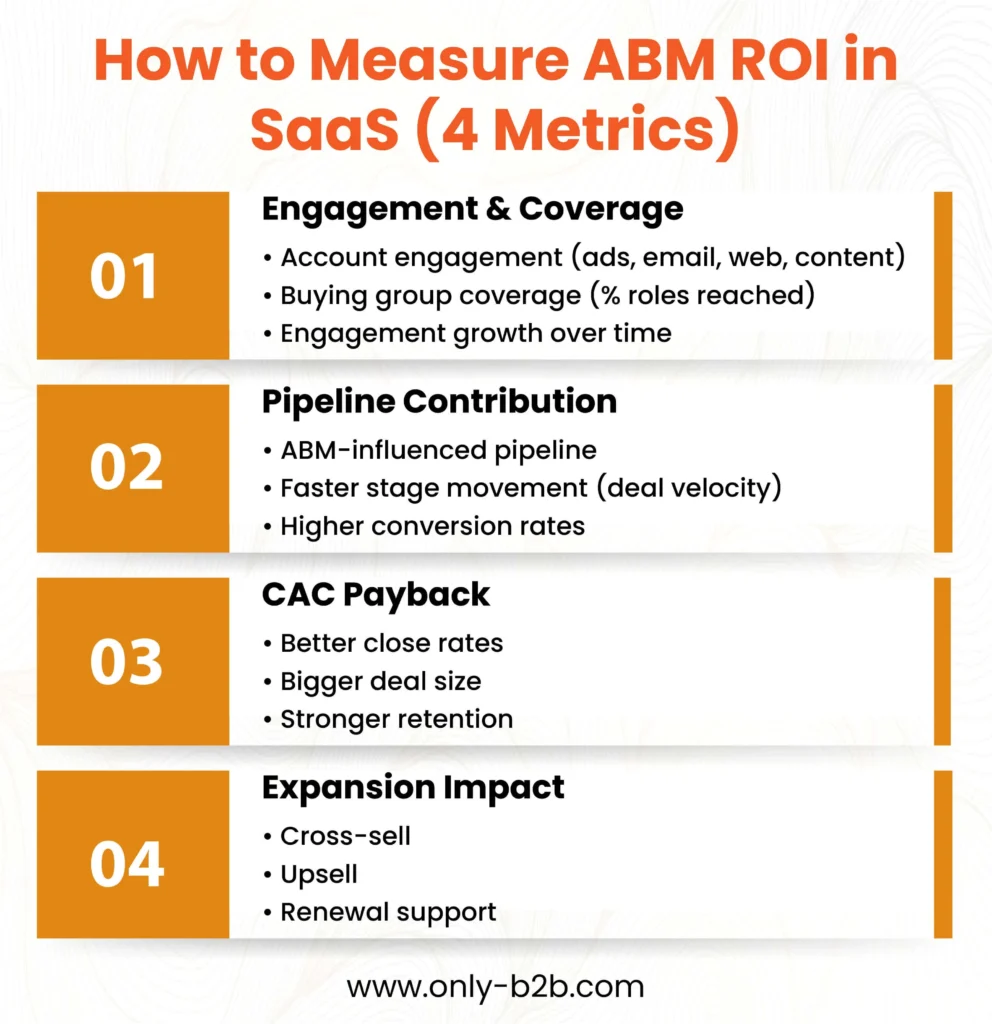
- measure success using pipeline and revenue impact – not lead volume.
If you’re planning ABM for 2026, start with one question:
Are you building ABM campaigns, or are you building an ABM engine?
Because the teams that build the engine will win.

Vikas Bhatt is the Co-Founder of ONLY B2B, a premium B2B lead generation company that specializes in helping businesses achieve their growth objectives through targeted marketing & sales campaigns. With 10+ years of experience in the industry, Vikas has a deep understanding of the challenges faced by businesses today and has developed a unique approach to lead generation that has helped clients across a range of industries around the globe. As a thought leader in the B2B marketing community, ONLY B2B specializes in demand generation, content syndication, database services and more.