

A lead can pass every automated check and still give sales very little to work with. The email appears deliverable, the phone number is correctly formatted and the company exists. Yet the person may have left the organisation, hold an irrelevant role or belong to an account outside the campaign’s ideal customer profile.
The problem becomes visible at handoff. An SDR receives the record as “validated,” researches the contact and discovers that the company’s buying team sits in a different subsidiary. The record looks clean, but sales still has to establish whether it belongs in the campaign.
The wider concern is well documented. IBM reports that 43% of chief operating officers identified data quality issues as their most significant data priority, citing its 2025 research. That finding concerns enterprise data broadly, rather than B2B leads specifically, but it highlights why usable data matters.
Effective B2B lead validation needs both reliable checks and clear acceptance criteria. Automation handles repeatable tasks at scale. Human review helps resolve context, conflicting evidence and exceptions. Knowing where each method stops is what makes the process useful.
Validation vs Verification, Enrichment, Scoring and Qualification
These terms often appear together in B2B operations, but each describes a different task. Teams should agree on their working definitions before using them in campaign briefs, vendor contracts or CRM workflows.
| Process | Main question | Typical output |
|---|---|---|
| Verification | Is an individual detail supported by the available evidence? | Email-check result, confirmed company domain or employment evidence |
| Enrichment | What relevant information is missing? | Added industry, employee range, job function or account relationship |
| Scoring | How should this record be prioritised? | Fit score, engagement score or priority tier |
| Qualification | Does the prospect meet the agreed requirements for the next sales stage? | Qualification outcome with supporting buyer context |
| Validation | Does the record meet the acceptance requirements for its intended use? | Accept, reject, correct, review or suppress decision |
For this article, B2B lead validation means checking a record against agreed campaign or delivery requirements. Verification and enrichment may support that decision. Scoring and sales qualification remain separate unless the campaign explicitly includes them.
An enriched profile can still contain outdated information. A verified business email does not establish buying authority. A high engagement score does not prove that a purchase is underway.
For example, a content-syndication lead may meet the agreed delivery criteria without being ready for an immediate sales conversation. A meeting-generation campaign may require additional confirmation of a relevant business need.
Understanding how data enrichment improves B2B lead quality helps teams decide which missing fields need attention before validation can be completed.
What Automated B2B Lead Validation Can Verify
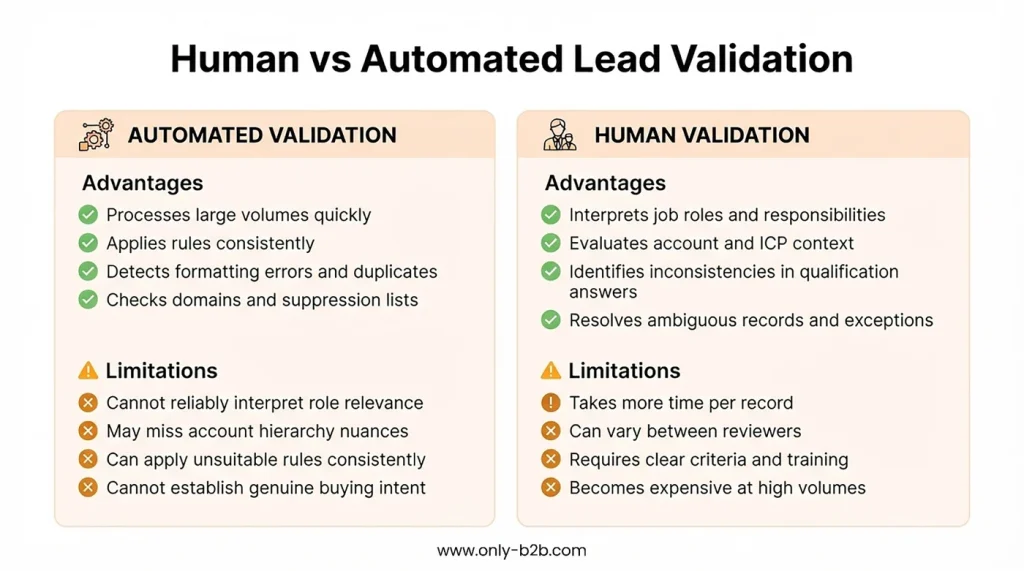
Automation works well when a question has a clear, repeatable answer. It can process large volumes consistently and catch routine errors before records reach sales.
Email syntax and deliverability signals
Email checks can identify malformed addresses, inspect domain and mail-routing information, and return mailbox or deliverability assessments.
For example, Mailgun’s email validation documentation describes syntax checks, DNS validation, mailbox detection and spelling checks. These are checks on the address and its infrastructure; they do not establish the contact’s responsibilities or buying interest.
Record the actual result rather than reducing every outcome to “verified.”
Phone formatting
Automation can normalise country codes and identify numbers that fail formatting or numbering-plan rules. A format check alone does not confirm that a number belongs to the named contact or will reach them.
If a tool performs additional ownership or reachability checks, store those as separate results.
Domain and account checks
Systems can check whether domains resolve and compare submitted domains with known company records. However, the existence of a company website does not establish the contact’s employment.
Duplicates and suppression
Matching rules can detect repeated emails, phone numbers and probable duplicate records. They can also compare incoming leads against current exclusions.
A documented account suppression strategy helps define which customers, opportunities, competitors or excluded accounts should be blocked.
Firmographic rules
Automation can apply industry, geography, employee-range and revenue filters to available data.
The distinction matters: applying a rule is deterministic; the underlying company classification may be inferred, estimated or outdated. Store the data source and timestamp alongside the rule result.
What Automation Cannot Reliably Confirm
The harder questions involve context.
A job title may contain the right keywords but describe someone with no involvement in the relevant purchase. A company may fit an industry filter while its actual business model falls outside the ICP.
Shared domains create another complication. A parent company, university or public institution may use one domain across several divisions. Matching the domain identifies an organisation, but may leave the relevant buying unit unresolved.
Account hierarchy can also affect acceptance and routing. A contact may work for a regional subsidiary while the opportunity belongs to a group-level account. Automatically merging the records could assign the lead to the wrong owner.
Email results can carry uncertainty too. Mailgun distinguishes catch-all and unknown results, where the validity of an individual mailbox cannot be determined conclusively. These results need an agreed treatment rather than an automatic assumption that the address is usable.
False positives can occur when a system accepts an unsuitable record. For example, a title filter accepts an “IT Director” whose responsibilities concern an unrelated business unit.
False negatives occur when a valid prospect is excluded. A relevant technical evaluator may have an unusual title that the approved keyword list does not recognise.
Automation is not inherently inaccurate. It may apply its configured rules perfectly. The limitation is whether those rules and their supporting data capture the decision the campaign actually needs.
What Human Review Can Actually Verify
Human review is useful when the evidence needs interpretation. Its value depends on separating what the reviewer can observe from what they infer.
Employment and role context
A reviewer can compare a company biography, professional profile or documented interaction with the submitted employment details.
The observable evidence might be a current company page naming the contact and their position. The reviewer’s judgment concerns whether those responsibilities match the campaign.
A public profile without a clear update date should not automatically be treated as definitive current-employment proof.
Business model and ICP fit
A reviewer can examine products, services, operating markets and customer types to resolve ambiguous industry classifications.
For example, two companies may both be categorised as technology businesses. One sells software to enterprises; the other operates a consumer marketplace. Their relevance to a campaign may differ substantially.
Account structure
Reviewers can investigate parent companies, subsidiaries, regional entities and shared brands.
The evidence should identify the relationship found and explain which entity the campaign should target. A vague note such as “same group” is insufficient when account ownership depends on the distinction.
Qualification-answer coherence
Someone may select “planning a purchase” but describe general research in an open-text response. Another contact may have no immediate timeline but describe a specific problem and an active internal evaluation.
Reviewers can flag these inconsistencies and request clarification through an appropriate, permitted process. They should preserve the original answers rather than rewriting them into a stronger buying signal.
Human lead verification adds context, but its conclusions should remain traceable to evidence.
Where Human Lead Validation Falls Short
Manual review takes time. Researching employment, account structure and role responsibilities becomes expensive when every record receives the same attention.
Turnaround time also depends on evidence availability. A reviewer may resolve a company-name variation quickly, while an unclear subsidiary relationship requires further investigation.
Judgment can vary. Two reviewers may interpret the same title differently, especially when the ICP is broad or acceptance criteria are unclear. Reviewer bias can also favour familiar titles, larger brands or records that resemble previously accepted leads.
Clear criteria, example decisions and periodic calibration help reduce that variation. Reviewing a shared sample independently can reveal where instructions need clarification.
Human review also has limits around intent. A conversation, completed questionnaire or positive response is not proof that a purchase will happen. It provides evidence about what the contact said at a particular time.
Where buying context is required, document the stated problem, involvement, evaluation stage and timing. Keep confirmed statements separate from the reviewer’s interpretation.
Human review should focus on decisions where interpretation changes the outcome. Applying it to every routine formatting error adds work without necessarily adding useful assurance.
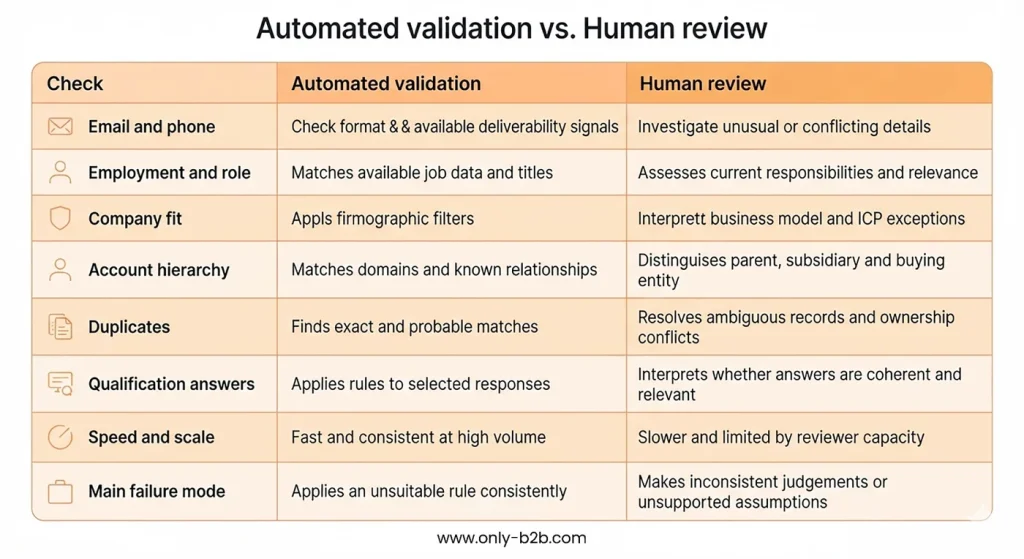
Human vs Automated Lead Validation: Check-by-Check Comparison
Neither method establishes every dimension of lead quality. The right choice depends on the check, the available evidence and the consequences of an incorrect decision.
| Check or factor | Automated validation | Human review | Evidence or common failure mode |
|---|---|---|---|
| Email address | Checks syntax, domain and available mailbox signals | Investigates conflicting results or supporting contact evidence | A positive email result does not establish employment or intent |
| Phone number | Checks format and, where supported, additional number signals | Investigates attribution to the contact | Correct formatting can be mistaken for confirmed ownership |
| Employment | Compares available employment data and update dates | Reviews current company information and documented interactions | Either method can rely on stale information |
| Role relevance | Applies title, function and seniority rules | Interprets responsibilities against the campaign | Keyword matches can misclassify roles; reviewers can make assumptions |
| Company fit | Applies firmographic filters | Assesses business model and ICP exceptions | An industry label may hide an unsuitable business model |
| Account hierarchy | Matches known domains and entity relationships | Resolves parent, subsidiary and buying-unit ambiguity | Incorrect associations can cause routing or ownership errors |
| Duplicates | Finds exact and probable matches at scale | Resolves uncertain matches and ownership conflicts | Overly broad rules can merge different people or entities |
| Qualification answers | Checks completeness and configured response rules | Assesses coherence and requests clarification where appropriate | Neither method should convert vague answers into confirmed intent |
| Speed | Processes routine checks quickly | Depends on reviewer availability and research depth | Fast processing can spread a poorly configured rule |
| Scalability | Handles higher volumes through system capacity | Requires reviewer capacity and training | Review queues can delay delivery |
| Cost | Includes tools, integration and monitoring | Includes research, training and management time | Cost varies with volume, complexity and required evidence |
| Consistency | Applies the same configured logic repeatedly | Depends on criteria and reviewer calibration | Consistency does not guarantee that the decision rule is suitable |
A hybrid process uses these differences deliberately. Routine checks run automatically, while uncertain decisions receive the level of review their impact justifies.
A Risk-Based Validation Model for B2B Leads
Not every record needs the same scrutiny. A practical model considers both uncertainty and the business impact of an incorrect decision.
The following routes are a starting framework, rather than universal acceptance rules.
| Route | When to use it | Example | Action |
|---|---|---|---|
| Auto-accept | All mandatory checks pass and no material ambiguity remains | Clear account match, relevant role and current supporting data | Release through the agreed delivery gate |
| Accept with sampling | Records pass mandatory checks, but source or rule performance needs monitoring | A new source produces apparently eligible records | Audit a defined sample and expand review if defects emerge |
| Manual review | Evidence is incomplete, conflicting or commercially significant | Shared domain, unclear buying entity or strategic-account ownership | Hold the record until an assigned reviewer resolves it |
| Reject or suppress | A confirmed mandatory failure or exclusion applies | Wrong geography, confirmed invalid required channel or opt-out match | Block release and record the reason |
Sampling should test decision quality. It should not bypass unresolved mandatory requirements, suppression conflicts or required permission evidence.
For example, a team might audit a sample of otherwise eligible records from a new vendor. If the sample reveals recurring employment errors, the team can increase review coverage or pause the affected batch.
Strategic-account status can justify closer review even when uncertainty appears low. The cost of routing a high-value account incorrectly may outweigh the review effort.
Risk tiers should therefore reflect the campaign’s economics and operating requirements, rather than a single rule applied to every source.
How to Build a Hybrid Lead Validation Workflow
A practical hybrid workflow gives automation the first pass and brings in human judgment when the evidence calls for it.
1. Agree on the validation contract
Input: Campaign brief, ICP, exclusions, required fields and intended use.
Owner: Campaign owner with marketing operations and sales input.
Output: Approved acceptance criteria, evidence requirements and exception rules.
Define which requirements are mandatory and which are informational. Record the version of the criteria so later disputes can be assessed against the rules in effect at delivery.
2. Standardise incoming records
Input: Original vendor, form or campaign submission.
Owner: Marketing operations or data operations.
Output: Normalised fields linked to the original record.
Assign a stable record ID. Preserve submitted values before standardising names, phone formats or company fields.
3. Run automated checks
Input: Standardised records and current reference lists.
Owner: Data operations.
Output: Field-level results, timestamps and exception flags.
Check contact details, domains, duplicates, suppression and required campaign attributes.
4. Resolve account and risk exceptions
Input: Automated results and uncertain matches.
Owner: Assigned QA reviewer or account-data owner.
Output: Supported correction, confirmed association or unresolved-review status.
Use agreed lead-to-account matching rules before associating a contact with a parent, subsidiary or existing account.
5. Apply the release gate
Input: Completed checks and reviewer findings.
Owner: Validation owner.
Output: Final disposition, reason code and permitted destination.
Do not release records with unresolved mandatory failures.
6. Deliver and reconcile
Input: Approved delivery records.
Owner: Marketing operations and receiving CRM owner.
Output: Delivery acknowledgement, CRM IDs and exception report.
Check that accepted records arrived once, retained the required fields and reached the correct workflow.
7. Feed outcomes back
Input: Audit findings, sales feedback and downstream progression.
Owner: Campaign owner with QA and sales operations.
Output: Documented changes to sourcing, rules or review coverage.
A complete MQL-to-SQL handoff SLA can define the next sales-stage responsibilities after validation and delivery.
A 12-Point B2B Lead Validation Checklist
Before accepting a record for CRM delivery, check the following requirements against the campaign brief.
Use pass, hold or fail for each applicable check. Mark a check “not applicable” only where the campaign criteria explicitly allow it, with the reason recorded.
| # | Validation check | Minimum evidence to record | Hold or fail trigger |
|---|---|---|---|
| 1 | Identity | Contact name, source record and supporting identity context | Identity is incomplete, conflicting or unsupported |
| 2 | Contactability | Required channel-check result, method and timestamp | Required channel fails or remains unresolved |
| 3 | Employment | Supporting source and date of employment check | Evidence conflicts or indicates the person has left |
| 4 | Role relevance | Submitted title, mapped function and rationale where needed | Responsibilities do not meet the agreed audience criteria |
| 5 | Account identity | Company name, domain and account identifier where available | Company cannot be reliably identified |
| 6 | Account hierarchy | Relevant operating entity and known parent relationship | Buying entity or ownership remains unclear |
| 7 | ICP fit | Results against mandatory industry, size and business-model rules | A mandatory account criterion fails |
| 8 | Geography | Relevant contact or account location and the rule applied | Location is outside the agreed market |
| 9 | Source and permission | Collection source, timestamp and required permission or approval records | Required evidence is missing or inconsistent |
| 10 | Duplicates and suppression | Match results against current CRM and exclusion lists | Prohibited duplication or suppression match |
| 11 | Content engagement | Asset or event identifier, action and timestamp | Claimed engagement cannot be reconciled with the source |
| 12 | Qualification responses | Original answers and completeness/coherence result | Required answers are missing, conflicting or ineligible |
Not every item requires a person. The checklist defines what must be established; the workflow determines how the evidence is gathered.
A hold means the decision is unresolved. A fail means a defined requirement has not been met. Keeping these separate prevents missing information from being misreported as confirmed invalidity.
Passing the checklist means the record meets its agreed delivery gate. It does not automatically make it sales-ready.
Accept, Reject, Review or Replace?
A clear lead disposition makes the outcome understandable to everyone handling the record.
| Outcome | Example reason code | Responsible owner | Next action |
|---|---|---|---|
| Accept | ACCEPT_CRITERIA_MET | Validation owner | Release to the approved destination |
| Reject | REJECT_ICP_SIZE | QA reviewer or campaign owner | Record the failed rule and return structured feedback |
| Correct | CORRECT_ACCOUNT_NAME | Data operations | Update using evidence, preserve the original value and rerun affected checks |
| Review | REVIEW_ENTITY_UNCLEAR | Assigned specialist or account owner | Hold delivery until the ambiguity is resolved |
| Suppress | SUPPRESS_OPT_OUT | Marketing operations or designated privacy owner | Apply the exclusion to the relevant workflows |
| Replace | REPLACE_CONFIRMED_INVALID | Vendor manager | Request replacement or credit under the agreed terms |
These are example codes. Teams should use a controlled set that matches their CRM and vendor reporting.
Correction and review are normally intermediate states. Once resolved, the record should receive a final decision.
Replacement is a commercial remedy rather than a substitute for the record’s quality status. A rejected record can have a replacement request attached to it. The replacement should receive its own record ID and pass the same validation gate.
“Poor quality” is too vague to investigate. “Contact no longer employed at account” gives the sourcing team a specific issue to resolve.
A shared B2B lead rejection taxonomy helps keep these reasons consistent across vendors, marketing and sales.
Lead Validation Requirements for Vendors
Vendor quality assurance should be agreed before delivery begins. The brief needs to explain what counts as acceptable evidence, how exceptions are handled and who resolves disputes.
| SLA requirement | What to define | Evidence or control |
|---|---|---|
| Acceptance criteria | Mandatory account, contact, engagement and qualification conditions | Approved, versioned campaign brief |
| Validation evidence | Required methods and acceptable sources for material checks | Record-level results, sources and timestamps |
| Freshness | Maximum permitted age by field or check | Collection, verification and revalidation dates |
| Delivery | Format, cadence, field mapping and acknowledgement | Delivery manifest and receipt reconciliation |
| Sampling | Sample selection, coverage and escalation triggers | Audit log covering accepted and rejected decisions |
| Corrections | Evidence needed, responsible owner and completion deadline | Original value, corrected value and change history |
| Rejections and disputes | Submission window, evidence requirements and adjudicator | Reason code and documented resolution |
| Replacement or credit | Eligible failures, exclusions and fulfilment deadline | Linked case and replacement or credit record |
| Audit access | Retained evidence, access permissions and retention period | Traceable history available to authorised reviewers |
Set actual deadlines in the agreement. Terms such as “prompt correction” or “recently verified” are difficult to enforce consistently.
Audit both accepted and rejected records. Sampling accepted records can uncover false acceptances; reviewing rejected records can expose valid leads being excluded by overly strict rules.
Separate technical receipt from contractual acceptance. A file reaching the CRM confirms delivery, but does not establish that every record meets the agreed campaign requirements.
Likewise, lack of a reply or meeting should not automatically trigger replacement unless the contract explicitly makes that outcome part of the acceptance terms.
B2B Lead Validation Metrics That Matter
Lead volume and delivery speed show whether records are arriving. They do not show whether those records meet requirements or support useful sales activity.
For percentage metrics below, multiply the stated ratio by 100.
| Metric | Numerator | Denominator | Decision owner |
|---|---|---|---|
| Validation acceptance rate | Records accepted after final validation | Records with a final validation decision in the same cohort | Campaign owner |
| Invalid rate by reason | Finalised records with a confirmed specified defect | All finalised records in the same cohort | QA lead |
| Correction rate | Submitted records requiring at least one supported correction | Submitted records in the cohort | Data operations |
| Replacement incidence | Original delivered records approved for replacement | Original delivered records in the cohort | Vendor manager |
| Manual-review yield | Manually reviewed records subsequently accepted | Manually reviewed records with a completed decision | QA lead |
| Pending-review rate | Records still awaiting a validation decision | Submitted records in the cohort | Operations lead |
| Sales acceptance rate | Delivered leads accepted by sales | Delivered leads whose sales-review window has elapsed | Sales operations |
| Meeting-held rate | Eligible delivered leads associated with a held meeting | Eligible delivered leads whose observation window has elapsed | Demand generation and sales operations |
| Lead-to-opportunity conversion rate | Eligible delivered leads associated with a qualifying opportunity | Eligible delivered leads whose observation window has elapsed | Revenue operations |
Define each cohort, observation window and counting rule before comparing results. Track lead-level and account-level opportunity reporting separately to avoid counting one opportunity several times.
A record can have multiple defects, so reason-specific invalid rates may overlap. Use one primary reason if the report needs mutually exclusive categories.
Exclude unresolved records from a final-decision acceptance rate, but show the pending rate alongside it. Otherwise, a high acceptance rate can hide a growing review backlog.
Use broader CRM data quality metrics to identify recurring database problems beyond an individual campaign.
Downstream outcomes should inform validation improvements, while recognising that sales execution, timing and offer relevance also affect progression.
Common B2B Lead Validation Mistakes
FAQs on Human and Automated Lead Validation
What does a verified B2B lead actually mean?
It depends on the checks performed. The label should specify whether the provider checked the email, employment, role, account fit or qualification answers, with supporting dates and evidence.
Is automated lead verification enough for B2B campaigns?
It can be sufficient for routine records that pass all mandatory requirements without material ambiguity. Context-heavy decisions may still need human review. Audit accepted records to test whether the rules remain suitable.
When is human review necessary?
Use it when evidence conflicts, roles are ambiguous, account relationships are unclear or the impact of an incorrect decision justifies additional scrutiny.
Can AI replace human lead validation?
AI can classify records, identify anomalies and help prioritise exceptions. Its output still needs reliable supporting evidence and controls proportionate to the decision. An AI-generated conclusion is not independent proof.
How often should leads be revalidated?
Set freshness requirements according to field volatility, source quality, campaign duration and intended use. Recheck when there is a material delay or new evidence that contact or account information has changed.
What should a vendor provide as proof of validation?
Agreed fields, material check results, evidence sources, timestamps, reason codes and a traceable correction process. The required depth should be documented before delivery.
Does passing validation make a lead sales-ready?
No. Validation establishes that a record meets the agreed acceptance criteria. Sales readiness may require additional evidence about need, involvement, timing or willingness to discuss the solution.
What is the difference between validation and verification?
Verification checks individual details. Validation determines whether the record meets the requirements for a defined use. A verified email can support validation without establishing that the complete lead should be accepted.
Conclusion: Match the Validation Method to the Risk
Automation brings speed and consistency to checks that can be clearly defined. Human review adds context when a record needs interpretation. Neither establishes every aspect of lead quality on its own.
The stronger process begins by deciding what must be checked, what evidence is acceptable and which uncertainties require escalation. Routine records can move efficiently, while ambiguous or high-impact cases receive closer attention.
A completed validation gate should give the receiving team a clear record of what passed, what was corrected and what remains outside the scope of the checks.
If clean-looking records are still creating poor sales handoffs, review the acceptance criteria and evidence behind them.
Request a B2B lead-quality and validation assessment from Only B2B to discuss your campaign requirements, validation gaps and handoff process.

Vikas Bhatt is the Co-Founder of ONLY B2B, a premium B2B lead generation company that specializes in helping businesses achieve their growth objectives through targeted marketing & sales campaigns. With 10+ years of experience in the industry, Vikas has a deep understanding of the challenges faced by businesses today and has developed a unique approach to lead generation that has helped clients across a range of industries around the globe. As a thought leader in the B2B marketing community, ONLY B2B specializes in demand generation, content syndication, database services and more.