
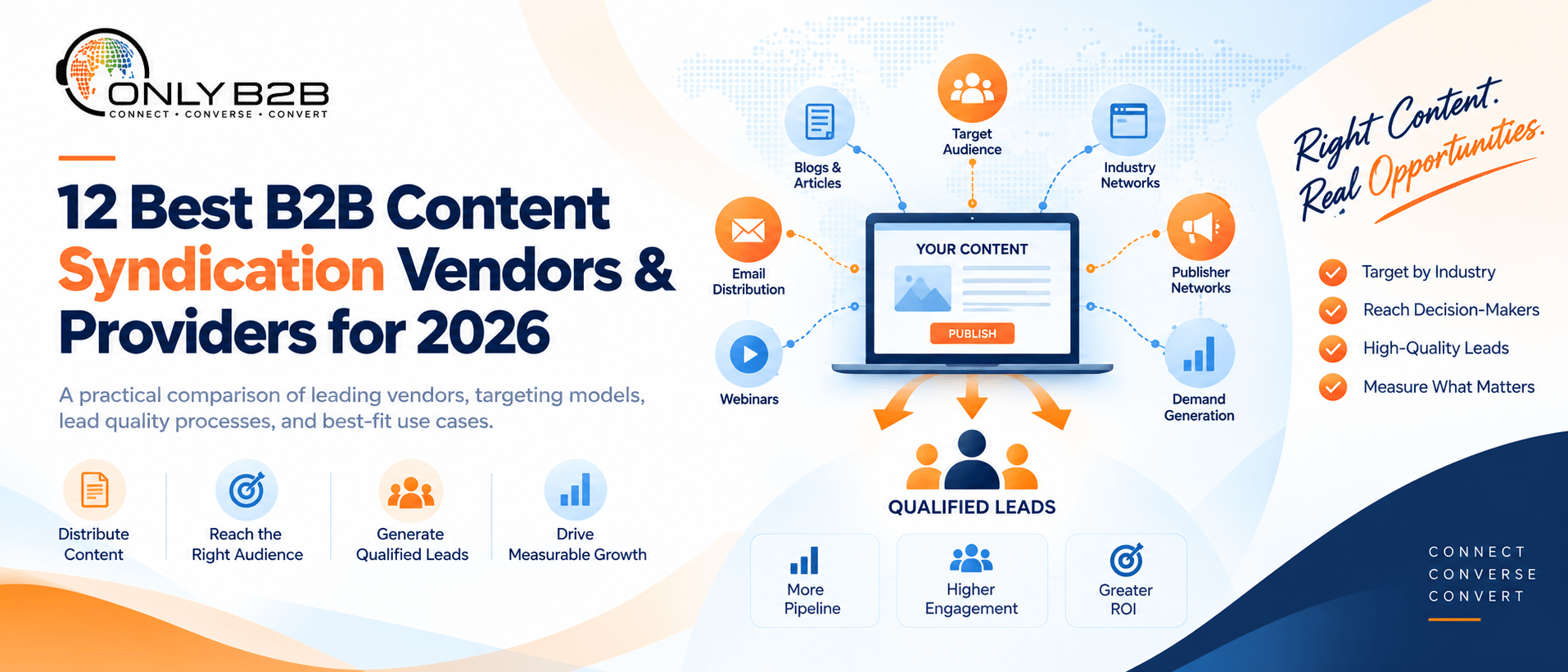
Choosing among B2B content syndication vendors in 2026 is no longer simply a matter of asking who can deliver the most leads at the lowest cost per lead.
The bigger questions are where those leads came from, how closely they match your ideal customer profile, whether the engagement is genuine, how the data is validated, and whether those contacts eventually create qualified pipeline.
That makes vendor selection more complicated than it first appears. Some content syndication providers operate large self-service publisher networks. Others combine syndication with intent data, account-based marketing, buying-group intelligence, programmatic advertising, tele-qualification, or fully managed demand generation.
The right choice therefore depends on your audience, geography, internal resources, qualification requirements, content assets, sales motion, and how much control you want over campaign execution.
This guide compares 12 B2B content syndication vendors and providers worth evaluating in 2026. Instead of pretending that one provider is universally best, we compare each vendor by its strongest use case, campaign model, audience and targeting approach, lead-quality process, pricing model, and important considerations before committing budget.
12 B2B Content Syndication Vendors at a Glance
The following table is designed for shortlisting, not for declaring a universal winner. A vendor that performs well for a global enterprise ABM program may be unnecessarily complex for a small team that simply wants a predictable CPL campaign.
| Vendor | Best For | Campaign Model | Targeting / Intent | Lead Quality Approach | Pricing |
|---|---|---|---|---|---|
| Only-B2B Converse™ Publisher’s offering |
ICP-led managed B2B syndication | Fully managed | ICP and campaign-defined targeting | Lead criteria established during campaign setup | Pay for performance |
| Informa TechTarget / NetLine | Enterprise technology audiences and flexible execution | Managed media + self-service | First-party intent and audience targeting | Permissioned audience / structured lead QA | CPL / custom |
| Madison Logic | Enterprise ABM and buying groups | ABM platform + managed programs | Intent-led account and buying-group targeting | Multi-stage verification | Custom |
| DemandScience | Global, predictable lead generation | Managed | ICP + intent targeting | Opt-in validated leads | Predictable CPL |
| INFUSE | Global full-funnel and buying-group programs | Fully managed | Buyer and buying-group intelligence | Verified B2B audience activation | Custom |
| TechnologyAdvice | B2B technology buyers | Managed media / lead generation | First-party audience and intent | Formal QA process | CPL |
| Foundry | Enterprise IT and technology audiences | Media + managed demand generation | First-party intent and ICP targeting | Verified lead programs | Custom |
| DemandWorks | Managed ICP-precise programs | Fully managed | ICP + intent + ABM targeting | Human + programmatic verification | Custom |
| Anteriad | Syndication combined with programmatic | Managed + platform capabilities | B2B data, intent and buying groups | TripleCheck® verification | Custom |
| Pipeline360 | Connected brand + demand programs | Fully managed | Audience and account intelligence | Publisher governance, cleansing and validation | Custom / fixed CPL options |
| Digitalzone | Global campaigns with multiple qualification levels | Managed | ICP and in-market targeting | Verified lead delivery | CPL |
| Datamatics Business Solutions | Managed international programs | Fully managed | ICP, intent and multi-channel activation | AI + human validation | Custom |
How We Evaluated B2B Content Syndication Vendors
Content syndication providers should not be evaluated using lead volume alone. A campaign can hit its delivery target and still create very little commercial value if contacts fall outside the ICP, the source of engagement is unclear, data is inaccurate, or sales has no context for follow-up.
For this comparison, we considered the factors that have the biggest effect on campaign quality and downstream usability:
If you want the deeper pre-contract evaluation framework rather than a provider comparison, use our separate guide on how to choose a content syndication vendor.
Content Syndication Vendors vs Platforms: Know What You Are Comparing
One reason content syndication comparisons become confusing is that very different products are frequently grouped into the same list.
A B2B content syndication vendor typically distributes gated assets to defined business audiences and delivers identifiable leads against campaign criteria. Depending on the provider, this may involve publisher networks, owned media properties, email activation, intent signals, tele-qualification, or managed campaign execution.
A content distribution platform may instead focus on native advertising, article amplification, publication, social distribution, SEO syndication, or traffic acquisition. Those channels can be useful, but they do not necessarily deliver the same CPL-based B2B lead-generation outcome.
Only-B2B Converse™
Best suited to B2B technology, SaaS, and enterprise teams looking for ICP-led, managed content syndication rather than another campaign platform to operate internally.
Only-B2B Converse™ takes a service-led approach to content syndication. The campaign begins with audience and ICP discovery rather than immediately activating a broad lead-generation program. Campaign goals, targeting requirements, budget, timeline, and available assets are then used to shape execution.
This model can be useful for organizations that want strategic and operational support throughout the campaign rather than responsibility for configuring targeting, distribution, qualification, and delivery on their own.
Where Converse™ fits best
- B2B SaaS and technology demand-generation teams.
- Campaigns requiring clearly defined ICP and audience criteria.
- Teams that prefer managed execution over self-service software.
- Organizations distributing assets such as whitepapers, reports, case studies, guides, and video content.
- Programs where cost-per-lead visibility and performance-based execution are important.
Considerations
Companies that specifically want an instant self-service platform may prefer a provider such as NetLine. Before launching any managed campaign, buyers should still document target geographies, lead volumes, qualification rules, duplicate policy, delivery cadence, replacement conditions, and CRM requirements in the campaign brief.
Use our B2B content syndication campaign brief before approaching any provider so targeting and qualification requirements are clear from the beginning.
Explore Converse™11 Other B2B Content Syndication Vendors Worth Comparing
1. Informa TechTarget / NetLine
Informa TechTarget and NetLine now sit within the same corporate group, but marketers should not treat their offerings as identical.
Informa TechTarget is particularly relevant to enterprise technology marketers. Its content syndication model places assets alongside technology editorial content across a large network of topic-specific properties. The company publicly emphasizes a permissioned business-technology audience, first-party purchase-intent signals, AI-driven targeting, and a multi-step lead-cleansing process.
NetLine provides a more self-service-oriented content syndication experience. Marketers can upload assets, define targeting filters, set campaign terms and budgets, and operate performance-based CPL campaigns through the platform. Its broad B2B publisher network makes it attractive when scale and direct campaign control are priorities.
Strengths
- Strong first-party content-consumption signals.
- Clear technology specialization through TechTarget.
- Self-service option available through NetLine.
- Large B2B publisher ecosystem.
- CPL-based activation available.
Considerations
- TechTarget is most relevant to technology-sector audiences.
- NetLine’s self-service model may require more internal campaign management.
- Managed TechTarget programs generally require consultation and custom planning.
2. Madison Logic
Madison Logic is one of the stronger choices when content syndication is intended to support an account-based marketing program rather than operate as a standalone lead source.
Its ABM Content Syndication offering focuses on identifying accounts showing relevant buying signals, engaging multiple members of the buying group, and activating content against priority accounts. Programs can include single-touch, double-touch, and qualification-oriented approaches such as BANT.
The vendor also publicly describes a multi-stage verification process that checks leads against client-defined parameters and validates contact data before delivery.
Strengths
- Strong account and buying-group orientation.
- Intent-led account prioritization.
- Multiple qualification program types.
- Lead verification built into the offering.
- Useful when syndication is part of broader ABM orchestration.
Considerations
- Can be more sophisticated than necessary for basic CPL campaigns.
- Pricing is not positioned as a simple public self-service rate.
- Best value comes when teams can actually use account-level signals downstream.
3. DemandScience
DemandScience is a strong fit for marketers who want global reach combined with a relatively clear CPL model.
The company currently positions its syndication offering around verified decision-makers, ICP-aligned targeting, intent signals, opt-in lead delivery, privacy compliance, and a guaranteed cost-per-lead structure. Its published footprint spans more than 100 countries, making it particularly relevant for teams operating campaigns across several regions.
The value proposition is less about operating a publishing tool yourself and more about activating a defined audience and receiving qualified contacts that can enter existing nurture workflows.
Strengths
- Global campaign reach.
- Predictable CPL structure.
- ICP and intent-based targeting.
- Opt-in lead positioning.
- No need to add another self-service tool to the stack.
Considerations
- Teams seeking granular self-service control may prefer NetLine.
- Always validate how intent is defined for your specific campaign.
- Large audience numbers should not substitute for ICP-fit analysis.
4. INFUSE
INFUSE is best considered when content syndication is part of a broader demand-generation strategy rather than a one-off download campaign.
The company increasingly describes its offering as content and audience activation. Its programs combine B2B audience data, buying-group identification, intent and competitive intelligence, personalized content, account activation, and omnichannel execution.
INFUSE also operates its own network of first-party B2B publications, giving it a different audience model from vendors that rely primarily on third-party contact aggregation.
Strengths
- Strong buying-group orientation.
- First-party publication network.
- Managed global programs.
- Content creation and personalization capabilities.
- Suitable for multi-channel demand strategies.
Considerations
- Broader than a straightforward content syndication buy.
- May require greater program planning and budget commitment.
- Buyers should clarify which signals and channels are included in a specific engagement.
5. TechnologyAdvice
TechnologyAdvice is another strong candidate for technology marketers that value a recognizable editorial and media ecosystem behind the audience.
The company operates more than 30 owned technology brands and distributes content across its media sites, newsletters, and other channels. Targeting can include buyer demographics, firmographics, qualification criteria, intent signals, and account-level requirements.
Its public syndication offering also describes a QA process, campaign reporting, marketing-automation delivery, BANT discovery, intent-based leads, nurtured leads, and account-based options.
Strengths
- Owned and operated technology media properties.
- Strong fit for software and IT audiences.
- Clear CPL pricing model.
- Intent and qualification options available.
- Marketing-automation delivery support.
Considerations
- Less compelling if your ICP sits far outside technology and business categories.
- CPL varies according to targeting depth and qualification requirements.
- Buyers should define required qualification before comparing proposals.
6. Foundry
Foundry is especially relevant to companies selling enterprise technology products and services.
Its demand-generation model draws on a large first-party audience, technology media brands, content engagement, events, newsletters, search behavior, and other signals. Syndicated content can be gated on Foundry’s B2B properties to generate nurture-ready contacts while capturing engagement and intent information.
The company also connects content syndication with ABM, advertising, intent data, and sales-development services, making it suitable for organizations that want a broader technology-media program rather than isolated lead delivery.
Strengths
- Strong enterprise IT and technology audience.
- Rich first-party media and engagement signals.
- Can connect syndication with ABM and advertising.
- Multiple content formats supported.
Considerations
- Primarily valuable to technology-focused marketers.
- Pricing is generally program-specific.
- Teams should define which media properties and engagement signals matter to their ICP.
7. DemandWorks
DemandWorks is a particularly interesting option for teams that put lead validation and audience precision ahead of raw volume.
Its content syndication service combines firmographic, role, seniority, industry, company-size, technographic, named-account, geographic, and intent criteria. The company currently describes distribution across inboxes, editorial environments, newsletters, and publisher channels.
Lead validation is one of the clearer elements of the offering. DemandWorks states that it uses both programmatic and human verification, opt-in consent, ICP matching, duplicate and data-quality controls, replacement guarantees, and CRM-ready delivery.
Strengths
- Detailed ICP targeting.
- Human + programmatic verification.
- Lead replacement positioning.
- CRM-ready delivery.
- Managed execution for lean internal teams.
Considerations
- Not designed primarily as an instant self-service platform.
- Buyers should confirm exact audience-source composition for each campaign.
- Custom programs require proposal-level comparison rather than public rate comparison.
8. Anteriad
Anteriad makes the shortlist because it treats content syndication as one element of a broader B2B activation system.
The company combines B2B data, intent, audience building, buying-group profiling, content syndication, programmatic advertising, analytics, and managed services. Its syndication offering includes co-branded email, tele-qualification, and its TripleCheck® lead-verification process.
Anteriad is particularly relevant when a marketer does not want the buyer journey to stop after a content download. Syndication engagement can be reinforced with programmatic media while marketing and sales receive a more connected account view.
Strengths
- Strong cross-channel activation.
- Buying-group and intent data.
- Lead verification process.
- Useful for integrated ABM and programmatic programs.
Considerations
- More complex than a simple CPL syndication purchase.
- Value depends on whether your team can use cross-channel data effectively.
- Clarify what is managed versus self-service in the proposed engagement.
9. Pipeline360
Pipeline360 is particularly relevant for teams that believe unbranded syndication leads are harder to convert when buyers have little prior awareness of the company.
The provider distributes content through a marketplace of vetted publishers and also offers a “Branded Demand” model that combines content syndication with display advertising. The idea is to build familiarity around the same audiences that later engage with syndicated content.
Pipeline360 also describes a governance process that cleanses, deduplicates and validates leads before delivery, with real-time campaign analytics supporting optimization.
Strengths
- Content syndication plus brand advertising.
- Vetted publisher marketplace.
- Lead cleansing and governance.
- Fixed-CPL option available within Branded Demand.
Considerations
- Teams looking only for isolated syndication may not need the wider program.
- Brand + demand programs introduce more variables when comparing vendor performance.
- Define attribution rules before launch.
10. Digitalzone
Digitalzone is worth considering when a program needs broad international reach and several different qualification models.
The company publicly positions its audience across more than 180 countries and offers multiple program types including standard content syndication, Waterfall, HQL, and BANT. That allows marketers to decide whether the objective is broad top-of-funnel capture or stronger qualification before delivery.
Campaigns are priced using a CPL model, with final cost influenced by campaign targeting and qualification depth.
Strengths
- Large global audience footprint.
- Several qualification options.
- CPL-based programs.
- Useful for multi-market demand generation.
Considerations
- Large database size should never be used as a proxy for lead quality.
- Compare qualification definitions carefully across program types.
- Ask exactly how “in-market” status is determined.
11. Datamatics Business Solutions
Datamatics Business Solutions is a strong shortlist candidate for organizations running managed campaigns across North America, EMEA, and APAC.
Its current content syndication service begins with ICP, campaign KPI, TAM, and asset definition before activating content through publisher networks, email, digital channels, and telemarketing. The company describes an AI-plus-human validation process and enriched CRM-ready lead delivery.
It can therefore be more appropriate for enterprises looking for broader outsourced execution than for marketers who only want access to a self-service syndication interface.
Strengths
- International campaign capabilities.
- ICP and intent-led targeting.
- AI + human lead validation.
- CRM-ready lead enrichment and delivery.
- Multi-channel activation.
Considerations
- Pricing is campaign-specific.
- Ask for clear visibility into publisher and acquisition sources.
- Qualification and replacement SLAs should be documented before launch.
Which Content Syndication Vendor Is Best for Your Use Case?
There is no useful answer to “Which content syndication vendor is best?” without first defining what the campaign needs to accomplish.
| Your Priority | Vendors Worth Shortlisting | Why |
|---|---|---|
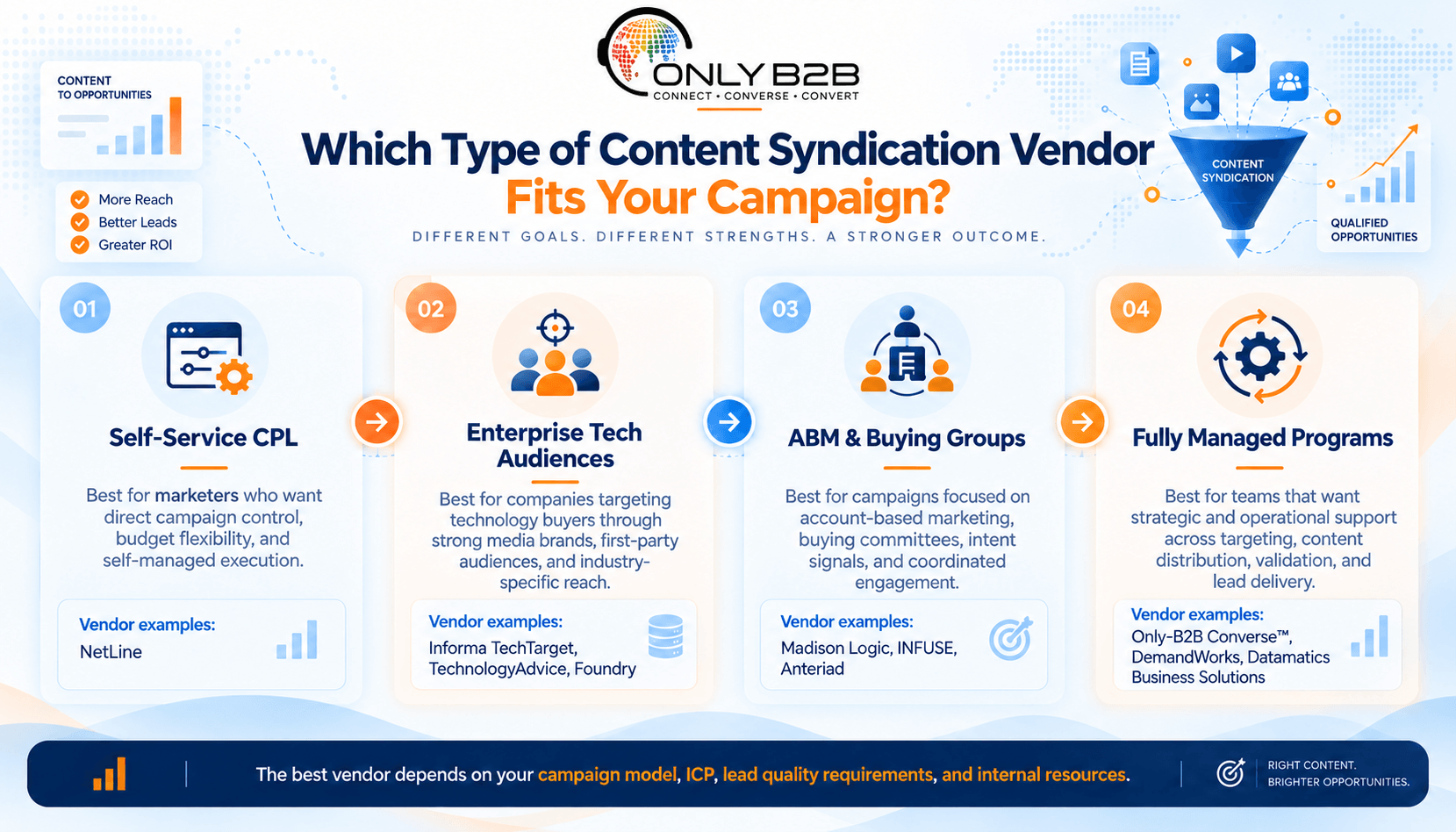
| Self-service campaign control | NetLine | Designed around marketer-controlled CPL campaign activation. |
| Enterprise technology buyers | Informa TechTarget, TechnologyAdvice, Foundry | Strong technology-focused media and first-party audience ecosystems. |
| Buying-group / ABM programs | Madison Logic, INFUSE, Anteriad | Greater emphasis on accounts, buying committees, intent, and multi-channel activation. |
| Predictable CPL | DemandScience, NetLine, Digitalzone | Clear cost-per-lead positioning. |
| Fully managed execution | Only-B2B Converse™, DemandWorks, Datamatics, INFUSE | Better fit when internal teams do not want to operate every campaign component. |
| Content syndication + programmatic | Anteriad, Pipeline360 | Designed to connect content engagement with broader media activation. |
| International programs | DemandScience, INFUSE, Digitalzone, Datamatics | Broad multi-region audience and campaign capabilities. |
| Lead validation emphasis | DemandWorks, Madison Logic, TechnologyAdvice, Datamatics | Each publicly describes structured validation or QA processes. |
How B2B Content Syndication Vendors Charge
Pricing is one of the hardest parts of comparing content syndication providers because proposals often use different commercial models.
Cost Per Lead (CPL)
You pay for leads that meet agreed campaign criteria. This model can make budgeting easier, but the cheapest CPL is not automatically the best offer. A $40 lead outside your ICP is more expensive than a $90 lead that becomes a qualified opportunity.
Custom Program Pricing
Many enterprise, ABM, and publisher-led vendors provide custom proposals because campaign cost depends on geography, seniority, targeting depth, account lists, qualification questions, content requirements, media channels, and lead volumes.
Fixed CPL Programs
Some providers package broader programs around a known CPL. This can improve predictability but you still need to understand what targeting, advertising, validation, and reporting are included in that rate.
Pay-for-Performance
Performance-based programs tie spending to agreed delivery outcomes. The contract still needs to define exactly what constitutes an accepted lead and what happens when a contact fails validation.
12 Vendor RFP Questions to Standardize Your Shortlist
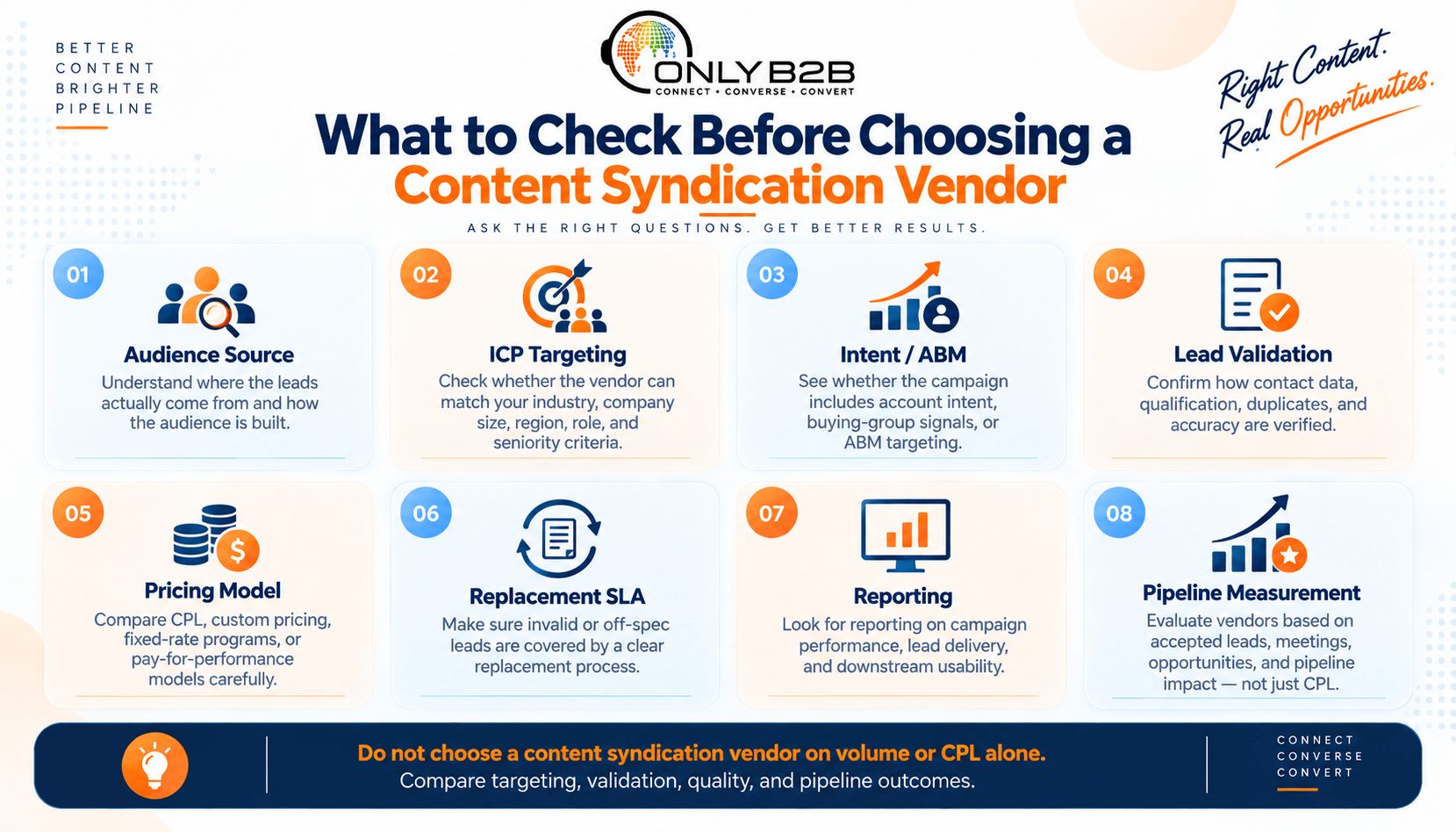
The strongest vendor comparison happens before the campaign starts. Ask every shortlisted provider the same questions so proposals can be evaluated consistently.
- Where will my leads actually come from? Ask whether the audience is owned, first-party, publisher-generated, partner-sourced, email-generated, tele-generated, or aggregated from several channels.
- What exactly does the lead consent to? Understand the opt-in language and whether the buyer knows their information may be shared with the sponsoring company.
- Which ICP criteria can you enforce? Define industry, company size, location, role, seniority, technology usage, named accounts, and exclusion criteria.
- How do you define intent? A content download, topic research, account-level activity, declared project, and tele-qualified requirement are very different signals.
- How is every lead validated? Ask what is automated, what is manually checked, and which fields are verified.
- What happens to invalid leads? Replacement conditions should be written into the SLA.
- How are duplicates handled? Provide suppression lists and agree on the duplicate window before launch.
- Can we use custom qualification questions? Clarify whether extra qualification changes pricing or volume.
- How quickly are leads delivered? Long delays can reduce the value of buyer engagement.
- What context accompanies each lead? Sales should ideally know the asset, topic, timestamp, source, qualification answers, and other useful engagement information.
- How will leads enter our systems? Confirm CSV, secure transfer, CRM, MAP, or direct integration options.
- How will we judge success after delivery? Align on accepted leads, MQLs, SQLs, meetings, opportunities, influenced pipeline, and revenue rather than stopping at form fills.
For a detailed breakdown of targeting, qualification, validation, and follow-up improvements, see how to improve content syndication lead quality.
Do Not Choose a Vendor on CPL Alone
One of the biggest mistakes in B2B syndication is optimizing the campaign around the cheapest possible lead.
A low CPL can be created by widening targeting, reducing qualification requirements, accepting low-seniority contacts, relaxing geography, or using broad publisher inventories. That may make a campaign dashboard look efficient while creating more work for marketing operations and sales.
A more useful performance chain is:
The further you can measure downstream, the easier it becomes to understand whether a vendor is actually creating commercial value.
How to Compare Content Syndication Vendors With a Controlled Pilot
If two or three vendors look promising, avoid launching completely different campaigns and then comparing the final CPL. The test will tell you very little because too many variables changed.
Step 1: Hold the ICP Constant
Give each provider the same target industries, company-size bands, functions, seniority, geography, account exclusions, and qualification requirements.
Step 2: Use the Same or Comparable Content
Different assets can attract very different types of buyers. A strategic research report and a product comparison guide will not produce equivalent lead behavior.
Step 3: Standardize Accepted-Lead Rules
Agree on duplicate windows, invalid email definitions, job-level requirements, replacement rules, geography, and other acceptance criteria before activation.
Step 4: Capture Source and Engagement Context
Record the asset consumed, campaign, vendor, delivery date, qualification answers, and any intent context available. Without this information, downstream analysis becomes difficult.
Step 5: Give Every Vendor the Same Follow-Up Treatment
If sales calls one provider’s leads in two hours but another provider’s leads five days later, the vendor comparison is already compromised.
Use a consistent content syndication follow-up strategy so response timing and nurture do not distort the test.
Step 6: Compare Pipeline Quality, Not Only Delivery
Track accepted lead rate, ICP match, engagement, MQL-to-SQL movement, meetings, opportunities, pipeline value, and cost per meaningful outcome. Continue the relationship with the provider that produces the strongest business result, not simply the largest spreadsheet.
Red Flags When Evaluating Content Syndication Companies
- No visibility into audience source. “Our global network” is not enough information.
- No written lead-acceptance criteria. This creates disputes after delivery.
- Volume guarantees without ICP discussion. High volume can be achieved by broadening the audience.
- No duplicate or suppression policy. You may pay for contacts already in your database.
- No clear consent explanation. Privacy and outreach risk should never be vague.
- Every lead is described as high intent. Content engagement and active purchase intent are not automatically the same thing.
- No replacement SLA. Invalid or off-spec contacts need a documented remedy.
- Reporting stops at lead delivery. Strong partnerships should help you understand quality and downstream impact.
- Pressure to judge the campaign only on CPL. Cost matters, but so do sales acceptance and pipeline creation.
How Content Syndication Fits Into the Wider Demand Generation Strategy
Content syndication works best when it is treated as the beginning of a buyer relationship rather than the end of a lead-generation campaign.
A whitepaper download tells you that a person showed interest in a topic. It does not automatically mean they want a sales demo tomorrow. The next step is to interpret the engagement alongside ICP fit, account activity, content topic, qualification responses, and other buying signals.
Marketing can then nurture research-stage buyers while sales focuses on accounts showing stronger fit and readiness.
If you are still designing the underlying channel strategy rather than selecting a vendor, start with our guide to content syndication for B2B lead generation.
Frequently Asked Questions About B2B Content Syndication Vendors
A B2B content syndication vendor distributes assets such as reports, whitepapers, eBooks, webinars, guides, and case studies to targeted business audiences. In lead-generation programs, the provider captures and delivers contacts who engage with the content and meet agreed campaign requirements.
There is no single best provider for every company. NetLine may suit a marketer seeking self-service CPL campaigns, while Informa TechTarget or Foundry may be stronger for enterprise technology audiences. Madison Logic can be more relevant for ABM and buying-group programs, while a fully managed provider may suit teams that want execution handled for them.
A vendor usually provides campaign execution and/or qualified lead delivery. A platform may provide software, native advertising, content amplification, publication, or distribution without necessarily delivering verified B2B leads. Always define the outcome you need before comparing providers.
Pricing depends on geography, role, seniority, industry, company size, account targeting, qualification depth, lead volume, and service model. CPL is common, but enterprise and ABM programs are frequently priced through custom proposals.
Should I choose the vendor with the lowest CPL?
No. CPL should be evaluated alongside accepted-lead rate, ICP match, MQL-to-SQL progression, meetings, opportunities, pipeline, and revenue. A lower CPL can become expensive when sales spends time working poor-fit contacts.
At minimum, providers should confirm that leads meet the agreed targeting requirements and that required contact fields are accurate. Stronger programs may also validate consent, duplicates, employment, account fit, qualification answers, intent signals, and other campaign-specific criteria.
Yes. Many vendors support named-account lists, account intent, buying-group targeting, multi-touch content programs, and account-level reporting. The campaign should still align content to the information needs of different buying-group members rather than treating every stakeholder identically.
Research reports, benchmark studies, practical guides, whitepapers, webinars, eBooks, and educational assets generally work well because they give buyers a reason to exchange information for useful insight. Heavily promotional product brochures tend to be less suitable for early-stage discovery campaigns.
For a controlled comparison, two or three providers are usually easier to evaluate than a large group. Keep the ICP, asset, qualification criteria, follow-up process, and measurement framework as consistent as possible so the results remain comparable.
Final Takeaway: Choose the Vendor That Produces Useful Pipeline Signals
The content syndication market includes very different operating models. Some vendors provide self-service CPL platforms. Others bring first-party editorial audiences, intent data, buying-group intelligence, global databases, programmatic advertising, tele-qualification, or fully managed campaign execution.
That means the “best” provider is the one whose audience source, targeting, qualification, commercial model, and service level match the way your organization actually generates and converts pipeline.
Build a clear ICP. Document lead requirements. Ask where every lead comes from. Understand the consent and validation process. Normalize pricing models. Then measure downstream results beyond the initial download.
When those fundamentals are in place, content syndication becomes much easier to evaluate as a revenue channel rather than simply another source of names for the CRM.
Looking for a Managed B2B Content Syndication Program?
Only-B2B Converse™ helps B2B teams define their ICP, plan the campaign, distribute high-value content to targeted audiences, and deliver leads against agreed campaign requirements.
Explore Only-B2B Converse™
Vikas Bhatt is the Co-Founder of ONLY B2B, a premium B2B lead generation company that specializes in helping businesses achieve their growth objectives through targeted marketing & sales campaigns. With 10+ years of experience in the industry, Vikas has a deep understanding of the challenges faced by businesses today and has developed a unique approach to lead generation that has helped clients across a range of industries around the globe. As a thought leader in the B2B marketing community, ONLY B2B specializes in demand generation, content syndication, database services and more.