Most SaaS products are not built for every company in the market. They work best in specific environments, with certain team structures, technology stacks, and operational needs.
The challenge is that many go‑to‑market teams begin by asking how to generate more demand instead of asking a simple and more logical question: which companies should we be targeting in the first place?
Top-performing SaaS organizations answer that question early. They define the type of company where their product naturally fits, delivers value quickly, and supports long‑term growth.
That definition becomes the Ideal Customer Profile (ICP), a clear description of the companies a SaaS business is truly built to serve.
What Is an ICP in B2B SaaS?
An ideal customer profile for SaaS describes the type of company that gains the most value from your product and, in return, creates the most value for your business. These are the organizations that adopt the product quickly, integrate it deeply into their operations, and remain customers for the long term.
An ICP is not simply a list of companies you want to sell to. It is a structured description of organizations where three important conditions align:
- The product solves a meaningful operational problem
- The buying process is predictable and repeatable
- The long-term revenue potential justifies the cost of acquisition
- When these conditions exist, the entire revenue engine operates more efficiently.
ICP vs Buyer Persona
The terms are often used interchangeably, but they answer two very different strategic questions.
High‑performing SaaS teams typically define the ICP first. Once the right companies are clear, personas help navigate the buying committee inside those organizations.
| Dimension | Ideal Customer Profile (ICP) | Buyer Persona |
|---|---|---|
| Focus | The company or account | The individual decision maker |
| Purpose | Identify which organizations should enter the pipeline | Understand motivations of people involved in the purchase |
| Data Used | Firmographics, technographics, revenue size, growth stage | Job role, goals, challenges, objections |
| Owned By | Revenue leadership, sales strategy, marketing ops | Marketing, sales enablement |
| Key Question | Which companies are the best fit for our product? | Who inside the company influences the buying decision? |
| When It Is Used | Account targeting and market segmentation | Messaging, outreach, and content strategy |
Both frameworks are necessary. The ICP ensures the business pursues the right accounts, while buyer personas help teams communicate effectively with the stakeholders inside those accounts.
Why SaaS Companies Need a Strong ICP
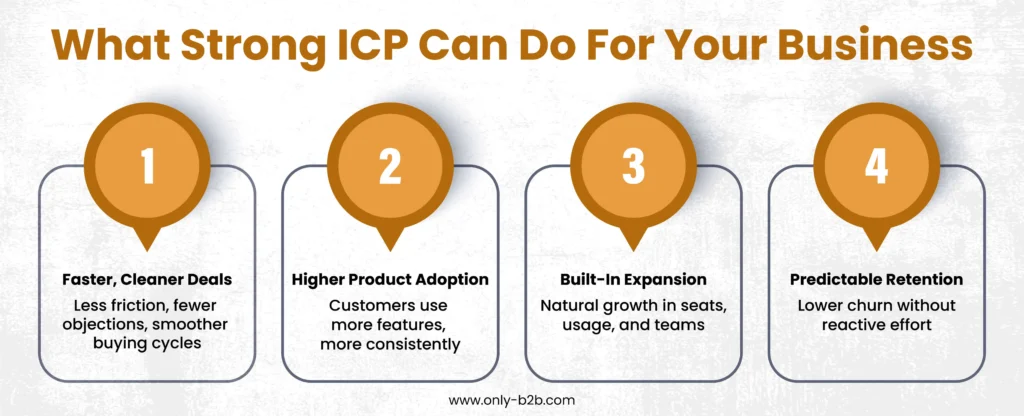
For SaaS companies, targeting decisions influence far more than lead generation. They shape the economics of the entire revenue model by helping sales and marketing operate in alignment. Organizations see up to 36% higher retention and 38% stronger win rates, with marketing contributing significantly more to revenue overall.
When the ICP for B2B SaaS is clearly defined, several operational advantages appear across marketing, sales, and customer success.
1. Lower Customer Acquisition Cost (CAC)
Marketing campaigns become more efficient when they focus on organizations with strong product-market alignment. Instead of attracting large volumes of low-quality leads, teams concentrate on accounts that are more likely to convert.
This reduces wasted marketing spend and improves campaign performance.
2. Higher Lifetime Value (LTV)
Customers that closely match the ideal customer profile often adopt the product more successfully. They implement it faster, integrate it with existing workflows, and expand usage across teams.
As a result, these customers typically generate higher lifetime value.
3. Predictable Expansion Revenue
Expansion revenue is a major growth driver in SaaS. When the initial account structure aligns with the product’s natural use cases, upsell and cross-sell opportunities emerge more naturally.
Organizations with multiple teams, departments, or regions often provide stronger expansion potential.
4. Lower Churn Risk
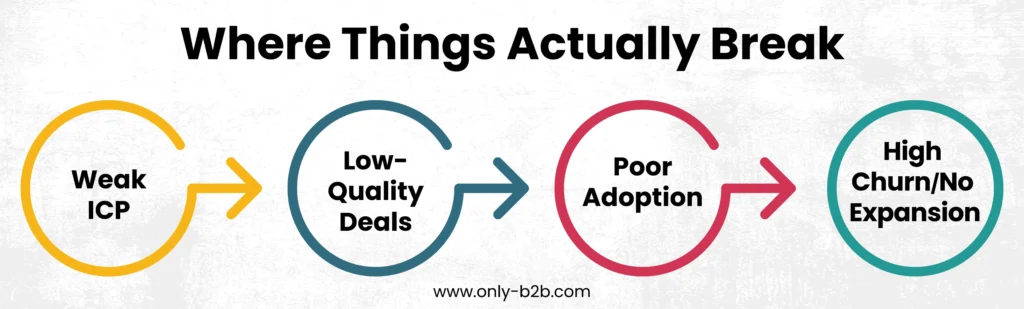
High churn is often interpreted as a product problem. But in many cases, it is actually a targeting problem.
When companies adopt a product that does not fully fit their operational needs, implementation becomes difficult and long-term retention declines.
This is why many SaaS leaders eventually recognize that growth is not simply about generating more demand. It is about improving the quality of demand entering the system.
And that process begins with a well-defined ICP.
Core Components of an Effective ICP
A strong B2B ICP framework is built on multiple layers of company insight. Instead of relying on assumptions, it combines structural, technological, and behavioral signals that reveal where the product works best.
Firmographics
Firmographic data describes the structural characteristics of a company.
Typical firmographic criteria include:
- Industry or vertical
- Company size and employee count
- Annual revenue range
- Geographic presence
- Organizational structure
For example, a SaaS collaboration tool designed for distributed teams may align naturally with mid-market technology companies rather than small local businesses.
Technographics
Technographic insight focuses on the technology environment inside the target organization. Common technographic indicators include:
- Existing CRM or ERP platforms
- Marketing automation tools
- Cloud infrastructure providers
- Data warehouses and analytics platforms
- Integration tools and APIs
Organizations with compatible technology stacks typically experience faster onboarding and higher product adoption.
Behavioral Signals
Behavioral signals provide valuable insight into a company’s level of interest or readiness to adopt a solution.
These signals can include:
- Engagement with industry content
- Research activity related to the product category
- Attendance at relevant webinars or events
- Interaction with product documentation or case studies
Behavioral patterns often reveal when companies are actively exploring solutions in a specific category.
Revenue Fit
Revenue fit reflects whether the economic structure of a company aligns with your pricing model.
SaaS companies typically evaluate:
- Budget capacity
- Growth stage
- Investment in operational technology
Companies that actively invest in productivity tools, automation, and data infrastructure often represent stronger ICP candidates.
Buying Committee Structure
Understanding the typical buying committee helps anticipate sales cycle complexity. It also helps sales teams prepare for conversations with different decision-makers.
For SaaS products, common stakeholders often include:
- Department heads
- Operations leaders
- IT teams
- Finance executives
Mapping this structure helps teams design more effective sales strategies.
SaaS-Specific ICP Criteria
While traditional B2B targeting focuses on company attributes, SaaS companies often need additional criteria tailored to subscription-based growth models.
1. ACV Tiering:
Not all accounts deserve equal focus; here is how you can tier prospects as per their buying potential.
- Tier 1: High-fit, high-budget, fast-moving accounts with strong ACV potential ($50K+).
- Tier 2: Good fit with expansion upside but longer sales cycles.
- Tier 3: Low ACV or fit, better suited for self-serve or automation.
The goal is to prioritize long-term revenue, not just initial deals.
2. Product Fit (Usage & Value)
This includes strong ICP accounts that have a clear, urgent use case.
- Defined job-to-be-done
- Operational readiness to adopt
- Frequent, embedded usage
The best customers make the product part of how they work.
3. Integration Stack (Technographic Fit)
Adoption of the software depends on ecosystem fit.
- Compatible core systems (CRM, ERP, tools)
- Cloud-native vs legacy environments
- Structured, usable data
Better fit reduces friction and speeds up time-to-value.
4. Expansion Potential (Scaling & NRR)
Ideal accounts grow after acquisition.
- Hiring and growth signals
- Increasing usage or seat expansion
- Multi-team adoption potential
A strong SaaS ICP prioritizes accounts that not only convert, but compound in value.
Ideal Customer Profile Template (Fill-In Framework)
Use this structured framework to define your ICP clearly and align marketing, sales, and revenue teams around high-fit accounts.
| ICP Field | What to Define | Example for B2B SaaS |
|---|---|---|
| Industry / Vertical | Industries where your product solves a clear and recurring business problem | B2B SaaS, technology, professional services |
| Company Size | Employee range where your solution is most relevant and commercially viable | 200–1,500 employees |
| Annual Revenue | Revenue range that indicates sufficient buying capacity | $20M–$250M annual revenue |
| Geography | Markets and regions your sales, support, and delivery teams can effectively serve | North America and Western Europe |
| Technology Stack | Existing systems that indicate compatibility or a stronger need for your product | Salesforce, marketing automation, cloud data warehouse |
| Operational Challenge | The core business problem your solution is expected to solve | Limited pipeline visibility or disconnected revenue data |
| Buying Committee | Roles typically involved in evaluating, approving, and using the solution | VP Sales, Revenue Operations, Marketing Operations, CFO |
| Budget Readiness | Expected ability and willingness to invest in solving the problem | Mid five-figure annual software or services budget |
| Growth Stage | Business maturity or growth phase where the need becomes more urgent | Scaling revenue organization or expanding into new markets |
| Buying Triggers | Events or signals that may indicate stronger purchase intent or urgency | New sales leadership, expansion, funding, hiring, or technology change |
| Expansion Potential | Ability to increase account value after the initial purchase | Multiple teams, business units, regions, or additional use cases |
| Disqualifiers | Conditions that make the account unlikely to become a successful customer | Insufficient budget, weak use case, incompatible stack, or limited buying authority |
ICP Example for B2B SaaS Company (How It Looks in Practice)
To better understand how ICP development works, here is a structured example of a well-defined target account profile.
How to Build an ICP Using Real Data
Creating a meaningful ICP requires evidence rather than assumptions.
The most effective approach is to analyze existing customer data to identify patterns among successful accounts.
Analyze Top Revenue Accounts
Start by identifying customers that generate the high lifetime value. These organizations often represent the clearest signal of product-market alignment.
Look for shared characteristics such as industry concentration, company size, operational complexity, and technology environment.
Study Churn Patterns
Churn analysis often reveals segments that struggle with product adoption.
If certain industries or company sizes consistently experience higher churn, they may fall outside the true ICP.
Evaluate Win Rate Data
Sales performance data can highlight where deals close most efficiently.
Higher win rates often indicate segments where the product value proposition resonates strongly.
Analyze Customer Expansion
Accounts with strong net revenue retention frequently represent the most accurate expression of the ICP.
These customers demonstrate both adoption and long-term value creation.
Creating an ICP Scoring Model
Once an ICP is defined, many SaaS companies translate it into a scoring model that helps prioritize accounts.
Each attribute receives a weighted score based on its importance to product success.
ICP Scoring Model (Prioritization Framework)
Use weighted criteria to prioritize high-fit accounts and focus resources on opportunities with the highest revenue potential.
| Criteria | Weight |
|---|---|
| Industry Match | 20% |
| Company Size Fit | 20% |
| Technology Compatibility | 20% |
| Revenue Capacity | 15% |
| Expansion Potential | 10% |
| Buying Committee Accessibility | 15% |
Accounts that achieve higher scores become priority targets for marketing campaigns and outbound sales efforts.
This structured approach helps revenue teams allocate resources toward the accounts most likely to convert and grow.
Common ICP Mistakes to Avoid
Even experienced teams struggle with ICP definition when alignment, data, and iteration are missing.
Trying to target everyone results in low relevance and weak conversion.
FixNarrow the ICP to segments where the product consistently delivers strong outcomes.
Relying on opinions instead of data leads to poor targeting decisions.
FixBase the ICP on CRM data, win rates, retention, and expansion patterns.
Excluding post-sale insights hides where real value is created.
FixUse product adoption, retention, and support data to validate ICP fit.
Not updating ICPs makes them outdated as markets and products evolve.
FixReview and refine the ICP regularly based on performance data.
FAQ’s
What is an ideal customer profile in SaaS?
An ICP represents the organization most likely to benefit from a product while also generating strong long-term revenue for the vendor.
What is the difference between ICP and buyer persona?
An ICP describes the target organization, while a buyer persona focuses on the individual decision maker involved in the purchase process.
Why is ICP important for SaaS companies?
It improves targeting efficiency, reduces wasted acquisition spending, and increases the likelihood of long-term customer success.
How often should an ICP be updated?
Most SaaS companies review their ICP annually or whenever significant product or market changes occur.
What data is needed to build an ICP?
Key inputs include CRM account data, customer retention metrics, win-loss analysis, and product usage insights.
Build a Revenue-Focused ICP
Many SaaS growth challenges appear complex on the surface.
But they often trace back to a simple question: are the right customers entering the pipeline?
A clearly defined ideal customer profile provides structure to that question. It helps marketing teams attract better prospects, enables sales teams to prioritize the right accounts, and allows customer success teams to support customers more effectively.
When targeting improves, the entire revenue engine becomes more efficient.

Vikas Bhatt is the Co-Founder of ONLY B2B, a premium B2B lead generation company that specializes in helping businesses achieve their growth objectives through targeted marketing & sales campaigns. With 10+ years of experience in the industry, Vikas has a deep understanding of the challenges faced by businesses today and has developed a unique approach to lead generation that has helped clients across a range of industries around the globe. As a thought leader in the B2B marketing community, ONLY B2B specializes in demand generation, content syndication, database services and more.