

What a short-term vendor trial can tell you is whether a team can book meetings or not. It cannot, by itself, tell you whether those meetings fit your market, whether sales will accept them, or whether the motion can produce pipeline consistently.
That distinction matters more as buyers become harder to reach. Gartner found in 2026 that 67% of B2B buyers prefer a rep-free experience, while 45% used GenAI during a recent purchase.
A useful appointment setting pilot program therefore tests the operating system behind the meetings: targeting, messaging, data, qualification, handoff, feedback and repeatability.
What Is an Appointment Setting Pilot Program?
An appointment setting pilot is a fixed learning period with a defined market, operating model, success criteria and decision point.
A pilot program should answer certain business questions:
- Can this team reach the right accounts?
- Does the message create relevant conversations?
- Do those conversations become meetings that sales considers it worth having?
- Can the process be improved enough to become repeatable?
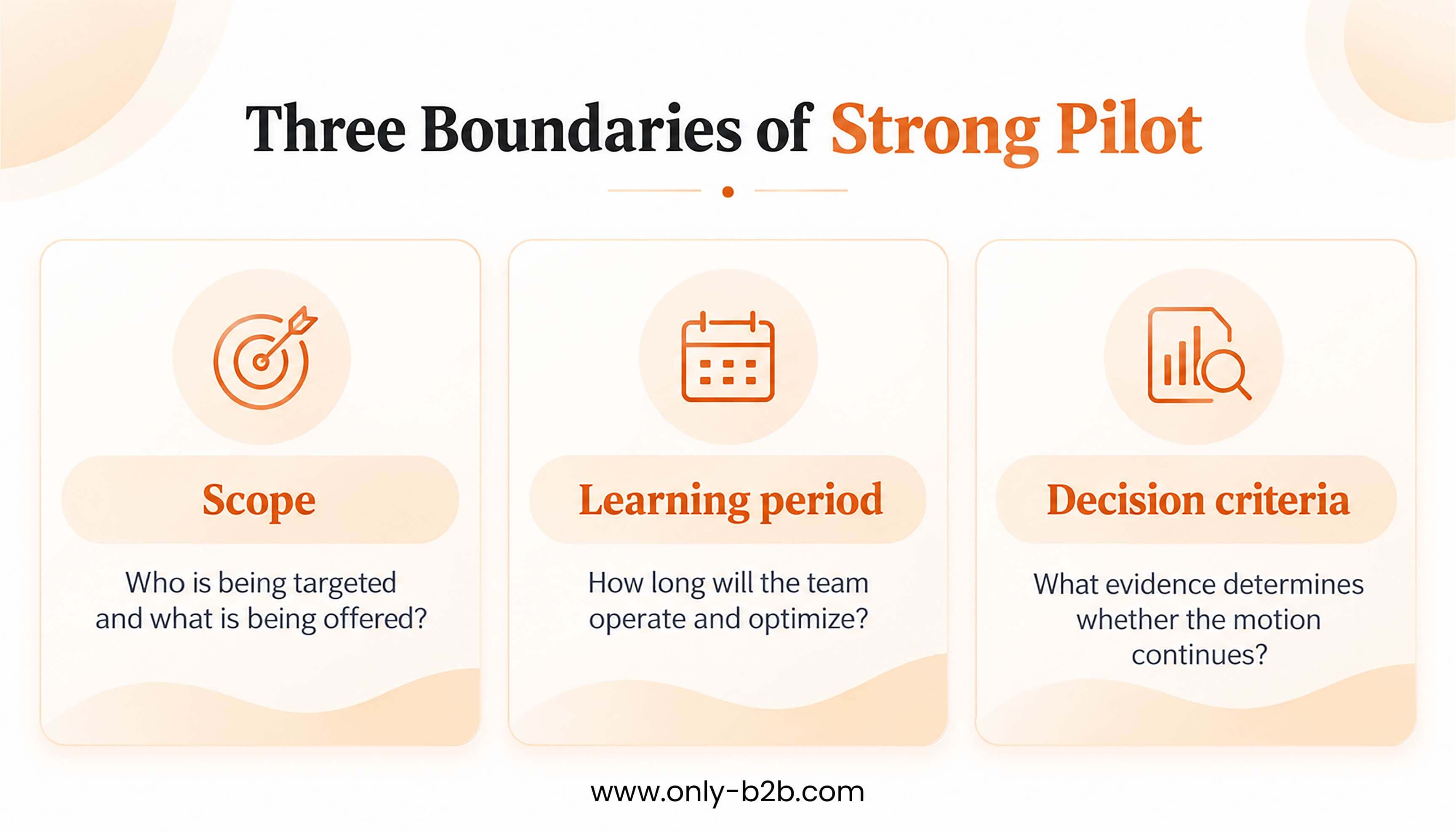
This makes an appointment setting trial less about proving that meetings can be booked and more about determining whether the entire motion deserves to scale.
When Does an Appointment Setting Pilot Make Sense?
A pilot becomes useful when uncertainty is more expensive than testing.
Common situations include:
- Entering a new market or geography
- Testing a new ICP
- Expanding into a new persona
- Adding capacity without immediately hiring an SDR team
- Replacing an existing provider
- Validating a new message or offer
- Testing whether an outbound motion can complement inbound demand
It can also be useful when internal teams disagree about what is actually limiting pipeline. If marketing believes targeting is the issue while sales believes messaging is the issue, a controlled outbound test can create evidence instead of another round of internal debate.
The point is not to make the pilot permanent. The point is to make the next decision better informed.
Establish a Baseline Before the Pilot
A pilot cannot demonstrate improvement if there is nothing to compare it with.
Before launch, document the existing performance baseline across the parts of the funnel that can reasonably be measured:
Document the current performance before the pilot begins so that future results have an honest comparison point.
Swipe horizontally to view the complete table →
| Stage | Baseline |
|---|---|
| 1 Contacts reached | Current monthly level |
| 2 Response rate | Current response |
| 3 Conversations | Current conversation rate |
| 4 Meetings booked | Current meeting rate |
| 5 Meetings held | Current show rate |
| 6 Accepted meetings | Current sales acceptance |
| 7 Opportunities | Current opportunity rate |
| 8 Pipeline | Current contribution |
The baseline does not need to be perfect. It needs to be honest.
If your existing motion generates meetings but sales rejects a large proportion of them, the pilot should not define success as simply producing more meetings. If there is no reliable historical data, document that limitation before launch rather than modifying a baseline later.
How to Scope the Pilot
The best pilot scope is narrow enough to learn from and large enough to expose real operating conditions.
Define:
- Target geography
- Number of accounts
- Target personas
- Account and contact criteria
- Outreach channels
- Core message
- Offer or meeting proposition
- Qualification criteria
- Exclusions
- Reporting cadence
- Client responsibilities
- Vendor responsibilities
An outsourced appointment setting pilot should also establish who owns data, messaging decisions, compliance requirements, CRM updates and meeting outcomes.
Do not leave these decisions implicit.
A pilot becomes difficult to evaluate when one side assumes that “qualified meeting” means a confirmed decision-maker with an active initiative, while the other treats it as anyone who agrees to a conversation.
The scope should make that difference impossible.
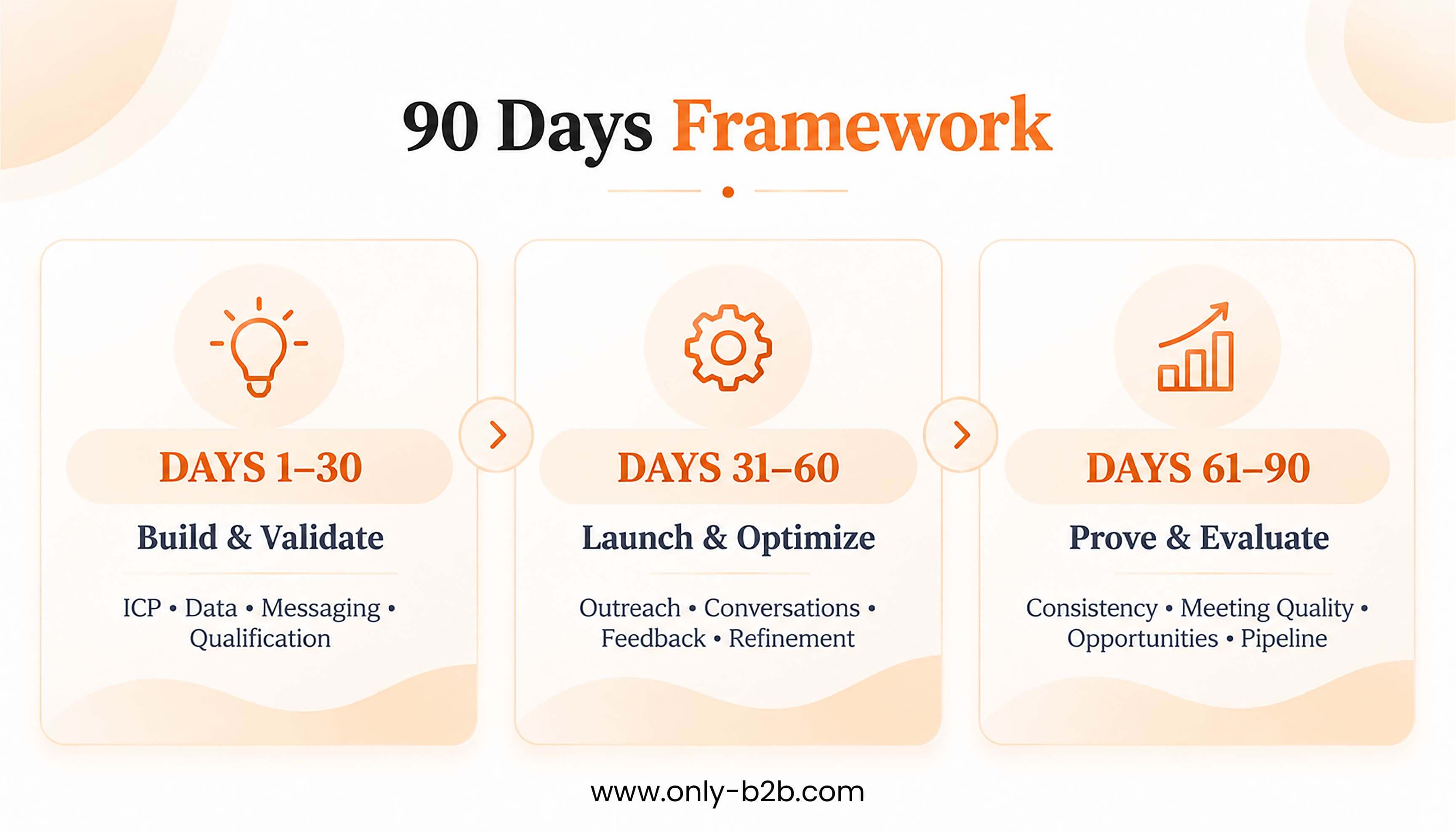
Days 1-30: Build and Validate the Foundation
The first 30 days are often underestimated because they may produce fewer meetings.
But that does not make them unproductive.
This is the period for pilot onboarding, account validation, contact research, messaging alignment, CRM, and scheduling setup, qualification calibration, and early quality assurance.
The team should establish whether the data actually represents the intended market. It should also test whether the messaging makes sense to the people receiving it.
Early signals matter here:
- Are the right accounts being reached?
- Are the intended personas responding?
- Are objections consistent?
- Are contacts confused about the offer?
- Are conversations progressing beyond surface-level interest?
- Are qualification rules filtering out poor-fit meetings?
The first month should create enough evidence to correct the foundation before activity is mistaken for performance.
Days 31-60: Launch, Learn, and Optimize
By the second month, the appointment setting pilot program should move from setup into a more stable outreach rhythm.
This is where the quality of live conversations becomes particularly useful.
Review:
- Which personas engage?
- Which industries respond?
- Which messages create genuine discussion?
- Which objections repeat?
- Which accounts show stronger fit?
- Which meetings sales considers useful?
This is where SDR feedback and sales feedback become operating inputs rather than post-campaign commentary.
The goal is not to change everything whenever a week underperforms. It is to identify patterns and make controlled adjustments.
If one segment consistently produces better conversations, investigate why. If a message generates responses but poor meetings, the problem may sit in qualification rather than outreach. If meetings are strong but fail to progress, the handoff or positioning may need attention.
Days 61-90: Prove Repeatability and Pipeline Value
The final 30 days should answer a different question. Can what worked in the first two months be repeated without depending on unusual conditions?
This is where pilot results need to be interpreted beyond the meeting calendar.
Look for consistency across:
- Target account engagement
- Conversation quality
- Meeting creation
- Meeting attendance
- Sales acceptance
- Opportunity creation
- Early pipeline contribution
A good final month does not automatically prove the model works. Nor does a weak first month automatically disprove it.
The question is whether the underlying pattern is becoming clearer.
If the team can explain which accounts respond, which personas engage, which messages work and what happens after the meeting, the pilot has produced something more valuable than a meeting count. It has produced an operating model that can be evaluated for scale.
Metrics That Determine Whether the Pilot Worked
The right appointment metrics follow the buyer journey rather than stopping at meetings booked.
Core appointment setting KPIs should include:
- Delivery: Were the agreed accounts and contacts reached?
- Conversation rate: Did outreach create real two-way conversations?
- Meeting rate: How often did relevant conversations become meetings?
- Show rate: Did scheduled meetings actually happen?
- Acceptance rate: Did sales consider the meetings qualified?
- Opportunity rate: Did accepted meetings progress into opportunities?
- Pipeline: Did those opportunities create measurable commercial value?
A useful distinction is between meeting volume and meeting quality.
A provider can produce a healthy number of meetings while creating little value if the accounts are wrong, the personas lack influence, or the stated business problem is weak.
For that reason, the meeting acceptance rate is often more revealing than the raw booking number. It creates a bridge between what the appointment-setting team considers qualified and what sales is prepared to work.
The further the measurement moves toward opportunity and pipeline, the more useful the evidence becomes.
The 90-Day Pilot Decision Framework
A mature vendor evaluation framework should not reduce the outcome to “worked” or “did not work.”
Use four decision gates:
Pass
The pilot meets the agreed quality and commercial thresholds, and the motion shows enough consistency to justify expansion.
Optimize
The market or message shows promise, but one or more controllable elements are limiting results. Continue with defined changes and a new review point.
Extend
The buying cycle is too long for the available evidence to show pipeline generation, but leading indicators are strong enough to justify more time.
Stop
The evidence shows persistent ICP mismatch, weak conversations, poor meeting quality, or insufficient commercial progression despite reasonable optimization.
The important part is that each decision is based on evidence defined before the pilot ends.
What the Client Must Contribute
An appointment setting partnership cannot operate effectively as a one-way vendor relationship.
The client has responsibilities too.
The most important are:
- Fast feedback on messaging and objections
- Timely acceptance or rejection of meetings
- Clear qualification standards
- CRM visibility into meeting outcomes
- Access to relevant product and positioning updates
- Availability for sales feedback
- Consistent follow-up after accepted meetings
These client responsibilities directly affect how quickly the pilot can learn.
A meeting that receives no follow-up cannot provide a clean signal about appointment quality. A positioning change that never reaches the outreach team can make a message test impossible to interpret.
The pilot is a shared operating environment, not a handoff from client to vendor.
Appointment Setting Pilot Red Flags
Some signals indicate that a pilot is measuring activity rather than learning.
Front-loaded volume
A large burst of activity early in the campaign can create an impressive first impression without establishing sustainable performance.
Vague qualification
If the definition of a qualified meeting changes depending on who reports it, the results become difficult to trust.
Hidden data sources
If the origin, freshness or methodology behind contact data is unclear, lead quality cannot be properly evaluated.
Weak reporting
Reporting that shows activity but not progression hides where the motion is actually breaking.
No optimization
If the same targeting, messaging and qualification approach continues despite clear evidence that something is not working, the pilot is functioning as a campaign rather than a test.
These are common vendor red flags because they make it difficult to separate genuine capability from temporary activity.
FAQs
How long should an appointment setting pilot last?
Ninety days is generally long enough to move through setup, early learning, optimization and repeatability testing without turning the pilot into an open-ended engagement.
How much should a pilot cost?
There is no universal number. Budget should reflect target account volume, market complexity, personas, channels, data requirements and the level of qualification expected.
How many meetings should a pilot generate?
Required volume should be calculated from the addressable market, outreach capacity, historical conversion rates and the number of opportunities sales actually needs.
Should a pilot have a fixed lead volume?
A defined activity range can help control scope, but the more useful question is whether the activity produces the right conversations and progresses toward qualified opportunities.
How long does appointment setting take to ramp?
The ramp depends on data quality, product complexity, market familiarity, message clarity and the number of stakeholders involved. The first 30 days should therefore be treated as a learning period rather than judged only on final output.
Should pilot contracts be month-to-month?
Not necessarily. A defined 90-day term with clear review points can create stronger accountability because both sides know what must be learned and when the decision will be made.
What happens if meetings are good but pipeline has not appeared by day 90?
Review the sales cycle and opportunity stage. If the pilot has produced strong accepted meetings and credible buying signals but the sales cycle has not matured, an extension may be more informative than an immediate stop.
Turn a 90-Day Test Into a Confident Vendor Decision
The purpose of an appointment setting pilot program is not to prove that a vendor can fill a calendar.
It is to determine whether a complete pipeline motion can work for your market.
That requires more than outreach. It requires accurate targeting, relevant messaging, clear qualification, useful conversations, disciplined handoffs, sales feedback and measurement that follows the journey beyond the meeting.
A well-run pilot gives both sides something more valuable than a short-term result: evidence.
It shows what is working, where the system is breaking, what needs to change, and whether the motion is repeatable enough to scale.
That is the real value of a 90-day test.
Looking to evaluate an appointment-setting motion without committing to an untested model?
Only B2B can help you structure a controlled pilot around your ICP, target accounts, buyer personas, qualification criteria and pipeline objectives, so the decision to scale is based on evidence rather than promises.

Vikas Bhatt is the Co-Founder of ONLY B2B, a premium B2B lead generation company that specializes in helping businesses achieve their growth objectives through targeted marketing & sales campaigns. With 10+ years of experience in the industry, Vikas has a deep understanding of the challenges faced by businesses today and has developed a unique approach to lead generation that has helped clients across a range of industries around the globe. As a thought leader in the B2B marketing community, ONLY B2B specializes in demand generation, content syndication, database services and more.