
A vendor promises 20 meetings a month. Another promises 30.
On paper, the difference seems obvious.
A few months later, both relationships are under review.
Sales says the meetings are not progressing. The vendor points to delivery numbers. Marketing sees activity, but pipeline tells a different story. Everyone is looking at the same program and reaching different conclusions.
According to HubSpot’s 2025 State of Sales Report, only 59.9% of sales teams are on track to meet or exceed revenue targets, highlighting the growing pressure to turn activity into measurable outcomes rather than simply generating more meetings.
This is where most appointment setting engagements begin to break down.
Not because meetings were not booked. Not because outreach failed. But because there was never a shared agreement on what success actually looked like. This challenge is precisely why an appointment setting SLA exists.
What Is an Appointment Setting SLA?
An appointment setting service level agreement (SLA) is a formal agreement that defines how a vendor and client will work together to generate meetings, evaluate quality, and measure performance.
Many organizations think of an SLA as a contractual document. In practice, it functions more like an operating framework for the engagement. It establishes expectations, responsibilities, timelines, qualification standards, and performance benchmarks.
Without this structure, appointment setting often becomes subjective. Teams may interpret results differently because they are evaluating them through different lenses.
A strong appointment setting service agreement answers all the important questions before campaigns begin.
- What type of prospect should be targeted?
- What qualifies as a successful meeting?
- How quickly should feedback be provided?
- What happens when meeting quality is disputed?
The value of an SLA is not found in the document itself. It comes from creating a shared understanding of how success will be measured and managed.
When expectations are documented and understood by both parties, performance discussions become more productive and decisions become easier to make.
Why SLAs Are Critical for Pipeline Success
Appointment setting sits at the intersection of marketing, sales, and prospect engagement.
That position makes clarity essential.
A vendor may be responsible for outreach execution, but the outcomes are ultimately judged by what happens after the meeting takes place. If qualification standards are unclear or responsibilities are loosely defined, even productive campaigns can create friction.
This becomes particularly important in modern B2B appointment setting environments where buying decisions involve multiple stakeholders, longer evaluation cycles, and evolving priorities.
Not every interested prospect is ready for a sales conversation. Not every qualified account is actively evaluating solutions. These distinctions matter because they influence how meetings are assessed and how opportunities are prioritized.
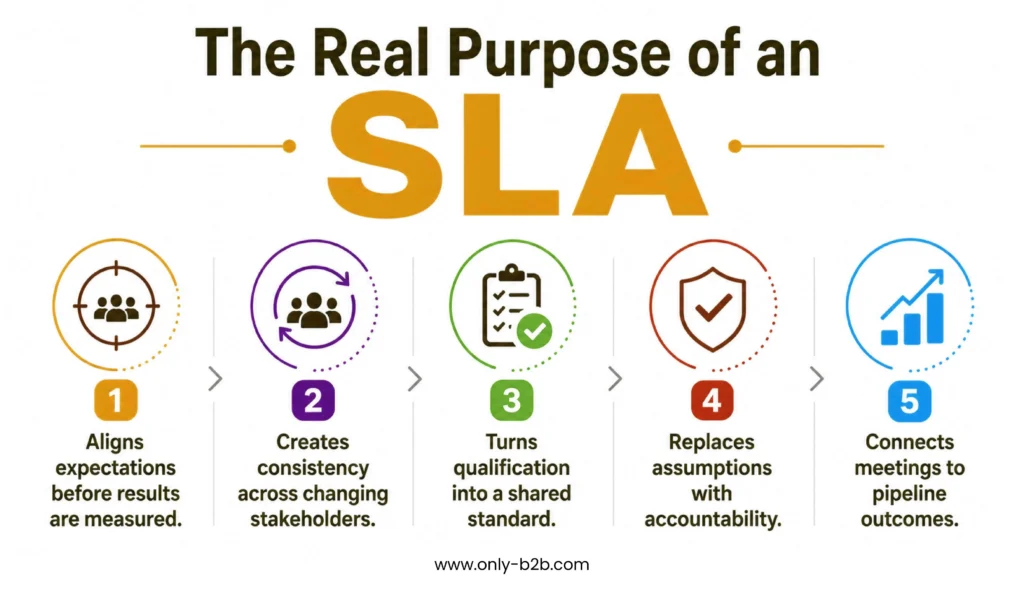
An effective appointment setting SLA creates consistency across teams. It establishes common definitions, outlines expectations, and provides a framework for evaluating performance.
That consistency becomes increasingly valuable as campaigns scale, stakeholders multiply, and pipeline goals become more ambitious.
Core Components of an Appointment Setting SLA
Not all SLAs are built with the same level of attention to detail.
Some focus primarily on activity targets. Others provide a more complete framework that addresses quality, accountability, communication, and performance management.
Several components should be present in every agreement.
Meeting Targets
The SLA should define expected meeting volumes within a specific timeframe. These targets should reflect audience size, market conditions, campaign maturity, and outreach complexity.
Qualification Standards
Meeting expectations should be tied to documented qualification requirements. Clear standards reduce ambiguity and create consistency across outreach efforts.
Target Audience Definition
The ideal customer profile should be explicitly outlined. Industry, company size, geography, job function, and decision-making authority should all be considered.
Communication Expectations
Both parties should understand response timelines, feedback requirements, and escalation procedures. Consistent communication often has a direct impact on campaign performance.
Review Processes
Regular performance reviews allow both sides to evaluate results, identify trends, and make adjustments before challenges become larger issues.
Documentation Standards
Meeting notes, qualification details, prospect context, and outreach history should be consistently captured and shared.
The strongest SLAs create operational clarity. They help teams spend less time interpreting results and more time improving them.
What Counts as a Sales-Ready Meeting?
One of the most important sections of any SLA is the definition of a sales-ready meeting.
This is where expectations become tangible. A meeting should represent more than a scheduled conversation. It should provide a realistic opportunity for a productive sales discussion.
Organizations define sales-ready meetings differently based on their market, sales cycle, and solution complexity. However, several factors consistently matter.
- The prospect should align with the organization’s ICP qualification criteria. They should represent a company that fits the target profile and hold a role that influences purchasing decisions.
- There should also be a relevant business context. This could be a challenge, initiative, objective, or operational priority that creates a reason for the conversation.
- Timing is another important consideration. Prospects evaluating options in the foreseeable future often require a different approach than those conducting broad market research.
- Stakeholder relevance matters as well. Conversations with individuals who have visibility into business priorities tend to create more meaningful outcomes than conversations with contacts who have limited influence.
The purpose of defining qualification criteria is not to eliminate opportunities. It is to create consistency in how opportunities are identified and evaluated.
When both parties share the same understanding of qualified meetings, performance becomes easier to assess and improve.
Vendor Responsibilities vs Client Responsibilities
Successful appointment setting requires participation from both sides.
The vendor is typically responsible for:
- Audience research
- Targeting
- Outreach execution
- Qualification conversations
- Scheduling
- Reporting
They manage the SDR workflow and create opportunities for engagement.
The client plays an equally important role.
Sales teams are responsible for:
- Timely follow-up
- Meeting feedback
- Outcome visibility
Marketing teams contribute:
- Positioning updates
- Campaign insights
- Market intelligence
Leadership teams help maintain strategic alignment as priorities evolve. Responsiveness often has a significant impact on results.
When feedback is delayed, optimization slows. When qualification decisions vary from one stakeholder to another, consistency becomes difficult to maintain.
The strongest appointment setting partnership operates as a collaborative relationship rather than a transactional one.
Both sides contribute information. Both sides contribute accountability. Both sides influence outcomes. Clearly defined responsibilities create a stronger foundation for long-term performance.
Metrics That Should Be Included in an SLA
Metrics provide visibility into performance, but not all metrics carry the same value.
Only 42% of sales professionals consider activity-based metrics their most important success measure, while revenue outcomes, conversion performance, and business impact receive greater emphasis.
Many organizations focus heavily on meetings booked because it is easy to measure. While volume matters, it rarely tells the complete story.
A balanced SLA should include multiple indicators.
- Meeting volume remains important because it reflects outreach effectiveness and campaign activity.
- Show rates provide insight into prospect commitment and scheduling quality.
- The meeting acceptance rate helps evaluate whether meetings align with agreed qualification standards.
- Conversion indicators reveal whether conversations are progressing into opportunities and contributing to the revenue pipeline.
Quality assessments should also be included. In many cases, meeting quality provides earlier signals than downstream conversion metrics, particularly in longer sales cycles.
Strong appointment setting metrics create visibility across the entire process rather than focusing on a single outcome.
The objective is not simply to measure activity. It is to understand whether outreach efforts are creating meaningful business opportunities.
Reporting Expectations and Communication Workflows
Reporting should help teams make better decisions.
Unfortunately, many reporting processes become collections of disconnected metrics that provide updates without delivering meaningful insight.
Effective reporting begins with consistency.
A structured reporting cadence allows both parties to evaluate progress, identify trends, and discuss optimization opportunities. Weekly reporting is common because it balances visibility with practicality.
Reports should extend beyond numerical outputs.
They should provide context around audience engagement, messaging performance, common objections, market feedback, and emerging opportunities.
These observations often become valuable inputs for broader sales and marketing decisions.
Regular review meetings should also be part of the process. Campaign optimization works best when feedback loops remain active and collaborative.
Transparency becomes particularly important during periods of underperformance. Strong partnerships use data, observations, and discussion to identify opportunities for improvement.
The purpose of reporting is not oversight.
It is shared visibility into what is happening and why.
Managing Escalations and Quality Issues
Even well-managed programs encounter challenges.
Meetings may be disputed. Prospects may fail to attend. Qualification standards may be interpreted differently.
What matters is having a process for addressing those situations.
A documented quality control process creates consistency when disagreements arise.
For example, if a sales representative believes a meeting was a poor fit, there should be a structured review process. Qualification notes, outreach history, and agreed criteria can be evaluated objectively.
Escalation procedures should also define response timelines and resolution responsibilities.
Without these mechanisms, isolated issues can quickly affect confidence in the engagement.
No-shows deserve particular attention. While vendors cannot control prospect behavior, they can influence attendance through confirmation processes, reminders, and expectation setting.
The purpose of escalation frameworks is not to assign blame.
It is to maintain trust, transparency, and operational consistency when challenges occur.
Common Appointment Setting SLA Mistakes
Most SLA challenges are predictable.
How to Evaluate an Appointment Setting Vendor
Evaluating a vendor requires looking beyond promises and projections.
The quality of the operating model often matters as much as the projected results.
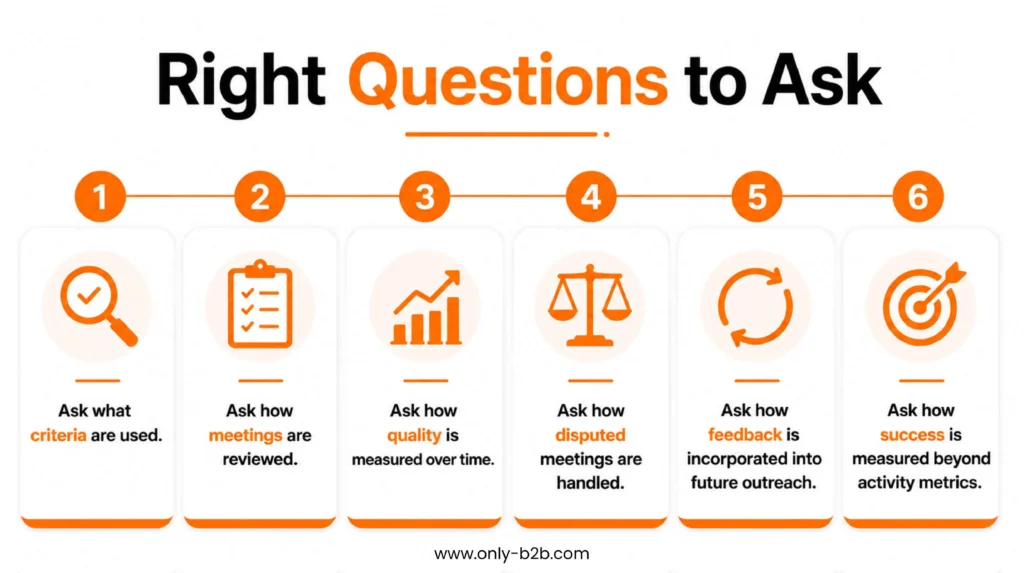
Start by understanding how the vendor defines qualification.
Explore their reporting methodology. Transparency often reveals operational maturity and process discipline.
It is also important to understand how performance is optimized. Effective vendors continuously refine targeting, messaging, and outreach strategies based on campaign data and market feedback.
Organizations considering outsourcing appointment setting should evaluate process quality as carefully as outcome expectations.
The best vendors do more than generate meetings.
They create repeatable systems that support long-term pipeline growth.
FAQs
What is an appointment setting SLA?
An appointment setting SLA is a documented agreement that defines expectations, responsibilities, qualification standards, performance metrics, and communication processes between a client and an appointment setting provider.
What should be included in an appointment setting service agreement?
A comprehensive agreement should include meeting targets, qualification criteria, target audience definitions, reporting requirements, communication expectations, escalation procedures, and performance measurement standards.
How do you define a qualified meeting?
A qualified meeting typically involves a prospect that aligns with the ideal customer profile, has a relevant business challenge, demonstrates interest in discussing solutions, and represents a meaningful stakeholder within the buying process.
What KPIs should be tracked in appointment setting?
Common KPIs include meetings booked, show rates, meeting acceptance rates, opportunity creation, conversion indicators, and overall pipeline quality metrics.
How often should vendors report performance?
Most organizations benefit from weekly reporting combined with regular review meetings. This frequency provides enough visibility to identify trends and make adjustments without creating unnecessary administrative overhead.
SLA as Performance Management Tool
A well-structured agreement creates clarity around expectations, responsibilities, qualification standards, and measurement. It gives both parties a common framework for evaluating progress and addressing challenges.
That clarity becomes increasingly important as buying journeys become more complex and pipeline goals become more demanding.
Meetings remain an important output. But the real objective is creating conversations that have the potential to move opportunities forward.
Organizations that build SLAs around pipeline quality rather than activity alone tend to create stronger partnerships, better decision-making processes, and more sustainable growth outcomes.
If you are evaluating providers, look beyond meeting commitments. Examine how quality is defined, how accountability is maintained, and how performance is continuously improved.
Those answers often reveal far more about future success than volume targets ever will.

Vikas Bhatt is the Co-Founder of ONLY B2B, a premium B2B lead generation company that specializes in helping businesses achieve their growth objectives through targeted marketing & sales campaigns. With 10+ years of experience in the industry, Vikas has a deep understanding of the challenges faced by businesses today and has developed a unique approach to lead generation that has helped clients across a range of industries around the globe. As a thought leader in the B2B marketing community, ONLY B2B specializes in demand generation, content syndication, database services and more.