
Imagine a high-intent lead requests a demo. The CRM creates a new account instead of joining it to the existing record. When sales team reaches out, the buyer says they are already speaking with someone else from your organisation.
The issue here was the identity decision beneath the workflow.
Gartner estimates that poor data quality costs organisations an average of $12.9 million each year. In B2B, a small identity error can affect routing, ownership, account reporting and the buyer experience at once.
What Is Lead-to-Account Matching?
Lead-to-account matching is the process of identifying which existing company record a new lead belongs to.
Before a lead can be routed, enriched, scored or included in account-based reporting, the CRM needs to answer a basic question:
Which organisation does this person represent?
That question is less straightforward than it appears. A lead may submit a trading name while the CRM stores a legal entity. Their email domain may belong to a parent company. The account may already exist under an older brand, regional entity or shortened company name.
The purpose of L2A matching is to establish account identity with enough confidence for the next action to be appropriate.
Why B2B Leads Fail to Match Correctly
Most CRM matching errors emerge from ordinary variations in how companies describe themselves and how systems store information.
Free-email domains
A corporate email domain is often the strongest available signal, but not every legitimate buyer uses one.
Consultants, founders, independent operators and early-stage teams may use Gmail, Outlook or a personal domain. That can confirm the person is real, but it does not reliably identify the account.
Subsidiaries and regional entities
A global organisation may operate through several legal entities, websites and domains. A lead using company.co.uk may belong to the same corporate group as an account stored under company.com, but the records should not automatically be merged.
The correct relationship may be parent and subsidiary. The local entity may have its own sales team, budget and buying process. Flattening the records can create ownership conflicts and make regional performance difficult to interpret.
Spelling and naming variations
Company names rarely appear consistently across systems.
Variations may include:
- Acme Limited
- Acme Ltd
- Acme
- Acme Holdings
- Acme Digital Services
Legal suffixes, punctuation, abbreviations and trading names create variation without necessarily changing the underlying organisation.
An exact-name rule will miss legitimate matches. A loose name rule will connect unrelated companies with similar names. Use name similarity to generate candidates, then confirm identity with stronger evidence.
Mergers, acquisitions and rebrands
Account identity changes over time. A company may acquire another business, change its brand or continue operating an acquired entity independently.
Historical CRM records may use the old name while new leads use the new one. If those relationships are not maintained, one commercial relationship can become several disconnected records.
Duplicate accounts and incomplete data
Duplicates are created through imports, manual entry, disconnected systems and inconsistent ownership processes. Once they exist, new leads may be attached to whichever record most resembles the submitted information.
Incomplete data makes the decision harder. A lead may provide only a company name. An account may have no website. A domain may be shared across several entities.
A dependable process evaluates what is available, makes uncertainty visible and avoids treating missing evidence as confirmation.
How Bad Matching Damages Pipeline and Reporting
A bad or incorrect match can damage your pipeline and reporting in the following ways:
Account ownership becomes unreliable
When a lead is attached to a duplicate or incorrect account, ownership rules may not fire as intended. A strategic account may be treated as an unqualified inbound lead, while an account executive may not receive the alert.
ABM measurement becomes fragmented
Account-based marketing depends on seeing activity at the account level. If several contacts from one organisation are distributed across multiple account records, engagement is understated and buying-group activity becomes difficult to interpret.
CRM attribution becomes misleading
CRM attribution depends on connecting activity to the correct account and opportunity. If a lead is matched incorrectly, a campaign may receive credit for creating demand that was already developing elsewhere. Or the campaign may receive no credit because the lead is separated from the opportunity it influenced.
Customer experience suffers
Buyers notice when a company does not recognise its own relationship with them. They may repeat information, receive conflicting messages or be contacted by multiple representatives which builds frustration.
The underlying issue may be that the CRM never established which account the buyer belonged to.
Core Lead-to-Account Matching Rules
No single rule is reliable enough for every B2B environment. Strong CRM account matching uses a hierarchy of evidence.
Exact domain match
A verified corporate email domain that matches the account domain is usually the strongest starting point. It is fast, explainable and relatively easy to maintain.
Normalized company name
Data normalization removes differences that do not carry meaning, including punctuation, legal suffixes, spacing, capitalization and common abbreviations.
Website, location and stable identifiers
A submitted website, email domain and known account website can provide useful supporting evidence. Country, city, postal code and operating region can help distinguish similar companies.
Where available, use company registration numbers, tax identifiers, provider-specific company IDs or verified external account IDs. These signals are more durable than names and should carry significant weight.
Use the strongest available evidence first, then use weaker signals to confirm or challenge it.
How to Score Match Confidence
A reliable process needs more than a matched or unmatched outcome. It needs a confidence framework that reflects certainty and determines what should happen next.
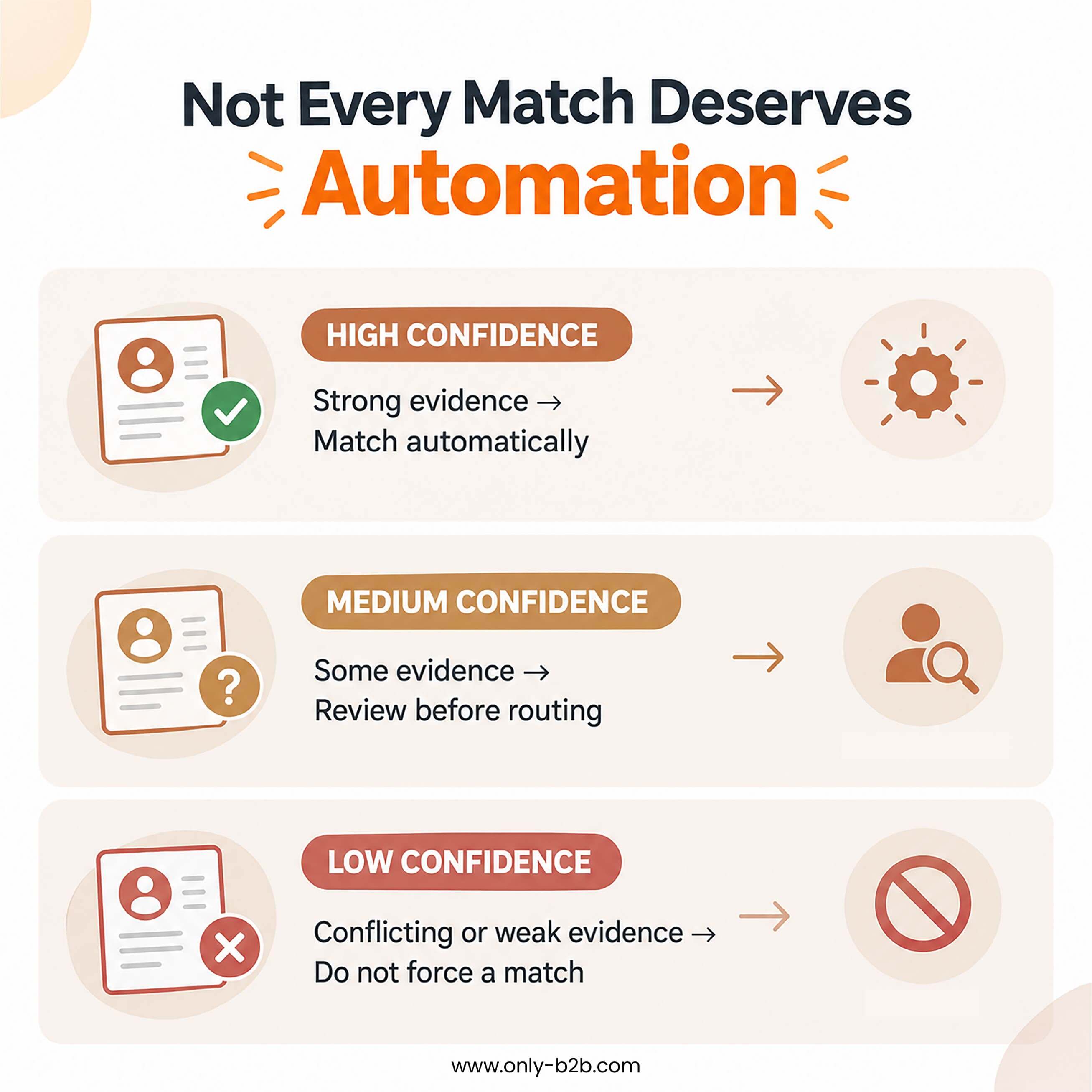
High confidence
A high-confidence match may include:
- An exact verified domain match
- A stable identifier match
- A domain match supported by a normalized company name
- A known website and location combination with no conflicting account data
These records can usually proceed through automated routing, provided the account is not disputed, inactive or duplicated.
Medium confidence
Medium confidence may apply when:
- The company name is highly similar but the domain is missing
- The domain belongs to a known parent or subsidiary
- The website and location align but the legal name differs
- Several signals support the same account without one decisive identifier
- These records may be routed with a review flag or held for manual review.
Low confidence
Low confidence includes:
- Free-email domains
- Generic or incomplete company names
- Multiple plausible account candidates
- Conflicting location, domain or ownership data
- A likely match to an account already marked as duplicate
Low-confidence records should not be forced into an account simply to improve dashboard completeness.
Manual review should be triggered when the account is strategic, potential revenue is material, multiple candidates score similarly or the match would change ownership.
Matching Leads Across Account Hierarchies
A parent company may own several subsidiaries. A regional entity may have its own sales team. A franchise may share a brand but operate as an independent business.
The matching decision should answer two separate questions:
- Which legal or operating entity does this person belong to?
- Which account should receive the activity for commercial action?
Those answers may be different.
A lead may use a subsidiary domain but work on a group-wide procurement project. The activity may need to remain on the subsidiary record for ownership while also rolling up to the parent for account-level reporting.
A useful structure distinguishes:
- Parent account
- Regional or country entity
- Operating subsidiary
- Franchise or partner location
- Brand or trading name
Do not flatten these relationships simply because it makes reporting easier. Define when activity rolls up, when ownership remains local and when an opportunity should be associated with both a buying entity and a wider corporate group.
Lead-to-Account Matching Edge Cases
Some records will not fit neatly into standard rules.
Consultants and agencies
A consultant may submit a form on behalf of a client while using their own email domain. An agency may represent several accounts and appear repeatedly in the CRM.
The record may need a relationship to both the intermediary and the end customer.
Personal domains
Personal domains can represent legitimate businesses, especially among founders and small firms. They require stronger supporting evidence, such as a website, company name, location or external identifier.
Stealth companies
A company may intentionally limit its public information before launch. The CRM may not have enough evidence for an automatic match.
The right outcome is a visible exception, not a speculative account assignment. A temporary unmatched state is safer than attaching the lead to an incorrect record.
Large institutions often use shared domains across departments, campuses and affiliated organisations. A domain match may identify the institution but not the relevant buying unit.
Department, location and existing ownership rules become important. Shared domains should lower confidence unless other evidence clearly identifies the account.
A Step-by-Step L2A Matching Workflow
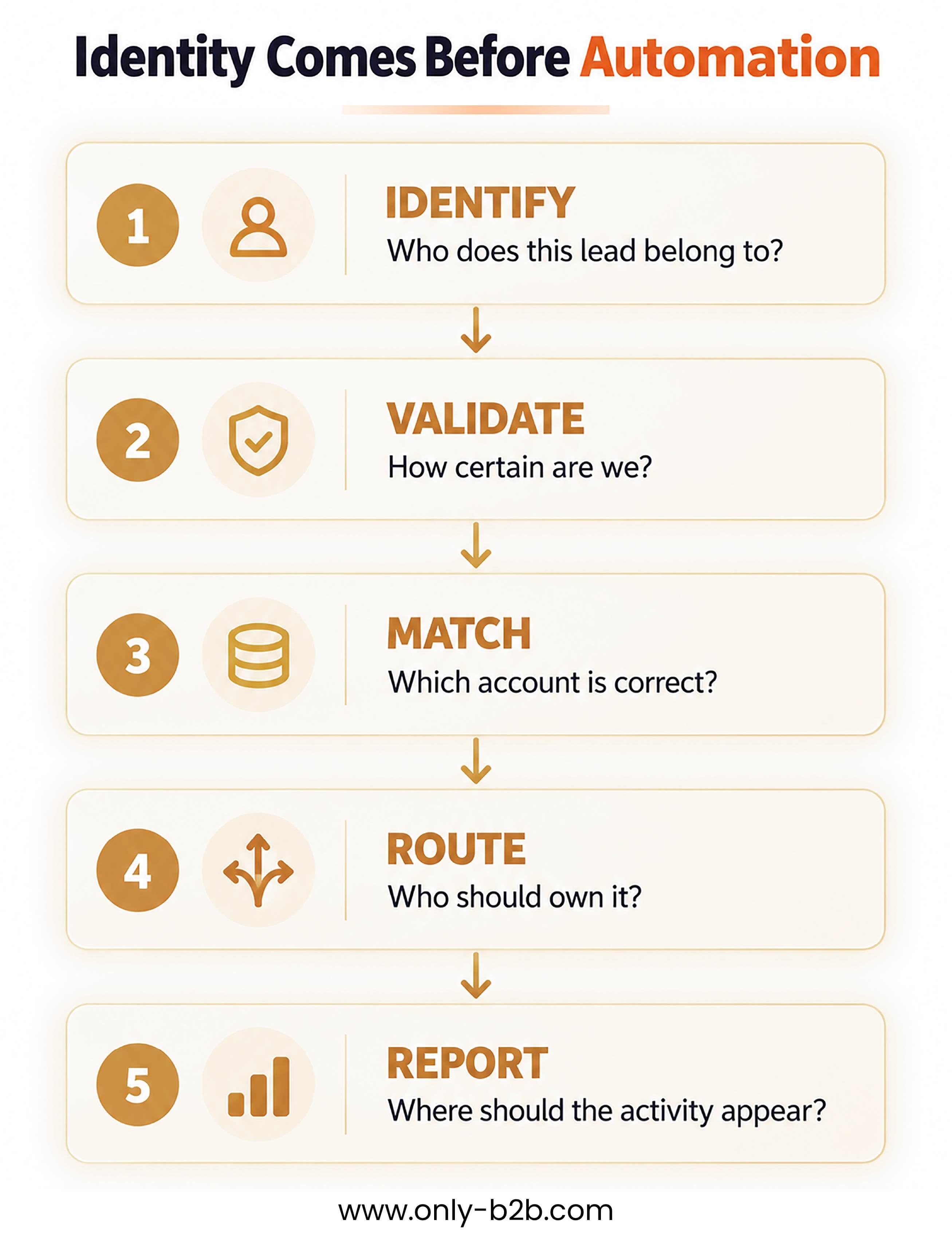
A dependable CRM workflow separates identity decisions from the actions that follow them.
Step 1: Normalize incoming data
Standardize company names, domains, websites, countries and locations before comparison. Remove formatting noise while preserving the original submitted values for auditability.
Step 2: Enrich where appropriate
Use enrichment to add missing firmographic information, known domains, identifiers and hierarchy relationships.
Enrichment should support matching, not silently overwrite the source data that informed the decision.
Step 3: Generate and score candidates
Search for possible matches using domain, normalized name, website, location and stable identifiers.
Apply weighted evidence: a verified identifier should carry more weight than a similar company name. The scoring model should also account for negative evidence, such as a different country, website or industry.
Step 4: Match or escalate
High-confidence records can be matched automatically. Medium-confidence records may require review. Low-confidence records should remain unmatched until sufficient evidence is available.
Store the decision with a reason code or evidence trail.
Step 5: Route after identity is established
Lead routing should use the matched account, its hierarchy, territory, segment and ownership rules.
Routing before matching creates avoidable reassignment because the system is acting on an uncertain identity.
Step 6: Monitor exceptions
Every manual correction, rejected match and duplicate creation should feed back into the process.
Metrics for Lead-to-Account Matching Quality
Matching metrics should measure both automation and accuracy. A high auto-match rate is not useful if it is achieved by accepting incorrect matches.
Track:
- Auto-match rate
- False-match rate
- Unmatched rate
- Duplicate-account rate
- Routing corrections
- Manual-review volume
- Time to resolve exceptions
- Percentage of opportunities linked to the correct account
Review these measures by segment, region, source and account type. Connect the metrics to operational outcomes. If routing corrections are increasing, the issue may be that account identity is being established too late or with insufficient evidence.
Build, Buy, or Outsource L2A Matching?
The right operating model depends on data complexity, CRM maturity and the cost of being wrong.
Native CRM rules can work when account structures are simple, domains are reliable and exceptions are limited. They are transparent and easy to govern, but often struggle with hierarchy, fuzzy identity and changing company data.
Automation platforms can extend native capabilities by combining workflows, enrichment and scoring. They are useful when the business needs flexibility and has the internal capacity to maintain rules and monitor outcomes.
Specialist L2A software is more appropriate when the organisation has complex account hierarchies, high lead volume, multiple regions or a strong ABM motion. These tools provide broader identity data and more sophisticated matching, but still require clear ownership and governance.
Managed data services can help when internal teams lack the capacity to maintain account records, resolve exceptions and keep hierarchy data current.
The choice should be based on the cost of inaccurate identity, not only the cost of technology. A simple CRM with well-governed rules may outperform a sophisticated platform that nobody reviews.
Common L2A Matching Mistakes
FAQs
What is the strongest signal for matching a lead to an account?
A verified stable identifier is usually strongest. Where that is unavailable, an exact corporate domain supported by company name and other consistent data is often the most reliable combination.
Should a free email domain prevent a lead from being matched?
It would reduce confidence because the domain does not identify the organisation. Use the company name, website, location and other available evidence, then send the record for review when the account is important or the evidence conflicts.
What match confidence threshold should trigger automatic routing?
There is no universal threshold. Automatic routing should require enough evidence that the cost of a false match is acceptably low for the segment.
Strategic accounts should generally use stricter thresholds than low-risk, high-volume segments. The threshold should be based on the consequence of being wrong.
Can CRM tools handle L2A matching without specialist software?
Sometimes. Native CRM tools can support straightforward rules and workflows. Complex hierarchies, multiple domains, high volumes and frequent exceptions may require enrichment, specialist software or managed data services.
Should a lead be matched to the parent or subsidiary account?
Match the lead to the entity that best represents the person’s organisation and buying activity. Then use hierarchy relationships to roll up engagement where appropriate.
Fix Account Identity Before Automating Revenue Workflows
Revenue workflows can only be as reliable as the account identity beneath them.
If a lead is attached to the wrong account, routing becomes uncertain, attribution becomes distorted and the buyer experiences the organisation as disconnected. More automation does not solve that problem. It can make the consequences move faster.
A stronger approach treats matching as a governed identity process. It combines normalized data, multiple evidence sources, confidence thresholds, hierarchy logic and visible exceptions.
The objective is to find dependable account identity where the business needs to act.
Once that foundation is in place, routing becomes more precise, account reporting becomes more credible and marketing and sales can work from the same view of the customer.
Before automating another revenue workflow, make sure the CRM knows who the buyer belongs to.

Vikas Bhatt is the Co-Founder of ONLY B2B, a premium B2B lead generation company that specializes in helping businesses achieve their growth objectives through targeted marketing & sales campaigns. With 10+ years of experience in the industry, Vikas has a deep understanding of the challenges faced by businesses today and has developed a unique approach to lead generation that has helped clients across a range of industries around the globe. As a thought leader in the B2B marketing community, ONLY B2B specializes in demand generation, content syndication, database services and more.