
In B2B, more appointments do not automatically mean more pipeline.
That is the part many teams learn the hard way. The meetings are there, but the fit is off, the timing is early, or the buyer was never truly ready to talk.
Sales Insights Lab reports that 67% of lost sales are linked to poor qualification, reinforcing a reality many revenue teams already recognize: not every booked meeting belongs in the pipeline.
That is why the real advantage is not volume. It is precision.
When appointment setting is built around the right prospects, the conversation starts with context instead of correction. Sales spends less time recovering from weak handoffs. The pipeline becomes easier to trust. And the sales cycle shortens because the meeting begins closer to the actual problem.
That is the role of an appointment setting quality control process. It makes sure the meetings that do get booked are worth the time they consume.
What Is a Quality Control Process in Appointment Setting?
Most teams already have a motion for booking meetings.
Far fewer have a process to check whether those meetings deserve to move forward.
A quality control process in appointment setting is the system used to review, validate, and improve the standard of meetings before they reach sales. It creates a filtration layer between outreach and handoff. Instead of assuming every booked meeting is a good one, the team evaluates whether it meets the standards of a real sales conversation.
A strong appointment QA process looks at fit, intent, authority, pain, and timing. It also checks whether the messaging that created the meeting matches the buyer’s actual situation. When those pieces line up, the meeting has a chance to move the deal forward. When they do not, the meeting becomes activity without momentum.
The best teams treat this as a filter, not a formality. They know that meeting generation and meeting quality are related, but they are not the same thing.
Why Quality Control Is Critical for Revenue Teams
Poor meetings create more damage than most teams realize.
The obvious cost is wasted time. Every low-quality meeting takes preparation, follow-up, and selling energy away from opportunities that could have advanced. But the deeper cost is structural. Weak meetings distort forecasting, inflate pipeline expectations, and make it harder for leadership to understand what is actually happening in the funnel.
According to Salesforce’s State of Sales report, sales representatives spend only 28% of their week actively selling. When selling time is already limited, every poorly qualified meeting takes away from conversations that could have moved genuine opportunities forward.
That is where the friction starts.
A disciplined appointment setting strategy creates cleaner handoffs and better internal trust. It also improves pipeline efficiency because the team spends less time on conversations that were never likely to convert. In practice, that means fewer dead-end meetings, stronger qualification, and a more reliable revenue motion.
What Counts as a Sales-Ready Meeting?
One of the most common reasons appointment programs underperform is that no one defines what “ready” actually means.
Without a shared definition, every SDR builds their own standard. One rep may book aggressively. Another may wait too long. A manager may coach for volume while sales asks for better fit. The result is inconsistency.
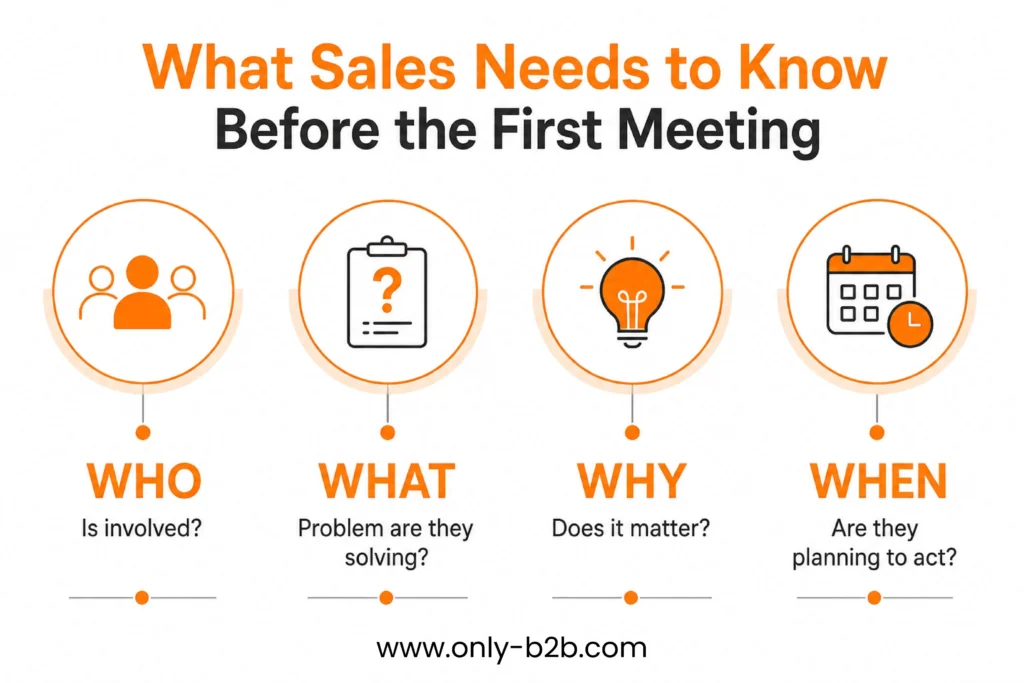
A sales-ready meeting usually has four things in place.
ICP Fit
The prospect should match the ideal customer profile closely enough to justify the conversation. That includes company size, industry, geography, business model, and operational maturity. If the account sits too far outside the ICP, the meeting may still happen, but it will rarely create predictable value.
Buyer Intent
The prospect should show some sign of active interest. That does not always mean they are ready to buy today. It does mean they are exploring a problem, evaluating options, or trying to understand whether change is worth pursuing.
Authority or Influence
The meeting does not always need the final decision-maker, but it should include someone who can shape the buying process. If the contact cannot influence the next step, the conversation may be informative but not commercially useful.
Pain or Priority
There should be a real reason for the meeting. A business challenge, a growth target, an operational bottleneck, or a strategic initiative gives the conversation direction. Without that, the meeting becomes polite discovery with no clear path forward.
When these four elements are present, the meeting is much more likely to be worth the time.
Appointment Qualification Checklist
A good qualification checklist removes guesswork.
It gives SDRs a consistent way to evaluate whether a meeting should be booked, pushed forward, or held until more context is available. That consistency matters because qualification is often where quality breaks down.
A practical SDR qualification checklist should answer questions like:
- Does this account fit our ICP?
- Is there a clear business issue or opportunity?
- Has the prospect shown active interest in solving it?
- Is the contact relevant to the buying process?
- Do we understand the likely timeline?
- Is there enough context to justify a sales conversation?
- Does the meeting objective match the buyer’s stage?
The point is not to force every prospect into a rigid script. The point is to create enough structure that the team can make better decisions.
A strong checklist improves qualified appointments because it filters out conversations that are too early or too vague. It also helps SDRs slow down just enough to gather the context that sales actually needs. That is where the difference between a booked meeting and a useful meeting becomes visible.
Using QA Scorecards for SDR Performance
If you only measure SDRs by meetings booked, you will get more meetings. You will not necessarily get better ones.
That is why SDR quality assurance needs a scorecard. A scorecard gives managers a way to review the work behind the meeting, not just the meeting itself. It turns quality into something observable.
A useful scorecard usually includes:
Qualification Accuracy
Did the SDR correctly assess fit, intent, authority, and need?
Messaging Quality
Did the outreach reflect the buyer’s world, or did it sound generic?
Discovery Depth
Did the SDR uncover enough context to support a meaningful handoff?
Data Accuracy
Was the CRM updated clearly and consistently?
Meeting Viability
Would sales reasonably accept this meeting as worth taking?
This is where call reviews become valuable. They show whether the rep is asking the right questions, listening to the right signals, and documenting the right details. Over time, the scorecard becomes a coaching tool, not just a reporting tool.
Creating a Sales Acceptance Process
A meeting should not become a sales meeting simply because it was booked.
That sounds obvious, but many teams still operate that way. The meeting lands on the calendar, and the assumption is that sales will make it work. In practice, that creates frustration on both sides.
A better model is a sales acceptance process.
That means the AE reviews the meeting details and decides whether to accept it, request more context, or reject it with a clear reason. This is not about creating conflict. It is about creating standards.
When acceptance decisions are tracked, patterns become visible quickly. Maybe the SDR is qualifying too loosely on authority. Maybe certain industries consistently underperform. Maybe the messaging is attracting curiosity but not urgency. Those insights are valuable because they show where the appointment setting process is leaking.
The acceptance workflow also improves accountability. SDRs learn what sales actually values. Sales learns where qualification is strong and where it needs support. That shared visibility is what makes the process durable.
Building a Continuous Feedback Loop
Quality control only works when feedback moves in both directions.
SDRs need to know what happens after the handoff. Sales needs to know what happened before the meeting was booked. Marketing needs to know which sources create stronger conversations. Without that loop, everyone is working from partial information.
The strongest teams build a rhythm around feedback.
That can include weekly meeting reviews, manager coaching, Account Executive feedback sessions, and periodic calibration between sales and marketing. The goal is not to create more meetings about meetings. The goal is to keep qualification standards aligned with reality.
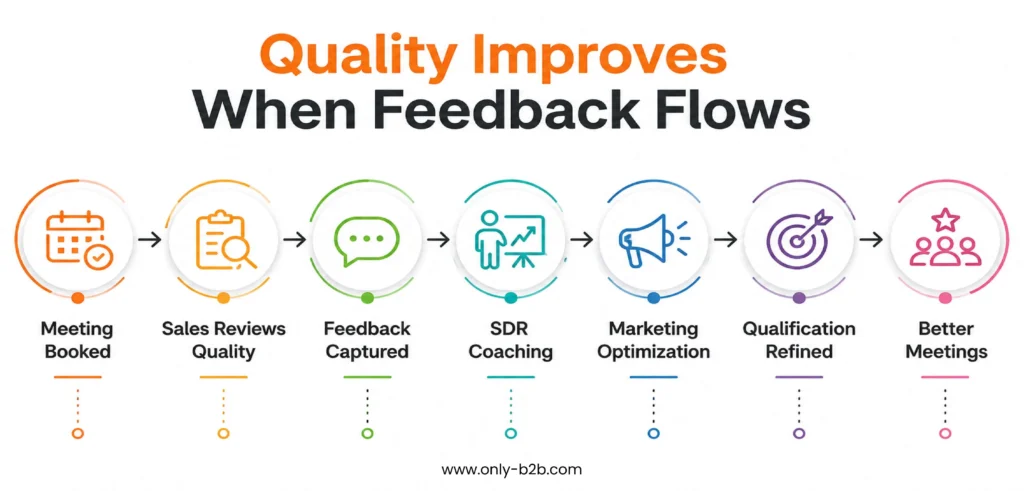
When the feedback loop is healthy, the team starts to see patterns instead of isolated outcomes. They learn which messages attract the right buyers, which objections signal weak fit, and which sources produce the best pipeline quality. That is how appointment optimization becomes a system rather than a guess.
Reducing No-Shows and Improving Meeting Attendance
A booked meeting is not a finished outcome.
If the prospect does not show up, the revenue value disappears before the conversation even starts. That is why no-show reduction belongs inside the quality process, not outside it.
The best teams treat confirmations as part of the selling motion. They do not rely on one automated reminder and hope for the best. They build a simple but intentional sequence.
That usually includes:
- A confirmation email right after booking.
- A reminder closer to the meeting date.
- Calendar alignment checks.
- A clear explanation of why the meeting matters.
In some cases, a human follow-up works better than another automated touch.
The goal is to reduce friction before the meeting begins.
When the prospect understands the purpose, the timing, and the expected outcome, attendance improves. That also improves the quality of the conversation itself because the buyer arrives with more context and less ambiguity.
Metrics That Measure Appointment Quality
If you want to improve appointment quality, you need to measure more than volume.
The most useful appointment setting metrics are the ones that connect meetings to revenue outcomes.
- Show Rate: How many scheduled meetings actually happen?
- Acceptance Rate: How many meetings does sales accept without hesitation?
- Meeting Conversion Rate: How often do meetings move into the next stage of the funnel?
- Opportunity Conversion Rate: How many meetings become qualified opportunities?
- Pipeline Contribution: How much pipeline can be traced back to booked meetings?
- Sales Feedback Score: How does sales rate the quality of the meetings it receives?
These metrics tell a more complete story than booked meetings alone. They show whether the process is creating real momentum or just filling calendars.
They also help teams diagnose the problem faster. If show rates are weak, the issue may be confirmation. If acceptance rates are low, the issue may be qualification. If conversion is weak, the issue may be fit or timing. That is the value of measurement. It turns vague frustration into something the team can actually improve.
Common Appointment QA Mistakes
Most appointment quality problems come from a few predictable mistakes.
FAQs
What is an appointment setting quality control process?
It is the system used to review booked meetings and confirm they meet the standards for a meaningful sales conversation.
Why are sales-ready meetings important?
Sales-ready meetings give sales a better chance of advancing real opportunities instead of spending time on weak or premature conversations.
What should be included in an SDR qualification checklist?
The qualification checklist should include ICP fit, buyer intent, authority, pain point, timing, and enough context to justify the meeting.
How does SDR quality assurance improve performance?
It helps managers review qualification accuracy, messaging quality, and meeting viability so coaching becomes more specific.
What is the best way to reduce no-shows?
Use confirmation workflows, reminder sequences, calendar alignment, and clear value reinforcement before the meeting.
Which appointment setting metrics matter most?
Show rate, acceptance rate, meeting conversion rate, opportunity conversion rate, and pipeline contribution are the most useful indicators.
Quality-First Approach to Appointment Setting
The strongest revenue teams do not chase appointments for the sake of activity.
They build a process that helps them book the right conversations with the right prospects at the right time.
That is what an appointment setting quality control process is really for. It protects sales time, improves handoffs, strengthens pipeline quality, and makes forecasting more reliable. It also gives SDRs a clearer standard to work toward, which improves both confidence and consistency.
When quality becomes the priority, the entire motion changes.
The team stops asking how many meetings were booked and starts asking which meetings were worth booking. This leads to cleaner pipeline, shorter sales cycles, and a revenue process that is easier to trust.

Vikas Bhatt is the Co-Founder of ONLY B2B, a premium B2B lead generation company that specializes in helping businesses achieve their growth objectives through targeted marketing & sales campaigns. With 10+ years of experience in the industry, Vikas has a deep understanding of the challenges faced by businesses today and has developed a unique approach to lead generation that has helped clients across a range of industries around the globe. As a thought leader in the B2B marketing community, ONLY B2B specializes in demand generation, content syndication, database services and more.