

For any business, the priority is straightforward. Revenue needs to be generated consistently.
That expectation usually shows up as pipeline performance.
A healthy pipeline is not just about volume. It depends on how many of those opportunities are qualified enough to move forward and close. Without that, a pipeline becomes an activity without an outcome.
Most teams are not struggling to generate leads. They are struggling to convert them. In fact, only 27% of leads are actually sales-ready when they enter the system
But this is where most teams start to feel the gap. There are leads coming in. There is outreach happening. The system looks active. Yet conversions remain unpredictable.
So the question is not whether you have pipeline.
It is how you are building it, and how it will translate into revenue the way it should.
What Is Pipeline Generation in B2B?
A prospect downloads a report, attends a webinar, and even replies to an email. It looks like progress, but when sales engages, the conversation stalls. There is interest, but no urgency, no defined problem, and no clear next step.
Now compare that with a prospect who is evaluating options, asking specific questions, and aligning stakeholders. That conversation moves forward with clarity.
Pipeline generation is the process of creating qualified sales opportunities that are ready to progress through the pipeline and convert into revenue.
A pipeline opportunity reflects readiness, where the prospect acknowledges the problem, the fit is clearer, and there is a reason to move forward.
It changes how teams allocate effort and how outcomes are measured.
Pipeline generation focuses on conversations that can progress, not just interactions that look positive. It filters early curiosity and prioritizes engagement with direction.
Pipeline Generation vs Lead Generation
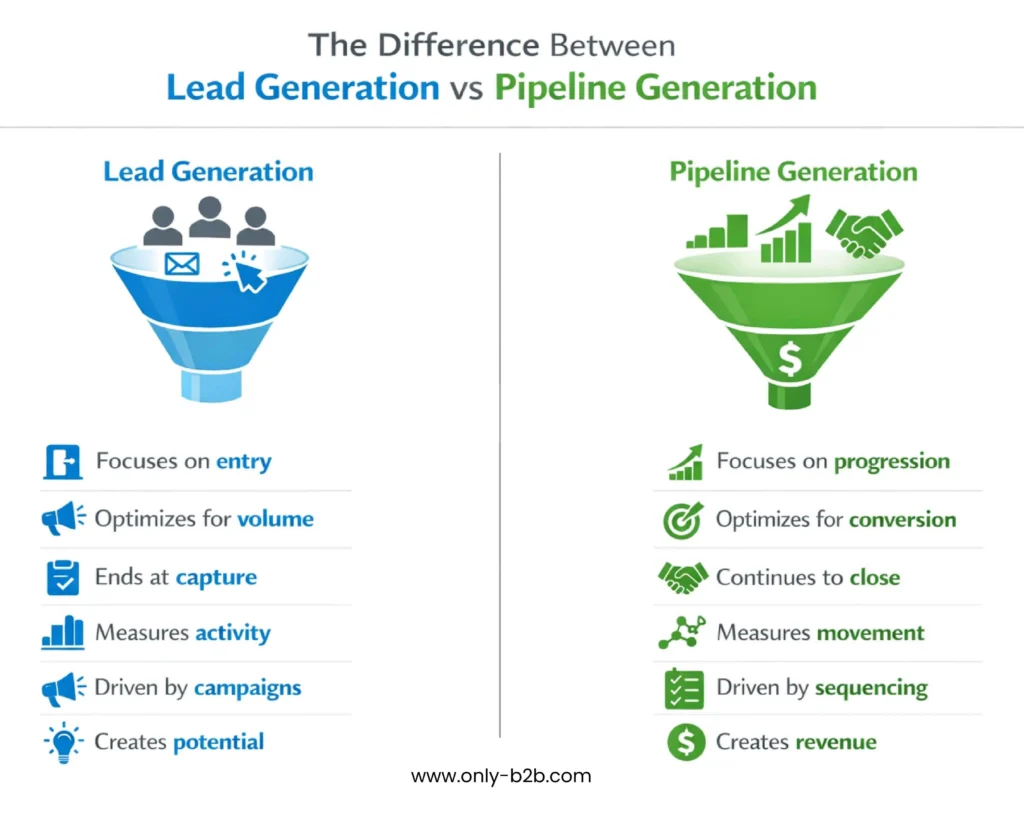
The difference between lead generation and pipeline generation is not just what they do, but where they sit in the flow.
Lead generation is focused on bringing new prospects into the funnel. Once a lead is captured, its role is largely complete.
Pipeline generation picks up from there. It is responsible for what happens after a lead enters the system. How it is qualified, how it is engaged, and whether it actually progresses toward a deal.
Lead generation creates entry into the system, while pipeline generation creates progression through it.
Both are necessary, but they serve different purposes. One fills the top funnel, and the other one determines whether anything actually moves forward.
A pipeline generation strategy ensures these two are aligned, so that leads do not just enter the funnel, but are consistently moved toward revenue.
The Math Behind Pipeline Generation
Pipeline generation becomes clearer when it is tied to a single control metric: coverage.
Most teams track pipeline as a number. Fewer understand whether that number is actually sufficient to support their revenue target.
Pipeline Coverage Ratio = Total Pipeline Value / Sales Target
The pipeline ratio tells you whether your current pipeline can realistically convert into the revenue you are aiming for.
If your coverage is 1x, you are relying on everything to close. That is not realistic. If your coverage is 3x to 5x, depending on your win rate and sales cycle, you have a healthier buffer built into the system.
This is where pipeline generation directly connects. Its role is not just to create opportunities, but to maintain the right level of coverage consistently over time.
When coverage is low, it signals that not enough qualified opportunities are entering the pipeline. When coverage is high but revenue is still missed, it points to issues with pipeline quality or conversion.
Fluctuating coverage is another signal. It usually indicates inconsistency in how the pipeline is being generated, rather than a stable system.
This is why pipeline generation cannot be viewed as a top of funnel activity. It is a continuous effort to ensure that the pipeline remains balanced, sufficient, and aligned with revenue expectations.
Where Pipeline Actually Comes From
Pipeline rarely comes from a single motion, even though teams like to assign it that way.
Marketing claims inbound. Sales claims outbound. Partnerships sit somewhere in between. On paper, it looks clean. In reality, a pipeline is built through overlap.
A prospect reads something, ignores it, sees you again, gets an email, attends a session, then finally responds. No single touchpoint created the opportunity. The sequence did.
- Inbound captures existing demand.
- Outbound creates it where it does not exist yet.
- Account-based efforts deepen relevance within a defined set of companies.
- Partnerships accelerate trust.
- Content syndication expands reach beyond owned channels.
Each of these works. None of these works alone for long.
The issue is not lack of channels. It is over-reliance on one. That is where the pipeline starts to feel inconsistent.
Strong teams do not ask which channel works best. They ask which combinations create movement. That is what a pipeline generation strategy actually evaluates. Not how leads enter, but how they turn into opportunities.
Building a Multi-Channel Pipeline Engine
Buyers do not move through a single channel. On average, companies are using around 10 different marketing channels to engage prospects.
The journey is not linear. It is built through repeated interactions across touchpoints.
They move across touchpoints without thinking about it. What feels like a campaign internally feels like a sequence externally.
When channels are disconnected, that sequence breaks. Messaging changes, context resets, and momentum drops.
When channels are aligned, the second interaction feels familiar. The third feels relevant. When the sales team engages, the conversation does not start from zero.
A pipeline generation strategy focuses on that movement. It ensures that each touchpoint adds to the previous one instead of restarting the journey.
To build this in practice:
- Start by aligning inbound and outbound efforts so they reinforce each other instead of operating in silos.
- Define a clear sequencing logic across touchpoints so interactions build momentum rather than feel random.
- Align messaging across channels so each interaction adds context instead of repeating the same narrative.
- Map the actual buyer journey to validate how prospects are moving across these touchpoints in reality.
- Track movement between stages, not just channel performance. Focus on progression, not isolated metrics.
Start With ICP and Intent Signals
Most pipeline problems do not start in execution. They start in selection.
If the wrong accounts enter the system, everything that follows becomes harder. More effort is required to get less movement.
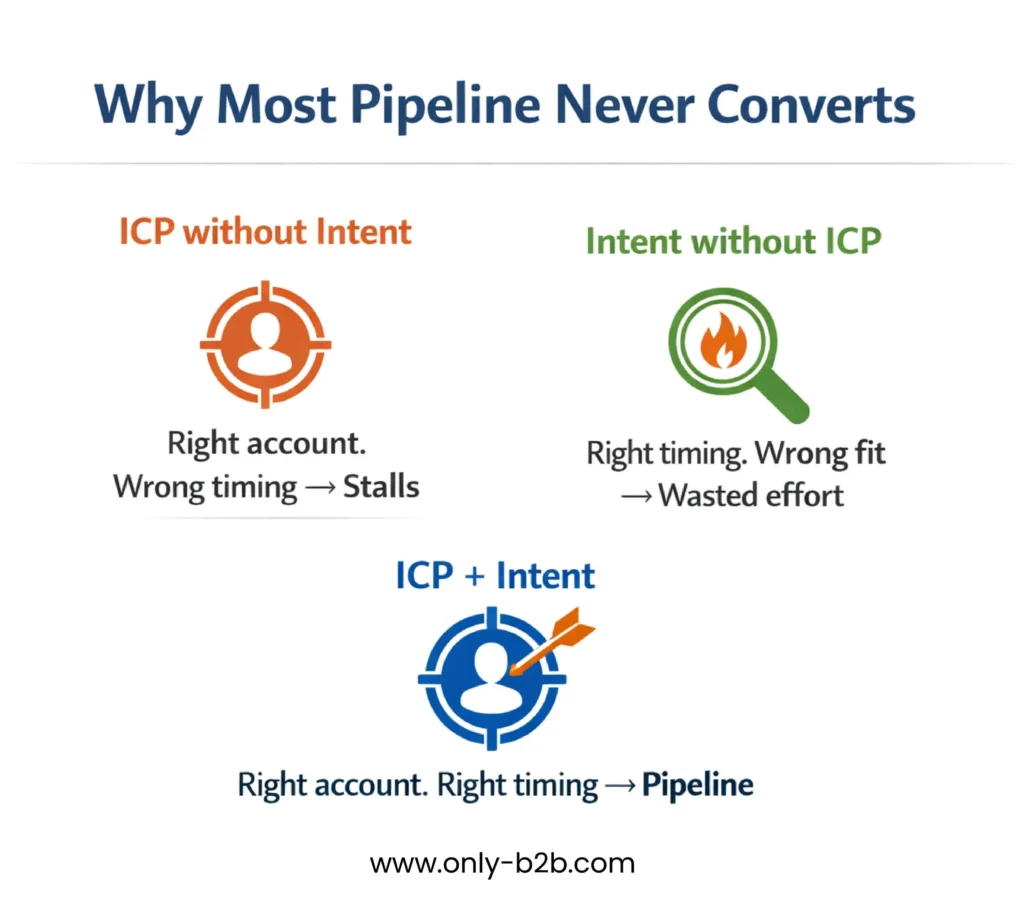
ICP defines who should not be in your pipeline just as clearly as who should.
Intent adds timing to that filter. It answers a different question. Not just who fits, but who is likely to act.
On their own, intent signals can be misleading. A few interactions do not always mean readiness. But when layered correctly, they reduce guesswork.
This is where teams either gain leverage or lose it. If selection is weak, pipeline depends on effort. If selection is strong, the pipeline depends on timing.
A pipeline generation strategy brings both together. It ensures that outreach is not just targeted, but timed in a way that increases the chance of progression.
Pipeline Strategy by Company Stage
Pipeline expectations change with maturity, but teams often apply the same model across stages.
Start-up/Seed Level: Early-stage teams rely on outbound because they need direct feedback. They are not just building pipelines. They are discovering where it exists.
Growth Level: Inbound starts contributing more consistently. Patterns emerge, conversion becomes more predictable, and the system begins to stabilize.
Enterprise Level: Deals are larger, cycles are longer, and multiple stakeholders are involved. Pipeline is less about volume and more about depth.
This is where orchestration matters. Not just generating interest, but managing multiple conversations within the same account.
There is no fixed playbook here. What works at one stage creates friction at another.
Who Owns Pipeline Generation?
Ownership becomes unclear the moment a pipeline is treated as a handoff.
When marketing generates, SDRs qualify and sales close, the gaps sit between these roles.
Pipeline does not exist within a function. It exists between them.
That is where most delays happen. A lead is passed too early. A conversation is picked up too late. Context is lost in transition.
This is not a resource problem. It is an alignment problem.
Revenue operations becomes critical here, not because it manages tools, but because it aligns definitions. What qualifies? What progresses? What actually counts.
When those definitions are not shared, the pipeline becomes inconsistent across teams.
A pipeline generation strategy does not assign ownership to one function. It creates shared accountability for movement.
Understanding Pipeline Velocity
Pipeline size gets attention because it is visible. Velocity matters because it is revealing.
A large pipeline with slow movement is not strength.
When deals take longer than expected, something earlier in the system is misaligned.
- Positioning may be unclear.
- Qualification may be loose.
- Expectations may not match reality.
Velocity exposes that.
Faster movement does not mean rushing deals. It means reducing friction. Conversations progress because they are relevant, not because they are pushed.
This is where predictability improves. Not by adding more opportunities, but by ensuring existing ones do not stall. A pipeline generation strategy looks beyond volume. It asks whether opportunities are actually moving, and why.
How to Build a Predictable Pipeline Engine
Predictability does not come from adding more activity. It comes from reducing ambiguity.
Step 1: Define what qualifies as an opportunity. Without a clear definition, pipeline gets inflated and misleading, and teams operate with different assumptions.
Step 2: Align on progression. Agree on what actually moves a deal forward and what does not, so movement is consistent across teams.
Step 3: Measure movement, not activity. Identify where deals slow down, where they drop, and where they accelerate.
Step 4: Identify patterns. Once movement is tracked, recurring gaps and bottlenecks start to become visible.
Step 5: Iterate based on what is observed. Changes are made from real patterns, not assumptions or isolated feedback.
Step 6: Repeat consistently. A pipeline engine is not built once. It is refined continuously as the system evolves.
A pipeline generation strategy connects these steps so improvements are not isolated but part of a larger, aligned system.
Common Pipeline Generation Mistakes
Common Pipeline Generation Mistakes
Most pipeline issues are not dramatic. They are subtle, repeated, and often hidden inside everyday execution.
Over-reliance on a single channel creates dependency and unstable pipeline.
FixBuild a balanced channel mix that distributes risk and improves consistency.
Broad targeting increases volume but reduces conversion.
FixTighten ICP and focus on relevance over reach.
Slow follow-up kills momentum before it develops.
FixReduce response time and prioritize high-intent leads.
Late qualification wastes effort on poor-fit prospects.
FixQualify earlier in the process before deeper engagement.
Disconnected messaging resets context across touchpoints.
FixAlign communication so each interaction builds on the previous one.
Tracking activity instead of movement hides real problems.
FixMeasure progression across stages, not just output.
FAQs
What is a pipeline generation strategy?
Pipeline generation strategy is a process that involves activities and tasks to create and advance qualified opportunities that contribute directly to revenue outcomes.
How is a pipeline different from leads?
Leads represent interest, while pipelines represent opportunities with a higher likelihood of conversion based on fit and timing.
What is a good pipeline coverage ratio?
It depends on the win rate but typically ranges between three to five times the revenue target for most B2B teams.
What are common B2B pipeline sources?
Inbound, outbound, account-based initiatives, partnerships, and content syndication all contribute differently.
How do buying intent signals improve pipeline?
They help prioritize prospects who are more likely to engage and convert based on observed behavior.
Final Thoughts
Pipeline is not an outcome. It is a system that reflects how well your growth efforts are aligned across functions and stages.
A pipeline generation strategy brings structure to how opportunities are created and progressed. It connects effort with direction and activity with intent in a way that compounds over time.
When that clarity exists, the pipeline becomes more predictable. And predictability is what turns growth from pressure into planning and from reaction into control.

Vikas Bhatt is the Co-Founder of ONLY B2B, a premium B2B lead generation company that specializes in helping businesses achieve their growth objectives through targeted marketing & sales campaigns. With 10+ years of experience in the industry, Vikas has a deep understanding of the challenges faced by businesses today and has developed a unique approach to lead generation that has helped clients across a range of industries around the globe. As a thought leader in the B2B marketing community, ONLY B2B specializes in demand generation, content syndication, database services and more.