In a live sales conversation, intent is easier to read. You hear it in the questions, you see it in the pauses, and you pick it up in how specific the discussion becomes.
You don’t get this clarity in a digital buying journey. With Gartner’s report highlighting that around 80% of B2B sales interactions are now on digital channels, this challenge doesn’t get any easier.
Most buyers move through research independently. Search queries, repeated website visits, time spent on specific pages, content downloads, and review platform activity. None of these say anything explicitly. But together, they begin to indicate direction.
These digital breadcrumbs are not noise. They are signals.
The challenge is not access to this activity. It is knowing how to read it well enough to understand when interest becomes intent.
This is where buying intent signals become useful. Not as additional data, but as a way to interpret behavior with enough clarity to act at the right time.
What Are Buying Intent Signals?
Buying intent signals are behavior patterns of a potential buyer that show their interest in a specific solution, product, or topic.
These behaviors might include reading articles, downloading assets, or direct demo requests. It is anything that shows you that the buyer is in the market, making their move.
You can see these signals from your first-party sources like your email or website or from third-party sources like syndication platforms, review sites, etc.
These signals help sales and marketing teams know who is actively looking for a similar solution in the market.
Types of Buying Intent Signals in B2B
Intent shows up in different ways depending on where the activity happens and what it actually reveals about the buyer. Not every signal comes from direct interaction with your brand, and not every meaningful signal looks like engagement.
A more practical way to look at intent is through four distinct lenses. Each one captures a different kind of movement inside an account.
Engagement Intent
This is the most visible form of intent because it happens directly on your channels. It reflects how a prospect is interacting with your brand and how that interaction is evolving over time.
It usually starts broad and becomes more specific.
This includes:
- Visiting pricing or product features pages on the website.
- Downloading gated content like reports or templates.
- Subscribing to newsletters.
- Registering for webinars.
- Clicking through product-focused emails.
- Spending time on high-intent pages.
When engagement becomes deeper and more focused, it starts indicating real consideration.
Technographic Intent Signals
These signals reflect changes in a company’s technology environment. They are less obvious, but often more telling because they indicate shifts in infrastructure, priorities, or capability.
These intent signals include:
- Adopting tools that integrate with your solution.
- Removing a competitor’s product from the tech stack.
- Adding new systems in adjacent categories.
- Moving from legacy systems to cloud-based platforms.
- Referencing specific technologies in job postings.
These signals rarely show urgency on their own. But they often indicate that the conditions for a buying decision are forming.
Company Activity Intent Signals
Not all intent comes from engagement or tools. Sometimes it comes from what is happening inside the business itself. This includes:
- New funding announcements.
- Expansion into new markets.
- Launching new product lines.
- Mergers or acquisitions.
- Internal restructuring often creates new requirements.
These shifts usually come with new budgets, new priorities, or new problems to solve. These signals do not tell you that a company is actively evaluating vendors. But they often explain why they might start soon.
Hiring Intent Signals
Hiring patterns are one of the more overlooked indicators of intent. The roles a company is hiring for often reflect what they are planning to build, fix, or scale.
Examples of hiring intent signals include:
- Hiring for roles that commonly use your solution.
- Creating leadership positions in relevant functions.
- Expanding teams in specific departments.
- Recruiting specialists with expertise aligned to your category.
Hiring does not confirm immediate intent. But it signals direction. And in many cases, direction is enough to prioritize an account earlier than competitors.
Each of these signal types captures a different layer of buyer behavior. Engagement shows attention. Technographic signals show capability shifts. Company activity shows business context. Hiring shows future direction.
When these start aligning, intent becomes much clearer.
High-Intent vs Low-Intent Signals
Not all intent signals reflect the same level of buying readiness. The difference is not just in what the action is, but in what it represents in the buyer’s journey.
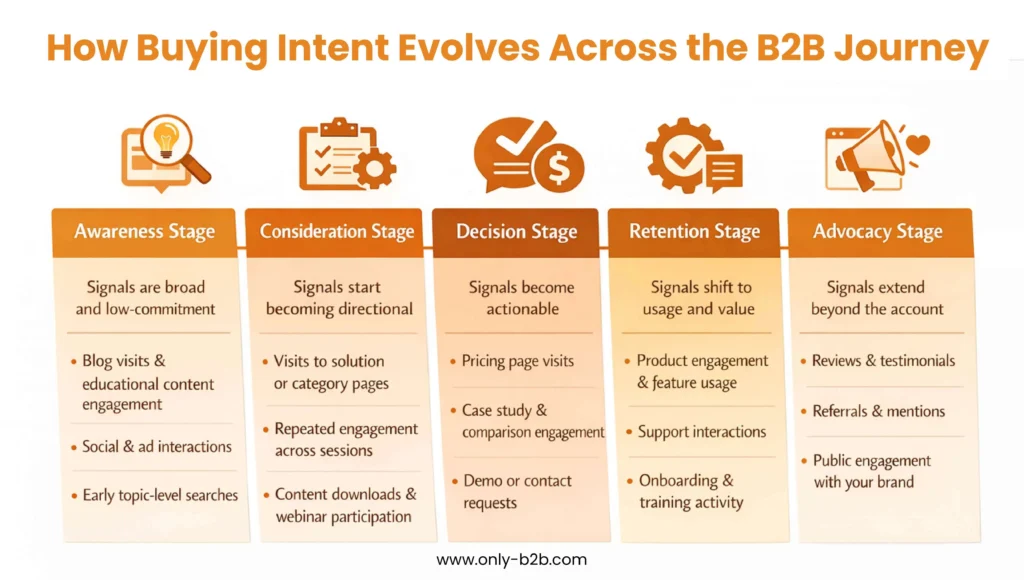
Low-intent signals usually appear early. They sit at the awareness stage where the buyer is exploring, trying to understand the space, and gathering context. This includes reading general content, browsing category pages, or engaging with broad topics.
These signals indicate interest, not urgency. They tell you the buyer is paying attention, but not necessarily preparing to act. Treating them as triggers for immediate outreach often leads to conversations that feel out of place. At this stage, the role is to stay relevant and allow the intent to develop.
High-intent signals look different. They tend to show up when the buyer has moved into evaluation and is actively narrowing options. Repeated visits to pricing pages, engagement with case studies, comparison-focused research, and demo requests are rarely accidental. They indicate that the buyer is moving closer to a decision.
This is where intent signal strength becomes useful. It helps distinguish between signals that require patience and those that justify action.
The shift is simple but important. Not every interaction needs the same response. The right interactions, at the right stage, should not be ignored.
Interpreting signals in the context of buying stages is what turns activity into direction.
Common Buying Intent Signals to Track
Intent signals show up in many forms. Some are obvious. Others are easy to miss because they do not look like direct engagement.
Here are some of the most useful signals to pay attention to:
Repeated visits to your website
A single visit can be curiosity. Multiple visits over a short period, especially to product or pricing pages, usually indicate deeper interest or internal discussion.
Time spent on educational content
Engaging with blogs, webinars, or learning resources shows the buyer is trying to understand a problem or evaluate approaches. This often sits between awareness and consideration.
Searching for competitor comparisons or alternatives
Queries like “[competitor] vs [your brand]” or “best tools in [category]” suggest the buyer is actively comparing options and narrowing choices.
Activity on third-party review platforms
Visits to sites like G2 or TrustRadius indicate evaluation. If your category is being researched there, the buyer is likely building a shortlist.
Account-level engagement spikes
A sudden increase in activity from a single company across content, ads, or emails often signals that something is happening internally.
Consistent traffic from target account IPs
Even without a form fill, repeated visits from the same organization suggest ongoing interest that has not yet been made explicit.
Participation in industry communities
Questions, comments, or discussions in niche forums or groups can reveal what problems the buyer is actively trying to solve.
Demo requests or contact form submissions
This is one of the clearest signals of intent. The buyer is ready to engage directly, and response timing matters.
Technographic changes
Adding or removing tools from a tech stack often signals shifting priorities or gaps that need to be filled.
How to Identify Buying Intent Signals
Identifying intent is less about adding more tools and more about knowing what to look for and how to connect it.
There are three practical shifts that make intent easier to identify:
More attention to sequences:
A single visit or download does not mean much. A sequence of actions across pages, content, and time starts to indicate direction. The question is not “what did they do” but “what are they doing repeatedly.”
Account-level activity:
In most B2B journeys, multiple stakeholders are involved. One person’s activity can look insignificant. Combined activity across a team often reveals real intent. This is where account prioritization becomes more accurate.
Pay attention to change:
Static engagement is easy to ignore. Sudden spikes, new types of interaction, or movement toward high-intent pages signal that something has shifted internally.
Tools and tracking systems support this, but they do not replace judgment. The role of tracking tools is to surface behavior. The role of the team is to interpret what that behavior means in context.
Creating an Intent Scoring Model
Intent scoring is simply a way to decide what deserves attention first.
It should be simple enough that any SDR or marketer can apply it without overthinking.
A usable model comes down to three checks:
- Closeness to decision: Is the action tied to evaluation or just exploration
- Repetition: Is this happening once or multiple times
- Recency: Is this happening now or did it happen earlier
Use this to label signals clearly:
Low Intent (Track)
- Blog reads
- Early content engagement
- One-time visits
Mid Intent (Watch)
- Repeat visits
- Engagement with solution pages
- Multiple actions over time
High Intent (Prioritize)
- Pricing page visits
- Case studies
- Comparison research
- Demo or contact requests
Make it operational:
- Prioritize accounts, not individuals
- Move accounts up only when signals repeat or intensify
- Review and re-rank regularly
If the team cannot quickly agree on what is high vs low intent, the model is too complex.
When Should You Act on Intent Signals?
Scoring helps you prioritize. Acting depends on signal behavior, not just signal type.
Three situations usually justify outreach:
- When activity spikes
A sudden increase in visits or engagement suggests something has changed internally - When multiple signals align
Website activity, external research, and multiple stakeholders engaging at once reduce guesswork - When behavior shifts toward decision
Pricing views, comparisons, or demo requests indicate the buyer is close to acting
What to avoid:
- Acting on single low-intent signals
- Waiting despite clear high-intent patterns
Poor timing feels like an interruption. Good timing feels like continuation.
Using Intent Signals in Outbound Strategy
Intent signals make outbound less about guessing and more about timing and context. Instead of starting cold, outreach begins from something the buyer has already done.
In practice, this shows up as:
- Trigger outreach based on signal clusters
- Align messaging to observed behavior
- Prioritize accounts showing recent and repeated engagement
- Route high-intent accounts directly to SDRs for faster follow-up
- Use signals to personalize entry points into the conversation
- Treat outreach as continuation of buyer research
This is where outbound stops feeling cold and starts feeling timely.
Turning Intent Signals Into Pipeline
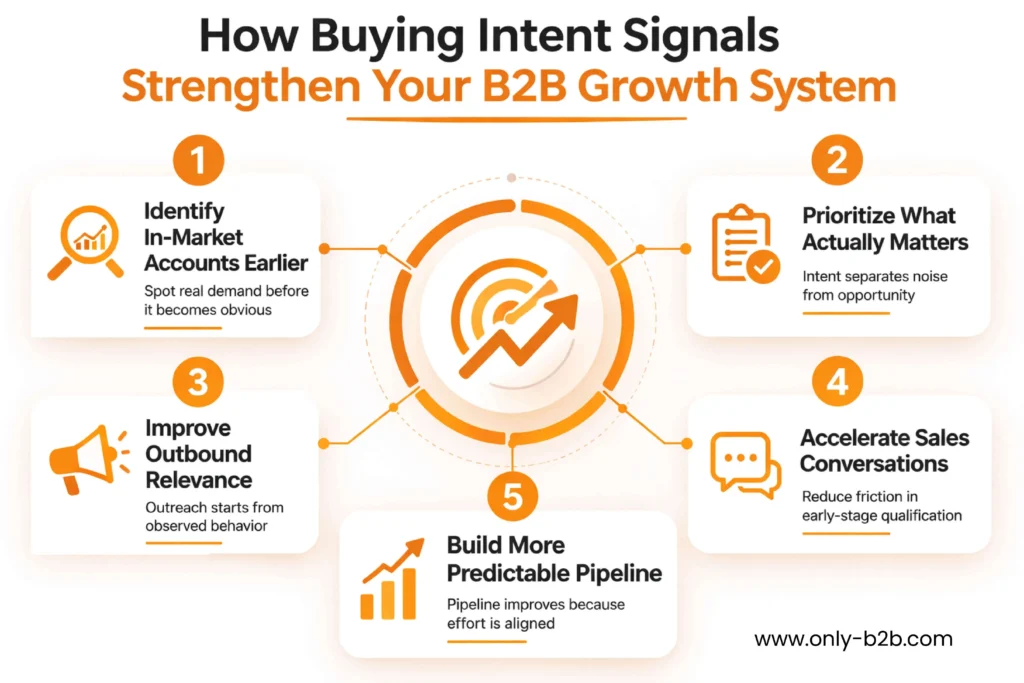
Intent signals improve pipeline by shifting focus from broad outreach to accounts already showing movement. As per Gartner, B2B buyers actively avoid the suppliers with irrelevant outreach.
Instead of creating demand from scratch, teams engage where evaluation is already underway.
Conversations start closer to decision, qualification becomes clearer, and effort is concentrated on higher-probability opportunities.
Over time, this tightens pipeline quality, shortens cycles, and makes outcomes more consistent because timing and relevance are built into how opportunities are created.
Common Intent Data Mistakes
Most issues with intent data come from how it is used, not the data itself. Small interpretation gaps tend to compound into missed opportunities or wasted effort.
Common Intent Signal Mistakes (And Fixes)
Misinterpreting intent signals often leads to poor timing, missed opportunities, or wasted outreach effort.
FAQs
What are buying intent signals in B2B?
Buying intent signals in B2B are common behavioral patterns of prospects online that indicate they are moving closer to making a purchase decision.
What are common intent data examples?
Common intent data examples include pricing page visits, repeat sessions, case study downloads, and increased research activity.
What is intent scoring?
A method of assigning relative importance to actions taken by prospects based on their buying readiness.
Why is intent timing important?
Engagement is most effective when it aligns with the buyer’s stage in the decision process.
How does intent improve pipeline generation?
Intent signals enable you to focus on accounts that are already showing meaningful interest, which improves the conversion likelihood.
Final Thoughts
Buying intent signals do not create demand. They reveal it earlier than most teams are used to seeing. The advantage is not in having more data, but in recognizing patterns before they become obvious.
When timing, prioritization, and context align, the pipeline stops being reactive and starts becoming predictable. That shift is where intent turns into real growth.

Vikas Bhatt is the Co-Founder of ONLY B2B, a premium B2B lead generation company that specializes in helping businesses achieve their growth objectives through targeted marketing & sales campaigns. With 10+ years of experience in the industry, Vikas has a deep understanding of the challenges faced by businesses today and has developed a unique approach to lead generation that has helped clients across a range of industries around the globe. As a thought leader in the B2B marketing community, ONLY B2B specializes in demand generation, content syndication, database services and more.