B2B marketers today face a frustrating reality: generic campaigns don’t break through anymore. Buying committees are larger, attention is shorter, and the best-fit accounts expect relevance from the first touch.
That’s where Account-Based Marketing (ABM) wins. ABM focuses your team on a defined set of high-value accounts and coordinates personalized outreach across channels, so you drive stronger engagement, cleaner pipeline, and better conversion efficiency.
In this guide, you’ll find 14 proven ABM tactics you can apply right now, from targeting and personalization to multi-channel execution and measurement.
If you’re new to ABM, start with our account based marketing framework to structure your program before you scale.

Account-Based Marketing Tactics for B2B Growth
Tactic #1: Prioritize Existing Customers (Your Fastest ABM Wins)
If you already have customers, you already have your best ABM “account list.” They’ve experienced your value, you have real usage + buying data, and expansion deals typically close faster than net-new.
Start by identifying:
- Top revenue customers
- High product adoption accounts (or highest engagement)
- Accounts with upcoming renewal dates
- Customers with adjacent teams/geographies you can expand into
Why this works: improving retention even slightly has a compounding impact. Bain’s research is widely cited for showing that increasing retention by as little as 5% can increase profits by 25% to 95%. Bain
Quick ABM playbook for existing customers:
- Run account reviews with Sales/CS and pick 10–20 expansion accounts
- Build role-based messaging (Economic buyer vs champion vs end users)
- Use personalized content: case studies, adoption guides, rollout templates
- Trigger outreach around key moments: renewals, new feature launches, usage drop-offs
This tactic also helps you clarify where ABM fits compared to lead-gen approaches.
Tactic #2: Use Lookalike Modeling to Find Net-New High-Intent Accounts
Once you know which customers are your best-fit, you can use them to find more accounts that look and behave similarly.
Start by building a “best customer” segment (even 20–50 accounts is enough) based on:
- Industry + company size
- Deal size and sales cycle length
- Retention / expansion history
- Use case fit (what they bought and why)
Then create lookalike audiences using:
- LinkedIn Matched Audiences (company list)
- Google/YouTube customer match (if you run ads)
- ABM/intent platforms (if available)
Pro tip: don’t build one huge lookalike list. Create 2–3 lookalikes based on different customer clusters (e.g., SaaS vs IT services vs manufacturing) so messaging stays tight.
Tactic #3: Engage Target Accounts on LinkedIn & Social Media
LinkedIn is one of the most reliable ABM channels because you can engage decision-makers publicly before you ever ask for a meeting. Start by identifying 3–8 key stakeholders per account (economic buyer, champion, influencers), then follow their activity and your target company pages.
Before you pitch, spend 7–10 days doing “signal-based engagement”:
- Like/comment on posts that reveal priorities (hiring, product launches, funding, expansion)
- Share a relevant POV (not a generic “great post”)
- Use those insights to personalize email/ad messaging later
📥 Download Your Free ABM Tactics Checklist
Want a quick-reference version of these ABM tactics?
Get the 2026 Edition ABM Checklist (PDF) — a 1-page actionable guide covering:
- ✅ ICP targeting & segmentation
- ✅ Multi-channel outreach
- ✅ Personalization, retargeting & analytics
Perfect for B2B teams planning, executing, or scaling ABM strategies.
Tactic #4: Build High-Conversion ABM Email Campaigns

Email remains one of the highest-performing ABM channels when it’s done with relevance and context. In ABM, the goal isn’t volume, it’s delivering the right message to the right stakeholder at the right moment.
Start by mapping email messaging by role and buying stage:
- Economic buyers care about business impact and risk
- Champions care about use cases and implementation
- Influencers care about technical fit and credibility
Instead of one-off emails, use short, coordinated sequences (3–6 emails) that:
- Reference the account’s industry or recent activity
- Align with what the prospect has already engaged with (ads, content, events)
- Progress from insight → value → conversation
What works well in ABM emails today:
- Clear, specific subject lines (avoid hype)
- One focused idea per email
- Proof points relevant to the account’s industry or size
- A low-friction CTA (e.g., “worth a quick discussion?” instead of “book a demo”)
This level of personalization is much easier when email is aligned with your broader ABM effort, ads, LinkedIn engagement, and sales outreach should all reinforce the same message.
For best results, review common mistakes before scaling campaigns.
Tactic #5: Run Hyper-Personalized Social Media Ads
Paid social works especially well in ABM because it allows you to control who sees your message and how it’s framed. Platforms like LinkedIn let you target accounts by company, job role, seniority, and industry, making personalization scalable.
Rather than generic ads, create account-aware messaging:
- Speak directly to the challenges of a specific role (CMO, Head of IT, RevOps)
- Reference industry context or common initiatives
- Align ad messaging with your email and sales outreach
When ads feel relevant, not promotional, they reinforce familiarity and credibility before a sales conversation even begins.
Tactic #6: Stay Top-of-Mind with ABM Retargeting Ads
ABM rarely converts on a single touch. Decision-makers interact with multiple channels before engaging, which is why retargeting helps you stay visible without being intrusive. Use retargeting to reinforce your core message, promote relevant content, and support accounts as they move through the buying journey.
Use retargeting to show relevant messages based on intent signals, such as visits to solution pages, pricing pages, or case studies. This keeps your brand relevant while aligning messaging with where the account is in the buying journey.
Tactic #7: Host In-Person ABM Events to Deepen Engagement
In-person events still work extremely well in ABM, especially for high-value deals, because they build trust faster than digital touchpoints. You don’t need large conferences.
Small, focused formats usually perform better: invite-only dinners, private roundtables, or short workshops tied to an industry event.
To make these events effective, design them around one shared priority (pipeline growth, cost reduction, security, compliance, automation, depending on the accounts you target). Invite the right stakeholders, keep it high-value, and avoid making it a sales pitch.
How to measure ABM event impact:
- Target-account attendance rate (invited vs attended)
- Post-event engagement (site visits, content downloads, reply rate)
- Meetings booked with target accounts within 14–30 days
- Pipeline influenced (opportunities created or accelerated)
After the event, follow up with coordinated email + LinkedIn outreach and share a relevant takeaway (notes, slides, or a short recap). The goal is to turn a great conversation into momentum that moves the account forward.
ABM Tactics Cheat Sheet
A quick way to choose the right ABM tactic based on your goal — targeting, engagement, pipeline acceleration, or scale.
- Prioritize existing customers for quick wins
- Use lookalike modeling to expand net-new
- Select accounts using firmographic + behavioral signals
- Personalize by role + buying stage
- Use proof points by industry (case studies, outcomes)
- Align ads + email + sales outreach with one story
- LinkedIn engagement before pitching
- Hyper-personalized social ads for target accounts
- Retargeting based on intent pages visited
- Small, high-value events (roundtables, dinners)
- Track account engagement + pipeline influence
- Use analytics tools for account-level insights
- Scale with AI + automation (without losing relevance)
- Repurpose winning assets across channels
Tip: Use this cheat sheet to plan your next 30-day ABM sprint (target accounts → outreach → engagement → pipeline).
ABM Best Practices & Execution Strategies
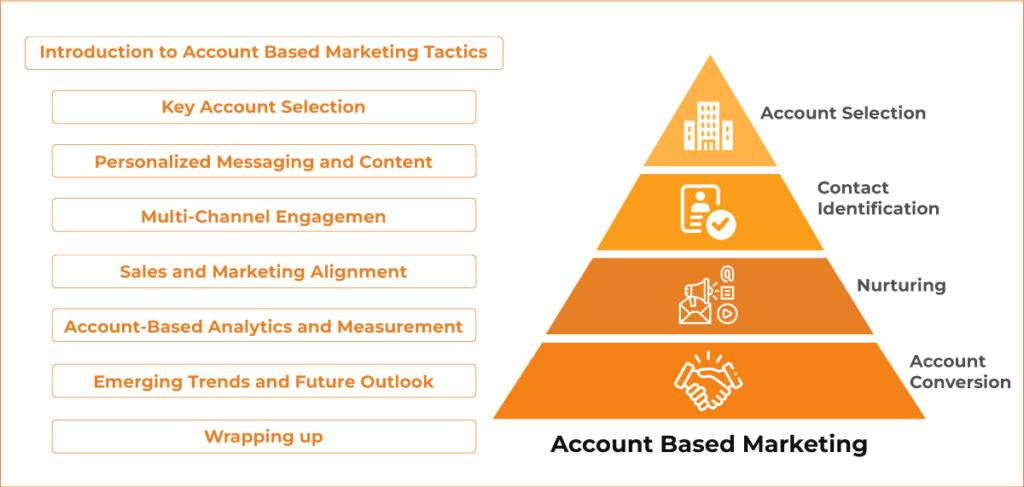
Tactic #8: Select Key Accounts Using Firmographic & Behavioral Data
The first step in successful B2B ABM is selecting the right key accounts to target. Understanding why Account-Based Marketing (ABM) is important can guide your selection process. Conduct thorough research and identify accounts that align with your business objectives and have the highest potential for revenue generation.
Factors such as company size, industry, and revenue can help in prioritizing the key accounts.
Tactic #9: Personalize Messaging and Content by Buying Stage
ABM thrives on personalized communication. Craft tailored messages and content that resonate with each target account’s specific needs, pain points, and goals.
Leverage data and insights to understand their challenges and create value-driven content that addresses their unique requirements.
Consider incorporating ABM content syndication strategies to ensure your content reaches the right decision-makers within your target accounts
Personalization creates a stronger connection and increases the chances of engagement and conversion.
Tactic #10: Use Multi-Channel Outreach to Maximize Touchpoints
Use a multi-channel strategy to communicate with target accounts at several touchpoints to maximize the impact of ABM.
Combine email campaigns, social media interactions, personalized website experiences, and offline events to create a comprehensive engagement strategy.
Consistent and coordinated messaging across channels ensures a seamless and compelling experience for the target accounts.
Alignment between sales and marketing teams is crucial for ABM success in 2026. Staying informed about the latest ABM trends can further enhance this collaboration and communication.
Foster close collaboration and communication between the two departments to ensure a unified approach towards target accounts.
Define shared goals, establish clear communication channels, and implement regular feedback loops to exchange insights and refine strategies.
This alignment enables a seamless handoff from marketing to sales, resulting in a more efficient and effective ABM strategy.
Tactic #12: Track Engagement and ROI with ABM Analytics Tools
Measure the effectiveness of your ABM efforts using account-based analytics. Monitor key metrics of ABM such as engagement rates, conversions, and revenue generated from target accounts.
Compare these results with industry account based marketing benchmarks to understand where your performance stands and identify areas for improvement.
Leverage advanced analytics tools to gain insights into the performance of specific campaigns, channels, and individual accounts.
Continuous measurement and analysis allow for data-driven optimizations and improvements to maximize ROI.
Tactic #13: Integrate AI & Automation to Scale ABM Campaigns

Stay updated with emerging trends in ABM to stay ahead of the competition. Technologies like AI and machine learning are transforming the ABM landscape, enabling advanced personalization, predictive analytics, and automation.
Recent account based marketing stats highlight the growing adoption of these technologies and their impact on campaign performance.
Stay abreast of industry developments and explore innovative tactics in 2026 such as intent data, hyper-personalization, and ABM orchestration platforms to further enhance your ABM strategy.
Tactic #14: Repurpose Winning Campaign Assets Across Channels
Don’t let high-performing ABM campaigns sit in a silo. Repurpose what works across multiple accounts and channels to save time and increase impact.
- Turn a successful webinar into a gated on-demand video + blog series
- Repurpose an email sequence into a LinkedIn InMail campaign
- Use account-specific insights from sales calls to refine future outreach copy
- Convert a landing page into a case study for similar industries
Scaling ABM is about recognizing patterns in what resonates, then amplifying it with less effort and higher consistency.
Ready to Elevate Your ABM Campaigns?
Learn how our proven ABM strategies and personalization framework can help you engage target accounts, shorten sales cycles, and boost conversions.
Talk to an ABM ExpertWe typically respond within 24 hours
Frequently Asked Questions About ABM Tactics
What are the most effective account-based marketing tactics?
Top ABM tactics include personalized email campaigns, LinkedIn and display ad targeting, retargeting sequences, exclusive events for decision-makers, and using platforms like 6sense or Demandbase to orchestrate multi-channel engagement.
How do I implement account-based marketing in B2B?
Start by defining your Ideal Customer Profile (ICP), aligning sales and marketing, selecting high-value accounts, and then personalizing content and campaigns to each. Track engagement, optimize over time, and scale using automation tools.
What is the difference between ABM and traditional lead generation?
Traditional lead gen focuses on attracting as many leads as possible. ABM focuses on a smaller number of high-value accounts with tailored campaigns designed to convert them more efficiently and profitably.
Can small teams or startups use ABM effectively?
Absolutely. Start with a narrow list of high-potential accounts. Use basic tools like email automation and LinkedIn outreach, repurpose your best content, and align closely with your sales team to make every interaction count.
How do I measure success in ABM?
Track metrics like account engagement (ad clicks, time on site, email opens), pipeline velocity, average deal size, conversion rate, and influenced revenue. Focus on account progress, not just lead volume.
Wrapping Up
ABM continues to evolve, but the core principle remains the same: focus on the accounts that matter most.
By implementing these 14 proven ABM tactics, you’re not just improving engagement, you’re building a smarter, more scalable growth engine for your B2B business.
Whether you’re just starting or optimizing an enterprise-level program, these tactics will help you personalize outreach, align your teams, and generate measurable ROI.
Before you go, make sure to download your free ABM Tactics Checklist to keep this playbook actionable and shareable across your team.
Need help bringing your ABM strategy to life?
Book a free strategy session with our team and get personalized guidance tailored to your goals.

Vikas Bhatt is the Co-Founder of ONLY B2B, a premium B2B lead generation company that specializes in helping businesses achieve their growth objectives through targeted marketing & sales campaigns. With 10+ years of experience in the industry, Vikas has a deep understanding of the challenges faced by businesses today and has developed a unique approach to lead generation that has helped clients across a range of industries around the globe. As a thought leader in the B2B marketing community, ONLY B2B specializes in demand generation, content syndication, database services and more.