
Content syndication tools help marketers distribute content beyond their own website, but the options serve different purposes. Some support paid promotion, others enable republishing or content discovery, and some provide managed B2B lead generation.
This guide reviews content syndication platforms, supporting tools and networks, including availability notes for services that have changed or closed. Use the comparisons to identify options that fit your audience, budget and campaign goals.
What Is Content Syndication?
Content syndication involves distributing or republishing existing content through third-party publishers, platforms or partners to reach additional audiences. Depending on the arrangement, readers may encounter a complete article, an excerpt or a promoted resource.
Managed B2B content syndication services can also distribute campaign assets to an agreed business audience and support lead generation. For a detailed explanation, see how content syndication works.
Why Use Content Syndication?
The potential benefits of content syndication include reaching relevant audiences beyond your own channels, extending the useful life of existing assets and creating additional opportunities for engagement.
For content syndication lead generation, results depend on audience fit, the content offer, qualification requirements and follow-up. Distribution alone does not guarantee high conversion rates or better search rankings.
Content syndication costs depend on the channel and service model. Some platforms offer free publishing or sharing features, while paid distribution networks and managed B2B programs require a campaign budget.
Compare Content Syndication Tools, Platforms and Sites
Content Syndication Platform:
#1. OnlyB2B

Only-B2B provides managed B2B content syndication services that help companies distribute their content to relevant business audiences and generate leads. Its service supports marketers looking to reach decision-makers beyond their own website and existing database.
For companies comparing content syndication options, Only-B2B fits the managed campaign category. Evaluate the service against your target audience, campaign goals, lead qualification requirements and reporting needs.
Category: Managed B2B content syndication provider
Best suited for: B2B marketers seeking content distribution and lead generation support.
Need Help with B2B Content Syndication?
Discuss your target audience, content assets and lead qualification requirements with our B2B content syndication team.
Talk to a Lead Expert#2. Outbrain (Now Part of Teads)
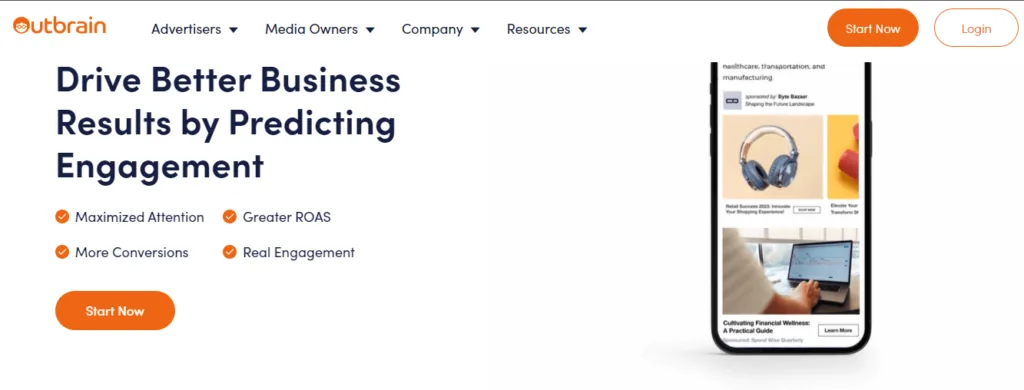
Outbrain, now operating under the Teads brand, supports paid content promotion through advertising placements across participating publishers. Marketers can use this approach to bring readers to articles, guides and campaign landing pages beyond their own website.
When evaluating this option, consider publisher relevance, targeting capabilities, campaign costs and the actions visitors take after clicking. For B2B campaigns, measure qualified conversions alongside traffic to understand whether the audience matches your business goals.
Category: Paid content recommendation network
Best suited for: Marketers seeking paid content discovery and referral traffic.
#3. Taboola

Taboola helps advertisers promote content and campaign landing pages across participating digital properties. Its Realize platform supports performance campaigns through multiple advertising formats and placements.
For content promotion, evaluate audience targeting, placement transparency, campaign costs and conversion tracking. B2B marketers should assess whether the resulting visitors match their target audience and take meaningful actions, such as downloading a resource or submitting an enquiry.
Category: Paid content discovery and performance advertising platform
Best suited for: Marketers seeking paid traffic and measurable conversions beyond search and social.
#4. Zemanta / Outbrain DSP (Part of Teads)

Zemanta, subsequently renamed Outbrain DSP and now part of the Teads offering, supports programmatic advertising. It helps advertisers manage paid media campaigns across native, display and video inventory.
For marketers promoting content, this option belongs in the paid media buying category. Evaluate available inventory, audience targeting, budget controls and conversion measurement against your campaign requirements.
Category: Programmatic advertising platform
Best suited for: Marketing teams and agencies managing paid content promotion across multiple advertising formats.
#5. Ciente
Ciente is a B2B technology publisher that also provides content syndication services to help brands expand the reach of their content and connect with relevant business audiences.
Its syndication approach uses multiple distribution channels, including email, social media, and its in-house publishing platform. Ciente also focuses on reaching senior professionals and decision-makers through targeted content distribution.
Category: B2B publishing and managed content distribution provider
Best suited for: B2B marketers seeking publication exposure and email distribution to relevant business audiences.
#6. ZergNet

ZergNet is an editorial content recommendation platform that helps publishers attract readers through recommendations across participating websites. Its audience development model uses customizable widgets to promote articles and exchange traffic within its publishing network.
Publishers should evaluate audience relevance, integration requirements and the engagement of referred visitors. For B2B marketers, suitability depends on whether the available readership matches the intended business audience.
Category: Publisher content recommendation and audience exchange platform
Best suited for: Publishers seeking readership growth and referral traffic.
#7. ContentSyndication.org

ContentSyndication.org provides managed B2B content syndication campaigns built around a company’s target audience, content and lead generation goals. Its services include campaign planning, content distribution and delivery of leads matched to an agreed ideal customer profile.
For marketers comparing providers, useful evaluation criteria include audience coverage, lead acceptance requirements, distribution methods and campaign reporting. These help establish whether the service fits the campaign’s objectives and sales follow-up process.
Category: Managed B2B content syndication provider
Best suited for: B2B marketers seeking targeted content distribution and lead generation support.
8. Datamatics Business Solutions (DBSL)

Datamatics Business Solutions (DBSL) provides B2B content syndication and demand generation services designed to help companies reach relevant decision-makers and generate qualified leads. Its programs combine audience targeting, multi-channel content distribution, and lead validation, with support for BANT-qualified leads and buying-group acquisition.
Beyond content syndication, DBSL also offers appointment setting, partner marketing, and account-based intelligence, making it suitable for organizations looking to extend syndication into broader full-funnel demand generation programs.
Category: Managed B2B content syndication and demand generation provider
Best suited for: B2B teams seeking content distribution alongside lead qualification and buying-group engagement.
Content Syndication Tools
#1. Kapost

Kapost by Upland helps marketing teams organize content planning, production, approvals, distribution and performance measurement. It supports collaboration across teams and publishing through connected marketing channels.
Its role in a syndication workflow is to help teams prepare, manage and track campaign assets. When measuring content syndication, evaluate campaign outcomes alongside content production and distribution activity. Teams seeking external audience access or managed lead delivery should evaluate those services separately.
Category: Content operations and workflow platform
Best suited for: Marketing teams coordinating content production and distribution across multiple teams and channels.
#2. Optimizely Content Marketing Platform (Formerly NewsCred)

Optimizely Content Marketing Platform, formerly NewsCred and later Welcome, helps marketing teams plan campaigns, collaborate on content, manage digital assets and coordinate publishing. Its capabilities include editorial calendars, content editing and workflow management.
For a syndication campaign, its role is to organize the content and production process. Teams seeking third-party audience access or managed lead delivery should evaluate those services separately.
Category: Content marketing and workflow platform
Best suited for: Marketing teams managing editorial planning, content collaboration and campaign execution.
#3. Contextly

Contextly helps publishers recommend related, trending and evergreen content within their own websites. Its features include recommendation units, editorial controls, in-article sidebars and reporting on content engagement.
Its role is to help visitors discover more of a publisher’s existing content and continue reading. Marketers seeking distribution across external websites should evaluate that requirement separately.
Category: On-site content recommendation and reader engagement tool
Best suited for: Publishers and content teams improving content discovery within their own websites.
#4. repubHub
iCopyright describes repubHub as a portal for discovering licensed articles that publishers can republish under the content owner’s terms. Its documented model also allows content owners to make their articles available for reuse.
Before considering this option, confirm current service availability, publisher participation and licensing terms directly with iCopyright.
Category: Licensed content republishing portal
Availability: Current portal access and onboarding require verification.
Content Syndication Networks and Sharing Platforms:

SlideShare is a presentation-sharing platform for slide decks, documents and infographics. It can help marketers make educational content available in a visual format, such as turning a research report into a presentation.
Availability note — checked 23 October 2026: SlideShare’s help centre reports that new presentation uploads are temporarily unavailable. Existing uploaded presentations remain available to view and share. Check the official service status before planning a new upload.
Category: Presentation and document-sharing platform
Best suited for: Sharing visual educational content, subject to upload availability.
#2. Tumblr

Tumblr is a blogging and community platform where creators publish original posts and share existing posts through reblogs. Marketers can adapt useful content for relevant communities, using clear descriptions and appropriate tags to support discovery.
For B2B campaigns, assess audience relevance before investing time in the platform. If video is part of your distribution plan, explore our guide to video content syndication for broader channel planning.
Category: Blogging and community content-sharing platform
Best suited for: Creators and brands with content that matches active Tumblr communities.
#3. Disqus

Disqus provides website commenting, moderation and community features that help publishers support conversations around their content. Its recommendation feature can also direct readers to other active discussions on the same site.
Its role is reader engagement and content recirculation. For distribution beyond your website, compare dedicated content syndication networks against your audience and campaign goals.
Category: Website commenting and community engagement platform
Best suited for: Publishers building reader discussions and encouraging further engagement with existing content.
#4. Scoop.it

Scoop.it helps teams discover relevant content, organize it into topic pages and add their own commentary. It also supports sharing curated content through channels such as websites, social accounts and newsletters, depending on the selected plan.
For marketers, its value lies in maintaining useful content hubs and a consistent curation workflow. Compare publishing visibility, integrations, collaboration features and reporting before selecting a plan.
Category: Content curation and distribution platform
Best suited for: Teams building topic-based content hubs and sharing curated industry information.
#5. Adblade — Not Accepting New Campaigns

Adblade offered content-style native advertising placements for promoting content across publisher websites.
Availability note — checked 23 October 2026: Adblade’s official website states that it is no longer accepting new campaigns. Existing advertisers and publishers are directed to its support team for account, billing and records enquiries.
Category: Native advertising network
Current suitability: Unavailable for new campaign launches.
#6. Reddit

Reddit is a community discussion platform organized into topic-based communities called subreddits. Marketers can contribute useful explanations, answer questions and share relevant resources where community rules permit.
For B2B content distribution, start by understanding the audience and contributing to discussions. Share a link only when it adds value and is allowed by the community. Repeatedly posting promotional content across communities can be treated as spam.
Category: Community discussion and content-sharing platform
Best suited for: Brands with relevant expertise and the capacity to participate consistently in niche discussions.
#7. Digg

Digg is a news discovery service that brings together stories and discussion signals from across the web. Its current offering focuses on helping readers discover noteworthy coverage, rather than providing a managed content syndication campaign.
Marketers should verify available participation and submission options before including Digg in a distribution plan. Coverage or referral traffic should not be assumed simply because an article has been published elsewhere.
Category: News aggregation and discovery service
Best suited for: Monitoring stories and trends; promotional distribution opportunities require separate verification.
#8. Flipboard
Flipboard is a content discovery and curation platform where publishers and creators organize articles into topic-based Magazines. Eligible publishers can connect their own RSS feeds, subject to Flipboard’s publisher requirements and feed guidelines.
For B2B marketers, it can support the discovery of educational articles and industry insights. Evaluate audience relevance and referral engagement rather than assuming that feed inclusion will generate qualified leads.
Category: Content discovery and magazine curation platform
Best suited for: Publishers and creators extending the reach of regularly published, topic-focused content.
#9. BizSugar — Content-Sharing Platform Closed

BizSugar previously operated a community platform where users could share and discover business articles, videos and other resources. That content-sharing service closed on 10 December 2024.
The main BizSugar website continues to publish small-business news and advice, but its former submission platform should no longer be treated as an available content distribution channel.
Category: Small-business publication; former content-sharing community
Current suitability: The former community submission service is unavailable.
Must Read: free content syndication sites
ShareThis provides customizable sharing buttons that let website visitors share articles, products and other pages through supported social and messaging channels. Options include inline and sticky buttons, with analytics to help publishers understand sharing activity.
Its role is to make visitor-led sharing easier. It does not replace a publisher distribution agreement or a managed B2B lead generation campaign. Evaluate channel relevance, mobile usability and referral engagement when adding sharing tools to your website.
Category: Website sharing and engagement tool
Best suited for: Website owners making existing content easier for readers to share.
8 Practical Content Distribution Strategies
Content Distribution Strategies #1: Syndicating Content on LinkedIn
LinkedIn supports articles and newsletters that let professionals and brands share expertise with their audiences. Adapt your original research, practical advice or industry insights into content that gives readers useful information directly on the platform.
Use a clear headline, add context for your intended audience and include a relevant next step. If you republish material from your website, acknowledge the original source and link to it where appropriate. Track engagement and referral conversions to assess whether the content reaches relevant buyers.
For broader channel planning, explore our guide to B2B content syndication strategies.
Presentation-sharing can help turn research, guides and webinar material into visual content that readers can browse and share. Build each presentation around a clear question, use readable slides and provide a relevant next step.
For SlideShare specifically, check its official service status before planning a new upload. As checked on 26 October 2026, its help centre reports that presentation uploads remain unavailable, while existing public presentations can still be viewed and shared.
Content Distribution Strategies #3: Participate in Relevant Communities
Relevant online communities can help marketers understand audience questions and share useful expertise. Start by reading discussions, checking community rules and identifying topics where your experience adds value.
On platforms such as Reddit, contribute helpful answers and share resources only where permitted. A concise explanation tailored to the discussion is more useful than repeatedly posting the same promotional link.
Choose communities based on audience relevance. Assess the quality of conversations, referral visits and resulting enquiries rather than treating community participation as a guaranteed source of backlinks or leads.
Content Distribution Strategies #4: RSS
RSS feeds let compatible platforms discover newly published content without requiring each article to be submitted manually. Publishers can use feeds to support distribution through services that accept RSS, subject to each platform’s eligibility and technical requirements.
Keep your feed accessible and ensure article titles, links, publication dates and images are accurate. Submit it only to relevant services with a clear audience fit, then check whether articles appear correctly and attract engaged visitors.
RSS supports content delivery. It does not guarantee search rankings, referral traffic or qualified leads.
Content Distribution Strategies #5: Work with Relevant Blogs and Publications
Identify blogs and publications that already reach your intended audience. Check their current editorial guidelines and contact the publisher to establish whether they accept republished articles, contributed content or sponsored placements.
Agree on the format, attribution, source link and permitted edits before publication. Clarify whether the placement includes the full article, an excerpt or an original contribution, as these arrangements serve different purposes.
Evaluate each placement through audience relevance, referral engagement and resulting business enquiries. Track production and placement costs when assessing content syndication ROI.
Content Distribution Strategies #6: Co-Marketing
Co-marketing brings complementary businesses together to create or promote a shared resource, such as a webinar, research report or practical guide. Choose a partner whose audience overlaps with your ideal customers and whose expertise adds value to the content.
Agree on each partner’s contribution, promotion channels, costs and reporting before launch. If the campaign collects enquiries, define how contact information will be handled and who will manage follow-up. Do not assume every registration can automatically be shared between partners.
For campaigns focused on named accounts, ABM content syndication can help structure audience selection and content planning.
Content Distribution Strategies #7: Press release
Press releases communicate newsworthy developments, such as a product launch, research findings or a significant company announcement. Use them when there is a clear news angle relevant to the intended publications and their readers.
Provide a concise announcement, supporting details, an appropriate spokesperson quote and a media contact. Link to a relevant page where readers can find additional information.
Distinguish paid press-release distribution from independently earned editorial coverage. Assess relevant placements, referral visits and resulting enquiries rather than assuming distribution will generate backlinks, rankings or qualified leads.
Content Distribution Strategies #8: Test Paid Distribution Channels
Paid distribution can promote content through advertising placements or managed B2B syndication campaigns. Choose the model according to your objective: attracting readers, reaching relevant accounts or generating leads against agreed criteria.
Before launch, define the audience, content offer, budget and success measures. For advertising campaigns, track what visitors do after clicking. For managed lead generation programs, agree on qualification requirements, delivery fields and acceptance criteria.
Begin with a defined test, review audience quality and downstream outcomes, and expand only when the results support further investment.
FAQs on Content Syndication Platforms & Tools
Content syndication software supports distributing or republishing content beyond its original location. Related tools may handle content planning, sharing or measurement without providing external audience access. Check each product’s actual role before comparing it with a managed syndication service.
Start with your objective: readership, referral traffic or qualified leads. Then compare audience relevance, distribution methods, targeting, reporting, costs and current availability. For lead generation campaigns, agree on qualification and acceptance criteria before launch.
Some publishing and content-sharing platforms offer free features. However, free access does not guarantee reach, unrestricted promotion or lead generation. Check current publishing rules, feature limits and service availability before planning a campaign.
The terms are often used interchangeably for republishing written content through another outlet. What matters is the arrangement: full-text republication, an excerpt linking to the original, or a separately commissioned contribution. Confirm the format and attribution with the publisher.
No. Content distribution should be evaluated for relevant audience exposure, referral engagement and business outcomes. Republishing does not guarantee backlinks or ranking improvements. Agree on attribution and indexing arrangements with partners; a canonical tag alone does not guarantee that Google will select your original page.
Content syndication vendors plan and distribute campaigns around agreed audience and content requirements. Depending on the service, deliverables may include exposure, website visits or leads. Clarify targeting, reporting, lead requirements and follow-up responsibilities before launch.
Businesses with useful educational content and a clearly defined audience can evaluate syndication. For B2B campaigns, consider whether a channel reaches the relevant industries, companies and buying roles. Suitability depends on audience fit and campaign economics rather than industry alone.
Match measurement to the goal. Track referral visits and engagement for readership campaigns. For lead generation, assess accepted leads, qualification, meetings, opportunities and attributable revenue. Include campaign costs and use a defined attribution method when evaluating returns.
Conclusion
Choose content syndication options according to the outcome you need. Managed B2B providers, paid advertising platforms, publishing communities and workflow tools serve different purposes. Compare audience fit, distribution capabilities, reporting and costs before committing time or budget.
Check current availability, particularly for services that have changed ownership, restricted uploads or closed their submission platforms. Start with a defined campaign, measure relevant outcomes and use those results to guide further investment.
If your goal is targeted B2B content distribution and lead generation, contact Only-B2B to discuss your audience, content assets and campaign requirements.

Vikas Bhatt is the Co-Founder of ONLY B2B, a premium B2B lead generation company that specializes in helping businesses achieve their growth objectives through targeted marketing & sales campaigns. With 10+ years of experience in the industry, Vikas has a deep understanding of the challenges faced by businesses today and has developed a unique approach to lead generation that has helped clients across a range of industries around the globe. As a thought leader in the B2B marketing community, ONLY B2B specializes in demand generation, content syndication, database services and more.