Buyers rarely struggle with access to leads anymore. The real challenge is knowing which model actually produces pipeline that sales teams can trust.
This is why pricing conversations in B2B have shifted from volume to accountability. Pay-for-performance approaches, including CPL, CPA, and meeting-based models, are increasingly being evaluated not just on cost efficiency, but on how reliably they translate into pipeline.
But while these models promise better alignment, they also introduce a new layer of complexity. Each one defines “success” differently, and that definition often gets lost in early vendor discussions.
When teams evaluate performance-based lead generation, they are not just comparing pricing structures. They are comparing how each model defines quality, intent, and ultimately, revenue impact. And that requires more clarity than most pricing sheets provide.
This is where a more structured view of CPL vs CPA lead generation becomes less about cost and more about control over outcomes.
What Is Pay-for-Performance Lead Generation?
The report from Forrester highlights that B2B buying is largely a process of confirmation, not selection. Buyers often have a clear preference before they formally evaluate vendors, which makes influencing the right buying signals early increasingly important.
Pay-for-performance lead generation is a commercial model where payment is tied to a defined outcome rather than effort or activity. That outcome can vary depending on the agreement. It may be a lead delivered, a qualified action completed, a meeting booked, or even a downstream acquisition milestone.
At its core, the model shifts risk. Instead of paying for campaigns, impressions, or time, buyers pay for results that are pre-defined and measurable.
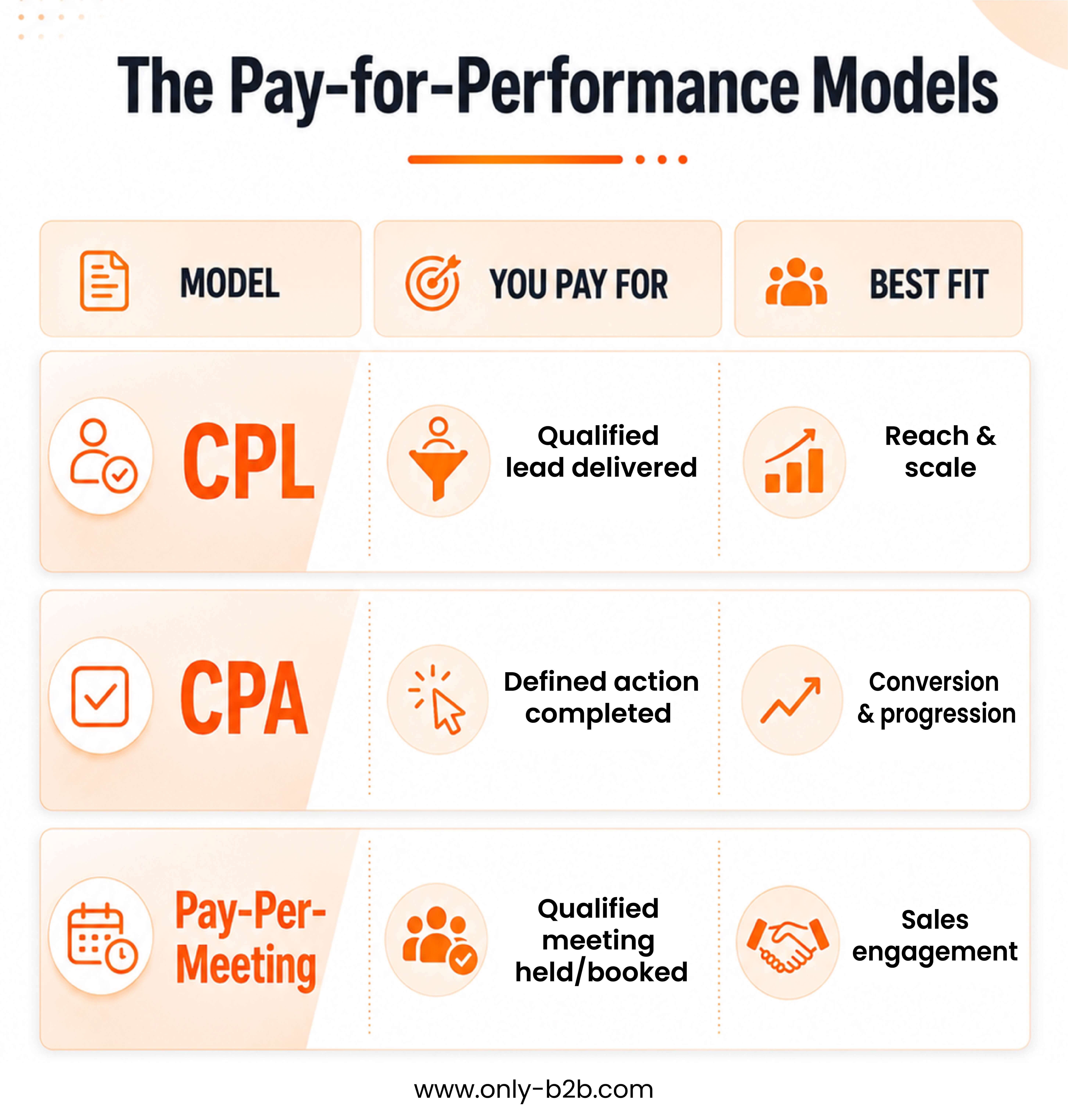
In practice, CPL vs CPA lead generation becomes a way to structure accountability across different stages of the funnel. CPL focuses on lead delivery, CPA extends into actions or conversions, and meeting-based models move closer to sales engagement.
The important distinction is not the label. It is the definition of “qualified.” That definition determines whether the model creates pipeline or just activity.
CPL Lead Generation: Pros, Cons, and Best Use Cases
Cost per lead (CPL) is the most widely used performance model in B2B. It is simple, scalable, and easy to benchmark. You pay for each lead delivered, usually based on form fills, content downloads, or gated asset engagement.
In CPL vs CPA lead generation, CPL sits at the top of the funnel. It is designed for volume, not depth.
The advantage is predictability. Teams can forecast lead inflow and scale campaigns quickly. It also works well for early-stage awareness or category creation where intent is still forming.
The limitation is equally clear. A lead is not a signal of readiness. Without strict filters, CPL can inflate MQL volume while weakening downstream conversion rates.
This is why CPL requires strong quality controls. ICP alignment, data validation, and source transparency become essential. Without them, cost efficiency at the top of the funnel often creates inefficiency in sales.
CPL works best when the goal is reach, not revenue immediacy.
CPA Lead Generation: When Outcome-Based Pricing Makes Sense
Cost per acquisition (CPA) or cost per action models move one step closer to business outcomes. Instead of paying for leads, buyers pay for a defined action such as a qualified signup, product trial, or sales-accepted lead.
Within CPL vs CPA lead generation, CPA introduces accountability beyond contact creation. It assumes that not all leads are equal and that value is created only when a meaningful action occurs.
This model makes sense when there is a clear, trackable conversion event. It is often used in mid-funnel programs where intent is already established and the goal is progression rather than discovery.
However, CPA only works when definitions are tightly controlled. What counts as an “action” must be agreed in advance. Otherwise, vendors may optimize for easy conversions rather than meaningful ones.
The strength of CPA is alignment. The risk is ambiguity. If the action is not tied to sales readiness, the model can still produce volume without pipeline quality.
Pay-Per-Meeting and Appointment-Based Lead Generation
Meeting-based models represent the most sales-aligned form of performance pricing. Here, payment is tied to qualified meetings booked with target accounts or decision-makers.
This model sits closest to revenue because it connects directly to sales conversations.
A qualified meeting is not just a calendar invite. It typically includes ICP fit, verified contact data, and confirmed interest in a relevant topic or solution area. Show rates and sales acceptance criteria become critical success factors.
This model works best when sales capacity is strong and follow-up discipline is consistent. If meetings are not properly qualified, the model loses its value quickly.
The advantage is clarity. Teams know exactly what they are paying for. The challenge is ensuring that qualification standards are not diluted in pursuit of volume.
Meeting-based lead generation is less about lead creation and more about opportunity creation.
Quality Criteria That Matter More Than the Pricing Model
Pricing models often dominate early conversations, but its quality criteria determine actual performance.
When deciding between CPL vs CPA lead generation, quality is the variable that changes everything.
ICP Fit
ICP fit ensures the lead matches the ideal customer profile in terms of industry, company size, geography, and buying potential. Without this, even high-volume lead flow becomes irrelevant because sales teams waste time on poor-fit accounts that will never convert.
Intent Level
Intent level measures how actively a buyer is engaging with a problem or solution category. High intent signals such as repeated content consumption or pricing page visits indicate readiness, while low intent signals often reflect early curiosity. This distinction determines whether outreach should be educational or sales-driven.
Data Verification
Data verification ensures that contact details, job titles, and company information are accurate and up to date. Poor data quality leads to wasted outreach, low connect rates, and distorted performance reporting, making it difficult to trust any downstream metrics.
A large majority of B2B marketers, 86% by one estimate, end up targeting the wrong decision-maker entirely because of bad contact data.
Buying Committee Relevance
Buying committee relevance ensures that leads are not just individual contacts but part of a decision-making group. In B2B, deals rarely close with a single stakeholder, so access to multiple influencers significantly increases conversion probability.
Source Transparency
Source transparency clarifies where the lead originated and how it was generated. This matters because different sources produce different intent levels, and without visibility, teams cannot optimize or replicate successful channels effectively.
Duplicate Controls
Duplicate controls prevent the same lead from being counted multiple times across campaigns or vendors. Without it, performance data becomes inflated, cost per lead appears artificially lower, and sales teams end up contacting the same prospects repeatedly, damaging brand perception.
Without these filters, even the most attractive pricing model can produce weak pipeline outcomes.
Quality is not a layer added after delivery. It is the foundation that defines whether delivery has value at all.
How to Compare Cost, Quality, and Pipeline Impact
Cost comparison alone rarely reflects true performance. A more accurate view comes from mapping cost to pipeline progression.
In CPL vs CPA lead generation, the real comparison is not price per unit, but cost per outcome stage.
Cost per Accepted Lead
This measures how many delivered leads are actually accepted by sales teams as valid opportunities. It reveals whether marketing-defined quality aligns with sales expectations.
Cost per Meeting Held
This goes beyond bookings and measures actual attended conversations. It highlights drop-off between scheduling and engagement, which is often a hidden efficiency gap.
Cost per Opportunity Created
This tracks how many leads convert into real pipeline opportunities. It is one of the strongest indicators of true revenue impact.
Pipeline Influenced
This measures the total pipeline value impacted by a campaign, even if it is not directly attributed. It helps capture the broader effect of marketing on deal acceleration and expansion.
This shifts the conversation from efficiency to effectiveness.
A lower CPL can still produce a higher cost per opportunity if conversion rates are weak. Similarly, a higher meeting cost can still outperform if those meetings consistently convert into pipeline.
The goal is not to minimize cost at one stage. It is to optimize cost across the full funnel.
Questions to Ask a Pay-for-Performance Lead Generation Vendor
Vendor evaluation is where most misalignment begins. The pricing model often looks clear, but definitions underneath it are not.
In CPL vs CPA lead generation, clarity comes from asking structured questions:
These questions reveal whether a vendor is optimizing for delivery or for pipeline quality. The difference is often subtle in language but significant in outcome.
Common Mistakes When Comparing Lead Generation Pricing Models
Most performance-based programs fail not because of execution, but because of early assumptions.
The most common mistakes include:
Performance models only work when feedback is continuous, not static.
CPL vs CPA vs Pay-Per-Meeting: Which Model Should You Choose?
There is no universal best model. The right choice depends on funnel stage, sales readiness, and internal capacity.
In CPL vs CPA lead generation vs pay-per-meeting, the decision framework is less about preference and more about alignment.
- CPL works best when the goal is awareness and top-of-funnel scale
- CPA works best when there is a defined conversion action and mid-funnel focus
- Pay-per-meeting works best when sales teams are ready to engage directly with qualified prospects
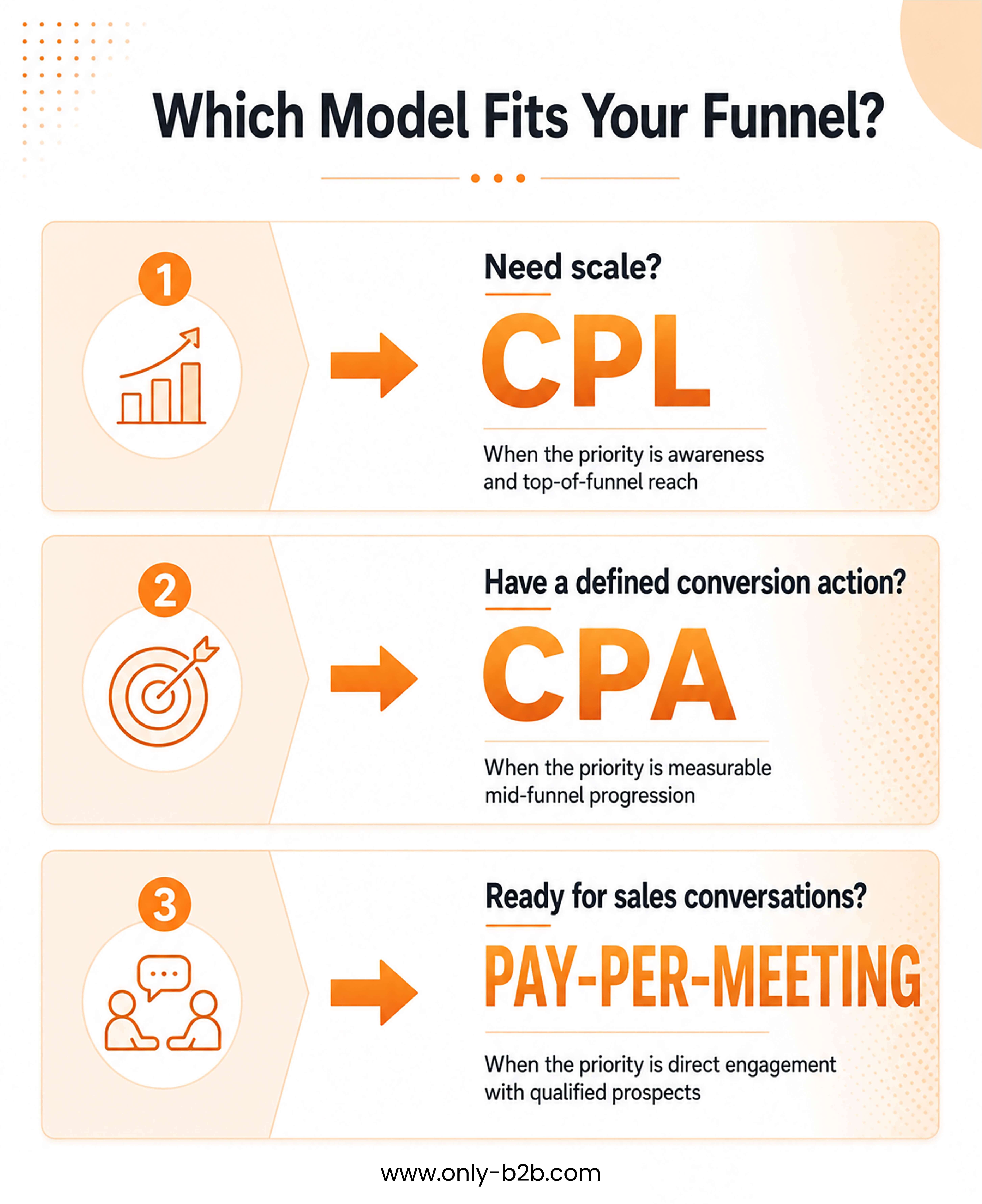
Budget also plays a role. Lower budgets often favor CPL due to scalability. Higher intent programs often justify meeting-based models due to closer revenue proximity.
Sales capacity is equally important. If teams cannot follow up quickly, even high-quality meetings lose value.
The right model is the one that matches operational readiness, not just pricing preference.
Pay for Outcomes You Can Actually Measure
Performance-based lead generation is not a pricing debate. It is a measurement discipline.
When models are evaluated correctly, they stop competing with each other. They start serving different stages of the same system.
The most effective teams do not optimize for the cheapest lead. They optimize for the most reliable path to revenue.
And that shift is subtle, but important. It moves the conversation from cost efficiency to outcome certainty.
That is where performance-based lead generation becomes less about buying leads, and more about building predictable pipeline systems.

Vikas Bhatt is the Co-Founder of ONLY B2B, a premium B2B lead generation company that specializes in helping businesses achieve their growth objectives through targeted marketing & sales campaigns. With 10+ years of experience in the industry, Vikas has a deep understanding of the challenges faced by businesses today and has developed a unique approach to lead generation that has helped clients across a range of industries around the globe. As a thought leader in the B2B marketing community, ONLY B2B specializes in demand generation, content syndication, database services and more.