Cold calling remains a viable B2B prospecting channel, but its performance benchmarks continue to evolve. Cognism’s 2026 cold calling report, based on more than 200,000 calls, places the industry-average success rate at 2.7%. Its sales team achieved 11.3%, demonstrating how strongly targeting, data quality and execution influence results.
Cold calling success cannot be measured by one percentage alone. Connect rates, conversations, meetings booked, call duration, timing, follow-up strategy and ideal customer profile fit all affect the outcome. These figures should therefore be treated as practical benchmarks rather than guaranteed results.
This guide brings together current B2B cold calling statistics for 2026, including success rates, connect rates, the best days and times to call, buyer preferences, call attempts and performance benchmarks. Each major statistic is linked to its original source so sales teams can evaluate and use the data responsibly.
20 Key B2B Cold Calling Statistics for 2026 at a Glance
These benchmarks summarize the most important cold calling findings covered in this guide. Results vary by audience, geography, contact-data quality, sales execution and how each study defines a successful outcome.
| # | Cold Calling Metric | 2026 Benchmark | What It Indicates | Research Source |
|---|---|---|---|---|
| 1 | Industry-average cold calling success rate | 2.7% | Cold calling remains a relatively low-conversion channel, making targeting and execution especially important. | Cognism |
| 2 | Cognism team success rate | 11.3% | Strong data, targeting and sales execution can significantly outperform the broader industry average. | Cognism |
| 3 | Average calls needed to reach a prospect | 1.55 calls | Accurate contact data can reduce unnecessary dialing attempts. | Cognism |
| 4 | Average dial attempts per prospect | About 3 | Repeated attempts can improve reach, although the optimal cadence varies by audience. | Belkins |
| 5 | Per-dial connect rate | 9.9% | Roughly one in ten individual dials connected with a live person in the benchmark dataset. | Belkins |
| 6 | Prospects connected at least once | 24.5% | Multiple calling attempts can increase the percentage of prospects ultimately reached. | Belkins |
| 7 | Best-performing calling day | Thursday | Thursday produced the strongest overall performance in Cognism’s dataset. | Cognism |
| 8 | Second-strongest calling day | Tuesday | Tuesday also performed strongly, although timing should still be tested against your own audience. | Cognism |
| 9 | Strong morning calling window | 10–11 AM | Late morning can be a productive calling period for B2B prospects. | Cognism |
| 10 | Strong afternoon calling window | 2–3 PM | Early afternoon also showed strong engagement in Cognism’s analysis. | Cognism |
| 11 | Consistent afternoon window | 3–4 PM | Belkins found a slightly later afternoon window to be particularly consistent. | Belkins |
| 12 | Connects that became conversations | 58% | Reaching a person does not automatically mean a meaningful sales conversation occurs. | Belkins |
| 13 | Conversations resulting in booked meetings | 4.6% | Meeting conversion depends heavily on qualification, messaging and prospect relevance. | Belkins |
| 14 | Approximate dials required per meeting | 370 dials | The full calling funnel shows why teams should measure more than raw dial volume. | Belkins |
| 15 | Non-booking outcomes that were hard rejections | 31% | Not every call that fails to book a meeting represents complete rejection. | Belkins |
| 16 | Prospects requesting email follow-up or callback | 19% | A call without an immediate meeting can still create a meaningful next step. | Belkins |
| 17 | Wrong person or incorrect number outcomes | 13.5% | Poor contact data can directly reduce cold calling efficiency. | Belkins |
| 18 | Average cold call duration | 82 seconds | Typical calls are relatively short, although duration varies substantially by outcome. | Cognism / WHAM |
| 19 | Average duration of calls that booked meetings | About 3.7 minutes | Successful conversations tended to last considerably longer than calls ending in rejection. | Belkins |
| 20 | Sales reps’ time spent selling | About 40% | Limited selling time makes data quality, targeting and workflow efficiency important for outbound teams. | Salesforce |
B2B Cold Calling Success Rates in 2026
The industry-average cold calling success rate is 2.7% in 2026, according to Cognism’s analysis of more than 200,000 calls. This represents roughly three successful outcomes for every 100 calls, although the result depends on how an organization defines success—such as a connected conversation, booked meeting, qualified opportunity or completed sale.
Cognism reported an 11.3% success rate for its own sales team. However, this should not be treated as a universal benchmark. Results are influenced by data accuracy, ideal customer profile fit, direct-dial availability, representative experience, regional differences, timing and the quality of the calling approach.
Before comparing performance with industry figures, define one consistent conversion event. Track total dials, successful connections, meaningful conversations and meetings booked separately. This helps determine whether weak performance comes from contact data, targeting, messaging or the sales conversation itself.
How Many Cold Call Attempts Are Needed?
Current studies do not support one universal number of call attempts for every B2B campaign. Cognism’s 2026 report found that it took an average of 1.55 calls to reach a prospect, with many people who answered doing so on the first attempt.
Belkins’ 2026 benchmark study, based on more than 175,000 dials, recorded an average of three dial attempts per prospect. Its per-dial connect rate was 9.9%, while 24.5% of prospects connected at least once when contacted across multiple attempts. This shows that follow-up improves reach, but results depend on list quality, market, seniority and campaign design.
These findings are not contradictory because the studies use different datasets and campaign conditions. Instead of applying an arbitrary eight-call rule, track attempts-to-connect for each audience and build a measured calling cadence around your own response data. Stop outreach when a prospect opts out and follow the calling requirements that apply in the relevant market.
Best Days and Times for B2B Cold Calling
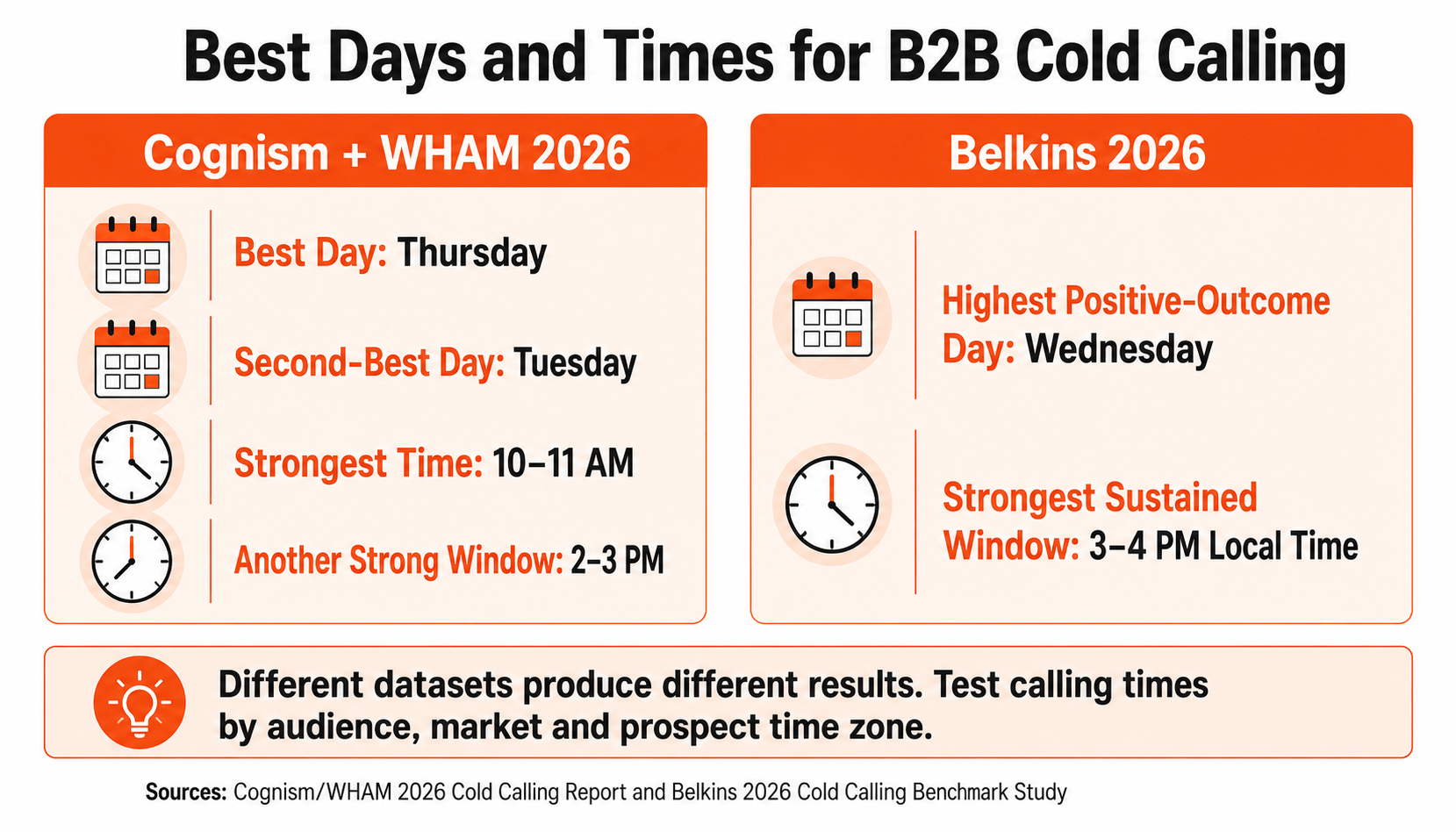
Timing can influence cold-calling performance, but there is no universally best day or hour for every B2B audience. Cognism’s 2026 report found Thursday to be its strongest calling day, followed by Tuesday. Its most productive calling windows were 10–11 AM and 2–3 PM.
Belkins’ 2026 benchmark study produced a different result: Wednesday generated nearly twice as many positive outcomes as Friday, while 3–4 PM was its most consistent time window. These differences reflect variations in industries, regions, prospect seniority, datasets and campaign methods.
Use these findings as starting points rather than fixed rules. Schedule calls according to the prospect’s local time, test several time windows and compare connect rates, meaningful conversations and meetings booked. Your own campaign data should determine the final calling schedule.
B2B Cold Calling Conversion Funnel Benchmarks
Belkins’ 2026 benchmark study analyzed more than 175,000 dials made during 2025. It found that 9.9% of individual dials connected with a live person, meaning approximately one in ten cold calls produced a connection.
Reaching someone does not automatically create a sales conversation. According to the study, 58% of connects progressed into an actual conversation, and 4.6% of those conversations resulted in a booked meeting. Across the complete funnel, approximately 370 dials were required to generate one meeting.
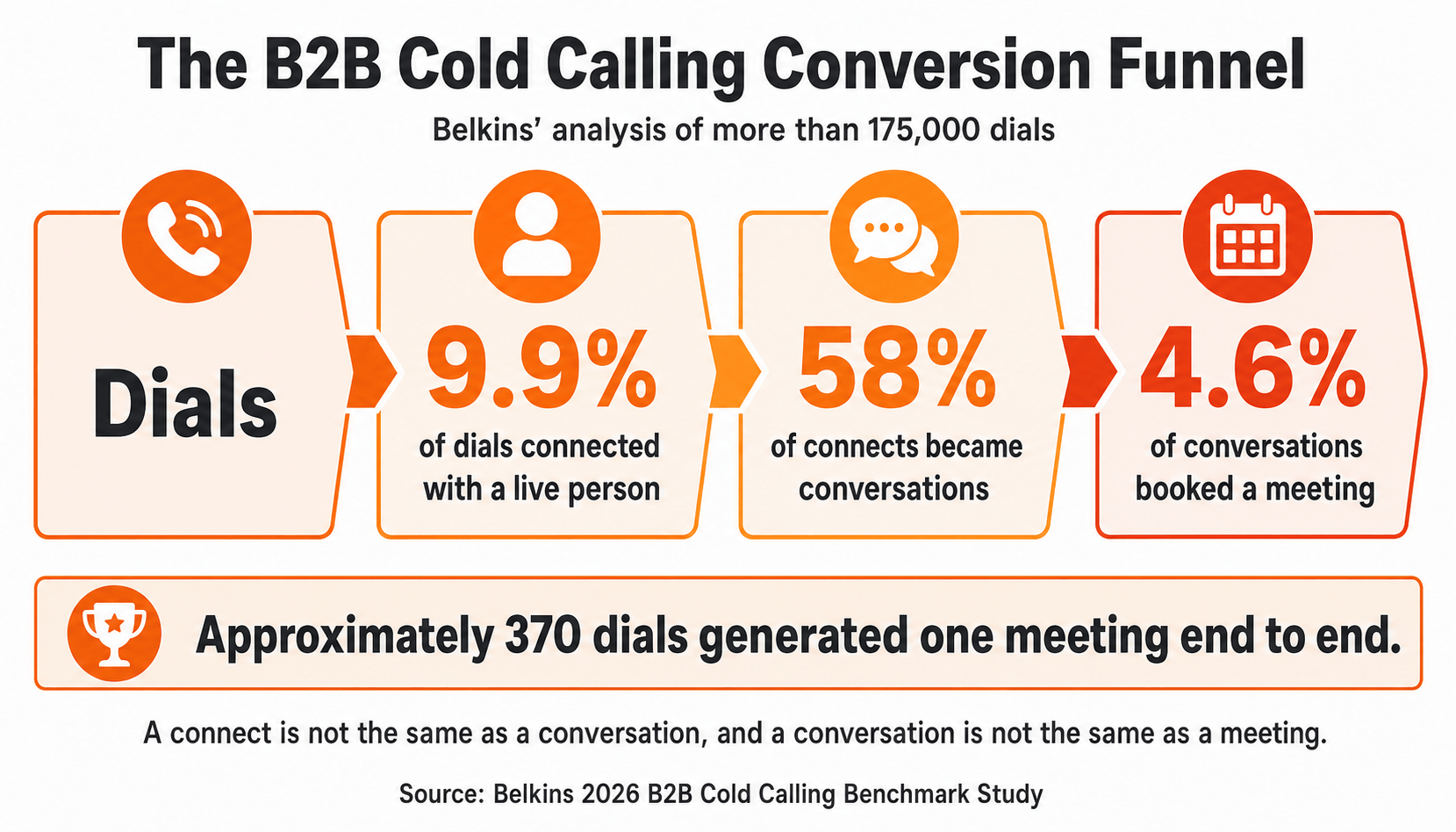
Track dials, connects, conversations and meetings as separate stages. A low connect rate may indicate inaccurate contact data or poor timing, while a low conversation rate can signal problems with the opening message. If conversations are occurring but meetings are not being booked, review targeting, qualification, relevance and the proposed next step.
Why B2B Cold Calls Do Not Book Meetings
Belkins’ 2026 benchmark study found that only 31% of its non-booking cold-call outcomes were hard rejections. Another 19% involved prospects requesting an email follow-up or scheduling a callback, showing that a call without an immediate meeting can still create a valuable next step.
The study also found that 13.5% of non-booking outcomes involved the wrong person or an incorrect number. This is primarily a data quality problem rather than evidence that the calling message or channel has failed.
Improve contact data before dialing and record each outcome separately, including rejection, wrong contact, gatekeeper, follow-up request and callback. This helps teams distinguish targeting problems from messaging problems and ensures interested prospects receive the promised follow-up.
How Long Should a B2B Cold Call Last?
Cognism’s 2026 report, using WHAM data, found that the average cold call lasted 82 seconds, down from 93 seconds in the previous year. Cognism’s own SDRs averaged approximately two minutes per call. A shorter average does not necessarily indicate lower quality because focused targeting and faster qualification can make conversations more efficient.
Belkins’ 2026 benchmark study found that calls resulting in booked meetings lasted approximately 3.7 minutes on average. These calls were more than four times longer than calls ending with “not interested” and over twelve times longer than unanswered calls.
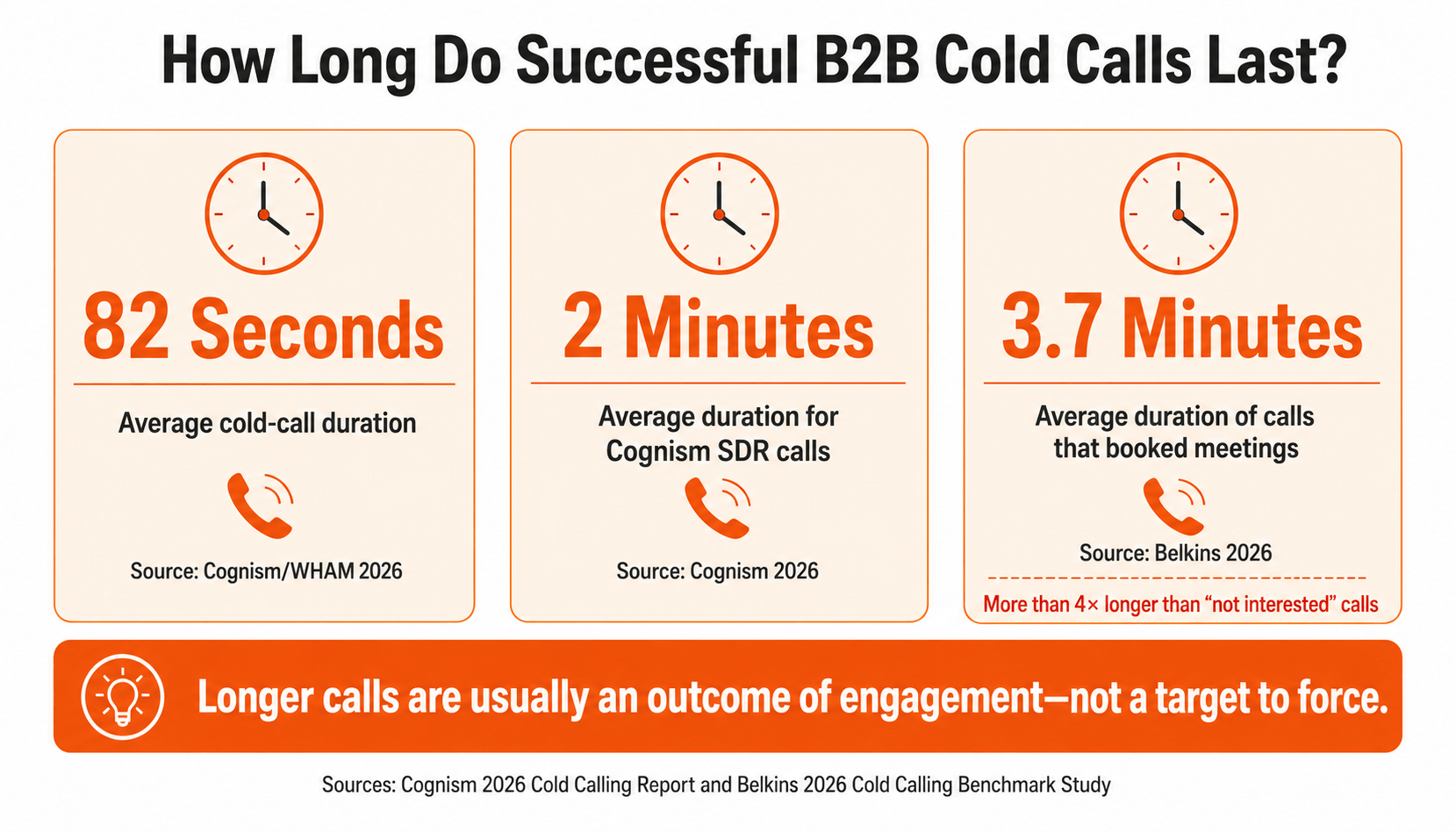
This does not mean representatives should artificially extend every conversation. Call length is generally an outcome of engagement rather than its cause. Track duration alongside call outcomes and use recordings to determine whether representatives are establishing relevance, asking useful questions and agreeing on a clear next step.
Sales Representatives Spend 40% of Their Time Selling
Salesforce’s 2026 State of Sales report, based on a survey of 4,050 sales professionals across 22 countries, found that representatives spend approximately 40% of an average workweek selling. The remaining 60% is spent on non-selling activities.
For cold-calling teams, limited capacity means dialing must compete with planning, contact research, data entry, call logging, follow-up and other operational work. Increasing call volume without improving targeting and workflow efficiency can therefore create more activity without producing more qualified conversations.
Automate repetitive tasks such as contact enrichment, call logging, follow-up reminders and meeting scheduling where appropriate. However, targeting decisions, qualification and prospect conversations still require human judgment. Measure productivity using meaningful conversations and qualified opportunities rather than total call volume alone.
How to Measure Cold Calling’s Pipeline Contribution
Cold calling contributes to pipeline by creating live conversations and revealing information that other outreach channels may not capture immediately. A call can confirm account fit, uncover a current business need, identify additional decision-makers or establish a suitable time for follow-up.
Measure its contribution across the complete journey: dials, live connects, meaningful conversations, meetings booked, qualified opportunities, pipeline value and closed revenue. Consistent CRM attribution makes it possible to identify whether the phone initiated the opportunity, influenced an existing conversation or helped progress a deal.
A practical telemarketing lead generation strategy should connect calling activity with email, social outreach and relevant content. Evaluate the channel using qualified pipeline and revenue outcomes rather than treating every dial, connection or meeting as an equally valuable result.
Turn Cold Calls Into Booked Meetings
Need help improving your targeting, contact data, calling cadence or meeting conversion? Only-B2B helps B2B sales teams build focused cold-calling campaigns designed to create qualified conversations and measurable pipeline.
Discuss Your Cold Calling CampaignTypically responds within 24 hours
Conclusion
Cold calling remains a viable B2B prospecting channel, but no single benchmark can predict the outcome of every campaign. The 2026 research shows that results vary considerably according to contact-data accuracy, ideal customer profile fit, timing, representative skill, market and the way success is defined.
Key takeaways:
- Define connects, conversations, meetings and qualified opportunities separately.
- Use accurate contact data and prioritize prospects that match the ideal customer profile.
- Test call attempts, days and time windows using results from your own audience.
- Evaluate call quality and downstream pipeline instead of relying only on dial volume.
- Coordinate phone outreach with email, social engagement and relevant follow-up content.
- Respect opt-out requests and applicable calling requirements in every target market.
Industry figures should be treated as diagnostic reference points rather than guaranteed targets. Compare your results with relevant benchmarks, identify where the calling funnel is losing prospects and improve one stage at a time.

Vikas Bhatt is the Co-Founder of ONLY B2B, a premium B2B lead generation company that specializes in helping businesses achieve their growth objectives through targeted marketing & sales campaigns. With 10+ years of experience in the industry, Vikas has a deep understanding of the challenges faced by businesses today and has developed a unique approach to lead generation that has helped clients across a range of industries around the globe. As a thought leader in the B2B marketing community, ONLY B2B specializes in demand generation, content syndication, database services and more.