

A calendar invite is not proof that a sales opportunity exists.
Sometimes the meeting was booked because a prospect agreed to “learn more.” But once the call begins, the AE discovers that the buyer has no active initiative, the problem is too vague, or the people needed to evaluate a solution are not involved.
That’s why appointment setting discovery questions are important. The most effective discovery calls typically involve 11–14 targeted questions, helping uncover the business context behind the inquiry: what changed, who is affected, how the organization is responding, and what the buyer expects from a conversation.
The goal is to avoid creating meetings that neither side can use.
What Are Appointment Setting Discovery Questions?
Appointment setting discovery questions are the questions SDRs and appointment setters ask before booking a meeting with an account executive.
These questions are designed to establish whether the opportunity has enough substance to move forward. That usually means understanding:
- Whether the account fits the ideal customer profile
- What business problem or initiative created the conversation
- How important the issue is now
- Who owns the problem and influences the decision
- When the buyer expects to act
- Whether the proposed conversation is relevant to the buyer’s situation
The appointment setter does not need to uncover every operational detail, map the entire buying process, or run a product demonstration.
The purpose is to determine whether the meeting has a credible reason to happen.
The best sales-ready meeting questions do not make the buyer feel screened. They make the buyer feel understood. They connect the meeting to something already happening inside the business rather than treating the calendar invite as the objective.
Why Discovery Questions Matter in B2B Appointment Setting
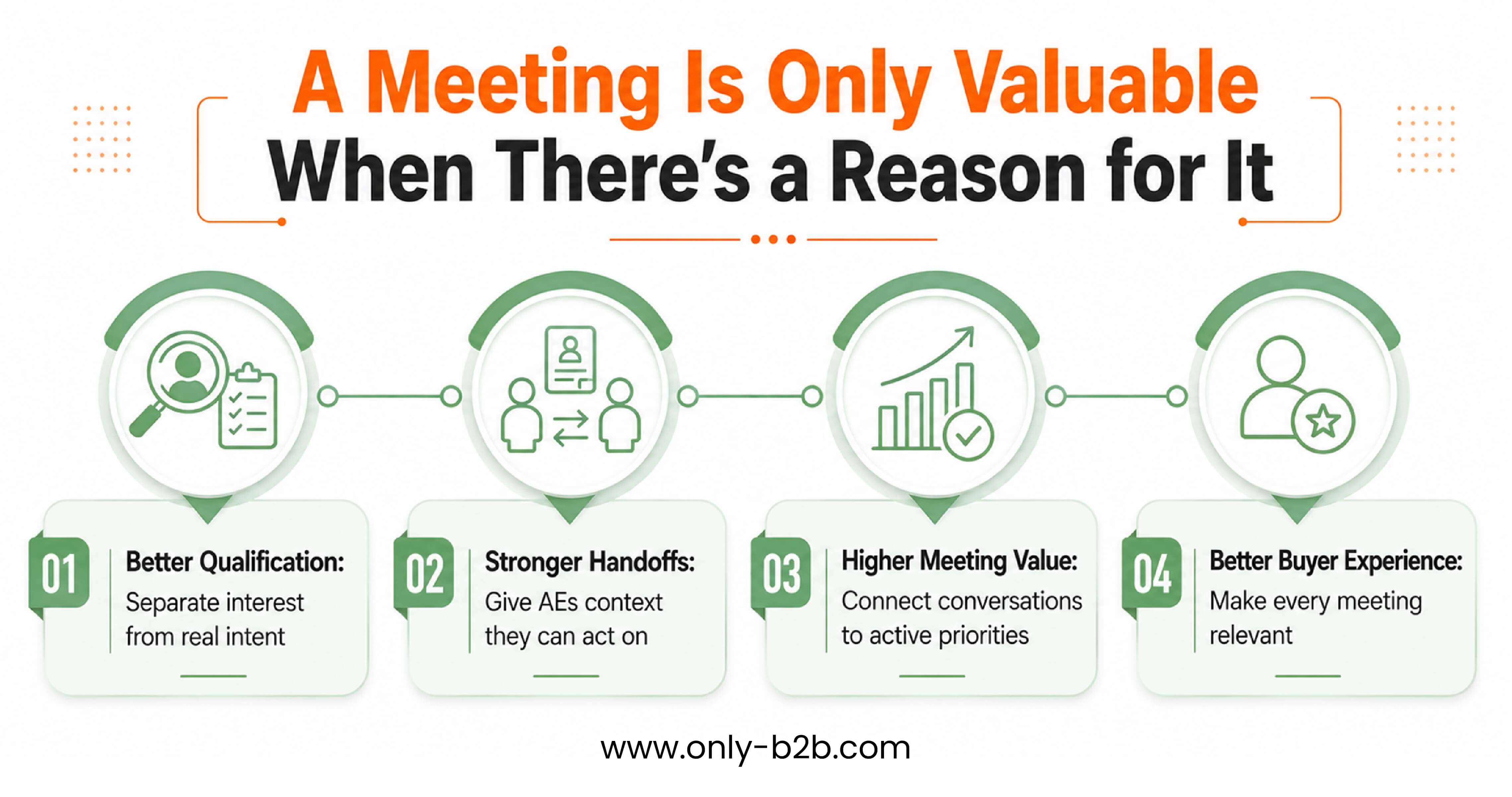
Marketing wants engagement to become action. SDRs want conversations to become meetings. AEs want meetings that can become pipeline. Buyers want their time to produce clarity.
Without discovery, each team can interpret the same interaction differently. A content download becomes “high intent.” A request for information becomes “ready to talk.” A polite response becomes “qualified.”
The result is often a calendar full of meetings that look productive in reporting but create little commercial movement.
Good discovery improves several parts of the system at once.
AE productivity
Account executives spend less time explaining basic context to people who are not ready, do not fit, or cannot influence the decision. Their time moves toward conversations where a meaningful business discussion is possible.
Show rate
Buyers are more likely to attend when the meeting reflects something that matters to them. A calendar invitation tied to a specific business issue is harder to ignore than one described as a general introduction.
Pipeline quality
Qualification improves the difference between activity and opportunity. The pipeline becomes a reflection of real buying situations rather than a collection of optimistic assumptions.
Buyer experience
Discovery also protects the buyer. It prevents them from entering a meeting that has no clear purpose, no relevant expertise, or no connection to their priorities.
This is why qualification should not be treated as a gate imposed on the buyer. It is a way to make the next step more useful for everyone involved.
Questions That Confirm ICP Fit
The first question is whether the account belongs in the conversation at all.
ICP fit questions help establish whether the company operates in a context where the problem is relevant and the solution can reasonably create value. They should be specific enough to reveal account fit without turning the exchange into a form disguised as a conversation.
Useful questions include- How is the business structured across teams, regions, or business units?
- What does your team own within the wider organization?
- How does your company currently approach this area?
- Is this challenge concentrated in one department or shared across the business?
- What has changed in your operating environment over the past year?
- Are you managing this internally, through a partner, or with a combination of both?
- How does the current process work across the teams involved?
- Is the issue more relevant to one market, location, or customer segment?
These questions reveal more than basic firmographics. They show how the account functions.
The useful signal is not simply whether the account matches a profile. It is whether the account’s current environment creates a credible reason for the conversation.
Questions That Reveal Pain and Priority
A buyer may express interest without having a problem that is important enough to solve.
Instead of asking only, “What challenges are you facing?” stronger B2B qualifying questions explore:
- What prompted you to look into this now?
- Where is the current process creating the most friction?
- What happens when the issue is not resolved?
- Which team feels the impact most directly?
- How is this affecting revenue, efficiency, customer experience, or risk?
- Has the problem become more visible recently?
- What have you already tried?
- What made those approaches insufficient?
- How is this issue being discussed internally?
- If nothing changes over the next six months, what is the likely impact?
The strongest answers usually contain a buying trigger . A new executive, missed target, expansion plan, compliance requirement, system change, or customer expectation can turn a familiar problem into an active initiative.
Questions About Authority and the Buying Committee
A meeting with the wrong person can still be a valuable first conversation. But it should not be mistaken for a fully qualified opportunity.
Authority is not limited to the person who signs the contract. In most B2B purchases, several people shape the outcome. One person may own the problem. Another may control the budget. Others may influence technical, operational, legal, or procurement decisions.
The right buying committee questions help map that reality without making the buyer defensive.
Useful questions include- Who is most affected by this issue?
- Who owns the decision to address it?
- Who would need to support a change internally?
- Which teams would evaluate the solution?
- Who controls the budget for this type of initiative?
- Has leadership already discussed the problem?
- Who else should be involved in a conversation about potential solutions?
- How are decisions like this usually made in your organization?
- What concerns might other stakeholders raise?
- Would it be useful for someone from operations, finance, IT, or procurement to join the next discussion?
These are not simply buying committee questions. They are questions about how change happens inside the account.
A contact may have strong personal interest but limited influence. Another may have authority but little day-to-day understanding of the problem.
The appointment setter’s role is to identify the relationship between those people and make sure the next meeting reflects it.
This also improves the buyer’s internal experience. When the right stakeholders are included early, the AE can address the questions that will actually determine progress rather than repeating the conversation later for each new participant.
Questions That Identify Timing and Readiness
Interest without timing is difficult to interpret.
A buyer may be researching for next year, comparing options for an active project, or responding to a problem that has become urgent this week. Each situation requires a different meeting and a different expectation.
Timing and readiness questions can clarify the buying stage without forcing the buyer into a commitment they are not prepared to make.
Ask- Where are you in the process today: exploring, evaluating, or preparing to decide?
- Is there a specific date by which this needs to be addressed?
- What event or deadline is shaping the timeline?
- Are you currently using a vendor or internal process?
- What would cause you to change the current approach?
- Have you spoken with other providers?
- What needs to happen before a decision can be made?
- Is this part of a broader initiative already underway?
- What would make a conversation with our team useful at this stage?
- If the discussion is relevant, what would the next step typically look like?
These questions help distinguish curiosity from readiness.
They also prevent a common handoff error: presenting an early-stage research conversation to an AE as an active evaluation. That mismatch creates frustration on both sides. The buyer feels pressured. The AE feels misled. The SDR loses confidence in the process.
Readiness does not mean the buyer has a finalized project plan. It means there is enough movement, relevance, or consequence for a conversation to create value now.
Questions That Clarify Budget and Solution Fit
Budget questions require judgment.
Asked too early or too bluntly, they can make the conversation feel transactional. Avoided entirely, they can create meetings where the solution is structurally impossible to pursue.
The better approach is to understand the economic context before asking for a precise number.
Useful questions include- Has funding already been allocated to this initiative?
- Is this likely to come from an existing budget or require a new request?
- How are similar investments evaluated internally?
- What is the cost of continuing with the current approach?
- Are you already spending money on tools, services, or internal resources to manage this?
- What level of investment would need leadership approval?
- What would the solution need to deliver to justify the investment?
- Are there financial or procurement requirements we should understand early?
- Is price the main consideration, or are risk, speed, and capability equally important?
These are budget-adjacent questions. They create room for the buyer to explain how value is assessed without turning the first conversation into a negotiation.
Solution fit matters just as much. A buyer may have a real problem but need a service model, implementation approach, or level of support that does not match what the provider offers.
The appointment setter should understand what the buyer expects from a solution:
- Is the priority replacing an existing system, improving a process, or adding new capability?
- Are you looking for strategic guidance, execution support, technology, or a combination?
- What would a successful outcome look like?
- Are there requirements the solution must meet from the beginning?
A meeting is more likely to become productive when the buyer’s expectations and the provider’s actual strengths are reasonably aligned.
Questions That Reduce No-Shows
Discovery calls have a reported 21.5% no-show rate, according to Salescadia’s 2026 benchmark analysis of published meeting data.
No-shows are often treated as a reminder problem. Sometimes they are. More often, they are a value problem.
A buyer who cannot explain why the meeting matters is less likely to protect the time. A buyer who agreed to a vague conversation may accept the invitation and still decide that other priorities are more important.
Meeting confirmation questions should reinforce purpose, ownership, and relevance.
Ask- What would make this meeting worth attending for you?
- Which questions would you like answered?
- Who should be included from your side?
- Will the people involved in evaluating this be available?
- Is the scheduled time still workable for everyone who needs to attend?
- Would a short agenda help you prepare?
- Is there anything specific you would like us to bring to the conversation?
- If priorities change, what is the best way to reschedule?
- Based on what we discussed, does this still feel like the right next step?
These questions do more than confirm a calendar slot. They create a small commitment from the buyer.
The meeting now has a stated purpose. The attendees are more intentional. The AE has a clearer brief. The buyer knows what will happen and why it is relevant.
A strong confirmation message should reflect the buyer’s own language. It might say that the conversation will focus on reducing manual reporting across regional teams, understanding the current process, and discussing what a practical improvement path could look like.
That is more durable than “introductory call.”
Appointment Setting Discovery Question Framework
A reusable qualification framework helps teams create consistency without forcing every conversation into the same script.
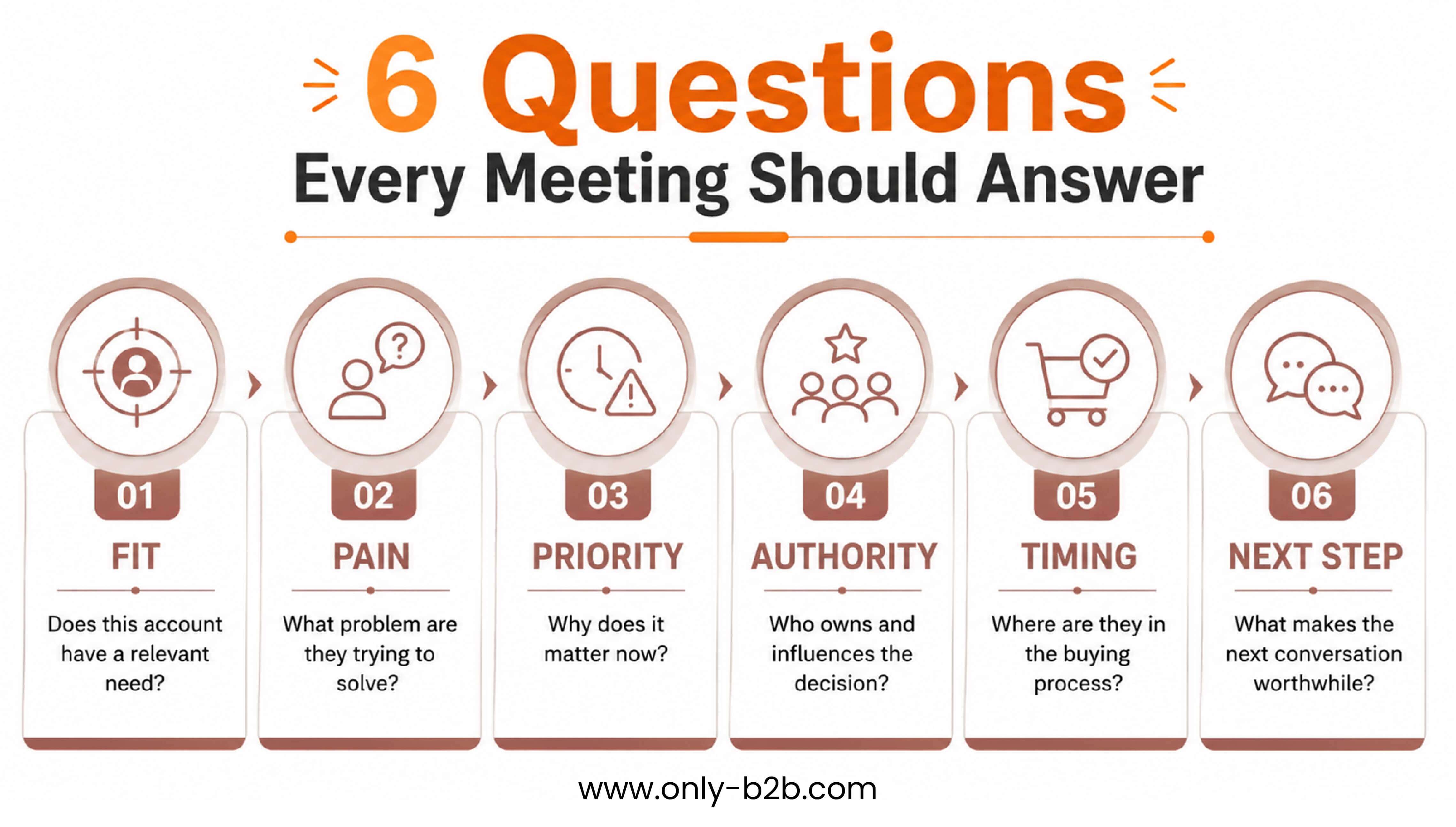
The framework can be organized around six areas:
1. Fit
Does the account operate in a context where the problem and solution are relevant?
Explore the company environment, team structure, operating model, and current approach.
2. Pain
What problem is the buyer experiencing?
Understand the operational issue, business impact, affected teams, and consequences of leaving it unresolved.
3. Priority
Why does the issue matter now?
Look for a trigger, leadership attention, financial impact, strategic initiative, or deadline that gives the problem weight.
4. Authority
Who owns the problem and who shapes the decision?
Identify the decision maker, influencers, budget owner, technical reviewers, and people who should be part of the next conversation.
5. Timing
Where is the buyer in the process?
Clarify whether they are researching, evaluating, building a business case, comparing providers, or preparing to act.
6. Next Step
What should happen next, and why?
Confirm that the meeting has a clear purpose, the right attendees, a realistic agenda, and a reason for both sides to continue.
This qualification framework is not a scorecard that replaces judgment. It is a way to make judgment visible.
A meeting does not need perfect answers in every category. Early-stage buyers may not know the full budget or buying committee yet. What matters is whether the available information supports a useful next step.
The framework also creates a better handoff between marketing and sales. Marketing can see which signals lead to meaningful conversations. SDRs can explain why a meeting is qualified. AEs can prepare around the buyer’s actual situation rather than a generic lead profile.
Qualify Before You Book
The purpose of appointment setting is not to produce the highest number of meetings.
It is to create the conditions for the right conversation.
Discovery questions protect the buyer from irrelevant outreach. They protect the AE from low-value calendar commitments. They protect the business from confusing activity with pipeline.
The strongest appointment setters do not ask questions to complete a checklist. They listen for the structure underneath the answers.
When the answers are present, the meeting has a foundation.
When they are not, booking it may only move uncertainty from one calendar to another.
Better qualification does not make appointment setting slower. It makes the next conversation more deliberate, more relevant, and

Vikas Bhatt is the Co-Founder of ONLY B2B, a premium B2B lead generation company that specializes in helping businesses achieve their growth objectives through targeted marketing & sales campaigns. With 10+ years of experience in the industry, Vikas has a deep understanding of the challenges faced by businesses today and has developed a unique approach to lead generation that has helped clients across a range of industries around the globe. As a thought leader in the B2B marketing community, ONLY B2B specializes in demand generation, content syndication, database services and more.