Does your B2B team treat webinar registrations as the finish line? Do you consider the campaign successful the moment someone fills out the form?
In practice, that is where real work begins. Registration is not demand captured. It is demand identified.
sense’s 2025 Buyer Experience Report found that B2B buyers first engage with sellers around 61% into their buying journey, compared with 69% in 2024.
That means webinar interest is often one of the earliest structured signals of intent, not the final one.
HubSpot reports that 42% of marketers use webinars specifically for lead generation, highlighting their role as more than an event format. This makes webinar engagement an important early signal of buyer interest, but the real value comes from understanding what that signal reveals about intent, timing, and readiness.
This means the value of a webinar is not in the sign-up itself, but in what that sign-up reveals about buyer curiosity, timing, and readiness. A registration is simply a moment where interest becomes visible enough to act on, not a conclusion of interest.
What Is B2B Webinar Registration Lead Generation?
At its core, B2B webinar lead generation is the process of using live or on-demand event content to capture, qualify, and progress buyer interest into structured pipeline opportunities.
But the definition is often misunderstood.
It is not just about filling seats. It is about using webinar registration lead generation as a system that connects awareness, engagement, and sales readiness in a controlled flow.
A registration is simply a signal. The system around it determines whether that signal becomes pipeline or disappears into inactivity.
In mature programs, webinar demand generation is not treated as a campaign. It is treated as a conversion environment where interest is shaped before, during, and after the event.
This means the webinar is not a one-time marketing activity. It is a continuous decision-shaping experience where buyer intent is refined at every stage of interaction.
When Webinars Work Best in the B2B Funnel
Webinars are not universally effective. They work best when the intent is already forming but not yet structured.
There are a few consistent use cases where webinar lead generation performs strongly:
- Product education where complexity needs context means buyers already know the problem but need clarity on how it is solved.
- Category awareness where buyers are still defining the problem means they are exploring, not evaluating vendors yet.
- Thought leadership where trust is still being built means credibility matters more than conversion pressure.
- Account engagement where multiple stakeholders need alignment means the webinar becomes a shared reference point.
- Partner campaigns where credibility is shared across ecosystems means trust is transferred through association.
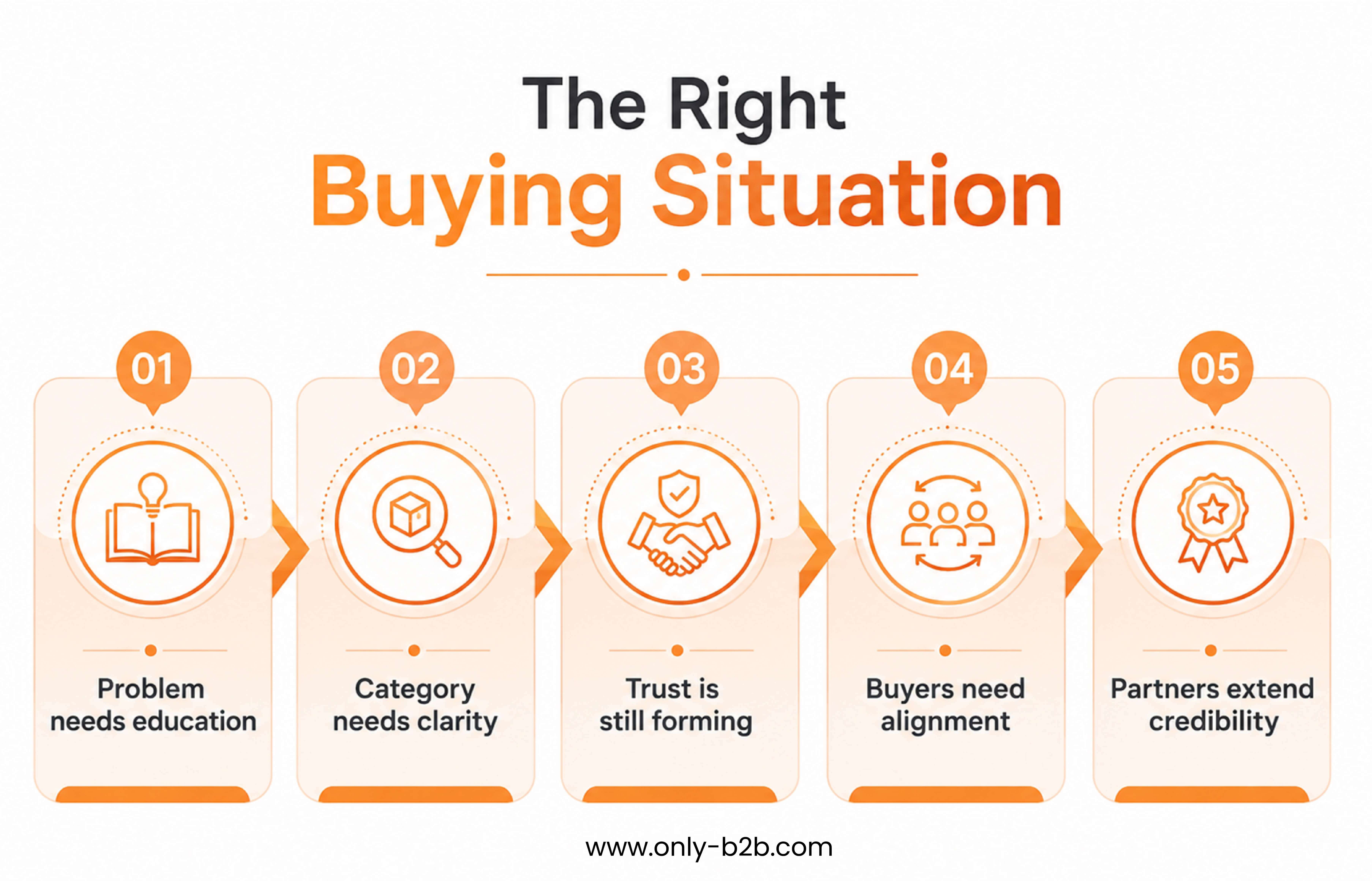
In each of these cases, the webinar is not the message. It is the environment where awareness, education, and engagement converge.
This is also where many teams misread performance. High registrations do not always mean high intent. They often mean broad interest without qualification.
The difference only becomes visible in how the pipeline behaves later, when some leads move forward quickly while others stall completely.
Define the Webinar ICP and Target Accounts
Every effective B2B webinar lead generation system starts before the landing page. It starts with clarity on who the event is actually for.
This is where account targeting becomes more important than audience size.
Strong programs define:
- Target account lists based on revenue potential and buying readiness which help you focus on companies that can realistically convert into revenue, not just attendees.
- Job titles aligned to decision-making influence, not just attendance so people who can approve or shape purchases are prioritized.
- Industry filters that reflect real use-case relevance, ensuring the topic actually applies to the audience’s operational reality.
- Company size bands that match solution complexity means avoiding mismatches between product depth and buyer maturity.
- Buying committee roles across technical, financial, and operational stakeholders to capture the full decision ecosystem, not just one perspective.
Without this structure, webinar registration lead generation becomes volume-driven. With these filters, it becomes precision-driven.
The goal is not to attract everyone who is interested. It is to attract accounts that can actually move.
That shift changes everything downstream, especially registrant qualification and sales routing, because it ensures effort is spent on opportunity, not noise.
Build a Registration Offer That Attracts the Right Buyers
The registration page is often treated as a form. In reality, it is a positioning statement.
A strong webinar registration campaign is defined by how clearly it communicates value before the event even happens.
Key elements matter more than most teams realize:
- The title should reflect a real business problem, not a topic because buyers respond to outcomes, not labels.
- The abstract should frame outcomes, not agenda points because people want to know what changes after attending.
- Speakers should signal credibility, not just participation because authority influences trust before content is even delivered.
- Pain points should be specific enough to self-select the right audience so unqualified users naturally opt out.
- Form fields should balance friction with qualification intent so you gather enough data without losing conversions.
- Confirmation pages should reinforce relevance, not just logistics so interest is strengthened immediately after sign-up.
- Calendar invites should anchor commitment, not just reminders so attendance becomes more likely and intentional.
This is where landing page and speaker credibility quietly influence conversion quality.
A common webinar marketing mistake is optimizing for registration volume instead of registration fit. The result is a full funnel that does not convert.
The offer is not just what you are presenting. It is who you are filtering in, and that determines pipeline quality long before the event begins.
Promotion Channels for B2B Webinar Registration
Promotion is where most B2B webinar promotion strategies become either scalable or inconsistent. Effective programs rarely rely on a single channel. They build layered distribution across intent and reach.
The common channels include:
- Email promotion to existing contacts and engaged segments works because it activates known interest rather than creating new awareness.
- Content syndication to expand reach into relevant audiences helps introduce the webinar to buyers who are already researching similar topics.
- Paid media targeting specific job roles and industries allows precision reach into defined ICP segments at scale.
- LinkedIn campaigns focused on account-level engagement help reinforce relevance through professional context and visibility.
- Partner lists that extend credibility into adjacent ecosystems bring borrowed trust that increases registration confidence.
Each channel plays a different role in webinar demand generation.
Email captures known interest. Paid media creates new awareness. Syndication expands reach. LinkedIn reinforces relevance. Partners add trust.
The mistake is treating all channels as equal sources of intent. They are not.
The real value comes from understanding which channel produces event leads, pipeline quality versus surface-level registrations, because not all traffic is equally ready to convert.
How to Qualify Webinar Registrants
Registration alone is not qualification. It is only the first filter.
Strong registrant qualification systems combine explicit and implicit signals.
Explicit signals include:
- Job title and seniority indicate decision power and influence within the organization.
- Company size and industry show whether the solution context actually fits the buyer’s environment.
- Role in buying committee clarifies whether the person is a user, influencer, or decision-maker.
- Budget or timeline indicators where appropriate help identify urgency and purchase readiness.
Implicit signals include: - Engagement with pre-event content shows whether interest is active or passive.
- Repeat visits to landing pages indicate deeper curiosity and consideration.
- Email interaction before the event reveals responsiveness and attention level.
- Historical behavior across campaigns helps identify patterns of long-term intent.
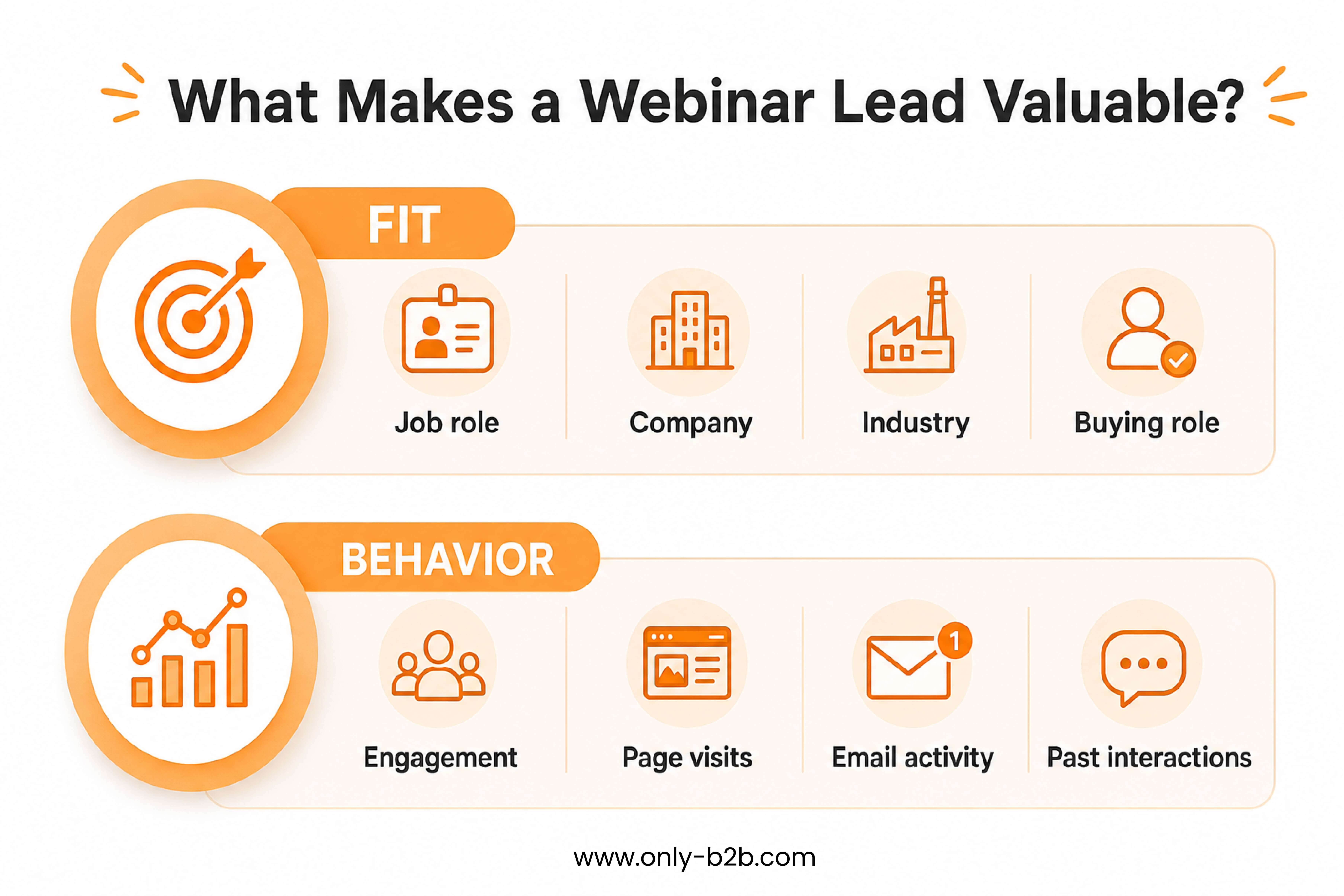
Modern webinar lead generation also relies on attendee scoring models that separate curiosity from intent.
A registrant who matches ICP and engages before the event is fundamentally different from a passive sign-up.
This is where lead scoring and account targeting begin to shape downstream outcomes, ensuring sales teams focus on meaningful opportunities instead of broad lists.
Turn Webinar Interest into Follow-Up Workflows
The value of a webinar is not realized during the event. It is realized in the follow-up structure.
A strong system routes registrants differently based on behavior:
- Attendees receive immediate engagement aligned to discussion depth so their experience is extended while interest is still fresh.
- No-shows enter reactivation sequences with contextual reminders so missed engagement is recovered instead of lost.
- High-intent registrants are flagged for faster sales outreach so momentum is not delayed.
- Target accounts are prioritized regardless of attendance status so strategic opportunities are never missed.
This is where webinar lead nurturing becomes operational, not theoretical.
The goal is not to send more emails. The goal is to align timing with intent so outreach feels relevant rather than repetitive.
Sales routing also becomes critical here. Without structured handoff, even high-quality pipeline conversion opportunities lose momentum because no one owns the next step.
A webinar is not a campaign asset. It is a routing mechanism for demand that already exists in different stages of readiness.
To make this system work at scale, teams also need a clear behavioral layer that tracks micro-signals after registration.
This includes:
- Tracking whether a registrant revisits the event page, opens reminder emails, or engages with speaker content before the session. These signals help refine urgency even before the webinar begins.
- Integrating CRM workflows ensures that every registrant is automatically assigned a next-best-action path. This prevents leads from sitting idle between marketing and sales systems. When intent is detected early, sales can intervene with context-rich outreach instead of generic follow-ups.
- Post-event sequencing should also be dynamic. Attendees who asked questions or stayed longer should not receive the same messaging as passive viewers.
- No-shows who engaged heavily before the event should be treated as high-priority reactivation opportunities rather than cold leads.
When these layers work together, the webinar stops being a single touchpoint and becomes a structured progression engine that continuously moves demand forward instead of letting it decay.
Webinar Lead Generation Metrics That Matter
Most teams measure webinars incorrectly. They stop at registration volume.
In mature webinar metrics frameworks, performance is evaluated across multiple layers:
- Registration volume to understand reach shows how far the message traveled. It tells you who showed interest.
- Attendance rate to measure engagement strength shows how compelling the topic actually was.
- Source quality to identify channel efficiency reveals which channels bring meaningful traffic.
- MQL rate to assess qualification accuracy shows how well targeting worked.
- Meeting rate to evaluate sales readiness indicates how many leads are ready for conversation.
- Pipeline influenced to measure commercial impact connects marketing activity to revenue outcomes.
- Opportunity conversion to validate long-term value confirms whether interest became business.
Each metric answers a different question.
Without this separation, webinar marketing mistakes often go unnoticed until revenue impact is already diluted.
The most important metric is not volume. It is progression, because progression shows whether interest is moving forward or stalling.
Common Webinar Lead Generation Mistakes
Most underperforming programs fail in predictable ways.
These are not execution errors. They are system design gaps that affect every stage of performance.
And they are the reason many webinar demand generation programs plateau despite strong top-of-funnel performance, because activity is not translating into revenue.
Turn Event Interest into Pipeline
Webinar registrations are not the outcome. They are the beginning of a structured conversion process.
When B2B webinar lead generation is designed correctly, it does not just create attendance. It creates clarity. It separates curiosity from intent. It connects engagement to timing. It turns passive interest into active pipeline.
The difference is not in how many people register. It is in how well those registrations are understood, qualified, and routed.
Most teams already have enough demand. What they lack is alignment between interest and action. And once that alignment exists, webinars stop being events.
They become systems for predictable pipeline creation.

Vikas Bhatt is the Co-Founder of ONLY B2B, a premium B2B lead generation company that specializes in helping businesses achieve their growth objectives through targeted marketing & sales campaigns. With 10+ years of experience in the industry, Vikas has a deep understanding of the challenges faced by businesses today and has developed a unique approach to lead generation that has helped clients across a range of industries around the globe. As a thought leader in the B2B marketing community, ONLY B2B specializes in demand generation, content syndication, database services and more.