
It’s hard to pinpoint which channel or message actually triggered a buying decision. In today’s complex B2B journey, that challenge is only growing. Buyers research quietly, compare options across multiple touchpoints, and often make progress long before they ever fill out a form.
Gartner found that B2B buyers spend only 17% of their buying journey meeting with potential suppliers. That means much of the influence shaping a deal happens outside standard reporting. With the dark funnel now a major part of B2B buying, visibility is limited unless teams learn to track the hidden signals behind demand more effectively.
What Is the B2B Dark Funnel?
A prospect may read comparison pages, watch a webinar replay, ask a question in a community, or get a recommendation through dark social. They may visit your pricing page twice, forward a case study to a colleague, and check a review site before anyone on your team knows they are in market.
None of those actions always show up cleanly in attribution reports, but each one shapes the buying decision. That hidden layer of research, validation, and peer influence is the DA.
The dark funnel is not a single channel. It is the part of the buyer journey that happens outside standard tracking. It includes ungated content, peer recommendations, review sites, private conversations, social discussions, podcasts, YouTube demos, webinar replays, and self-serve research that never gets logged by a pixel or cookie.
Buyers are not actively trying to hide. They are simply moving in the way that is most efficient for them, not in the way that is easiest for reporting systems to capture. By the time a form is filled out, much of the decision-making may already be underway. That is why dark funnel visibility matters: it reveals how interest becomes intent before the CRM ever records a lead.
Why Traditional Demand Gen Attribution Falls Short
Traditional demand gen attribution was built for a simpler buying motion. It assumes the last tracked interaction deserves the credit, or at least most of it. That is where the model starts to break down.
A buyer may first hear about your brand from a colleague, then read several articles, compare vendors on a review site, attend a webinar, and only later submit a form. In a standard report, the form gets the credit. The earlier influence disappears. That is not just a gap in measurement. It is a distorted view of how demand actually forms.
B2B buyers now use 10+ digital touchpoints before they engage with sales.
If teams keep relying on traditional demand gen attribution, they will keep overvaluing the easiest-to-track touchpoints and underestimating the channels that actually shape buying intent.
That leads to five predictable problems:
Inflated direct conversions
Traditional demand gen attribution makes it look like buyers arrived and converted on their own, even when earlier untracked research and peer influence did most of the work.
Misallocated ad spend
Teams end up funding the ads that are easiest to measure, not the ones that actually influenced the buyer earlier in the journey.
False positives in campaign reporting
A webinar registration, syndication click, or retargeting visit can look like campaign success in a standard report, even when it did not materially move the buyer closer to a decision.
Weak visibility into which content drives deals
Most demand gen attribution stops at the form fill, so it misses the case studies, comparison pages, calculators, and replays that help buyers justify the purchase internally.
Dependence on incomplete data instead of real buyer behavior
Traditional attribution only sees what is tracked, which leaves out peer conversations, dark social, review sites, private communities, and offline validation. The result is a model built on partial evidence, not on how buyers truly move through the market.
Content syndication can also create confusion. A click from a distribution partner may look like fresh demand, but it may only be one step in a much longer evaluation process. Webinar registrations can do the same. They matter, but they do not explain the full sequence of influence on their own.
The deeper issue is that buying committees do not move as one person in one straight line. One stakeholder may discover the category, another may validate the vendor, a third may raise budget concerns, and a fourth may assess risk. Traditional attribution struggles because it tries to assign a single source to a multi-person decision.
That is why the real question is not which touchpoint happened last. It is which signals consistently shaped the account before the opportunity was created.
A Practical Dark Funnel Attribution Framework
A useful dark funnel attribution model does not try to capture everything. It tries to connect the signals that matter.
Step 01: Declare Attribution:
Keep the source fields, form fills, and self-reported channels. They still matter because they give you a baseline. But do not stop there.
Step 02: Layer Intent:
Look for topic research, competitor comparisons, and repeated category interest across target accounts. Intent signals are not proof of purchase, but they are useful indicators that a buyer is moving from curiosity to evaluation.
Step 03: Add Content Engagement:
Track which assets are being consumed, how often they are revisited, and whether the same account keeps returning to the same themes. This is where account engagement becomes more useful than isolated clicks. One visit might be noise but repeated visits across multiple contacts tell a different story.
Step 04: Review Sales Notes:
Discovery calls, objection handling, competitor mentions, and internal dialogue from the buyer often reveals what the dashboard cannot. Sales teams hear the state of the market before marketing sees it in the data. That is why sales alignment is not a nice-to-have in this model. It is part of the measurement system.
Step 05: Review Pipeline Source Notes:
Ask where the deal really started, what triggered the first serious conversation, and which signals appeared before the opportunity was created. This is where pipeline review becomes valuable. It helps you separate the first tracked touch from the first meaningful influence.
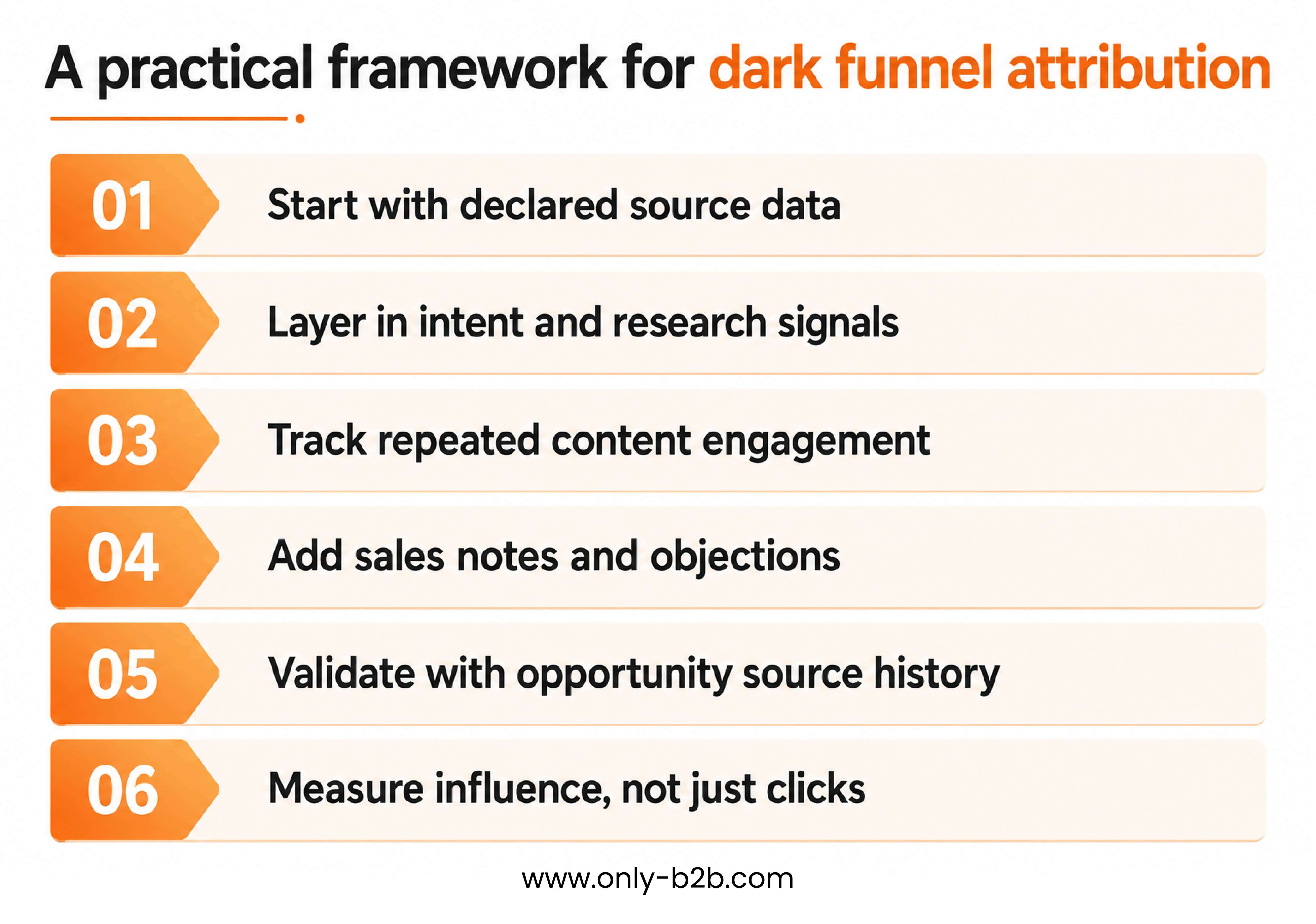
The goal of this framework is to have a more honest view of pipeline attribution.
Signals That Reveal Hidden Buying Influence
The strongest dark funnel attribution signals are rarely dramatic. They are cumulative.
First-party signals
These include repeat website visits, pricing page views, calculator usage, ungated content downloads, email engagement, and return visits from the same account. On their own, they are not enough. Together, they show momentum.
Third-party signals
This is where buyer intent signals become useful. Topic research, competitor comparisons, and category-level activity can show that an account is actively exploring a problem. Review sites such as G2, Trustpilot, and Capterra often appear here as well. Buyers trust peer validation more than vendor claims, and that trust shows up early.
LinkedIn comments, Slack groups, private messages, peer forums, and forwarded content often influence the buyer before any tracked click does. This is the part of dark social that standard dashboards miss. It is hard to see, but it is not hard to feel once sales starts hearing the same questions repeatedly.
Webinar signals
Attendance matters, but so do questions, replay views, and follow-up visits to related content. A webinar is not just an event. It is often a validation step in the hidden buyer journey.
Sales conversation signals
These are some of the most valuable signals because they show what the buyer is trying to solve. Objections, competitor mentions, internal stakeholder concerns, and timing questions all reveal where the account is in its decision process.
When you combine these sources, content influence becomes easier to see. Not as a single touch, but as a pattern.
How to Report Dark Funnel Influence
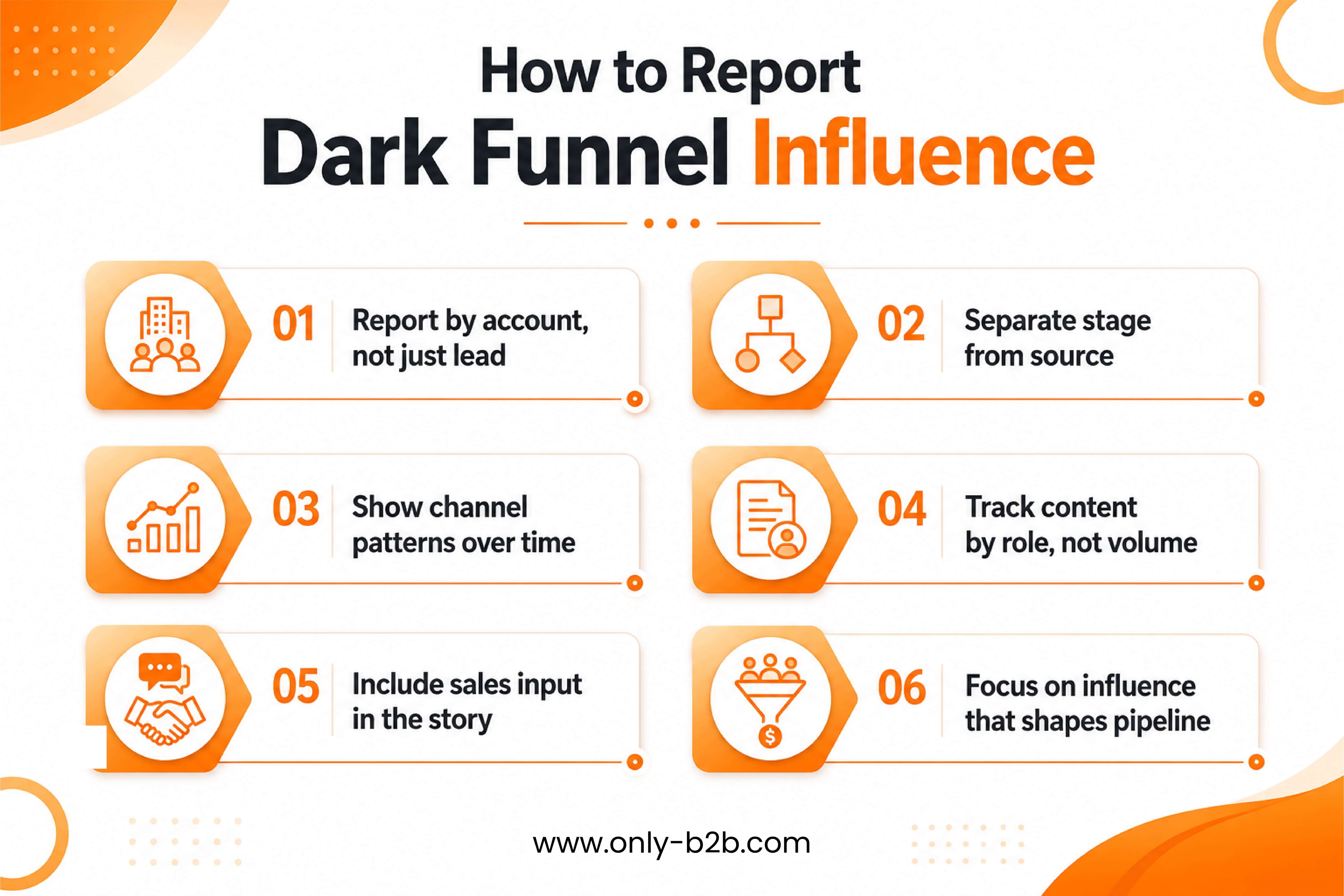
Reporting dark funnel influence well means accepting that influence is not the same as source.
The report should not try to force one channel to explain the whole deal. It should show how influence appears across the account, the stage, the channel, and the content asset.
Report by account
Show which target accounts are accumulating signals over time. This helps you see whether an account is warming up even before it converts. It also gives sales a clearer view of account journey progression.
Report by stage
Early research, active evaluation, and late-stage validation do not look the same. A buyer reading educational content is not the same as a buyer comparing implementation details. Stage-based reporting helps you avoid flattening those differences.
Report by channel
Separate organic, paid, review, webinar, community, and sales-assisted influence. This is where pipeline attribution becomes more useful than channel vanity metrics. You are not asking which channel got the last click. You are asking which channels consistently appear before pipeline creation.
Report by content asset
Some assets influence awareness. Others influence confidence. Case studies, comparison pages, calculators, and webinars often play different roles in the account journey. If you only report on downloads, you miss the real content influence.
The best reporting view is not the most detailed one. It is the one that helps marketing and sales make the same decision with the same context.
Common Dark Funnel Attribution Mistakes
Most content influence measurement errors come from trying to make the data cleaner than it is.
30-Day Plan to Improve Dark Funnel Measurement
A 30-day dark funnel attribution plan should focus on structure, not perfection.
Days 1 to 7: Audit what you already track
Review your current source fields, campaign tags, CRM notes, and reporting views. Identify where declared attribution is helping and where it is hiding the real story. At the same time, align marketing and sales on the signals that matter most.
Days 8 to 14: Define your signal framework
Create a simple taxonomy for first-party, third-party, community, webinar, review, and sales conversation signals. Decide what counts as meaningful influence and what counts as noise. Keep it practical. The goal is not to build a research project. It is to build a usable system.
Days 15 to 21: Map historical opportunities
Review a sample of recent opportunities and trace the signals that appeared before pipeline creation. Look at account engagement, content consumption, sales notes, and opportunity source fields together. This is where hidden patterns usually become obvious.
Days 22 to 30: Build the reporting cadence
Create a monthly review that shows influence by account, stage, channel, and content asset. Share it with sales leadership, demand gen, and operations. Then refine the model based on what the team actually uses. A measurement system only matters if it changes decisions.
If you do this well, you will not just improve reporting. You will improve sales alignment and make the next round of demand generation more precise.
Turn Hidden Demand Into Measurable Pipeline
The value of dark funnel attribution is not academic. It is practical.
It helps teams see where demand is forming, how buyers are educating themselves, and which signals are showing up before the opportunity exists in the CRM. That creates a better conversation between marketing and sales. It also creates a more realistic view of what is driving pipeline.
Only B2B helps demand teams build that kind of system. As an aligned partner that understands both marketing and sales, we look at demand as a growth system, not a set of disconnected campaigns. We help teams connect intent, content, and pipeline in a way that is clear enough to use and strong enough to trust.

Vikas Bhatt is the Co-Founder of ONLY B2B, a premium B2B lead generation company that specializes in helping businesses achieve their growth objectives through targeted marketing & sales campaigns. With 10+ years of experience in the industry, Vikas has a deep understanding of the challenges faced by businesses today and has developed a unique approach to lead generation that has helped clients across a range of industries around the globe. As a thought leader in the B2B marketing community, ONLY B2B specializes in demand generation, content syndication, database services and more.