

Most organizations spend enormous energy chasing the next customer while paying surprisingly little attention to the customers who have already decided they are worth buying from.
It is not difficult to understand why. New audiences create momentum. They give leadership teams something tangible to celebrate.
But the most efficient growth opportunity is rarely sitting somewhere at the top of the funnel. More often, it already exists inside accounts that have adopted your product, built trust in your team, and proven there is a problem worth solving together.
According to Forrester research, around 61% of revenue comes from existing customers through retention, expansion, and increased adoption.
That is where an ABM account expansion strategy becomes valuable.
It shifts the focus away from selling more and toward creating deeper alignment between what customers need next and what your organization can help them achieve. The revenue follows.
What Is an ABM Account Expansion Strategy?
An ABM account expansion strategy is a coordinated approach to identifying, engaging, and developing growth opportunities within existing customer accounts through alignment between sales, customer success, and marketing.
The objective is not simply increasing contract value. It is understanding where additional business value can be created and helping the right stakeholders recognize that opportunity at the right time.
This is what separates expansion-focused ABM from traditional account management.
Traditional account management often operates reactively. A customer raises a need, and the team responds.
Expansion-focused ABM actively maps relationships, monitors adoption patterns, identifies emerging stakeholders, and uncovers business priorities before they become formal buying initiatives.
The result is a more intentional account expansion strategy where growth is driven by insight and coordination rather than chance.
Why Expansion Revenue Is Critical for SaaS Growth
Every SaaS company eventually reaches a point where acquisition alone stops being enough.
Not because new customers are unimportant, but because sustainable growth becomes increasingly difficult when it depends entirely on finding the next buyer.
There is a practical reason for this.
Acquisition creates growth one account at a time. Expansion allows growth to compound across relationships that already exist.
When a customer increases adoption, adds new teams, expands into additional use cases, or invests in complementary solutions, revenue grows without restarting the entire trust-building process. The relationship, implementation knowledge, business context, and proof of value are already in place.
That makes expansion one of the most efficient paths to growth. An 5% increase in customer retention can increase profits by 25% to 95%, according to Bain & Company research.
Expansion also reveals something important about the health of a SaaS business.
Customers do not expand because they are persuaded to. They expand because they continue finding value. They see outcomes worth scaling. They gain confidence that the solution can support broader business objectives than originally anticipated.
In that sense, expansion is often the result of successful adoption rather than successful selling.
This is why high-performing SaaS companies pay close attention to expansion revenue. It sits at the intersection of customer success, product value, and commercial growth.
The Land-and-Expand Revenue Model
Very few enterprise relationships begin at their maximum potential.
Most start small through a single team, a pilot initiative, a specific business challenge, or a limited deployment. That is the foundation of a land and expand strategy.
The goal of the initial engagement is not to capture every possible budget line. The goal is to establish credibility.
Customers need evidence before they commit to broader adoption.
Once measurable outcomes are achieved, the conversation changes naturally. The customer is no longer asking whether the solution works. They are asking where else it could work.
That shift creates opportunities across departments, business units, regions, product lines, and operational functions.
The strongest expansion programs understand that growth follows proof. They do not rush expansion conversations before value has been demonstrated.
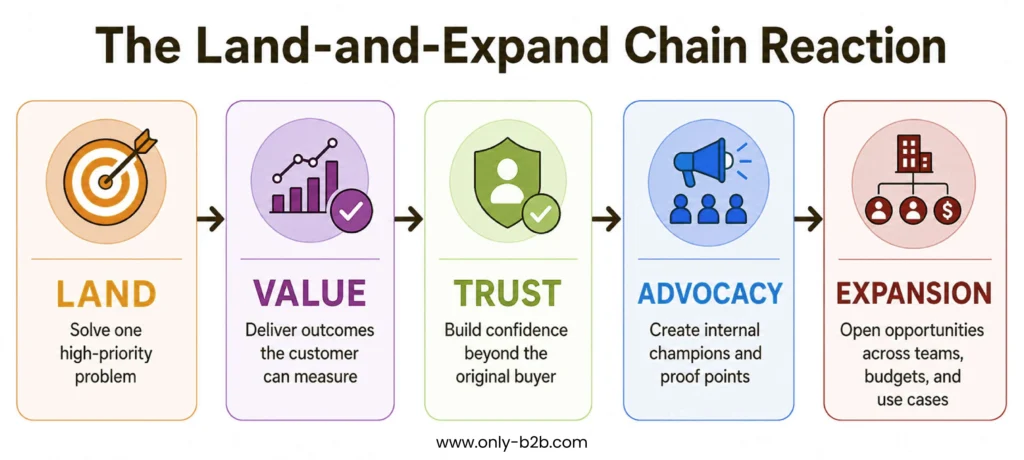
When adoption is strong, expansion feels like a logical next step. When adoption is weak, expansion feels like a sales initiative. Customers can tell the difference.
The determining factor is rarely sales capability. It is customer confidence.
Organizations that consistently grow accounts understand that every successful deployment creates the foundation for future growth. The first deal is often the beginning of the relationship, not the destination.
How to Identify Expansion Opportunities
Expansion opportunities leave clues long before a buying conversation begins. The challenge is developing the discipline to recognize them.
The strongest indicators often come from behavior rather than direct requests.
Customers reveal future needs through how they engage. Usage expands into new teams, feature adoption increases, requests become more sophisticated, integration discussions emerge, and stakeholders begin exploring capabilities they previously ignored.
These signals often indicate that the customer is moving beyond initial adoption and beginning to think more strategically.
At the same time, growth opportunities can also be found in what is missing.
A customer may have successfully deployed a solution within one department while similar challenges remain unresolved elsewhere in the organization.
Those gaps frequently represent meaningful account expansion opportunities that remain invisible when teams focus exclusively on current users.
This is where customer-facing teams become invaluable.
Customer success professionals often hear about organizational changes, operational challenges, and evolving priorities long before they appear in a CRM.
The organizations that excel at expansion create systems for capturing those insights and sharing them across teams.
Growth becomes less dependent on luck and more dependent on visibility.
Expanding Across the Buying Committee
One of the most common reasons expansion stalls has nothing to do with product fit. It has to do with relationships.
Many vendors become heavily dependent on a single champion. That works until it does not.
People change roles. Leadership priorities shift. Budgets move. Influence changes hands.
When relationships remain concentrated around one stakeholder, expansion becomes fragile.
A stronger approach requires broader engagement across the account.
This is where buying committee mapping becomes essential.
The objective is to understand how decisions actually happen.
- Who owns the problem?
- Who influences investment decisions?
- Who measures outcomes?
- Who manages implementation?
- Who controls strategic priorities?
The answers often reveal stakeholders who have never been included in previous conversations.
As organizations evolve, different departments frequently encounter similar challenges from entirely different perspectives. Those stakeholders can become future advocates, sponsors, or decision-makers.
Effective customer expansion ABM focuses on building relevance across the organization rather than dependence on a single relationship. The broader the internal network, the greater the opportunity for sustainable growth.
Upsell vs Cross-Sell in ABM Expansion
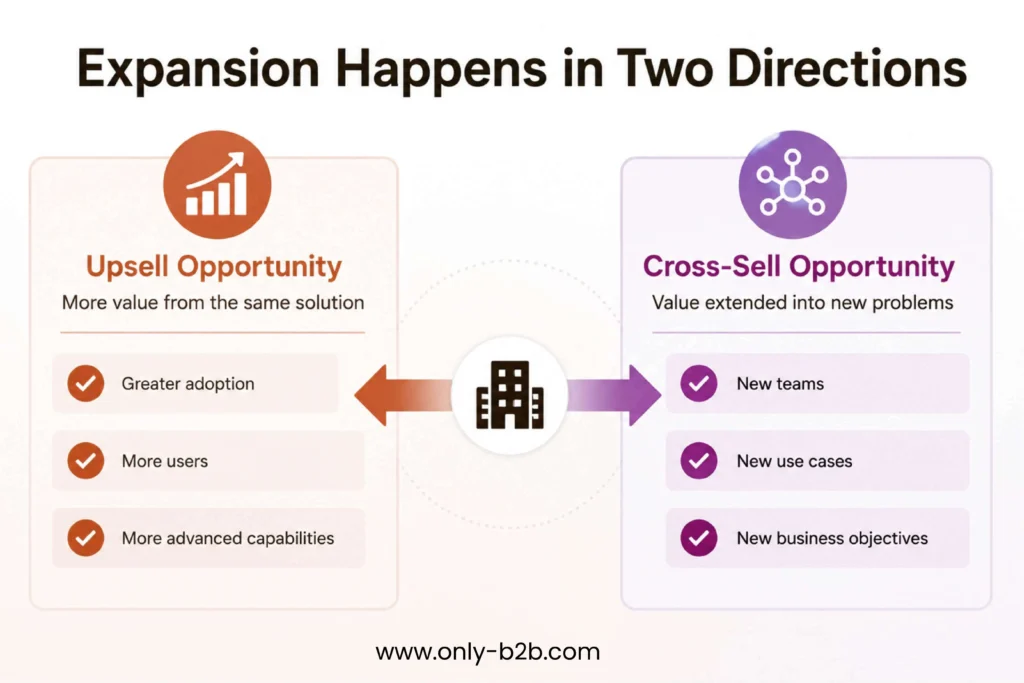
There are typically two ways to support the expansion.
An upsell strategy helps customers increase their investment in an existing solution through greater capability, scale, or functionality.
A cross-sell strategy introduces complementary solutions that address adjacent business challenges.
The distinction matters because the customer context in both methods is different.
Upsell conversations are usually driven by maturity. The customer has already achieved value and now requires more sophisticated capabilities.
Cross-sell conversations are driven by breadth. The customer faces a new challenge and evaluates whether an existing partner can help solve it.
The right path depends entirely on the customer’s situation.
One of the most common mistakes organizations make is leading with product availability instead of business relevance. Customers do not expand because additional products exist. They expand because those products help them solve problems that have become important.
It’s important to keep in mind that the most effective expansion conversations begin with business priorities.
Using Intent Signals for Account Expansion
Not every account is ready for expansion at the same moment.
Timing matters more than many organizations realize.
The strongest expansion teams rely on customer intent data to identify momentum before formal buying activity begins.
Intent appears through behavior such as increased platform engagement, growing feature adoption, participation in training programs, executive involvement, support interactions, integration exploration, and renewal planning discussions.
Individually, these signals may seem insignificant. Together, they create a picture of customer readiness.
These customer intent signals help revenue teams prioritize where attention should be focused.
Organizations that understand intent engage earlier. They help shape priorities rather than simply respond to them.
Building an Expansion Revenue Workflow
Expansion succeeds when customers experience one coordinated growth journey. Unfortunately, many organizations still operate in functional silos.
Customer success focuses on adoption. Sales focuses on revenue. Marketing focuses on engagement. Internally, those distinctions make sense. Customers do not experience them that way. They experience one relationship.
That is why revenue orchestration has become increasingly important.
Expansion requires shared visibility across teams.
Customer success identifies adoption trends and emerging opportunities. Sales evaluates commercial potential. Marketing supports stakeholder engagement and education.
Together, these functions create a structured expansion revenue strategy.
The workflow itself is often straightforward:
- Customer success identifies positive expansion triggers
- Teams evaluate the opportunity collectively.
- Sales validates business relevance and strategic fit, and marketing supports conversations with targeted content and stakeholder-specific messaging.
- The account progresses from adoption to expansion through coordinated action rather than disconnected outreach.
Customers experience consistency. Teams gain clarity. Growth becomes easier to scale.
Measuring Expansion Revenue Success
Expansion becomes difficult to improve when organizations only measure outcomes.
The strongest organizations monitor leading indicators that reveal account health before expansion occurs.
- Net revenue retention remains one of the most important measures because it reflects both retention and growth.
- Expansion ARR helps quantify revenue generated from existing customers.
- Product adoption reveals whether value is deepening.
- Account penetration measures organizational reach.
- Stakeholder expansion indicates whether relationships are becoming more resilient over time.
Together, these expansion metrics provide a more complete picture of growth potential.
More importantly, they help answer a question that matters far more than whether expansion occurred. They help explain why it occurred.
Common Account Expansion Mistakes
Here are some of the common mistakes teams make and how you can avoid making them:
FAQs
What is an ABM account expansion strategy?
An ABM account expansion strategy is a structured approach to growing revenue within existing customer accounts by identifying new stakeholders, uncovering additional use cases, and expanding adoption through coordinated sales, marketing, and customer success efforts.
Why is expansion revenue important in SaaS?
Expansion revenue improves growth efficiency because existing customers already trust the vendor, understand the product, and require fewer resources to generate incremental revenue compared to acquiring new customers.
What is the difference between upselling and cross-selling?
Upselling focuses on increasing investment in an existing solution through enhanced capabilities or higher-tier offerings, while cross-selling introduces complementary solutions that address related business challenges.
How do companies identify expansion opportunities?
Organizations typically analyze product usage patterns, stakeholder engagement, adoption trends, organizational changes, and business priorities to uncover potential growth opportunities within existing accounts.
What role does customer success play in account expansion?
Customer success teams often have the deepest visibility into customer outcomes, adoption levels, and emerging business needs, making them critical contributors to expansion planning.
What are customer intent signals?
Customer intent signals are behavioral indicators that suggest growing interest or readiness for additional investment, including increased usage, executive engagement, feature adoption, training participation, and strategic discussions.
Which metrics should be tracked for expansion?
Key metrics include net revenue retention, expansion ARR, adoption rates, account penetration, stakeholder engagement, and overall customer retention performance.
Turn Existing Accounts Into Profit Makers
Growth conversations often start with acquisition. The strongest growth strategies do not end there.
The organizations that consistently outperform understand that customer relationships are not static assets to maintain. They are dynamic opportunities to create additional value over time.
Expansion is not about extracting more revenue from existing customers.
It is about recognizing where customer priorities are evolving and ensuring the partnership evolves alongside them.
That requires visibility, alignment, patience, and a commitment to thinking beyond individual transactions.
When expansion becomes intentional, existing accounts stop being accounts that need managing. They become engines of growth.
At Only B2B, we help organizations build expansion-focused strategies that align sales, marketing, and customer success around the opportunities already present within their customer base.
Because in many cases, the most valuable growth opportunity is not the next account you win. It is the one that already trusts you.

Vikas Bhatt is the Co-Founder of ONLY B2B, a premium B2B lead generation company that specializes in helping businesses achieve their growth objectives through targeted marketing & sales campaigns. With 10+ years of experience in the industry, Vikas has a deep understanding of the challenges faced by businesses today and has developed a unique approach to lead generation that has helped clients across a range of industries around the globe. As a thought leader in the B2B marketing community, ONLY B2B specializes in demand generation, content syndication, database services and more.