
Most B2B organizations are not struggling to find buyer signals anymore. Between intent platforms, website analytics, content engagement data, and third-party research insights, there is more visibility into buyer behavior than ever before.
Visibility has improved, yet decision-making often becomes harder.
According to Gartner, 67% of buyers prefer representative free experience, making the signals more important than ever. But visibility alone does not create momentum. When intent data remains disconnected from CRM records and sales workflows, signals become observations rather than actions.
That gap between knowing and acting is where most intent strategies lose value.
What Is Intent Data Integration?
Intent data integration is the process of connecting buyer intent signals with the systems that revenue teams use every day to execute marketing, sales, and customer engagement activities.
At a surface level, this sounds like a technical exercise. Data moves from one platform into another. Fields are mapped. Records are updated.
But the real purpose is much more strategic than that.
The objective is to ensure that buyer behavior becomes part of operational decision-making. When a sales representative opens an account record, intent insights should already be visible alongside engagement history, opportunity status, firmographic information, and previous interactions. When marketing builds audiences, segmentation should reflect current buying activity rather than static assumptions.
A mature intent data integration strategy creates a connected environment where signals influence actions automatically and consistently.
Without integration, intent remains an observation. With integration, intent becomes part of how the business operates.
Why Intent Integration Matters for Revenue Teams
Many organizations initially adopt intent data because they want better targeting.
While targeting is valuable, the larger opportunity often lies elsewhere.
Revenue teams constantly face prioritization challenges. Every week presents hundreds or thousands of accounts that could be contacted, nurtured, or pursued. The question is rarely whether opportunities exist. The question is where attention should be focused first.
Intent signals help answer that question.
When integrated properly, intent data provides context that helps teams distinguish between accounts that fit an ideal customer profile and accounts that are actively researching solutions right now. That combination creates a much stronger basis for decision-making than demographic fit alone.
The impact extends across the revenue organization.
Sales teams can respond faster because signals appear directly within existing workflows rather than requiring manual monitoring. Marketing teams can align campaigns with active buying interests instead of relying solely on historical engagement. Revenue leaders gain greater confidence in account prioritization because decisions are informed by observable buyer behavior.
The operational impact is measurable as well. Research shows that 82% of B2B marketers report faster conversion of intent-based leads, highlighting what happens when buyer signals are connected to execution rather than left in isolated systems.
This is why intent data is increasingly becoming part of broader RevOps workflows.
Core Systems in an Intent Data Stack
Intent data rarely delivers value through a single platform. Instead, it becomes useful when multiple systems work together to create a complete operational picture.
CRM Systems
The CRM remains the central source of truth for most revenue organizations. It houses account records, opportunity data, contact information, activity history, and ownership structures.
This makes CRM intent data integration one of the most important components of any intent strategy. If sales teams cannot access intent insights where they already manage accounts and opportunities, adoption becomes significantly more difficult.
Marketing Automation Platforms
Marketing automation systems help translate intent signals into audience actions.
Intent data can influence segmentation, campaign enrollment, nurturing programs, and content delivery strategies. Rather than treating all prospects equally, marketers can align engagement efforts with demonstrated buying interests.
Sales Engagement Platforms
Sales engagement tools help operationalize intent through coordinated outreach.
Whether teams use sequencing platforms, prospecting tools, or engagement systems, these platforms often become the bridge between account intelligence and seller activity.
Customer Data Platforms
Organizations managing multiple data sources frequently use customer data platforms to unify information across systems.
These platforms support stronger CRM enrichment efforts by creating a more complete account view and reducing fragmentation across teams.
Intent Data Platforms
Intent providers collect and analyze behavioral signals from publisher networks, content consumption patterns, search activity, website engagement, and other digital interactions.
These platforms generate the signals, but the value emerges only when those signals move into operational systems.
The strongest intent programs are not defined by the sophistication of any individual platform. They are defined by how effectively information flows between them.
How Intent Data Flows Across Systems
The most effective sales intent workflow is often built around a straightforward sequence of actions.
The process begins when intent platforms detect relevant buyer activity. This activity may involve research around specific topics, engagement with industry content, or increased interest in solution categories.
ICP Evaluation
Once captured, those signals are matched against target accounts and evaluated against ideal customer profile criteria. This step is important because not every signal deserves the same level of attention. Buyer activity matters, but fit still matters.
Account Scoring
Signals are evaluated based on intensity, frequency, recency, and relevance. This creates a structured way to compare accounts and prioritize resources.
Routing Qualified Signals
Qualified signals are then routed to the appropriate teams. Depending on account ownership and lifecycle stage, notifications may be directed to SDRs, account executives, marketers, customer success managers, or account-based marketing teams.
Triggered Actions
Outreach begins, campaigns adjust, tasks are assigned, or workflows are activated.
The purpose of this process is not to create more activity. It is to reduce the distance between buyer behavior and organizational response.
Mapping Intent Signals Into Your CRM
One of the most overlooked aspects of integration is field design.
Many organizations successfully connect intent platforms to their CRM but struggle to generate meaningful outcomes because the information lacks structure. Data appears inside records, yet nobody knows how to interpret it consistently.
Effective CRM intent integration starts with defining which signals matter and how they should be represented.
Common CRM fields include:
- Intent score
- Research topics
- Topic intensity
- Last detected activity
- Engagement level
- Buying stage signals
- Account ranking
- Signal source
- Signal recency
The goal is not to capture every available data point. The goal is to create information that supports decision-making.
For example, a sales manager reviewing pipeline should interpret intent signals the same way an SDR reviewing daily priorities does. Consistency matters because it creates alignment across teams.
When intent data lacks structure, it creates confusion. When it is standardized and clearly defined, it becomes a practical tool for prioritization and execution.
Prioritizing Intent Signals for Sales Teams
One of the most common mistakes organizations make is assuming that all intent signals carry equal value. They do not.
Some signals indicate casual research. Others suggest active buying evaluation. Treating them the same often leads to inefficient sales workflows and wasted effort.
Effective intent scoring typically combines two dimensions.
The first is account fit. The second is signal strength.
An account that closely matches your ideal customer profile and demonstrates strong buying activity deserves immediate attention. An account with weak fit but high activity may warrant monitoring rather than direct investment. Likewise, a strong-fit account with limited activity may belong in a nurturing motion rather than an active sales motion.
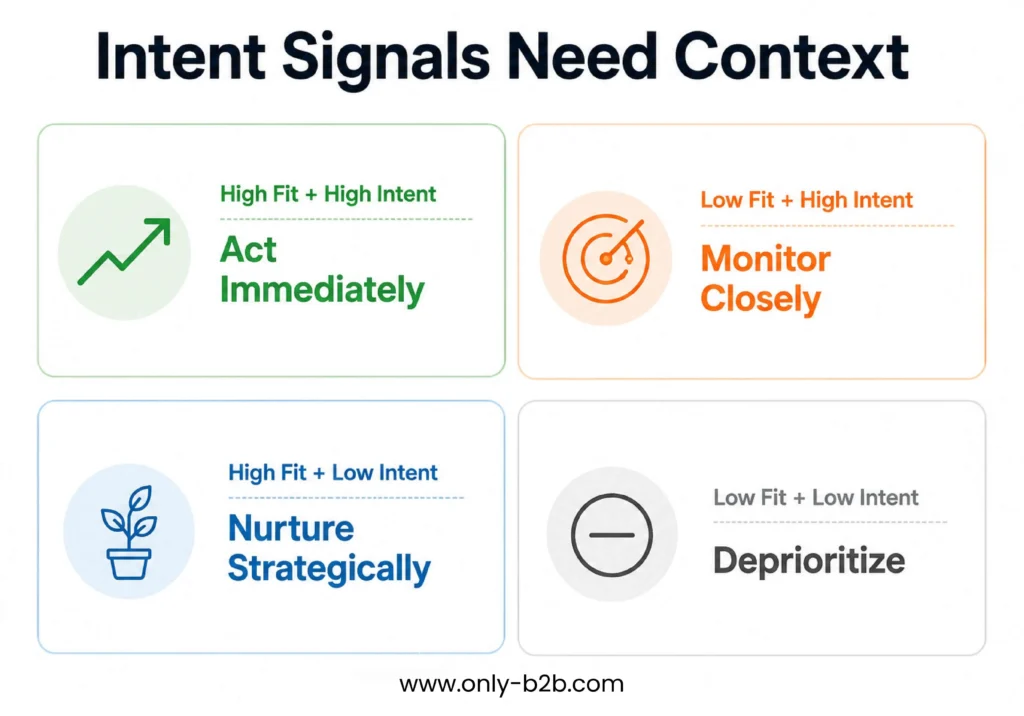
This framework helps teams balance opportunity with efficiency.
The objective is to improve account prioritization so that resources are directed toward accounts most likely to convert. Organizations often discover that better filtering creates more value than collecting additional signals. Clarity frequently outperforms complexity.
Using Intent Data in SDR Workflows
Intent data becomes meaningful when it changes how conversations begin.
For SDRs, the challenge is rarely finding accounts to contact. The challenge is determining which accounts deserve attention today and what message is most likely to resonate.
Integrated SDR workflows provide context that helps answer both questions.
Instead of relying exclusively on firmographic information, SDRs gain visibility into emerging interests, active research topics, and behavioral patterns. This context helps shape outreach strategies and improves the relevance of conversations.
More importantly, intent data helps SDRs understand timing.
Many prospecting efforts fail not because the message is wrong, but because the timing is disconnected from buyer priorities. Intent signals provide clues about when interest is increasing, allowing outreach to align more closely with actual buying behavior.
The result is more informed outreach.
That distinction matters because relevance often creates stronger engagement than volume.
Automating Sales Actions with Intent Signals
Automation is often where organizations realize the most immediate operational benefits from intent integration.
However, effective automation is not about removing human judgment. It is about ensuring that important signals consistently reach the right people at the right time.
Intent-driven sales automation can support a variety of actions, including:
- Trigger alerts for account owners
- Lead routing based on activity thresholds
- Sequence enrollment
- Territory assignment updates
- Audience synchronization
- Follow-up task creation
- Trigger-based outreach programs
These workflows reduce manual effort while improving consistency across teams.
The key is maintaining balance.
Organizations that automate every signal often create noise. Organizations that automate nothing often create delays. The most effective approach sits between those extremes, using automation to support execution while preserving human decision-making where context matters most.
Managing Data Quality and Governance
Intent data is only as useful as the systems that manage it.
Many organizations invest heavily in implementation but underestimate the importance of governance. Over time, this creates challenges that gradually reduce trust in the data.
Duplicate records create confusion. Ownership conflicts slow execution. Outdated signals distort prioritization decisions. Inconsistent definitions lead to misalignment across teams.
Strong CRM data quality practices help prevent these issues before they become operational problems.
Governance frameworks should address areas such as:
- Duplicate management
- Account ownership rules
- Data refresh schedules
- Signal expiration policies
- Access controls
- Documentation standards
Intent data is inherently dynamic. A signal that indicated strong buying interest last month may no longer be relevant today.
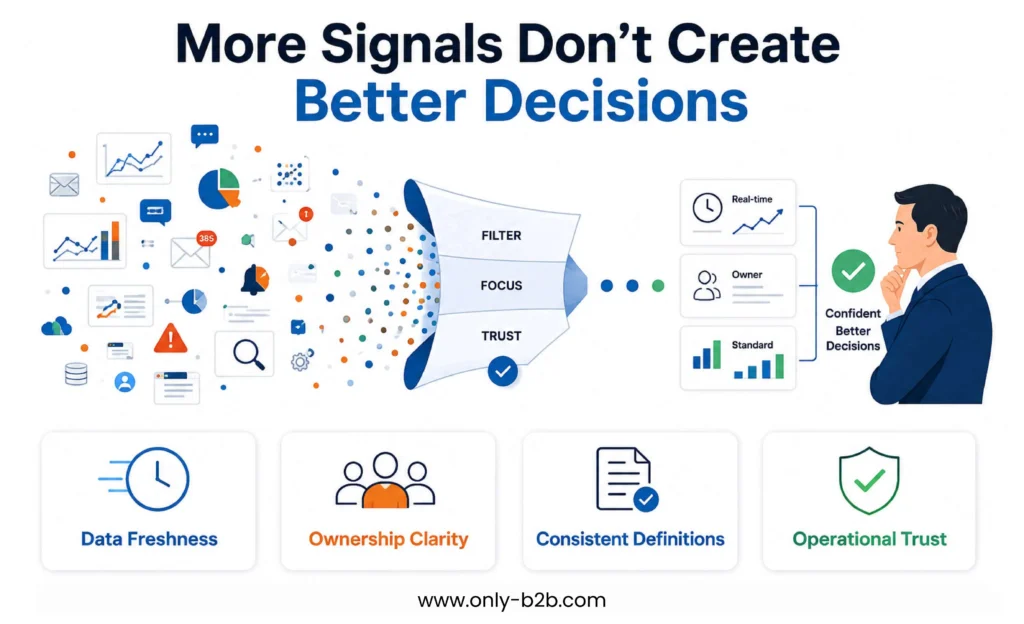
Organizations that maintain disciplined governance practices tend to achieve stronger adoption because users trust the information they see. That trust becomes critical because even the most sophisticated integration loses value when teams stop believing the data.
Measuring Intent Data Integration Success
Many organizations evaluate intent initiatives by measuring signal volume.
While signal volume may indicate activity, it rarely indicates business impact.
The more useful question is whether integration is improving execution.
Several intent data metrics can help answer that question.
- Response speed reveals whether teams are acting on signals more quickly.
- Meeting conversion rates indicate whether intent-informed outreach is generating stronger engagement.
- Opportunity creation rates show whether prioritized accounts are progressing into the pipeline.
Organizations should also evaluate pipeline visibility and pipeline contribution to understand how intent-supported accounts influence revenue outcomes over time.
Ultimately, success is not determined by how many signals enter the system.
Success is determined by whether those signals improve decision-making, strengthen coordination, and contribute to pipeline growth.
Common Intent Integration Mistakes
Most intent initiatives struggle because of operational issues rather than technology limitations.
FAQs
What is intent data integration?
Intent data integration is the process of connecting buyer intent signals with CRM systems, marketing platforms, sales tools, and operational workflows so revenue teams can act on buyer activity more effectively.
Why is CRM integration important for intent data?
Without CRM integration, intent insights remain disconnected from the systems where sales teams manage accounts and opportunities. Integration ensures signals become part of everyday decision-making.
How does intent data support account prioritization?
Intent signals help identify accounts actively researching relevant topics, allowing teams to focus resources on opportunities demonstrating stronger buying interest.
What fields should be added to a CRM for intent tracking?
Most organizations track intent scores, research topics, engagement levels, activity dates, account rankings, and buying stage indicators.
How often should intent data be refreshed?
Refresh frequency depends on the provider and use case, but regular updates are essential because buyer behavior changes quickly and older signals lose relevance over time.
How do SDRs use intent data effectively?
SDRs use intent insights to prioritize outreach, personalize messaging, identify relevant business challenges, and engage accounts at more appropriate moments.
What role does automation play in intent workflows?
Automation helps distribute signals, assign ownership, trigger actions, and ensure timely responses without requiring constant manual monitoring.
How do you measure intent data success?
Organizations typically evaluate response speed, meeting generation, opportunity creation, pipeline influence, and revenue contribution to determine effectiveness.
Turn Intent Signals Into Revenue Actions
Intent data has matured significantly over the past few years. Most revenue teams now have access to more buyer intelligence than ever before.
The challenge is not visibility but integration.
Organizations that generate meaningful results from intent data are not simply collecting signals and reviewing dashboards. They are embedding buyer behavior directly into the systems, workflows, and decisions that drive revenue execution.
When intent signals flow seamlessly across marketing, sales, and revenue operations, teams gain more than information. They gain clarity around where to focus, when to engage, and how to prioritize resources.
That is ultimately the purpose of intent data integration.

Vikas Bhatt is the Co-Founder of ONLY B2B, a premium B2B lead generation company that specializes in helping businesses achieve their growth objectives through targeted marketing & sales campaigns. With 10+ years of experience in the industry, Vikas has a deep understanding of the challenges faced by businesses today and has developed a unique approach to lead generation that has helped clients across a range of industries around the globe. As a thought leader in the B2B marketing community, ONLY B2B specializes in demand generation, content syndication, database services and more.