
Sales and outbound outreach sit at the center of how most B2B businesses grow.
That is also why the roles of telemarketing and appointment setting often get grouped together. Both involve prospect conversations, outbound communication, and business development, so on the surface, the difference can seem small.
But the intent behind them is very different.
Telemarketing is generally built to create reach and open conversations at scale. Appointment setting is designed to create qualified meetings that have a stronger chance of moving into the pipeline.
According to pricing benchmarks referenced by SalesAR, the average cost per qualified appointment has increased significantly year over year, making outreach efficiency and qualification quality more important than ever.
As sales cycles become more competitive and buying journeys become more layered, understanding the difference between appointment setting and telemarketing becomes important for choosing the right outbound approach at the right stage of growth.
What Is Telemarketing?
The telemarketing meaning has evolved over time, but the core principle remains the same. Telemarketing is a broad outbound communication approach focused on reaching a large number of contacts through phone-based outreach.
The objective was visibility, awareness, lead generation, survey collection, promotions, or initial buyer engagement. Success often depended on the volume of outreach rather than the depth of qualification.
In many organizations, telemarketing teams operate through structured scripts, predefined workflows, and high daily call targets. The process is designed for consistency and repeatability.
For certain industries, markets, and campaign goals, mass outreach still serves a purpose. Companies launching into new regions, validating market demand, promoting time-sensitive offers, or collecting basic lead data may benefit from telemarketing campaigns.
Many B2B organizations expect telemarketing efforts to produce highly qualified meetings with decision-makers who are already aligned on pain points, budget realities, and buying intent. That is rarely how broad outbound systems work.
Telemarketing creates surface-level engagement efficiently. It opens doors, generates initial responses, and increases top-of-funnel activity. But activity and momentum are not the same thing.
This is why telemarketing vs appointment-setting conversations often become less about outreach mechanics and more about sales maturity.
What Is Appointment Setting?
Appointment setting is a targeted outbound process built to secure qualified sales meetings with prospects that closely match an ideal customer profile.
It is centered around identifying the right accounts, understanding business context, and creating conversations worth continuing. This difference changes how the entire process operates.
An appointment setter or SDR outreach team typically spends significant time researching accounts before outreach even begins. They look at industry fit, company size, decision-maker roles, operational triggers, technology stack, expansion signals, or hiring patterns.
Instead of following a generalized script, conversations are adapted to the prospect’s environment, priorities, and likely business pressures. The objective is not simply to generate interest. It is to determine whether a meaningful sales conversation should happen at all.
That is why appointment setting often sits much closer to revenue strategy than traditional outbound activity.
The strongest appointment setting programs are optimized for sales continuity.
Appointment Setting vs Telemarketing
The easiest way to understand appointment setting vs telemarketing is to look beyond channels and focus on intent.
| Area | Telemarketing | Appointment Setting |
|---|---|---|
| Primary Objective | Broad outreach and awareness | Qualified meetings for sales pipeline |
| Targeting Approach | Larger contact databases | ICP targeting and account selection |
| Qualification Depth | Basic qualification | Multi-layer account qualification |
| Outreach Style | Script-driven | Personalized and research-led |
| Performance Focus | Call volume and contact rates | Meetings booked and pipeline movement |
| Buyer Engagement | Early-stage interaction | Sales-ready conversation building |
| Conversion Quality | Higher variability | Higher intent alignment |
| Team Structure | Call-center oriented | SDR and sales development focused |
It’s important to learn about this difference, as it helps organizations to plan better and have expectations that make sense.
When to Use Telemarketing vs Appointment Setting
The decision between telemarketing vs appointment setting should come from business objectives.
Companies often default toward whichever model appears more scalable or more affordable in the short term. But outbound effectiveness depends less on activity volume and more on alignment with the buying environment.
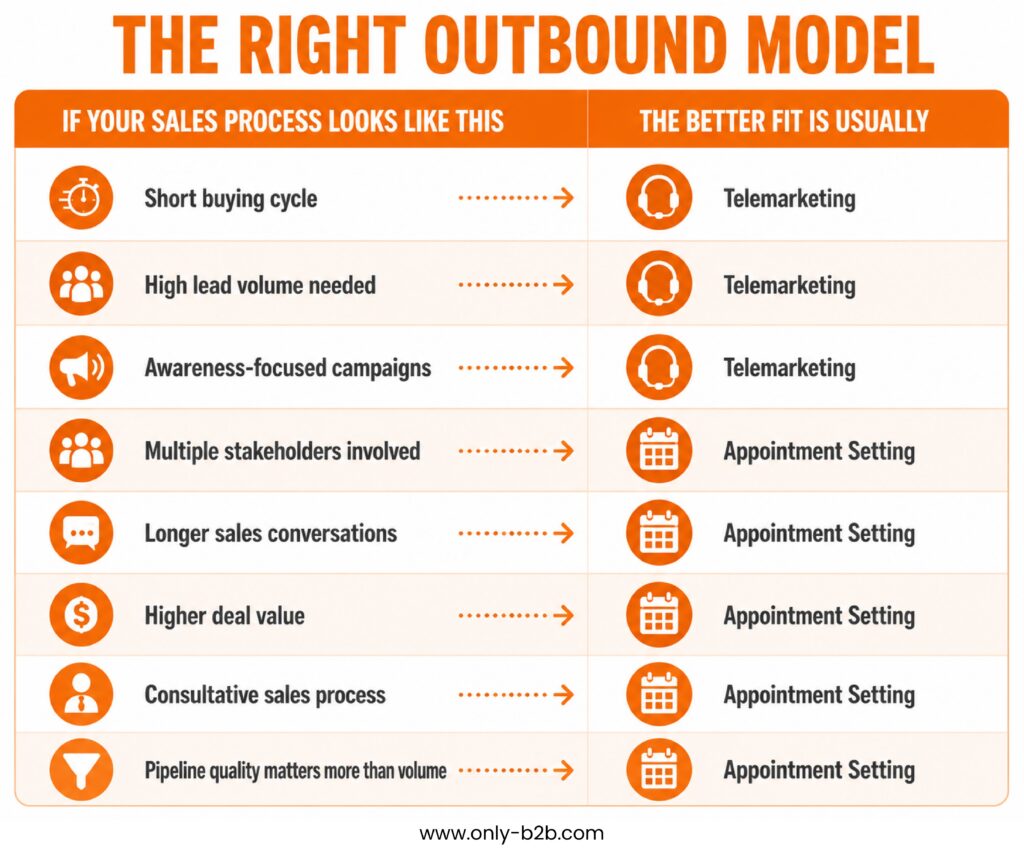
Telemarketing tends to work best when the objective is reach.
This includes scenarios like:
- Market awareness campaigns
- Large-scale database activation
- Event promotion
- Survey collection
- Entry-level lead generation
- Geographic expansion outreach
- Time-sensitive campaign pushes
These situations benefit from speed and coverage.
Appointment setting becomes more valuable when the sales process requires deeper context, stakeholder engagement, and stronger qualification.
This typically applies to:
- Mid-market and enterprise sales
- Complex solution selling
- Long sales cycles
- High-value professional B2B services
- Multi-decision-maker buying groups
- Account-based outbound strategy
- Consultative sales workflows
The distinction becomes even more important in industries where buying decisions involve operational risk.
When buyers are evaluating vendors tied to revenue, infrastructure, compliance, or transformation goals, generic outreach rarely creates meaningful traction.
Decision-makers respond differently when the outreach reflects familiarity with their business environment. This is why mature B2B sales strategy increasingly prioritizes quality of engagement over raw activity metrics.
Targeting & Qualification Differences
Targeting and qualification work very differently in appointment setting vs telemarketing because the purpose behind both approaches is not the same.
As the goals change, the targeting methods, outreach style, and qualification process naturally change with them.
Traditional telemarketing systems are usually built around scale efficiency.
Lists are often broader, qualification criteria are lighter, and outreach is designed to maximize contact rates across larger databases. This approach can generate significant activity quickly, especially in markets where reach matters more than precision.
The tradeoff here is relevance.
Broader outreach naturally creates lower alignment between messaging and buyer context. As campaigns scale, personalization often becomes difficult to maintain consistently.
Appointment setting operates differently because the filtering process starts before outreach begins.
Instead of asking, “How many contacts can we reach?” the process asks, “Which accounts are most likely to convert into meaningful opportunities?”.
- Teams begin working from defined ICP targeting parameters instead of generalized lists.
- Outreach becomes more selective.
- Messaging becomes more contextual.
- Qualification becomes layered rather than binary.
This matters because account qualification is no longer just a sales exercise.
In modern B2B outreach, qualification shapes efficiency across the entire revenue system.
Strong qualification creates cleaner sales handoffs, better discovery conversations, and higher downstream conversion stability.
Conversion Rates & ROI Comparison
The conversation around conversion rates often becomes misleading because many organizations measure outbound success too early in the funnel.
Telemarketing campaigns may generate high contact activity, larger response pools, or increased engagement volume. On reporting dashboards, this can initially look productive.
But pipeline value is rarely determined at the top of the funnel. As only 0.2–2% of cold outreach efforts convert into actual closed deals.
It is determined by how efficiently conversations move toward qualified opportunities, stakeholder alignment, and revenue progression.
This is where appointment setting typically produces stronger long-term ROI.
Because outreach is more targeted, meetings tend to carry higher buyer intent from the beginning. Sales teams spend less time filtering unqualified conversations and more time advancing accounts with genuine potential.
Higher-quality meetings often lead to:
- Better discovery outcomes
- Stronger stakeholder engagement
- Lower drop-off rates
- Improved meeting conversion rate
- More predictable sales forecasting
- Higher opportunity progression
Meanwhile, high-volume outbound systems frequently create hidden operational costs.
Sales teams spend time on poorly aligned calls. Marketing interprets activity as traction. The pipeline appears healthy until deeper-stage conversion reveals weak qualification.
This is one reason many organizations struggle to connect lead generation vs pipeline performance.
The top of the funnel may look active while revenue movement remains inconsistent.
Appointment setting tends to reduce wasted sales motion by prioritizing alignment earlier in the process.
SDR Outreach vs Telemarketing Teams
The operational structure behind outreach matters more than most organizations realize.
A telemarketing environment is usually optimized around the volume of calls made.
Teams are trained for consistency, script adherence, and activity execution. Performance systems are often tied to daily calls, contact rates, or outreach coverage.
Cold calling success averages 2.3%, but over 80% of buyers say they’re open to calls.
An SDR vs telemarketing comparison becomes more interesting when sales complexity increases.
SDR teams are typically aligned with sales strategy.
Their role extends beyond initiating contact. They research accounts, identify buying signals, personalize communication, navigate gatekeepers, and assess sales readiness.
That changes the skill profile significantly. Strong SDR outreach requires:
- Business context understanding
- Industry familiarity
- Messaging adaptability
- Qualification judgment
- Sales alignment
- Objection handling beyond scripts
This is also why appointment setting cannot simply be reduced to meeting booking.
The strongest outbound systems understand that relevance scales differently from activity.
What Metrics to Focus On
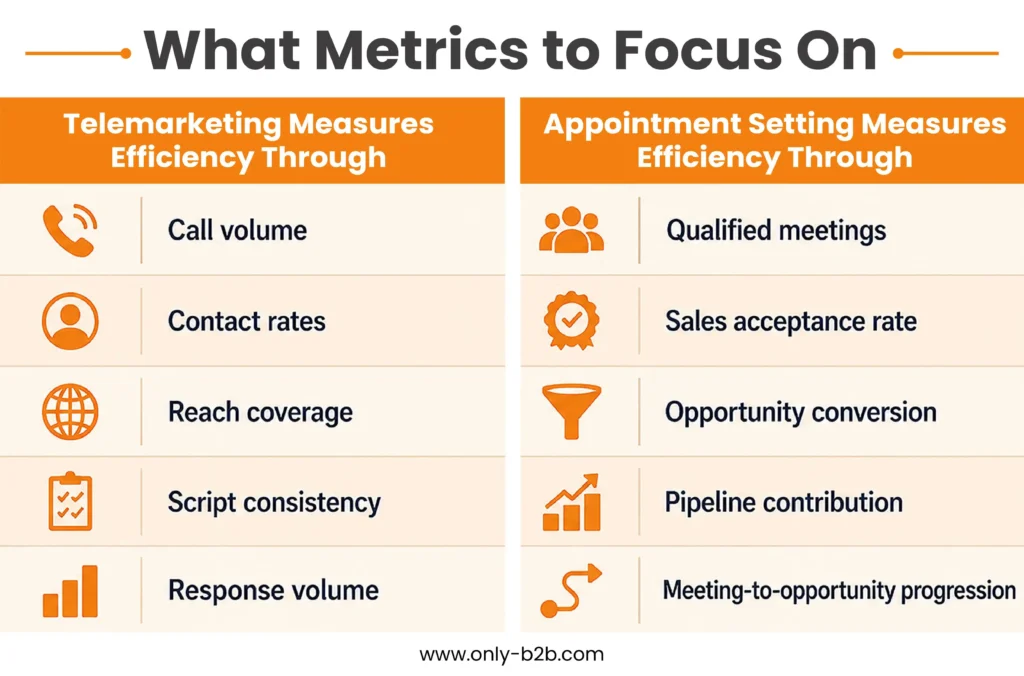
One of the biggest outbound mistakes organizations make often is measuring fundamentally different systems through identical metrics.
Telemarketing performance should be evaluated through activity-based indicators such as:
- Call volume
- Contact rates
- Script adherence
- Response percentages
- Database coverage
- Lead capture numbers
These metrics make sense in high-volume environments because efficiency depends on operational throughput.
Appointment setting requires a different measurement framework.
The more useful outbound metrics often include:
- Qualified meetings booked
- Sales acceptance rates
- Opportunity creation rates
- Pipeline contribution
- Meeting-to-opportunity progression
- Account engagement quality
- Revenue influence
This distinction matters because metrics shape behavior.
If appointment setters are measured only on activity volume, personalization quality usually declines. If telemarketing teams are measured solely on pipeline impact, expectations become unrealistic.
The measurement system must reflect the actual role of the outreach function. Otherwise, teams optimize for numbers that look productive without necessarily improving pipeline growth.
The strongest outbound organizations understand that metrics are not just reporting tools. They are operational signals.
Common Mistakes to Avoid
Many outbound issues start showing up much later in the pipeline, which is why they often go unnoticed in the beginning.
Most of them come from treating outreach as a volume problem instead of an alignment problem.
FAQs on Appointment Setting vs Telemarketing
What is the difference between appointment setting and telemarketing?
Telemarketing focuses on broad outbound communication to initiate engagement at scale. Appointment setting focuses on securing qualified meetings with prospects that match the ICP.
Which is better for B2B companies?
The better approach depends on the objective. Companies focused on reach, awareness, or database activation may benefit from telemarketing. Businesses selling complex or high-value solutions usually benefit more from appointment setting because qualification quality becomes more important.
Is appointment setting part of lead generation?
Yes, but it operates deeper in the outbound process. Traditional lead generation often focuses on interest capture, while appointment setting focuses on moving qualified accounts into meaningful sales conversations.
Why do appointment setting campaigns usually convert better?
Appointment setting campaigns tend to perform better because outreach is more targeted, qualification standards are stronger, and conversations are aligned more closely with actual buyer intent.
What industries benefit most from appointment setting?
Industries with longer sales cycles, multiple stakeholders, or consultative buying processes often benefit the most. This includes SaaS, IT services, manufacturing, healthcare, logistics, consulting, and enterprise B2B services.
Can telemarketing still work in modern B2B sales?
Yes, particularly for awareness campaigns, market expansion, surveys, or large-scale outreach initiatives. The challenge is ensuring expectations match the strengths of the model being used.
Choose the Right Approach for Growth
The discussion around appointment setting vs telemarketing is ultimately a discussion about intent. Both approaches can create value. But they create value differently.
The mistake is expecting the same outcome from fundamentally different systems.
As B2B buying journeys become more layered, outbound performance increasingly depends on alignment between targeting, messaging, qualification, and sales readiness.
Companies that recognize this early tend to build cleaner pipelines, stronger sales conversations, and more predictable revenue motion.
At Only B2B, we help organizations design outbound systems that align with how modern B2B buyers actually engage. Whether the need is large-scale outreach, qualified appointment setting, or a more refined outbound structure, the focus remains the same: creating conversations that move business forward with clarity and intent.

Vikas Bhatt is the Co-Founder of ONLY B2B, a premium B2B lead generation company that specializes in helping businesses achieve their growth objectives through targeted marketing & sales campaigns. With 10+ years of experience in the industry, Vikas has a deep understanding of the challenges faced by businesses today and has developed a unique approach to lead generation that has helped clients across a range of industries around the globe. As a thought leader in the B2B marketing community, ONLY B2B specializes in demand generation, content syndication, database services and more.