When you look at your dashboard at the end of the month, the first question is simple. Was it a good month or not?
The answer rarely sits in total leads or reach. It shows up in how many real conversations were created and how many of those moved forward with intent.
That is where things start to feel unclear. Replies come in, interest appears, but calendars do not fill in proportion. Follow-ups extend, decisions delay, and momentum becomes harder to read.
Across B2B, appointment setting conversion rates often fall between 2% to 3% unless targeting and timing are tightly aligned. Which means most activity does not convert into meetings.
This is where B2B appointment setting matters. Not as a top-of-funnel metric, but as the point where pipeline either becomes tangible or starts to thin out.
What Is Appointment Setting Conversion Rate?
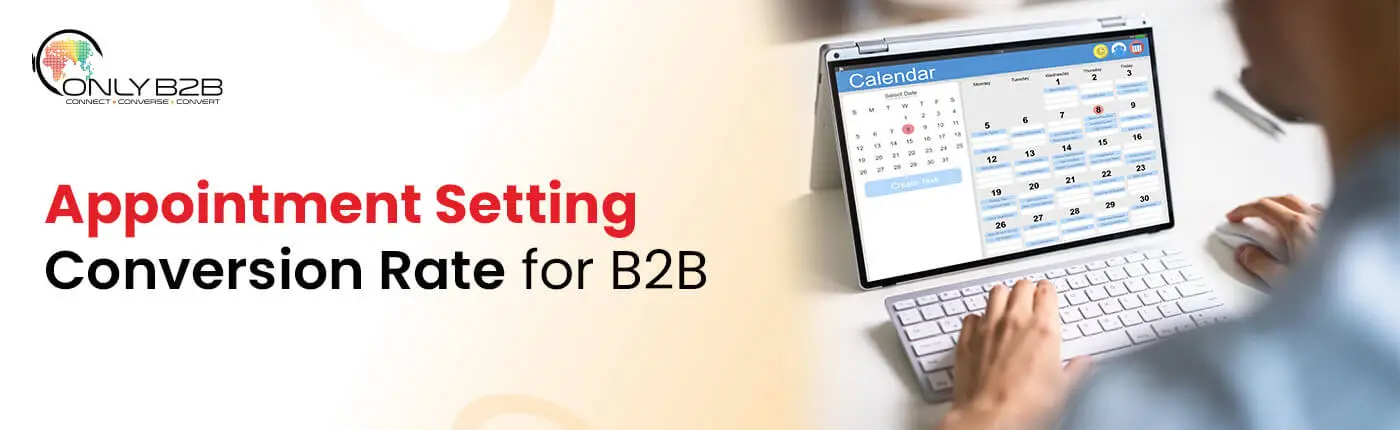
The appointment setting conversion rate measures how effectively your team converts leads or outreach into booked meetings. It reflects whether your pipeline is moving forward with intent or simply accumulating activity.
Appointment Setting Conversion Rate = (Number of Meetings Booked / Number of Leads or Contacts Reached) × 100
While the formula is straightforward, the interpretation of it is not. This metric behaves differently depending on whether it is applied to inbound, outbound, or partner-led motion.
In inbound, conversion reflects how well your positioning aligns with existing demand. In outbound, it reflects how well you are creating relevance where intent is not yet formed.
A strong appointment setting conversion rate is rarely about outreach alone. It is a signal that targeting, messaging, and timing are working together.
How to Calculate B2B Appointment Setting Conversion Rate
Appointment setting conversion rate can be calculated at different stages of the funnel. The right formula depends on what you want to measure: booking efficiency, meeting attendance, meeting quality, or overall pipeline progression.
| Conversion Metric | Formula | What It Tells You |
|---|---|---|
| Lead / Contact → Meeting | Booked Meetings ÷ Leads or Contacts Reached × 100 | Measures the overall efficiency of turning targeted contacts into booked sales meetings. |
| Reply → Meeting | Booked Meetings ÷ Replies × 100 | Shows how effectively prospect engagement converts into actual calendar intent. |
| Booked → Held | Meetings Held ÷ Meetings Booked × 100 | Measures meeting show rate and how many booked appointments actually take place. |
| Held → Opportunity | Opportunities Created ÷ Meetings Held × 100 | Helps evaluate whether completed meetings are reaching prospects with genuine sales potential. |
| Lead → Opportunity | Opportunities Created ÷ Leads or Contacts Reached × 100 | Measures end-to-end efficiency from initial outreach through pipeline creation. |
Understanding the B2B Conversion Funnel
Most teams view the B2B funnel as a sequence of stages, but in practice, it is actually a series of validations.
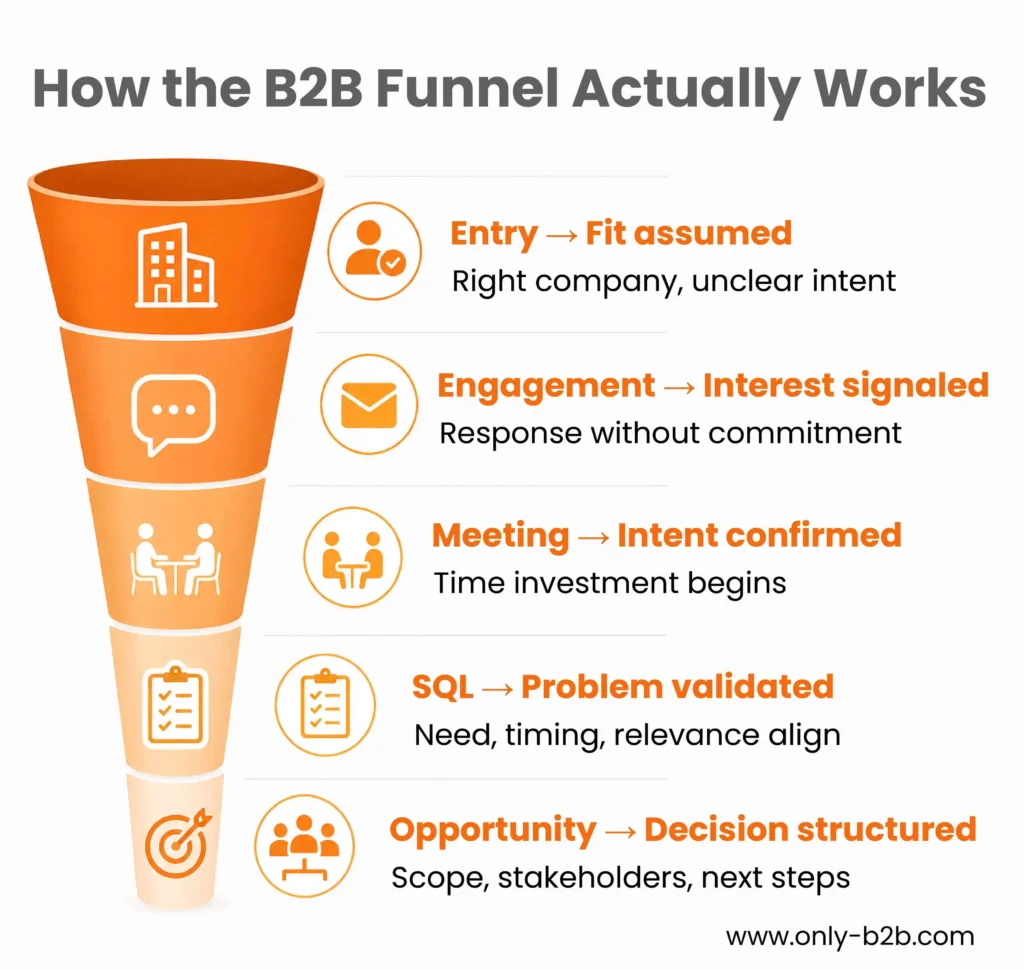
Targeting and Entry
This is where prospects enter your funnel through campaigns, outbound, or inbound channels. The quality of this stage depends on how clearly your ICP and entry points are defined.
Engagement
At this stage, the prospect shows a signal. A reply, a click, or any form of interaction. This is not intent yet, but it is the first indication of relevance.
Qualification
Here, fit and intent are evaluated together. Does this account match your ICP, and is there a real problem or timing behind the engagement?
Meeting (Scheduling)
This is the first real commitment. The prospect is willing to invest time. This is where appointment-setting conversion rate becomes visible and measurable.
Show and Outcome
A booked meeting only matters if it happens and progresses. This stage reflects whether expectations were aligned before the call.
Opportunity Creation
Once validated, the conversation becomes structured into a real opportunity with defined scope, stakeholders, and next steps.
The transition from engagement to meeting carries disproportionate weight. It determines whether your funnel builds real pipeline or just accumulates activity.
What Is a Good Appointment Conversion Rate?
There is no universal benchmark that defines a good appointment setting conversion rate. Context matters more than comparison.
Inbound channels typically convert higher because intent already exists. In many cases, conversion falls between 20% to 40%, depending on how clearly the problem and solution are aligned.
Outbound behaves differently. Conversion ranges are wider, often between 1% to 10%, influenced heavily by targeting accuracy and outreach quality.
These B2B benchmarks are useful as directional indicators, not performance targets. A higher number does not always indicate better performance if it comes from overly broad qualification, and a lower number is not always a concern if it reflects a more selective pipeline.
The more useful question is whether your conversion rate reflects clarity in your system or friction within it.
Conversion Rates by Deal Size
Conversion does not behave uniformly across segments. Deal size introduces a different set of dynamics that influence how meetings are booked and progressed.
In SMB environments, decisions are faster and involve fewer stakeholders. Lower ACV reduces perceived risk, and the path from meeting to opportunity is more direct. As a result, meeting booking rate tends to be higher and more consistent.
In enterprise settings, the process slows down. Higher ACV and deal complexity introduce additional layers of evaluation. Meetings require stronger justification, and alignment takes longer. Conversion is lower, but the value per opportunity is significantly higher.
This is not a performance issue. It is a structural difference in how decisions are made. Expectations around conversion need to reflect this rather than apply a single benchmark across segments.
What Impacts Appointment Conversion Rates?
Appointment conversion is influenced by multiple factors, and they are often interconnected.
- Targeting determines whether you are speaking to the right accounts. If the ICP definition is too broad, conversion drops because relevance is diluted.
- Intent signals to determine whether the timing is right. Even the right account will not convert if the problem is not active.
- Messaging connects your offering to the buyer’s context. If the message is generic, it fails to create urgency or interest.
- Timing shapes how outreach is received. Even strong messaging can be ignored if it arrives at the wrong moment.
- SDR performance determines how effectively initial engagement is handled. This includes how conversations are opened, how objections are navigated, and how follow-ups are managed.
Low conversions are not usually caused by a single breakdown. It is the result of these factors being slightly misaligned.
How to Diagnose Low Conversion Rates
Low conversion is often treated as a volume issue, but increasing volume rarely fixes it. The more useful approach is to understand where the drop actually occurs.
Start with funnel analysis and observe behavior across stages.
- If leads are not responding, the issue is likely in targeting or outreach quality. The message may not be relevant enough to initiate engagement.
- If responses are coming in but meetings are not being booked, the gap is in how value is being communicated. Interest exists, but it is not strong enough to commit time.
- If meetings are booked but do not progress, the issue shifts to qualification or expectation setting. The initial alignment may not be strong enough to sustain the conversation.
Diagnosis is not about identifying a weak metric. It is about understanding what that metric is indicating.
How to Improve Appointment Conversion Rates
Improving conversion is not about increasing activity. It is about removing points of friction between interest and commitment.
Tighten targeting around buying context, not just ICP
Move beyond firmographics. Look for signals like recent hiring, tech adoption, or active initiatives. Conversion improves when outreach aligns with something already in motion.
Anchor messaging in a specific tension, not a broad value prop
Generic value gets acknowledged, not acted on. Frame your outreach around a problem the buyer is already dealing with but hasn’t clearly defined.
Reduce the ask before the meeting
If your outreach tries to explain everything, it creates hesitation. The goal is not to close in the message. It is to make the next step feel easy and relevant.
Design cadence around response behavior, not schedules
Most sequences are time-based. Stronger ones are signal-based. If a prospect engages, the follow-up should adapt immediately, not wait for the next step. Delays here are not neutral. The odds of qualifying a lead drop 21× when response time moves from 5 minutes to 30 minutes, which means even small lags directly reduce conversion potential.
Shorten the gap between response and booking
Conversion drops when there is a delay. Faster replies, clearer next steps, and fewer back-and-forths increase the likelihood of securing the meeting.
Control the quality of the meeting, not just the booking
Set expectations before the call. Who should join, what will be discussed, and why it is worth their time. This improves both show rates and downstream conversion.
SDR Performance vs System Problem
When conversion declines, the immediate reaction is often to evaluate SDR performance. While individual capability matters, it is rarely the only factor.
If multiple SDRs are experiencing similar conversion challenges, the issue is likely systemic. This includes how leads are sourced, how messaging is structured, and how the overall sales process is designed.
Improving SDR performance without addressing system gaps creates temporary improvements but does not sustain them. Over time, the same issues reappear in different forms.
A more effective approach is to view SDR output as a reflection of system inputs. When inputs improve, performance becomes more consistent across individuals.
Why Conversion Rate Impacts Pipeline
Pipeline generation is often measured by volume, but volume alone does not create predictability. Movement through the funnel is what determines pipeline quality.
A small improvement in appointment setting conversion rate can significantly impact pipeline growth. Not because you are doing more, but because more of what you are already doing starts to convert.
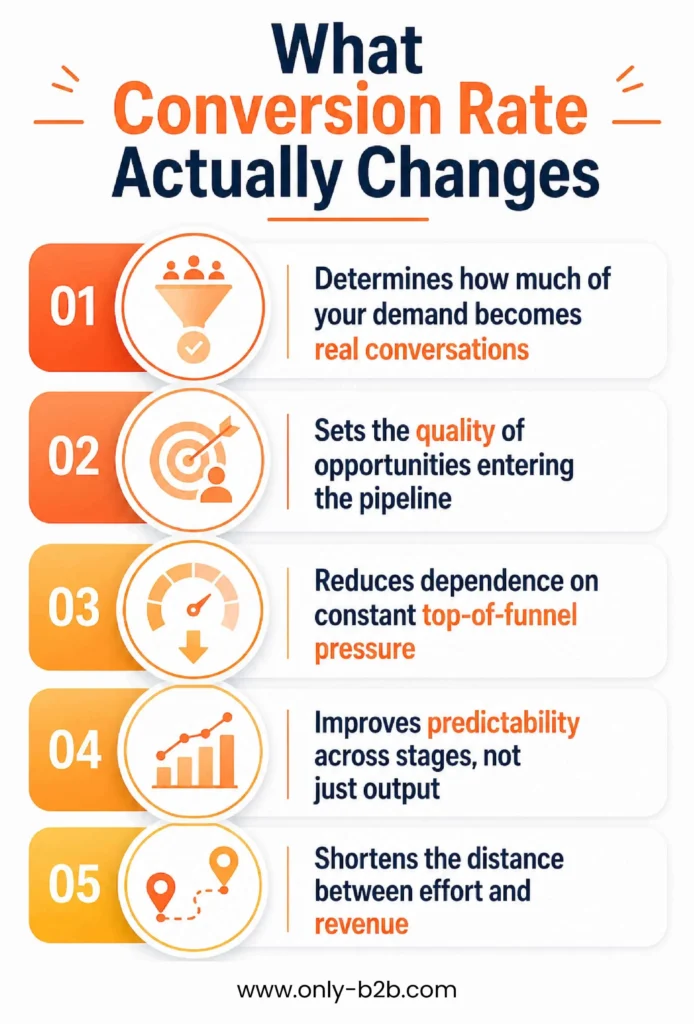
This relationship is not linear. Improvements at the conversion stage tend to compound as they move downstream. When conversion is stable, forecasting becomes more reliable. When it is inconsistent, the pipeline becomes difficult to interpret.
Common Conversion Rate Mistakes
Conversion does not usually drop in obvious ways. It erodes quietly across stages, making it harder to trace back to a single cause.
FAQs
What is a good meeting conversion rate in B2B?
A good meeting conversion rate falls between 20 to 35% depending on channel, segment, and deal complexity, with inbound generally converting higher than outbound.
How can low conversion in sales funnel stages be improved?
Improving low conversion in a sales funnel starts with identifying where the drop occurs and aligning targeting, messaging, and follow-up to address that gap.
What role does outreach improvement play?
Stronger outreach increases response quality, which directly influences meeting conversion.
How does conversion impact revenue?
Higher conversion leads to more qualified opportunities, improving overall revenue potential.
What is the connection between pipeline generation and conversion?
Conversion determines how effectively leads move into a pipeline, shaping both quality and predictability.
Conclusion
Most teams attempt to fix pipeline challenges by increasing input through more campaigns, more leads, and more outreach.
But a pipeline is not only built at the top. It is shaped by how effectively leads convert into meaningful conversations. If appointment setting conversion rate is weak, additional volume will not solve the problem. It will only make inefficiencies harder to manage.
The more effective approach is to understand where alignment breaks and correct it at the source. When meetings convert consistently, the rest of the funnel becomes easier to manage, easier to predict, and easier to scale.
And that is what ultimately turns activity into growth.

Vikas Bhatt is the Co-Founder of ONLY B2B, a premium B2B lead generation company that specializes in helping businesses achieve their growth objectives through targeted marketing & sales campaigns. With 10+ years of experience in the industry, Vikas has a deep understanding of the challenges faced by businesses today and has developed a unique approach to lead generation that has helped clients across a range of industries around the globe. As a thought leader in the B2B marketing community, ONLY B2B specializes in demand generation, content syndication, database services and more.