From the inside, most outbound motions look fine. Sequences are set up, touchpoints are scheduled, and activity is steady. But on the buyer’s side, it lands differently.
The conversation feels fragmented because each interaction carries just enough context to be recognized, but not enough to move things forward. So instead of building, it resets. That’s usually where attention drops.
According to Gartner, B2B buyers spend only 17% of their time meeting suppliers, with the rest going into independent research and internal alignment.
In that reality, outreach is not competing on effort or volume. It’s competing on continuity. A sales cadence strategy exists to create that continuity, so each touchpoint adds context and the conversation actually progresses.
What Is a Sales Cadence?
A sales cadence is a predefined sequence of touchpoints and actions a salesperson follows during outreach. It defines when to reach out, how often to follow up, and which channels to use across the life of a conversation. More importantly, it creates consistency in how that conversation unfolds over time.
This is where it goes beyond scheduling. A well-designed cadence aligns timing, channel, and messaging so each interaction connects to the last.
It removes randomness from the outreach process and replaces it with direction. The structure may look similar across teams, but the intensity, spacing, and depth of communication should adapt based on audience, industry, and what’s being sold.
When a team operates within a clear cadence, follow-ups feel intentional, not reactive. Conversations carry forward. And pipeline quality improves because interactions are designed to progress, not just persist.
Why a Strong Sales Cadence Drives Results
The impact of a strong cadence shows up in how prospects respond. When outreach builds instead of repeats, reply rates improve. When timing aligns with how buyers actually engage, meeting booking improves. And when the conversation has already been shaped before the call, conversion improves.
According to research, sales teams using structured multi-touch outreach see up to 287% higher engagement compared to single-channel approaches. It’s about making each interaction count.
A good B2B outreach strategy reduces friction across the funnel by connecting steps that are usually treated in isolation. The experience becomes continuous instead of disjointed.
Key Elements of an Effective Sales Cadence
A strong cadence is not built on one lever. It works because a few elements are defined clearly and designed to work together.
- Defined Ideal Customer Profile (ICP): A cadence only works when it is built for a specific audience. Clear targeting ensures the message lands in the right context from the start. Without this, even well-written outreach feels off.
- Multi-Channel Approach: Email, calls, LinkedIn, and selective voicemail work together to create recognition over time. The goal is not to be everywhere, but to show up in the right places in a way that feels connected.
- Strategic Spacing and Duration: Strong cadences balance visibility with restraint. Typically 8 to 12 touches over 2 to 4 weeks, with tighter spacing early and more distance later, works because it mirrors how attention builds.
- Personalized Value-Based Messaging: Each touch should add something new. Not a new pitch, but a new angle. That’s what keeps the conversation moving.
- Clear Call to Action (CTA): Every message should make the next step obvious and easy. If the ask is unclear, engagement drops.
- Automation with Human Oversight: Tools help maintain consistency, but judgment keeps it relevant. The balance matters.
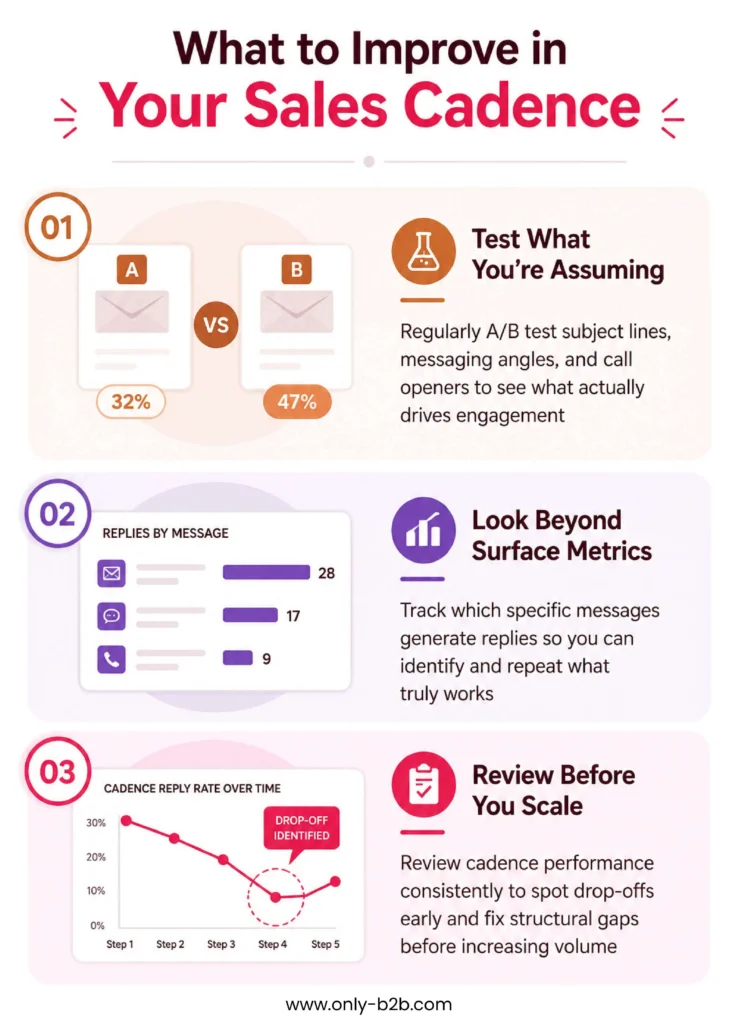
- Metrics and Optimization: A cadence should evolve. Tracking what actually moves conversations forward helps refine structure instead of just increasing activity.
The strength of a cadence comes from how these pieces work together, not how well each performs in isolation.
How to Build a High-Converting B2B Sales Cadence
A high-converting B2B sales cadence is not simply a fixed number of emails and calls. It should align the right accounts, channels, timing, messaging, and buying signals into a repeatable outreach process. Use the following steps to build a cadence that gives prospects a clear reason to engage at every touchpoint.
Define the ICP and Buying Context
Start with the accounts and contacts most likely to benefit from your solution. Segment prospects by factors such as industry, company size, role, seniority, pain points, and buying stage so the cadence reflects their actual context.
Choose the Right Outreach Channels
Select channels based on how your target buyers prefer to engage. A B2B sales cadence may combine email, phone calls, LinkedIn outreach, voicemail, and other relevant touchpoints rather than relying on a single channel.
Set Cadence Length and Touch Frequency
Determine how long the outreach sequence should run and how much time should separate each touch. Avoid contacting prospects too aggressively while also preventing long gaps that cause momentum and recognition to disappear.
Give Every Touchpoint a Purpose
Each interaction should add something new. One touch may introduce a relevant problem, another can share an insight or proof point, and a later touch can present a clear next step. Repeating the same message across every channel reduces the value of the cadence.
Personalize by Segment and Buying Signal
Adapt messaging using available account context, engagement activity, intent signals, role, and known business priorities. Personalization should explain why the outreach is relevant rather than simply inserting a prospect’s name or company into a template.
Measure Replies, Meetings, and Progression
Track more than email opens. Monitor positive replies, conversations, meetings booked, opportunities created, and progression through the pipeline. Use these results to identify which channels, messages, and timing patterns should be improved in the next version of the cadence.
The goal is not to maximize the number of touches. A strong B2B sales cadence creates a structured path from initial outreach to meaningful sales conversation while giving prospects enough context and value to decide whether to engage.
Multi-Channel Outreach Strategy
Multi-channel outreach reflects how buyers actually behave. They don’t sit in one place waiting for outreach. They move between email, calls, and platforms depending on context and what they’re trying to get done. If you rely on one channel, you are not being ignored. You are just not intersecting with attention.
Each channel does a different job in the same conversation.
- Email is where you can hold context. It’s where you explain something clearly, reference specifics, and give the buyer a reason to think.
- Calls create personalized moments. They introduce immediacy and allow real-time interaction when timing aligns.
- LinkedIn builds familiarity over time. Even when there is no direct response, repeated visibility warms up the prospects.
- Voicemail rarely drives action on its own, but it reinforces recall. It makes your name feel less unfamiliar when the next message arrives.
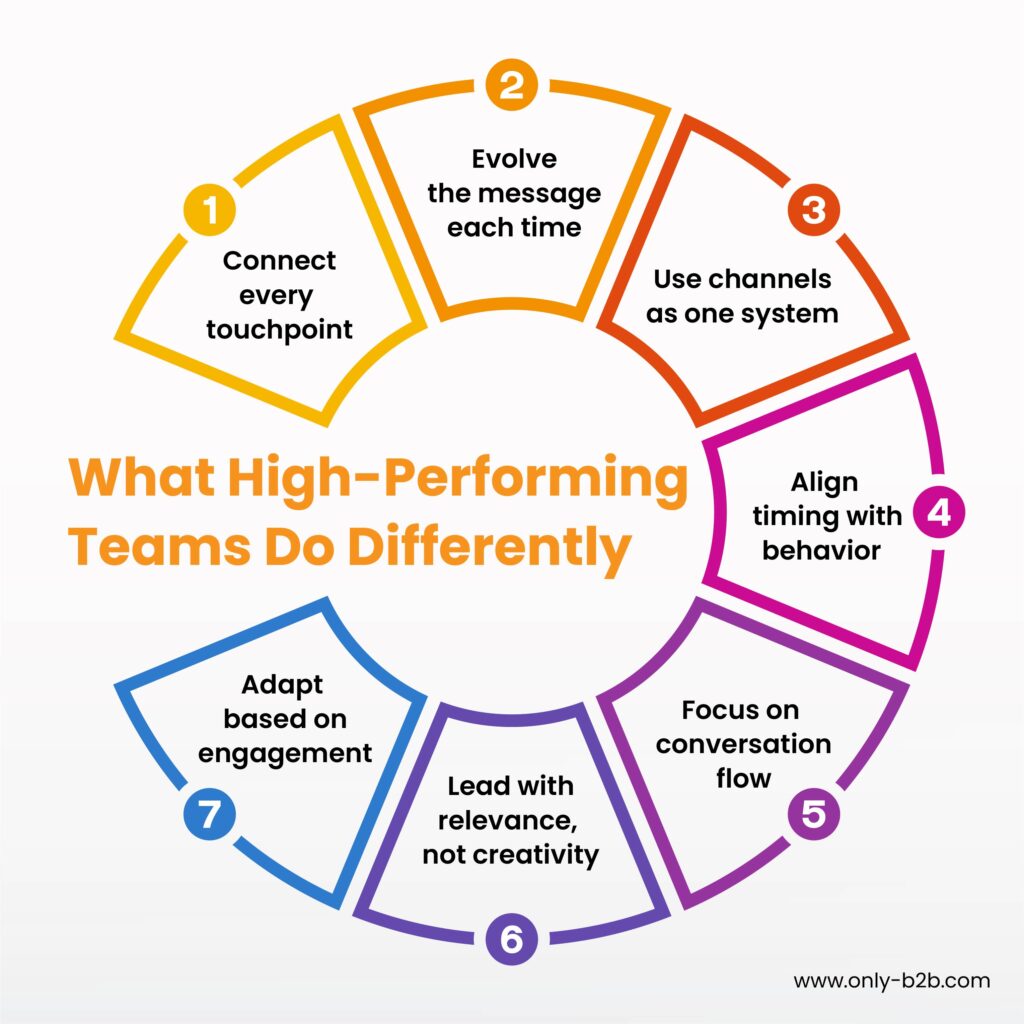
What works is not using more channels, but coordinating them. When a call references an email or a LinkedIn touch reflects awareness of a previous interaction, and the experience feels connected. Without that, multichannel becomes repetition across platforms.
What Does a High-Performing Cadence Look Like?
Most teams ask for the “right” cadence, as if there’s a fixed template that guarantees results. In reality, the structure only works when it reflects how your buyers think, respond, and make decisions. What you can standardize is the shape of progression, not the exact sequence.
Example 1: Standard cadence
- Day 1: Email anchored in a specific problem relevant to the role
- Day 2: LinkedIn connection or profile view
- Day 3: Call attempt with a short, contextual voicemail
- Day 5: Follow-up email with a different angle on the same problem
- Day 6: Call referencing prior outreach briefly
- Day 8: LinkedIn interaction tied to their role or content
- Day 10: Email introducing a use case or insight
- Day 11: Call focused on timing and relevance
- Day 13: Email narrowing the ask
- Day 14: Final call attempt
Example 2: Multi-channel balanced cadence
- Day 1: Email referencing a trigger or signal
- Day 2: Call attempt within context of that trigger
- Day 4: Email expanding on the implication of that signal
- Day 6: LinkedIn message referencing prior outreach
- Day 8: Call attempt focused on timing
- Day 10: Email with a specific use case or outcome
- Day 12: LinkedIn interaction for reinforcement
- Day 14: Final email with a clear, simple ask
The sequence itself is not the differentiator. The progression is.
Early touches build recognition. Mid touches build context. Later touches make the ask feel reasonable. When that progression is missing, even a well-structured cadence feels repetitive.
Personalization in Sales Cadence
Personalization often peaks at the first touch and drops off after. That’s where most sequences lose credibility.
- First touch personalization: Establish why this outreach exists by tying the message to the prospect’s role, company context, or a specific problem they are likely facing.
- Follow-up personalization: Build on that context by introducing a new angle, insight, or implication so the conversation deepens instead of repeating.
When personalization carries through the sequence, the conversation feels deliberate. When it doesn’t, it feels automated.
Cadence Strategy by Deal Size
Cadence structure should reflect how decisions are made.
- SMB: Short cycles and fewer stakeholders mean tighter spacing and more direct messaging; speed and clarity matter more than depth.
- Mid-market: Moderate complexity requires balancing pace with context; touches are spaced slightly wider, and messaging adds layers.
- Enterprise: Longer cycles and multiple stakeholders demand fewer but deeper interactions; patience and context carry more weight than frequency.
Using the same cadence across all segments usually creates friction because it ignores these differences.
Intent-Driven Sales Cadence
Not every prospect is ready at the same time.
Signals like website visits, content engagement, or email interaction indicate when attention is actually there. Adjusting outreach based on these signals changes how it is experienced.
A message that might have felt early becomes relevant. A follow-up that might have been ignored gets considered because timing aligns.
This is what makes a cadence feel responsive instead of rigid.
SDR Workflow for Sales Cadence Execution
For an SDR, the day is about maintaining sequence integrity. Knowing where each prospect is, what they’ve seen, and what the next touch should do.
- Start with high-intent prospects who have shown recent engagement or signals.
- Move to scheduled follow-ups that are due within the cadence.
- Execute calls in focused blocks to maintain context and energy.
- Send emails in sequence, ensuring each one reflects previous interactions.
- Engage on LinkedIn where it supports ongoing conversations, not as a separate activity.
- Track responses and adjust next steps instead of blindly following the sequence.
- End the day by reviewing where prospects are in the cadence to maintain continuity.
Measuring Sales Cadence Performance
- Engagement metrics: Track email open rates (typically 18–24%), click rates, and reply rates to understand how well your messaging is landing.
- Conversion rates: Measure how prospects move through the cadence, especially how many convert into meetings from initial outreach.
- Activity metrics: Monitor calls made, emails sent, and LinkedIn touches to ensure the cadence is being executed consistently.
- Outcome metrics: Look at opportunities created, revenue generated, and sales cycle length to understand overall impact.
- Optimal cadence length: Most effective inbound cadences include 8–12 touchpoints over 10–15 business days, while colder outbound sequences often perform better with 6–8 well-spaced touches.
Looking at these together gives a clearer picture than activity alone.
Common Sales Cadence Mistakes
Inside a cadence, some common mistakes quietly break the continuity and make the entire sequence feel disjointed. Here is how you can fix them:
Common Outreach Sequence Mistakes (And Fixes)
Sequence performance often breaks due to repetition, poor timing, and lack of progression.
FAQs
What is the ideal sales cadence length?
Most effective cadences run between two to four weeks, depending on deal complexity.
How many touchpoints should a cadence include?
Typically, eight to twelve touchpoints across channels are good.
Which channels work best?
The best channel for your business depends majorly on where your target audience is. It could be email, calls, LinkedIn, selective voicemail, or a multichannel approach to improve visibility.
What are common mistakes?
Some of the common mistakes made in sales cadence strategy are lack of structure, poor timing, and repetition of messages.
How do intent signals help?
Intent signals help you adjust timing and messaging and reach prospects at the right time.
Final Thoughts
A sales cadence strategy is not about increasing activity. It’s about creating alignment.
When that alignment exists, conversations feel natural. Prospects engage because the interaction makes sense.
If your cadence feels active but inconsistent, it’s worth stepping back and looking at the system behind it. Clarity there usually fixes more than adding more steps ever will.

Vikas Bhatt is the Co-Founder of ONLY B2B, a premium B2B lead generation company that specializes in helping businesses achieve their growth objectives through targeted marketing & sales campaigns. With 10+ years of experience in the industry, Vikas has a deep understanding of the challenges faced by businesses today and has developed a unique approach to lead generation that has helped clients across a range of industries around the globe. As a thought leader in the B2B marketing community, ONLY B2B specializes in demand generation, content syndication, database services and more.