
A B2B SaaS go-to-market (GTM) strategy is the operating plan that connects a product to the right market, buyers, revenue model, and growth channels. It defines who the company should target, how the product should be positioned, which sales and marketing motion should be used, and how success will be measured.
For SaaS companies, the strategy must account for recurring revenue, acquisition costs, product adoption, expansion, and retention. A plan built only around lead generation or a product launch can create activity without producing predictable pipeline or sustainable ARR. An effective GTM system aligns product, marketing, sales, customer success, and RevOps around one ideal customer profile and shared revenue outcomes.
This guide provides a practical nine-step B2B SaaS GTM framework for 2026. It covers market research, ICP definition, positioning, pricing, GTM motion selection, channel strategy, revenue-team alignment, metrics, and a 90-day execution roadmap.
What Is a B2B SaaS Go-to-Market Strategy?
A B2B SaaS go-to-market strategy is a cross-functional plan for acquiring, converting, retaining, and expanding business customers. It connects the product, target market, value proposition, pricing, customer-acquisition channels, sales process, onboarding experience, and revenue metrics into one operating system.
Unlike a marketing plan, a GTM strategy covers the complete customer lifecycle. Marketing may create awareness and demand, but the GTM strategy also determines how sales qualifies opportunities, how the product delivers value, how customer success supports adoption, and how the company generates recurring revenue.
A practical B2B SaaS GTM strategy should answer five questions:
- Who is the ideal customer, buyer, and buying committee?
- What business problem does the product solve, and why should buyers choose it?
- Should the company use a sales-led, product-led, partner-led, or hybrid GTM motion?
- Which channels and processes will create and convert qualified demand?
- Which metrics will confirm that the model is efficient, repeatable, and scalable?
These decisions must be made together. Strong messaging cannot compensate for the wrong market, and increased lead volume cannot fix weak positioning, unsuitable pricing, or an inefficient sales motion.
What’s Changed in B2B SaaS GTM
Buyers Research Before Speaking with Sales
B2B SaaS buyers often research problems, compare approaches, consult peers, read reviews, and evaluate vendors before contacting a sales representative. Their journey is rarely a simple progression from awareness to consideration and decision.
This means marketing must help buyers understand the problem and evaluate available options, while sales must enter the conversation with context. Generic outreach is less effective when buyers have already developed expectations about capabilities, pricing, implementation, and business outcomes.
AI Is Changing Product Discovery and GTM Execution
Search engines, review platforms, professional communities, and AI assistants now influence how buyers discover and compare SaaS solutions. At the same time, revenue teams use AI for research, data enrichment, personalization, forecasting, content development, and workflow automation.
However, AI cannot repair weak positioning, poor data, an unclear ICP, or disconnected revenue processes. It creates the most value when it supports a well-defined GTM strategy and remains connected to human judgment and reliable customer information.
Efficient Growth and Retention Shape GTM Decisions
A SaaS GTM strategy cannot focus only on acquiring new leads. Recurring revenue depends on activation, product adoption, renewals, expansion, and the cost of acquiring and supporting customers.
GTM teams should therefore evaluate performance using pipeline quality, conversion rates, customer acquisition cost, CAC payback, product-qualified leads, win rate, net revenue retention, and expansion revenue. These measures connect acquisition decisions to sustainable revenue rather than isolated marketing activity.
Why B2B SaaS GTM Strategies Fail
Many B2B SaaS GTM strategies fail because important decisions are made separately. Marketing selects channels, sales builds its process, product manages adoption, and customer success focuses on retention without one shared view of the customer or revenue model.
1. The ICP and Positioning Are Unclear
A broad ideal customer profile produces generic messaging, inconsistent qualification, and inefficient acquisition. The company must define which accounts experience the problem most strongly, which stakeholders influence the purchase, and why the product is meaningfully different from available alternatives.
2. The GTM Motion Does Not Match the Product
A product-led motion may struggle when implementation is complex and buyers require extensive support. A fully sales-led model may become expensive when the product has a low contract value and can be adopted independently. The GTM motion should reflect product complexity, time to value, average contract value, buyer expectations, and available resources.
3. Revenue Teams Operate Separately
Marketing, sales, product, RevOps, and customer success frequently use different definitions, systems, and performance measures. This creates weak handoffs, duplicated work, inconsistent customer experiences, and limited visibility into what actually creates revenue.
4. Activity Is Mistaken for Progress
Traffic, form submissions, email opens, and MQL volume can indicate activity, but they do not prove that the GTM model is working. Teams must connect activity to qualified pipeline, conversion, product adoption, customer acquisition cost, payback, retention, and expansion.
5. Acquisition Is Separated From Retention
SaaS growth does not end when a deal closes. Poor onboarding, weak adoption, and limited customer value can erase the benefits of successful acquisition. Customer success and product usage must therefore be included in GTM planning from the beginning.
The solution is not to add more isolated campaigns. It is to build a coordinated GTM framework in which every decision supports the same market, customer, and revenue objectives.
9-Step B2B SaaS GTM Framework
A B2B SaaS GTM framework converts market knowledge into a coordinated plan for positioning, acquiring, converting, retaining, and expanding customers. Each step should produce a clear decision or operating output that the revenue team can execute and measure.
The following nine-step framework moves from market definition and ICP research through positioning, pricing, GTM-motion selection, channel strategy, revenue-team alignment, measurement, and execution. The steps should be reviewed together because a change in one area—such as pricing, target market, or product complexity—can affect the entire GTM system.
Step 1: Define the Market and Revenue Objective
Before selecting channels or building campaigns, define exactly what the GTM strategy must accomplish. A strategy for launching a new SaaS product will differ from one designed to enter a new region, move upmarket, improve product adoption, or increase expansion revenue.
The GTM objective should specify:
- The product, package, or use case being taken to market
- The target industry, company size, geography, and customer segment
- The revenue outcome the company wants to influence
- The expected timeframe
- The available budget, team capacity, and operational constraints
- Whether the priority is acquisition, activation, retention, expansion, or a combination
Convert these decisions into one clear GTM objective. For example: “Build a repeatable sales-led motion for mid-market US SaaS companies that creates qualified pipeline and supports predictable new ARR.”
A defined objective gives product, marketing, sales, RevOps, and customer success one shared destination. Without it, individual teams may produce activity while optimizing for different business outcomes.
Step 2: Define the ICP and Buying Committee
A B2B SaaS ideal customer profile defines the accounts most likely to experience the problem, receive meaningful value from the product, and become commercially sustainable customers. It should go beyond basic firmographic filters such as industry and company size.
Evaluate account fit using:
- Industry, company size, location, growth stage, and business model
- Existing technology, integrations, operational maturity, and data requirements
- Priority use cases and the severity of the business problem
- Product complexity, implementation requirements, and expected time to value
- Budget potential, average contract value, retention potential, and expansion opportunity
- Relevant intent signals, product activity, or organizational changes that indicate timing
After defining the account, map the buying committee. A B2B SaaS purchase may involve an end user, internal champion, technical evaluator, department leader, economic buyer, procurement team, security team, and executive sponsor. Each participant evaluates the product from a different perspective and requires different information.
Document qualification and disqualification criteria so marketing and sales apply the same standards. The output of this step should be a prioritized ICP, a buying-committee map, and clear evidence that determines when an account is ready for focused engagement.
Step 3: Build Positioning and Buyer-Specific Messaging
Positioning explains why your product is the right choice for a specific customer and business problem. It should connect the buyer’s situation, the cost of leaving the problem unresolved, your product’s differentiated value, and the evidence supporting that value.
Create a positioning foundation that defines:
- The target segment and priority use case
- The problem or change creating urgency
- The alternatives buyers currently use
- The product’s differentiated value and expected business outcome
- The evidence required to reduce buyer risk
Turn this foundation into multi-threaded messaging for the buying committee. End users may care about workflow and usability, technical evaluators about security and integrations, department leaders about performance, and economic buyers about cost, risk, and expected return.
Keep the central value proposition consistent while adjusting the language, evidence, and call to action for each stakeholder and buying stage. The output of this step should include a positioning statement, message hierarchy, role-specific narratives, and proof assets that marketing and sales can use consistently.
Step 4: Select the Right GTM Motion
Your GTM motion determines how prospects discover, evaluate, purchase, and begin using your SaaS product. Choose it according to the product and buying process—not simply because a particular motion is currently popular.
Evaluate the following factors:
- Average contract value and customer acquisition cost
- Product complexity and implementation requirements
- Number of stakeholders involved in the purchase
- Time required for a customer to experience value
- Availability of a free trial, freemium plan, or self-service purchase
- Length of the sales cycle and level of buyer support required
Common B2B SaaS GTM motions include:
- Sales-led: Best suited to complex or higher-value purchases that require discovery, demonstrations, security reviews, procurement, or negotiated contracts.
- Product-led: Appropriate when users can experience value quickly, evaluate the product independently, and begin with limited sales assistance.
- Marketing-led: Uses educational content, search, events, campaigns, and demand-generation programs to create and capture interest before sales engagement.
- Partner-led: Relies on consultants, agencies, resellers, marketplaces, or technology partners to introduce, recommend, or deliver the product.
- Hybrid: Combines motions—for example, product-led acquisition for smaller accounts and sales-led expansion for larger opportunities.
Define the primary motion first and assign supporting roles to the others. The output of this step should explain how prospects enter the journey, how they qualify, when sales becomes involved, and how the company converts initial interest into recurring revenue.
Step 5: Define Pricing and Packaging
Pricing and packaging determine which customers the business can serve profitably, how buyers evaluate the offer, and which GTM motion is economically sustainable. These decisions should reflect customer value, product usage, implementation requirements, and the cost of acquiring and supporting each segment.
Define the pricing structure by answering:
- Which product capability or outcome creates the greatest customer value?
- Should pricing be based on users, usage, features, data volume, transactions, or another value metric?
- Which features and service levels belong in each plan?
- Will customers purchase through self-service, a sales conversation, or a negotiated enterprise agreement?
- Are onboarding, implementation, support, integrations, or training included or charged separately?
- How will free trials, pilots, annual contracts, upgrades, and discounts be managed?
Avoid copying a competitor’s pricing without understanding differences in customers, product maturity, costs, and positioning. Validate proposed packages through customer conversations, win-loss reviews, product-usage data, and controlled pricing tests.
The final pricing model should make it easy for buyers to understand what they receive, while giving the company a practical path from initial adoption to retention and expansion.
Step 6: Map the Buyer Journey and Revenue Process
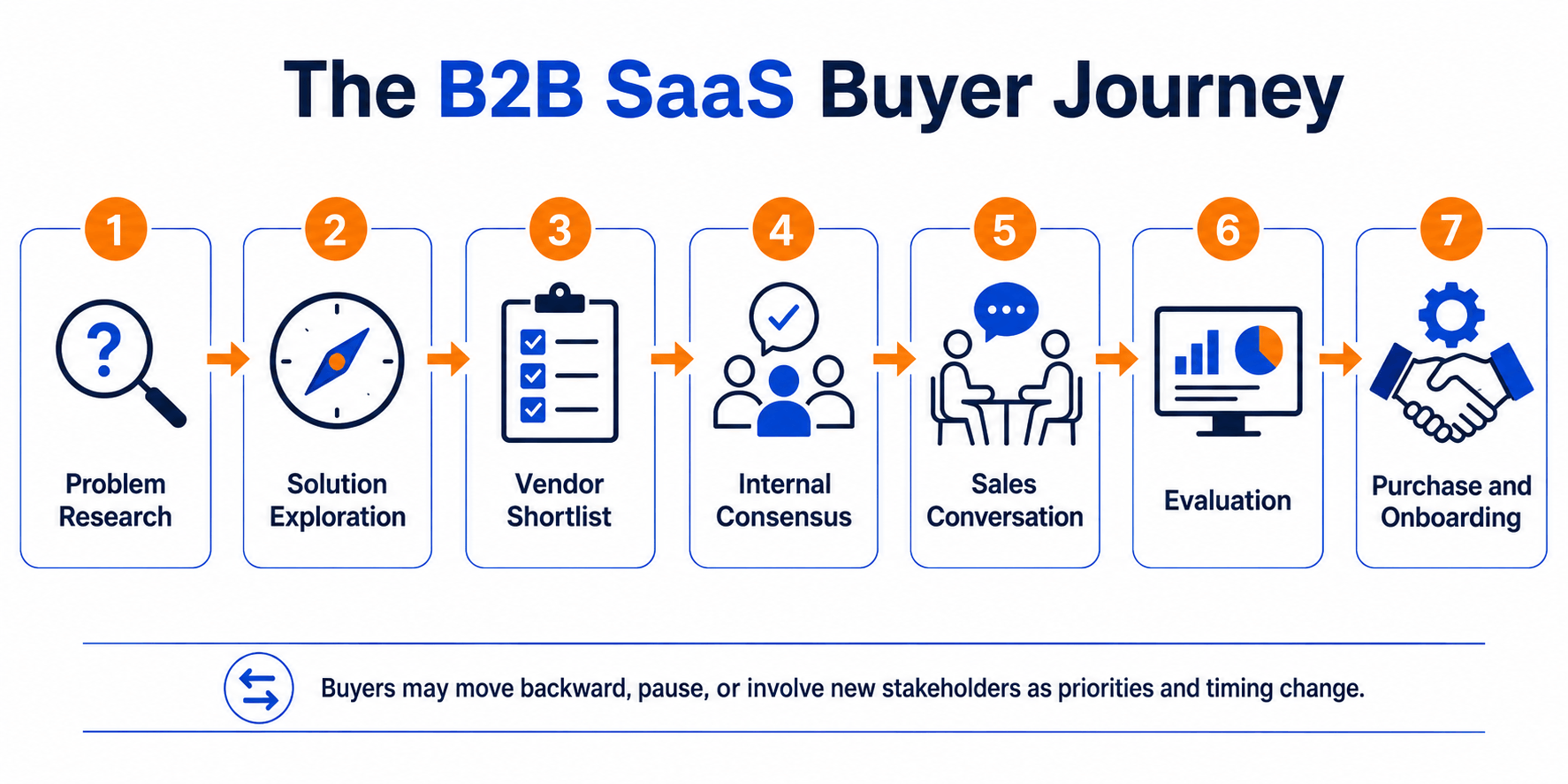
A B2B SaaS buyer journey rarely follows a perfectly linear funnel. Prospects may research independently, involve new stakeholders, revisit earlier decisions, compare alternatives, and pause until budget or timing changes. Your GTM process should support these movements without losing ownership or context.
Map the major stages of the journey:
- Problem recognition and initial research
- Solution exploration and vendor discovery
- Shortlisting and internal consensus
- Product evaluation, demonstration, trial, or pilot
- Security, technical, procurement, and commercial review
- Purchase and implementation
- Adoption, renewal, and expansion
For every stage, document the buyer’s main questions, participating stakeholders, required content, expected action, responsible revenue team, and evidence needed to move forward. For example, a website visit may indicate awareness, while a confirmed business problem, suitable account fit, stakeholder involvement, and agreed next step provide stronger qualification evidence.
Translate this journey into clearly defined lifecycle and opportunity stages within the CRM. Marketing, sales, customer success, and RevOps should use the same definitions so prospects are routed correctly and handoffs do not depend on personal interpretation.
The output of this step should be a buyer-journey map, agreed stage definitions, qualification criteria, team ownership, and a documented process for progressing qualified accounts.
Step 7: Choose Acquisition Channels and Content
The right acquisition channels are the places where your ideal customers already research problems, evaluate solutions, and interact with trusted sources. A B2B SaaS company does not need to use every available channel. It needs a focused combination that matches its ICP, GTM motion, sales cycle, resources, and growth objective.
Potential channels include:
- Organic search and educational content for capturing existing demand
- Targeted outbound for reaching selected accounts and stakeholders
- Paid search and paid social for testing messages and generating demand
- Account-based marketing for coordinating campaigns around high-value accounts
- Partners, marketplaces, communities, and industry associations for accessing established audiences
- Webinars, events, reports, case studies, and product demonstrations for supporting evaluation
- Product trials, freemium experiences, and referral programs where product-led adoption is practical
Evaluate each channel according to audience fit, buyer intent, cost, time to produce results, scalability, internal capability, and measurement reliability. Begin with a limited number of primary channels and establish a clear purpose for each one.
Connect content to the buyer journey instead of publishing disconnected assets. Early-stage buyers may need problem education, while later-stage buyers may need product comparisons, technical documentation, customer evidence, implementation guidance, pricing information, or an evaluation plan.
The output of this step should be a prioritized channel mix, a channel-specific content plan, assigned ownership, test budgets, success criteria, and a process for increasing investment only when a channel demonstrates meaningful progress.
Step 8: Align Revenue Teams, Data and Technology
A B2B SaaS GTM strategy cannot operate effectively when product, marketing, sales, customer success, and RevOps use different goals, data, and definitions. Every team should understand its role in creating, converting, retaining, and expanding customer revenue.
Define clear responsibilities:
- Product: Shares product-usage insights, customer feedback, roadmap priorities, and time-to-value data.
- Marketing: Owns market education, positioning, demand creation, campaign execution, and early-stage engagement.
- Sales: Qualifies opportunities, manages buying relationships, documents objections, and progresses commercial decisions.
- Customer success: Supports onboarding, adoption, retention, advocacy, and expansion.
- RevOps: Maintains shared processes, lifecycle definitions, routing rules, data quality, reporting, and revenue technology.
Agree on the meaning of an ideal customer, qualified account, accepted lead, active opportunity, successful customer, expansion opportunity, and at-risk account. Document handoff requirements, response expectations, ownership rules, and the information that must accompany every transition.
Use the CRM as the primary source of revenue information and connect only the tools required to support marketing automation, sales activity, product analytics, customer success, enrichment, and reporting. More technology does not automatically create a stronger GTM system; consistent data and team adoption matter more than the number of platforms.
The output of this step should be a shared revenue operating model containing team responsibilities, lifecycle definitions, handoff rules, technology ownership, reporting standards, and regular feedback between customer-facing teams.
Step 9: Measure GTM Performance and Build a 90-Day Plan
GTM measurement should connect marketing, sales, product, and customer activity to revenue outcomes. Reporting only traffic, leads, calls, or demonstrations can hide problems with account fit, conversion, adoption, and retention.
Track a focused set of metrics across the customer lifecycle:
- Market and demand: ICP engagement, qualified accounts, channel contribution, and cost per qualified opportunity
- Pipeline: Stage conversion rates, pipeline velocity, sales-cycle length, win rate, and average contract value
- Acquisition efficiency: Customer acquisition cost, CAC payback period, and revenue generated by channel
- Product and customer value: Activation rate, time to value, product adoption, retention, churn, expansion, and net revenue retention
- Execution quality: Follow-up time, stage accuracy, data completeness, and performance against agreed service levels
Establish baseline figures before changing the strategy. Review performance by segment, channel, use case, and GTM motion so a strong overall average does not conceal weak areas.
Use the following 90-day execution plan:
- Days 1–30 — Establish the foundation: Confirm the revenue objective, analyze customers and competitors, define the ICP and buying committee, document baseline metrics, and finalize positioning.
- Days 31–60 — Build the GTM system: Confirm pricing and packaging, select the primary GTM motion, map the buyer journey, prepare essential content, configure lifecycle stages, and assign team ownership.
- Days 61–90 — Launch, measure, and refine: Run focused channel tests, review account and opportunity quality, collect feedback from customer-facing teams, identify conversion barriers, and adjust messaging, targeting, processes, or investment.
At the end of 90 days, document what has been validated, what remains uncertain, and which changes deserve additional investment. The goal is not to prove that every assumption was correct; it is to create a repeatable learning system that improves revenue performance over time.
Frequently Asked Questions About B2B SaaS GTM Strategy
What is a B2B SaaS go-to-market strategy?
A B2B SaaS go-to-market strategy is the operating plan used to reach, acquire, onboard, retain, and expand business customers. It connects the target market, ideal customer profile, positioning, pricing, sales motion, acquisition channels, buyer journey, revenue teams, and performance metrics.
How is a GTM strategy different from a marketing strategy?
A marketing strategy primarily focuses on creating awareness, communicating value, and generating demand. A GTM strategy has a broader scope covering the complete customer lifecycle, including product positioning, pricing, sales, onboarding, customer success, retention, expansion, and revenue measurement.
What are the main components of a B2B SaaS GTM strategy?
The main components include a clear market objective, ideal customer profile, buying-committee map, positioning, pricing and packaging, GTM motion, buyer journey, acquisition channels, team responsibilities, technology, qualification rules, and measurable revenue outcomes.
How should a SaaS company choose its GTM motion?
The company should consider its average contract value, product complexity, implementation requirements, buyer involvement, time to value, customer acquisition cost, and availability of self-service evaluation. The resulting motion may be sales-led, product-led, marketing-led, partner-led, or a combination of these approaches.
Which metrics should a B2B SaaS GTM team track?
Useful metrics include qualified pipeline, stage conversion rates, sales-cycle length, win rate, customer acquisition cost, CAC payback period, activation, time to value, retention, churn, expansion, and net revenue retention. The selected metrics should reflect the company’s current revenue objective and GTM motion.
How often should a B2B SaaS GTM strategy be reviewed?
Teams should monitor important performance indicators continuously and conduct structured reviews at agreed intervals. The strategy should also be reassessed when the company enters a new market, changes pricing, launches a major product capability, targets a different customer segment, or experiences a meaningful shift in conversion or retention.
Conclusion: Build a Repeatable B2B SaaS GTM System
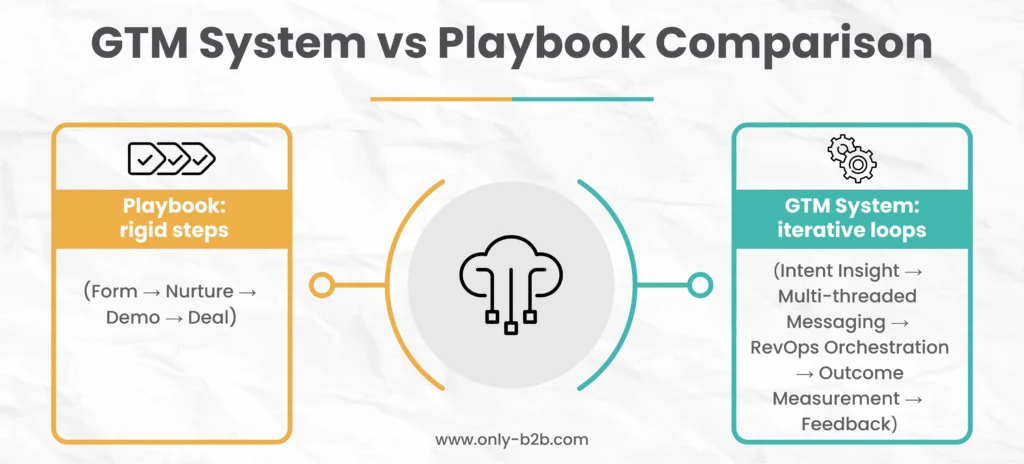
A successful B2B SaaS go-to-market strategy is not a single campaign or static launch document. It is a coordinated operating system that connects the target market, ideal customer, positioning, pricing, GTM motion, buyer journey, acquisition channels, revenue teams, and performance measurement.
Use the nine steps in this framework to establish a clear foundation, test important assumptions, and identify where prospects or customers experience friction. Begin with a focused market and revenue objective rather than trying to address every segment, channel, and growth opportunity simultaneously.
As customer behavior, competition, product capabilities, and business priorities change, revisit the framework and update the decisions supported by new evidence. Consistent learning and cross-functional execution are what turn a GTM strategy into a repeatable source of customer and revenue growth.
If your company needs support reaching suitable B2B accounts and building qualified pipeline, speak with the Only-B2B demand generation team.

Vikas Bhatt is the Co-Founder of ONLY B2B, a premium B2B lead generation company that specializes in helping businesses achieve their growth objectives through targeted marketing & sales campaigns. With 10+ years of experience in the industry, Vikas has a deep understanding of the challenges faced by businesses today and has developed a unique approach to lead generation that has helped clients across a range of industries around the globe. As a thought leader in the B2B marketing community, ONLY B2B specializes in demand generation, content syndication, database services and more.