Outbound is often considered outdated.
The assumption behind that conclusion is simple.
Research from Gartner consistently highlights that B2B buyers spend only a small fraction of their time (17%) engaging directly with vendors. The rest is spent researching independently, aligning internally, and evaluating options without ever raising a hand.
If buyers are increasingly self-directed, inbound should carry the load.
But in practice, most SaaS pipelines do not struggle because inbound is weak. They struggle because visibility is uneven.
Large portions of the buying journey happen outside the reach of marketing and sales, leaving teams to react to signals that arrive too late.
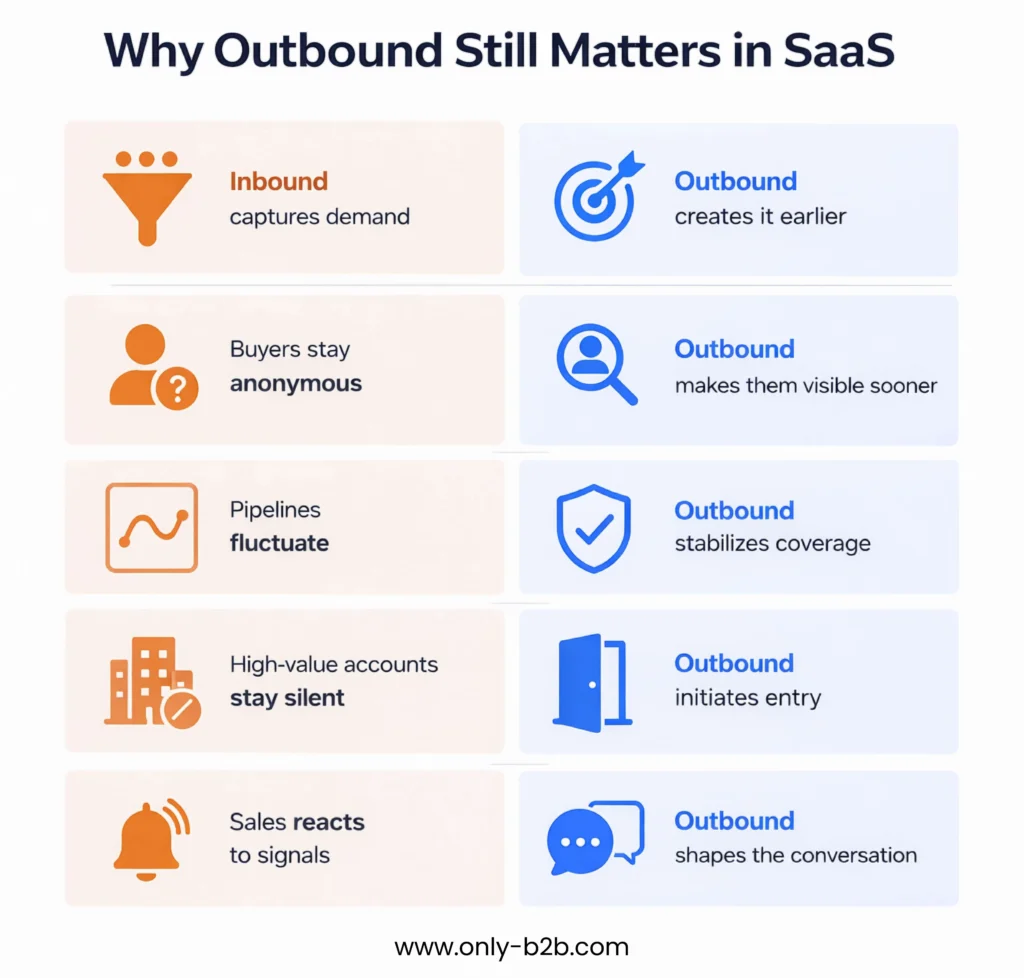
Outbound prospecting strategy still works because it addresses that gap. Not by interrupting buyers, but by entering the conversation earlier, before intent becomes visible and before inbound has a chance to capture it.
Table of Contents
- 1 What Is Outbound Prospecting in B2B SaaS?
- 2 How Outbound Prospecting Strategy Shifts Across Growth Stages
- 3 Start Outbound Prospecting Strategy With the Right ICP
- 4 Outbound Strategy for SaaS & Pipeline Coverage
- 5 Intent-Driven Outbound Prospecting
- 6 How to Build an Outbound Engine
- 7 Sample Outbound Sequence Structure
- 8 Outbound Tech Stack for SaaS
- 9 Measuring Outbound Performance
- 10 Common Outbound Prospecting Mistakes
- 11 FAQs
- 11.1 What is an outbound prospecting strategy?
- 11.2 How is outbound different from cold outreach?
- 11.3 Does outbound prospecting strategy still work for SaaS companies?
- 11.4 When should a SaaS company invest in outbound prospecting?
- 11.5 What metrics define outbound success?
- 11.6 How important is intent data in outbound?
- 11.7 What causes low reply rates in outbound?
- 11.8 Can outbound create revenue predictability?
- 12 Conclusion
What Is Outbound Prospecting in B2B SaaS?
Outbound prospecting is often reduced to cold outreach, and that simplification is where most strategies begin to break.
Cold outreach is an activity. An outbound strategy for SaaS is a structured system of proactively identifying and engaging potential buyers who fit your ICP before they express intent.
A structured approach defines who should be contacted, why now is the right moment, and what context makes the outreach relevant. Outbound prospecting in B2B SaaS connects targeting, timing, and messaging into a cohesive flow rather than treating them as isolated tasks.
That’s how a B2B outbound strategy diverges from random outreach. One operates on lists and volume. The other operates on logic and alignment, where every interaction is tied back to a defined business problem.
How Outbound Prospecting Strategy Shifts Across Growth Stages
Outbound strategy for SaaS is not a default growth lever. Its effectiveness depends on where the company is in its growth journey.
Early Stage (Pre–Product Market Fit to Early PMF)
You can use outbound when you lack reliable conversion data. If ACV is low to mid and sales cycles are short (15–45 days). An outbound strategy is used to generate early response and conversion signals when inbound volume is insufficient. The goal is not scale but to establish what consistently turns into a pipeline.
Growth Stage (Post-PMF, Scaling Revenue)
Structured outbound should be used in the growth stage when pipeline variability starts impacting revenue. Typically applies when ACV increases (mid-market) and sales cycles extend (30–90 days). At this stage, inbound creates demand but is inconsistent across segments or time periods, making forecasting unreliable.
Outbound strategy is used to systematically fill those gaps by targeting defined segments, ensuring a steady flow of qualified meetings that align with revenue targets rather than relying on inbound spikes.
Enterprise Stage (High ACV, Complex Deals)
Outbound strategy becomes highly important when ACV is high and sales cycles are long (90–180+ days). Deals involve multiple stakeholders, undefined entry points, and long evaluation cycles where inbound rarely reaches all decision-makers.
Across all stages, the trigger is the same: when inbound cannot reliably generate enough qualified pipeline aligned to revenue targets, outbound shifts from optional to necessary, making an outbound strategy for SaaS essential.
Start Outbound Prospecting Strategy With the Right ICP
If the Ideal Customer Profile for your outbound prospecting is unclear, every downstream activity, targeting, messaging, sequencing, loses precision. Even well-crafted outreach begins to feel irrelevant because it is directed at the wrong audience.
ICP-driven outreach aligns multiple dimensions. These include:
- Company attributes
- Buying triggers
- Problem maturity
- Decision structures
It creates a shared understanding of where value exists and where it does not.
A strong outbound prospecting strategy begins before outreach exists. It begins with exclusion, removing accounts that do not fit, so that effort is concentrated where it can actually convert.
Outbound Strategy for SaaS & Pipeline Coverage
Pipeline coverage defines how much opportunity value is required to achieve revenue targets, based on win rate and sales cycle length. When that coverage is insufficient, no amount of activity can compensate for the shortfall.
Every stage, from outreach to closed revenue, operates on conversion. A percentage of emails become replies. A percentage of replies become meetings. A percentage of meetings convert into SQLs, and only a fraction of those ultimately close.
This creates a simple but nonnegotiable reality. Small drops at each stage compress the pipeline significantly by the time it reaches revenue. The implication is structural. If downstream conversion remains constant, upstream volume is not a choice. It is a requirement.
Example: If a SaaS company needs $100K in revenue with a 20% win rate and $10K ACV, it requires 10 closed deals → ~50 opportunities → ~200 meetings → ~800 replies → ~8,000 outbound touches (depending on reply rates at each stage).
Outbound plays a specific role within this equation. It does not close deals. It creates entry points that feed the pipeline with qualified opportunities.
When inbound produces inconsistent volume, outbound restores balance by introducing controlled, repeatable pipeline creation. This is where SaaS pipeline growth shifts from reactive to engineered, and where revenue predictability begins to take shape.
Intent-Driven Outbound Prospecting
The difference between interruption and relevance is timing.
Intent data changes how outbound operates by shifting it from static targeting to dynamic engagement. Instead of reaching out based on predefined lists, teams engage when signals suggest a higher likelihood of interest.
These signals can include:
- Content consumption patterns
- Category-level research
- Changes in technology stacks
- Hiring activity that indicates strategic priorities
Intent-driven outbound prospecting significantly improves contextual alignment. Around 90% of B2B teams have reported increased lead volume using intent data. In most cases, misalignment, not effort, is what causes outbound to underperform.
How to Build an Outbound Engine
Outbound should not be treated as a campaign. It is an operational system that requires clarity across roles, stages, and handoffs.
A practical, high signal process looks like this:
- Set clear rules for which accounts qualify for outbound based on ICP fit, timing signals, and disqualifiers. This controls who enters the system.
- Rank qualified accounts based on potential impact and likelihood to engage so effort is focused, not distributed evenly.
- Identify key stakeholders and their roles in the buying process to ensure outreach aligns with decision dynamics.
- Define the problem framing and perspective that will anchor all outreach. This shapes how the conversation is positioned.
- Determine how each channel is used across account tiers. This defines how outreach is delivered, not just where.
- Define what constitutes a meaningful conversation and when it should move forward. This controls pipeline quality.
- Ensure every qualified conversation includes clear notes on the problem, stakeholders, and timing before passing to sales.
- Continuously refine targeting, messaging, and prioritization based on real response and conversion patterns.
Each stage builds on the previous one, and small inefficiencies compound quickly when the system lacks precision.
Sample Outbound Sequence Structure
A sequence is a structured progression of context. Each touchpoint should add new information or perspective. A structured sequence can follow this pattern:
Touch 1. Context introduction
Email highlighting a specific observation tied to the account or role to establish relevance.
Touch 2. Insight layer
Introduce a perspective that reframes the identified problem without repeating the first message.
Touch 3. Channel reinforcement
LinkedIn engagement that supports visibility and familiarity without duplicating content.
Touch 4. Real-time validation
Call attempt focused on confirming relevance rather than pushing for a meeting.
Touch 5. Proof alignment
Share a concise, context-specific example that connects directly to the earlier problem framing.
Touch 6. Low-friction ask
Suggest a simple next step that reduces commitment while keeping the conversation open.
Touch 7. Exit with clarity
Close the sequence with a message that leaves space for future engagement without pressure.
Cadence should be spaced to allow signal to emerge across 10 to 14 days, adjusted based on account priority.
Outbound Tech Stack for SaaS
Tools are critical because outbound only scales when targeting, sequencing, and data flows are systematized; without them, execution breaks once volume increases.
They also ensure consistency across teams, reduce manual errors, and allow performance tracking at every stage of the funnel. Each component should solve a distinct operational need.
- CRM: Maintains structured visibility of accounts, pipeline stages, and historical interactions. It anchors decision-making.
- Sequencing tools: Coordinate multi-channel outreach and enforce consistency in timing and execution.
- Data platforms: Improve targeting precision through accurate account and contact intelligence.
- Intent data sources: Identify when accounts are more likely to engage, adding timing intelligence to targeting decisions.
- Sales automation layers: Reduce manual effort in repetitive tasks once workflows are clearly defined.
- Analytics and reporting: Highlight where conversion drops across stages to identify system constraints.
The stack should evolve with scale, adding complexity only when required.
Measuring Outbound Performance
Outbound success is often measured through activity metrics, which creates a misleading sense of progress.
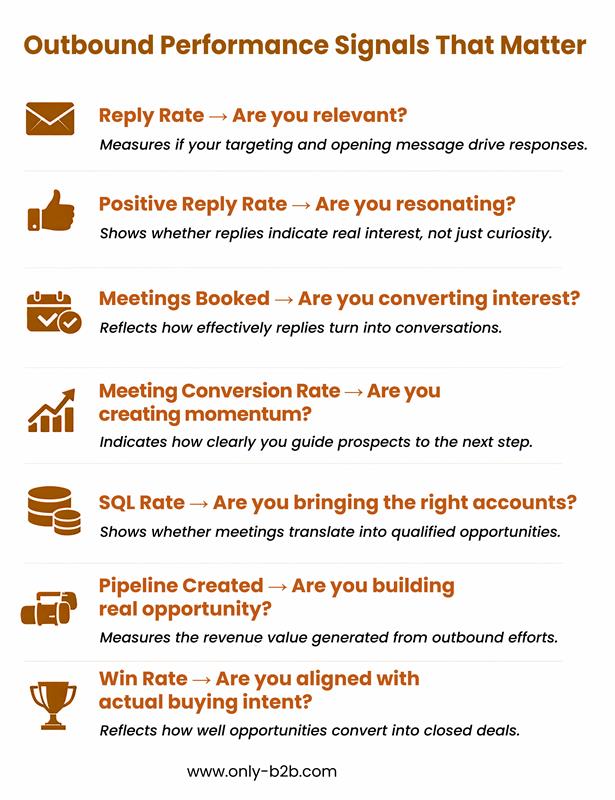
The metrics that matter are those that connect directly to pipeline and revenue outcomes. These include meetings booked, reply rate, pipeline created, and SQL rate. These indicators reveal not just performance, but also where breakdowns occur within the system.
Common Outbound Prospecting Mistakes
A few common outbound prospecting mistakes are the following:
Common Outbound & ABM Execution Mistakes (And Fixes)
Execution gaps in targeting, messaging, and follow-up often prevent ABM and outbound programs from converting pipeline effectively.
FAQs
What is an outbound prospecting strategy?
It is a structured approach to identifying, engaging, and qualifying potential customers through proactive outreach aligned with defined targeting logic.
How is outbound different from cold outreach?
Cold outreach is a tactic, while an outbound sales framework is a system that governs targeting, timing, and messaging.
Does outbound prospecting strategy still work for SaaS companies?
Yes, particularly when inbound alone cannot generate a predictable pipeline or effectively reach specific accounts.
When should a SaaS company invest in outbound prospecting?
When product market fit is sufficiently defined and pipeline variability begins to impact growth consistency.
What metrics define outbound success?
Pipeline created, meeting conversion rate, and downstream revenue impact are more meaningful than activity-based metrics.
How important is intent data in outbound?
Intent data improves timing and relevance, aligning outreach more closely with buyer behavior.
What causes low reply rates in outbound?
Typically poor targeting, unclear value positioning, or lack of contextual relevance.
Can outbound create revenue predictability?
When aligned with pipeline coverage logic and executed consistently, it contributes to more stable and predictable pipeline generation.
Conclusion
Outbound works when it is designed with intent. When targeting, messaging, and measurement operate as one system, pipeline creation becomes more controlled and less dependent on chance.
- Define strict ICP and trigger-based entry so effort stays focused on accounts that can convert.
- Ensure narrative, channels, and sequence build on each other instead of repeating disconnected messages.
- Track conversions across the funnel, and improve where momentum drops instead of increasing overall activity.
At Only B2B, outbound is approached as a system to be aligned, not activity to be scaled. When each part works together, the pipeline becomes consistent and predictable.

Vikas Bhatt is the Co-Founder of ONLY B2B, a premium B2B lead generation company that specializes in helping businesses achieve their growth objectives through targeted marketing & sales campaigns. With 10+ years of experience in the industry, Vikas has a deep understanding of the challenges faced by businesses today and has developed a unique approach to lead generation that has helped clients across a range of industries around the globe. As a thought leader in the B2B marketing community, ONLY B2B specializes in demand generation, content syndication, database services and more.