

Is your B2B organization still qualifying at the lead level? Where a form fill, content download, or webinar signup get scored and pushed to sales? It feels efficient, but it assumes buying intent shows up clearly through individuals and can be read in isolation.
In practice, it doesn’t. A typical B2B purchase involves 6 to 10 stakeholders, often across functions, each engaging differently. Some interact with your brand; others shape the decision without ever appearing in your data. What looks like scattered activity is often part of a broader evaluation inside the account.
Lead-based models capture activity, but they struggle to capture alignment. And without that, it becomes difficult to know when an account is actually ready for a meaningful sales conversation.
This is exactly where the concept of a marketing qualified account starts to matter, shifting the focus from isolated leads to coordinated account-level intent.
Table of Contents
- 1 Key Differences Between MQA vs. MQL vs. SQL
- 2 Why MQAs Drive Better Pipeline
- 3 Move From Leads to Accounts
What Is a Marketing Qualified Account (MQA)?
A marketing qualified account is an account that has demonstrated sufficient engagement, intent, and fit to warrant focused sales attention. Unlike traditional models, qualification is not tied to a single individual’s action but to collective behavior across stakeholders within the same account.
This includes keeping an eye on how multiple stakeholders are engaging, what they are engaging with, and whether those interactions indicate real evaluation.
In practical terms, an MQA reflects coordinated curiosity. It is not just activity, but activity from different accounts of same company clustering around a problem, a category, or a solution. When multiple signals start pointing in the same direction, the account moves from passive awareness to active consideration.
This is what makes MQAs different. They are not defined by volume but by pattern. Not by intensity alone, but by alignment across people and actions.
Key Differences Between MQA vs. MQL vs. SQL
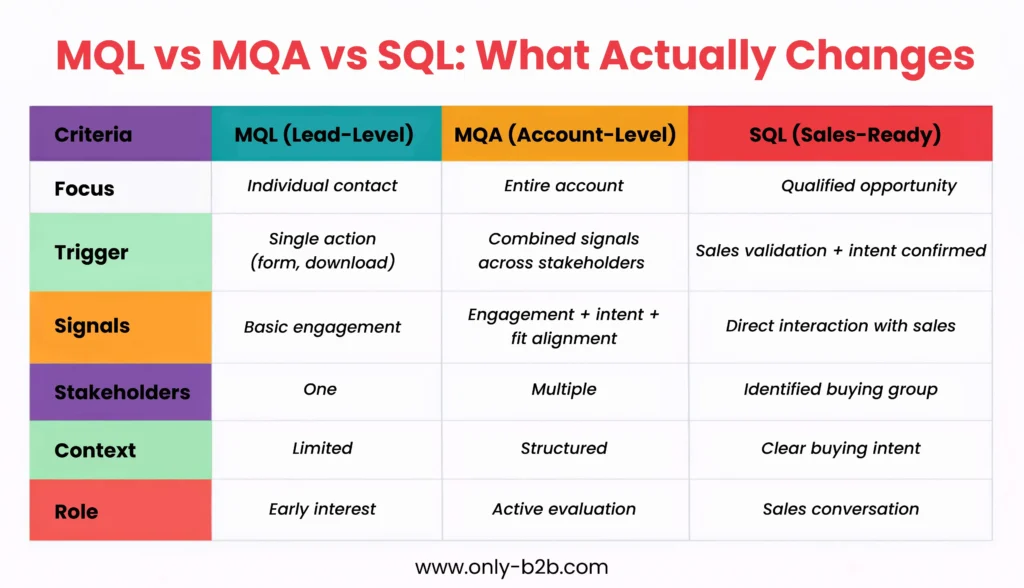
The comparison of MQA vs MQL vs SQL reflects a broader shift in how demand is understood and measured.
- An MQL (Marketing Qualified Lead) captures individual interest. It is triggered when a single contact performs a qualifying action such as downloading content or signing up for a webinar. This works in simpler buying environments but becomes limited in complex sales cycles, where individual actions rarely represent organizational intent.
- An MQA (Marketing Qualified Account) aggregates signals at the account level. It reflects engagement across multiple stakeholders and focuses on patterns rather than isolated actions. This makes it more aligned with real buying behavior, especially in environments where decisions are distributed.
- An SQL (Sales Qualified Lead) represents a sales-validated opportunity. At this stage, the account has been engaged directly, stakeholders are clearer, and there is confirmation that a real buying process is underway.
The gap between MQL and SQL is where most friction exists. Leads enter the system with signals, but without sufficient context. Sales teams are left to interpret intent that was never fully qualified.
MQAs help bridge that gap by introducing structure and context into qualification. They do not replace MQLs, but they refine how those signals are interpreted and when they should be acted upon.
Why MQAs Drive Better Pipeline
Pipeline quality improves when qualification reflects how decisions are actually made. In B2B environments, decisions are shaped by buying groups, internal alignment, and evolving priorities over time.
This is where account-based marketing becomes essential. Instead of focusing on volume at the lead level, teams align around accounts as the primary unit of growth. This shift changes how success is measured and how effort is distributed.
MQAs play a central role in this alignment. They ensure that marketing is not just generating activity but identifying accounts that are showing meaningful progression. Sales, in turn, engages with accounts that already have context, reducing the need for cold qualification.
This alignment improves pipeline generation in a more sustainable way. Rather than inflating the pipeline with low-quality opportunities, teams build a pipeline that has a higher probability of conversion.
Over time, this leads to better forecasting, more efficient resource allocation, and a clearer understanding of what drives revenue.
Key Signals That Indicate an MQA
Most teams already use the terms intent signals, engagement signals, and firmographic fit. The issue is not awareness. It is how loosely these are applied. For MQAs to be meaningful, these three signals need to be clearly defined, separated, and then connected.
1. Intent Signals
Intent signals indicate external research behavior. They show whether an account is actively exploring a problem or solution category beyond your owned channels.
- Third-party intent data spikes
- Increased searches around relevant keywords
- Competitor and category-level comparisons
These signals answer a critical question: Is this account in-market or just browsing?
2. Engagement Signals
Engagement signals capture how the account is interacting with your brand directly. This is your first-party view of behavior.
- Website visits across key pages
- Content downloads and repeat interactions
- Webinar attendance and email engagement
What matters here is not just activity, but progression. Are they moving from awareness to evaluation?
These signals answer: How seriously are the people of this account engaging with you?
3. Firmographic Fit
Firmographic fit determines whether the account is worth pursuing in the first place. High engagement without fit creates false positives.
- Industry alignment
- Company size and revenue range
- Technology environment and scalability
These signals answer: Even if they are interested, should you prioritize them?
Individually, each of these signals provides limited insight. Intent without engagement lacks visibility. Engagement without fit lacks relevance. Fit without activity lacks timing.
An MQA is identified when all three signals begin aligning at the same time, indicating that the right account is actively moving toward a decision.
Step by Step MQA Identification Framework
Identifying an MQA is not about collecting signals. It is about interpreting them in sequence.
Most teams jump straight to scoring. The more effective approach is to first establish progression logic.
Step 1: Confirm relevance before activity
Start with ICP alignment. If the account does not fit your target profile, no amount of engagement should qualify it. This prevents noise from entering the system early.
Step 2: Look for clustered engagement, not isolated actions
Instead of reacting to single events, observe whether interactions are happening close together in time. Clustering indicates momentum, not coincidence.
Step 3: Validate stakeholder spread
Check if engagement is expanding beyond a single contact. One person researching is curiosity. Multiple stakeholders engaging highlights internal conversation.
Step 4: Check for directional consistency
Ensure that interactions are not random. If stakeholders are engaging with related themes, solutions, or problems, it suggests focused evaluation.
Step 5: Apply qualification threshold
Only after these conditions are met should an account be evaluated against a scoring threshold. This ensures scoring is used as confirmation, not discovery.
Creating an MQA Scoring Model
A scoring model should not try to understand behavior. That has already been done in the identification stage.
Its role is different. It translates interpreted behavior into a system that teams can act on consistently.
This is where most models fail. They try to do both thinking and measuring at the same time.
A strong account scoring model follows three principles.
1. Weight signals based on decision proximity
Not all actions are equal, and the weighting should reflect how close each action is to a buying decision.
- High intent: pricing visits, demo requests, solution comparisons
- Mid-intent: webinars, case studies, product pages
- Low intent: blogs, awareness content
2. Score at the account level, not the contact level
Individual scores create noise. Aggregated scoring captures patterns. The model should combine all stakeholder activity into a single account score.
3. Use thresholds as decision triggers, not insights
Scoring thresholds should answer one question: Should this account be acted on now?
They should not attempt to explain why the account is qualified. That context comes from earlier stages.
A simple structure could look like this:
- 0 to 40: Awareness stage
- 40 to 70: Consideration stage
- 70 and above: MQA threshold
The exact numbers will vary, but the logic should remain stable.
Real Life Example of How One Can Identify an MQA in SaaS
A mid-market SaaS target account shows a short burst of aligned activity.
- A manager downloads a case study.
- A director attends a product webinar.
- A senior stakeholder revisits pricing and integrations.
At the same time, intent data signals increased research around similar solutions. Individually, these actions are routine. Together, they indicate coordinated evaluation, making the account a clear marketing qualified account.
From MQA to Sales Opportunity
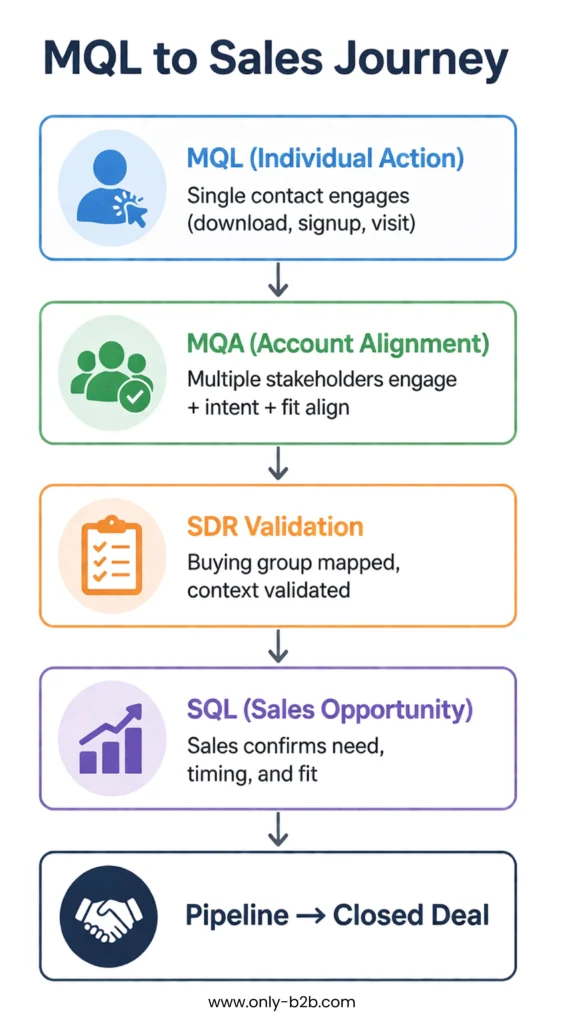
Once an account is identified as an MQA, the transition to sales should be deliberate and structured. This is not a simple handoff, but a continuation of context and insight.
- Marketing identifies the account based on aggregated signals and provides visibility into engagement patterns, key stakeholders, and areas of interest.
- The SDR then builds on this context by validating stakeholders, mapping the buying group, and identifying gaps in engagement. This step ensures that the account is not just active, but relevant and actionable.
- The account is then passed to the account executive for deeper qualification and conversation. By this stage, the conversation is not starting from scratch. It is informed by prior signals and aligned with the account’s context.
This structured workflow improves pipeline conversion and reduces friction between teams. It also ensures that sales efforts are focused on accounts that have already demonstrated meaningful intent.
Measuring MQA Performance
Tracking MQAs requires a shift in how performance is measured. Volume-based metrics become less relevant, and quality-based metrics take priority.
Key indicators include
- Account Engagement Score: Normalized across accounts based on stakeholder roles, depth of interaction, and recency.
- MQA to Opportunity Conversion Rate: Percentage of MQAs that convert into pipeline opportunities.
- Deal Velocity: Time taken for an account to move from MQA to opportunity to closed deal.
- Win Rate and Average Deal Size: Performance of MQA-sourced accounts compared to non-target accounts.
- Multi-Touch Revenue Attribution: Distribution of revenue credit across channels, campaigns, and stakeholders.
- Customer Lifetime Value and Expansion Rate: Growth and long-term value generated from MQA-driven accounts.
Accounts that show deeper and more diverse engagement patterns are more likely to convert, making this an important leading indicator.
Common MQA Mistakes to Avoid
FAQs on Marketing Qualified Accounts
What is the meaning of MQA in B2B marketing?
A Marketing Qualified Account (MQA) is a company identified by marketing as ready for sales outreach, based on combined engagement signals from multiple stakeholders within the account.
MQA vs. MQL: Which is better?
MQAs provide a more accurate reflection of buying behavior in complex B2B environments where multiple stakeholders are involved.
How to identify MQA effectively?
One can identify MQA by combining ICP alignment, engagement patterns, and intent data into a structured qualification framework.
What is the difference between SQL vs MQL?
MQLs indicate individual interest, while SQLs represent validated opportunities. MQAs sit between them at the account level.
Which businesses benefit most from MQAs?
Any organization with complex sales cycles and multi-stakeholder buying processes can benefit from adopting MQAs.
Move From Leads to Accounts
When qualification is aligned with how buying actually happens, the pipeline becomes more predictable and more meaningful. Teams are no longer reacting to isolated signals but responding to coordinated movement within accounts.
At Only B2B, the focus is not on increasing activity for its own sake. It is on bringing clarity to how demand is identified and acted upon. When that clarity exists, everything that follows becomes easier to manage and scale.

Vikas Bhatt is the Co-Founder of ONLY B2B, a premium B2B lead generation company that specializes in helping businesses achieve their growth objectives through targeted marketing & sales campaigns. With 10+ years of experience in the industry, Vikas has a deep understanding of the challenges faced by businesses today and has developed a unique approach to lead generation that has helped clients across a range of industries around the globe. As a thought leader in the B2B marketing community, ONLY B2B specializes in demand generation, content syndication, database services and more.