Intent data is the holy grail of B2B marketing. It is proven to lift pipeline and accelerate conversions. So why isn’t yours working the way it should?
Are you missing the secret? Or is your outcome nowhere close to the “best case studies,” or your tech is broken?
What B2B marketers say:
- Data quality is still a headache (70% say this is their #1 challenge).
- It is hard to turn data into action (64% collect it but struggle to use it well).
- Real ROI is rare (only 24% report exceptional ROI).
So, where is the gap between the intent data’s potential and its actual outcome? It is not about the technology. It is about how organizations implement and use it. And this gap is fixable.
In this blog post, we will explore seven critical mistakes that position you on the right side of the story, helping you realize the full value of this highly valuable asset.
Table of Contents
- 1 The Current State of Intent Data in B2B
- 2 How to Turn Intent Data Into Revenue
- 3 The Seven Critical Mistakes (and How to Fix Them)
- 3.1 Mistake #1: Treating All Intent Data Sources as Equal
- 3.2 Mistake #2: Failing to Act on the Data You Collect
- 3.3 Mistake #3: Relying Exclusively on One Data Type
- 3.4 Mistake #4: Ignoring Data Decay and Timing
- 3.5 Mistake #5: Using Intent Signals Without Context
- 3.6 Mistake #6: Mistaking Intent Signals for Qualification
- 3.7 Mistake #7: Failing to Align Sales and Marketing
- 4 Conclusion: Better Data = Better Pipeline
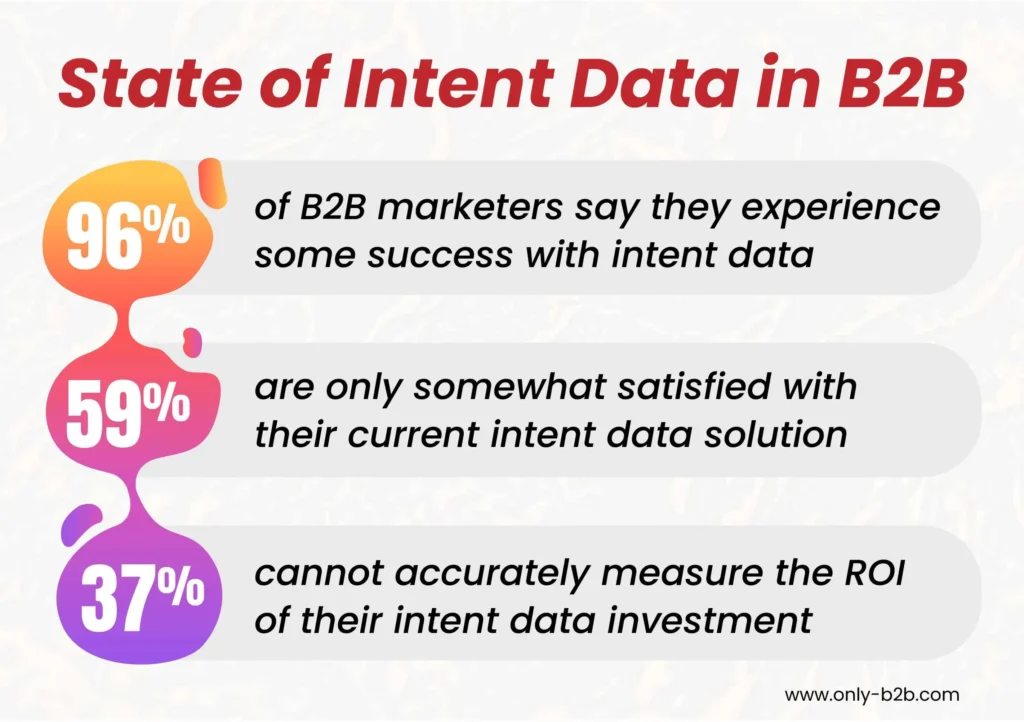
The Current State of Intent Data in B2B
Intent data is a key element in B2B marketing, and 97% of B2B marketers believe that intent data gives brands a competitive advantage.
However, adoption is not equal to success.
How to Turn Intent Data Into Revenue
Before we address the mistakes, it is important to understand what “good” intent data usage looks like.
Here is how teams that succeed with intent data experience it:
Stronger Pipeline Impact:
Marketers using multiple intent sources often see a higher share of their leads become sales-ready.
Faster Sales Cycles:
Sales teams consistently report that intent-driven leads convert faster than standard inbound or cold leads.
Better Alignment:
More than half of marketers say their primary reason for using intent data is tighter alignment with sales. When implemented well, intent becomes the shared source of truth across both teams.
So why do others fall short?
Most organizations under-measure key indicators. Very few track conversion time, closed or won deals influenced by intent, or churn impact. If you are not measuring visibility, it is almost impossible to connect intent signals to revenue.
So, what insights do most teams overlook, and exceptional teams do not?
Organizations that report exceptional ROI tend to have strong activation processes, not just good data.
The Seven Critical Mistakes (and How to Fix Them)
Mistake #1: Treating All Intent Data Sources as Equal
Most teams assume that every intent signal is gold. They then lump together low-value actions, such as reading a general blog, with high-value ones, such as viewing pricing pages.
Without understanding where signals come from and how they are generated, you are simply doing guesswork and therefore losing sales trust.
Fix: Build a Signal Hierarchy
Teams who see ROI do not treat every action the same. They build a clear hierarchy for signal strength:
Tier 1: High Intent
- demo requests
- pricing page activity
- product-specific research
Tier 2: Moderate Intent
- repeat website engagement
- topic-level research
Tier 3: Low Intent
- one-off traffic
- general industry browsing
To implement this, you must audit your signals and classify them by strength. If you cannot explain a signal’s value, you should not use it for sales outreach.
Usually, technology is not the issue. It is because teams have not set a smart, practical filter. Get this right, and you will finally see the shift from “just clicks” to true buyers.
Mistake #2: Failing to Act on the Data You Collect
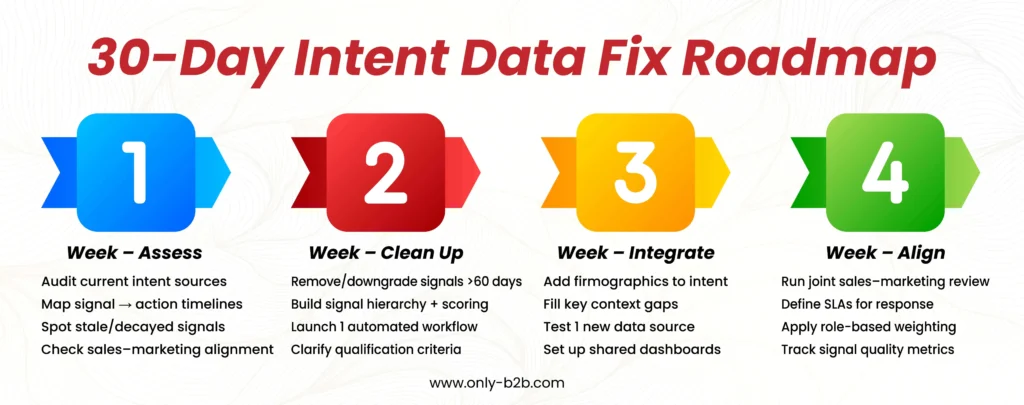
One of the biggest failures is collecting signals but not activating them quickly. Intent signals lose value fast. By the time a list is compiled and sent to sales, the window of interest may have closed.
Speed is a major differentiator here. Teams that respond early win more deals.
Fix: Automate and Accelerate
Do not let intent data sit. Turn it into action as early as possible.
Set up workflows for:
- instant alerts to sales when signals spike
- automated nurture sequences
- dynamic ad targeting
- scheduled weekly reviews of emerging accounts
Begin by mapping your current “signal to action” timeline. If you are not reaching out within 48 hours of a high-priority signal, you are losing deals to faster-moving teams.
Mistake #3: Relying Exclusively on One Data Type
Many teams rely on a single source, hoping to uncover key in-market buyers. But after the campaign, they realize that using only first-party or only third-party data always leaves critical gaps.
First-party shows who engages with you.
Third-party shows who is researching the category.
Neither works alone. Your team needs to blend both data types for a 360° view.
Fix: Integrate Multi-Source Insights
Combine:
- website activity
- email interactions
- review site behavior
- topic-level research
- firmographic and technographic context
If you are only using one data source today, add a complementary source for your top accounts. Cross-validate signals to make sure your “hot” leads are actually showing intent.
To find true buyers, you must see the whole journey, not just one slice of the data.
Mistake #4: Ignoring Data Decay and Timing
A lot of marketers expected intent data to surface the perfect buyer but quickly discovered that intent is always a moving target.
Signals from 30 or 60 days ago almost never reflect today’s buying intent.
Teams relying on old data waste time chasing ghosts, leads who already made a decision, went dark, or moved on.
Fix: Apply Time-Based Scoring
Use a simple decay model:
- Days 0–7: High priority
- Days 8–30: Moderate interest
- Days 31–45: Cooling
- 46+ days: Expired
You need to audit your CRM for old “high intent” leads and clear them out. Implement automatic score decay so only current, actionable signals are flagged for sales.
Intent data is volatile. The faster you act and the tighter you score your data, the more likely you are to turn signals into real conversations and closed deals.
Mistake #5: Using Intent Signals Without Context
Have you ever chased a “high intent” account only to realize they were never going to be a real buyer?
Intent data will not hand you perfect-fit prospects. Without context such as industry, size, tech stack, and buying authority, teams engage accounts that will never convert.
Fix: Validate Before You Act
Layer your signals with:
- firmographics
- technographics
- past engagement
- role-based context
- recent company changes
Review your top high-intent accounts manually this week. Identify which ones actually fit your ICP. Adjust your scoring gaps accordingly.
Remember, intent shows who is interested, but only context tells you who can buy. Get this right, and you will stop wasting effort on dead ends and start building a real, conversion-ready pipeline.
Mistake #6: Mistaking Intent Signals for Qualification
If you have ever sent a list of “high intent” leads to sales and received the feedback, “These are not even real opportunities,” you know the issue.
Sending every intent signal to sales results in wasted time and erodes trust.
Fix: Prioritize With Intent, Qualify With BANT or Similar Models
Use intent to determine when to engage.
Use qualification to determine who should be engaged.
Combine both into a unified scoring model where:
- qualification is primary
- intent boosts priority
Make sure your sales team only receives qualified accounts showing intent, not lists based on intent alone. Build a unified score that gives sales the right “who” and the right “when.”
Remember, intent tells you when to pay attention. Qualification tells you who is worth your time. Marrying both is the key to a trusted, high-converting pipeline.
Mistake #7: Failing to Align Sales and Marketing
Many B2B teams invest heavily in intent data but see it fall flat simply because sales does not trust the signals or know how or when to act on them.
Fix: Build Operational Alignment
Create shared:
- dashboards
- account scoring
- definitions
- SLAs for response
- weekly review cycles
Provide sales with:
- messaging playbooks
- role-based insights
- competitive signals
Hold a monthly intent alignment meeting with sales and document your agreed follow-up process.
The best intent data in the world will not drive pipeline unless your teams are aligned and committed to acting on it together.
Conclusion: Better Data = Better Pipeline
Intent data is a powerful tool when used with discipline and a focus on lead quality. If you blast every signal, skip enrichment, and celebrate volume over validation, you will end up with more noise, not more revenue.
Takeaway:
Use multiple sources.
Segment and enrich leads.
Validate every contact.
Prioritize data hygiene.
Measure what matters.
That is how you turn intent signals into actual, high-quality pipeline and finally get the ROI you expected.

Vikas Bhatt is the Co-Founder of ONLY B2B, a premium B2B lead generation company that specializes in helping businesses achieve their growth objectives through targeted marketing & sales campaigns. With 10+ years of experience in the industry, Vikas has a deep understanding of the challenges faced by businesses today and has developed a unique approach to lead generation that has helped clients across a range of industries around the globe. As a thought leader in the B2B marketing community, ONLY B2B specializes in demand generation, content syndication, database services and more.