

Interest has a short shelf life. A prospect who actively requests a demo, downloads a buying guide, or shows repeated buying signals is not simply another lead entering the CRM. They are at a point where momentum matters.
Yet in many organizations, that momentum is slowed by unclear ownership, manual assignment, or inconsistent routing decisions.
According to research from Harvard Business Review, companies that respond to leads within 5 minutes are significantly more likely to qualify them than those that wait even a few hours.
Speed alone, however, is only part of the equation. The fastest response from the wrong salesperson rarely creates better outcomes. That is why a strong B2B lead routing strategy is crucial.
What Is a B2B Lead Routing Strategy?
Most organizations think of routing as a CRM function.
In reality, it is a revenue decision.
A B2B lead routing strategy defines the logic that determines who owns a qualified prospect the moment they enter your revenue process. It translates buyer information into operational decisions, ensuring every opportunity reaches the person most likely to advance it.
That sounds straightforward until growth introduces complexity, such as:
- Multiple products
- Regional territories
- Strategic accounts
- Channel partners
- Existing customers
- Different buying stages
- Specialized sales teams.
Without a clear routing strategy, every new layer of complexity creates another exception. Over time, exceptions become the process.
This is why mature organizations treat routing as part of their revenue architecture rather than an administrative workflow. The objective is not simply assigning leads. It is preserving buying momentum while matching every opportunity with the team best equipped to continue the conversation.
When routing works well, sales representatives spend less time questioning ownership and more time engaging buyers who are already prepared to have meaningful conversations.
Why Lead Routing Breaks in B2B Teams
Lead routing often breaks for B2B teams because organizational decisions evolve faster than operational processes.
Many businesses continue adding products, expanding into new markets, or restructuring sales teams while relying on routing rules designed years earlier. The result is a system that reflects yesterday’s organization instead of today’s reality.
Here are a few common reasons that present challenge for B2B teams and might hinder the lead routing process:
Delays
Someone manually reviews incoming leads. Another person checks territory assignments. Ownership questions move between sales managers before finally reaching a representative. Every additional handoff increases response time while reducing buyer intent.
Unclear Ownership
An SDR believes the account belongs to an Account Executive. The AE assumes the opportunity belongs to Customer Success because the company already exists in the CRM. A partner team expects ownership because the prospect originated through their channel.
No one intentionally ignores the opportunity. Everyone simply believes someone else owns it.
Duplicate Records
Poor CRM data quality often results in multiple versions of the same organization or contact. One record reaches an SDR while another lands with an AE. Conversations become fragmented, reporting becomes unreliable, and buyers receive inconsistent outreach from different people within the same company.
Context plays an important role in the process.
A lead arriving from a pricing page behaves differently from someone downloading an educational report. Yet if routing ignores behavioral signals, both prospects may enter identical follow-up processes despite having completely different buying intent.
Most routing problems are therefore not technology problems. They are alignment problems disguised as operational inefficiencies.
Signals That Should Drive Lead Routing Rules
Deciding which signals actually matter for your B2B business is where the effective routing begins.
Too many organizations rely on one variable, such as geography or company size, even though buying decisions are influenced by multiple dimensions simultaneously. One must consider the following signals as well to drive better lead routing:
ICP Fit
A prospect matching your ideal customer profile deserves a different experience from someone who only loosely aligns with your market. Routing should recognize strategic fit, not simply form completion.
Account Tiering
Not every account represents the same growth opportunity. Enterprise accounts often require experienced sellers, coordinated outreach, and executive engagement, while commercial opportunities may follow entirely different paths.
Intent Strength
Repeated visits to pricing pages, product comparisons, implementation guides, or demo requests indicate different levels of purchase readiness. Strong high-intent lead routing recognizes these differences instead of treating every inquiry equally.
Someone exploring industry trends is looking for education. Someone requesting implementation timelines is evaluating vendors. Routing should acknowledge where buyers are rather than assuming every inquiry represents immediate sales readiness.
Buying Stage
Geography and product specialization remain important, particularly for organizations operating across regions or managing multiple business units.
The strongest routing models rarely depend on one rule. They combine several signals to create decisions that reflect both buyer context and organizational priorities. That is what makes routing feel more intentional instead of procedural.
Creating a Speed-to-Lead SLA
A speed-to-lead SLA is not simply a response-time target.
It is a shared agreement between marketing, sales, and RevOps that defines how quickly different types of leads should receive human engagement, who is responsible for that response, and what happens if the response window is missed.
The reason this matters is that buyer intent fades faster than most teams realize. Research from MIT found that companies responding within five minutes are 100 times more likely to connect with a prospect and 21 times more likely to qualify the opportunity than those that wait longer.
Yet many organizations still take close to 47 hours to respond, even though studies show the first vendor to engage wins roughly 78% of deals. In other words, speed is rarely just an operational metric. It is often the first competitive advantage.
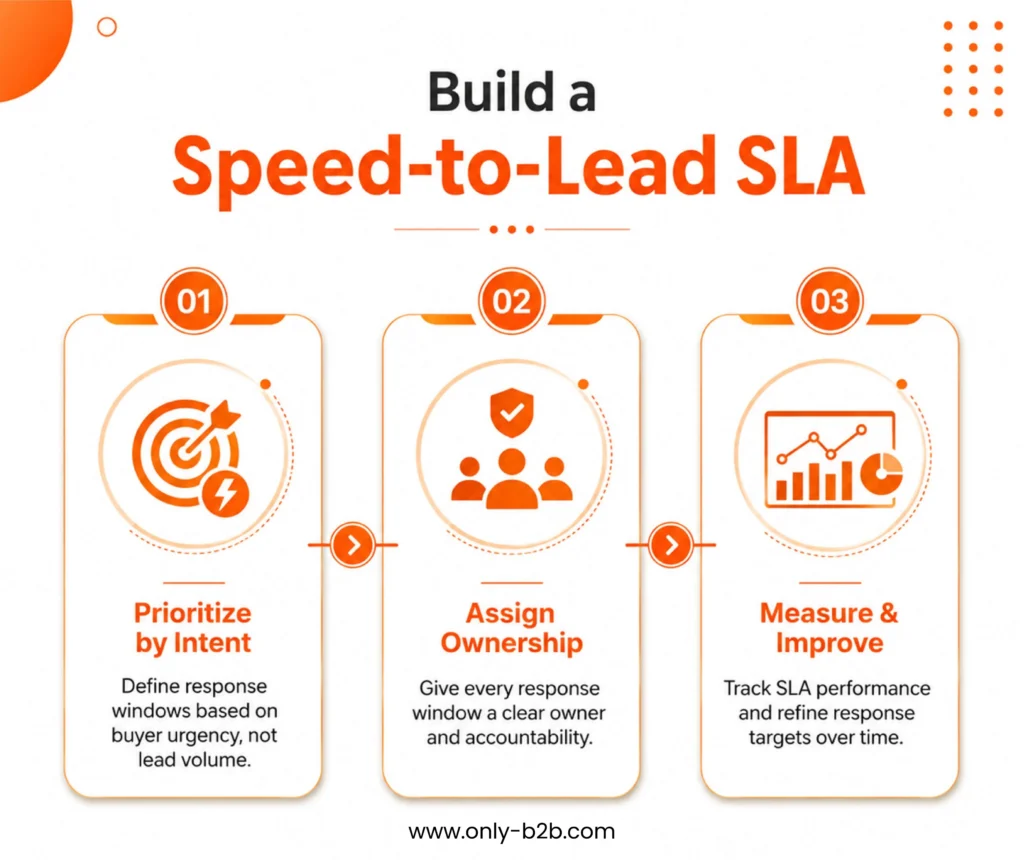
Creating an effective involves the following steps:
Step 1:
Speed-to-lead SLA starts with separating leads by urgency. A demo request, pricing inquiry, or contact from a strategic account should trigger the fastest response window, while educational downloads or webinar registrations can follow a longer timeline nurturing because the buyer is still exploring.
Step 2:
Attach a clear owner to each response window. Every lead category should specify who responds, within what timeframe, and how missed SLAs are escalated. Without accountability, SLAs might become guidelines instead of operating standards.
Step 3:
Measure the SLA against business outcomes. The goal is not to chase an impressive response-time number; it is to protect buyer momentum while the prospect is still actively evaluating solutions. When marketing, sales, and RevOps work against the same response expectations, follow-up becomes predictable instead of reactive, and high-intent opportunities are far less likely to go cold between teams.
Lead Ownership Rules for Sales Teams
Ownership should never be decided after a lead arrives. It should already be clear.
One of the biggest sources of revenue friction is overlapping responsibility between SDRs, AEs, customer success teams, and partner organizations. Without clearly documented sales ownership, every valuable opportunity becomes open to interpretation.
A practical ownership model answers straightforward questions before they become operational issues.
- Who owns existing customers requesting another product?
- How should named accounts be handled?
- When should partner-generated opportunities remain with channel teams?
- At what point does an SDR complete the qualified lead handoff?
The objective is not rigid hierarchy. It is removing ambiguity.
Clear ownership also improves the overall sales handoff experience.
Instead of simply forwarding contact information, every transition should include qualification context, buying signals, previous interactions, and agreed next actions.
Poor handoffs restart conversations buyers believed they had already completed. Good handoffs preserve momentum.
The difference is often invisible internally but immediately noticeable to customers.
A Practical CRM Lead Routing Workflow
Technology should reinforce decisions, not replace them.
A well-designed CRM workflow simply operationalizes the strategy already agreed upon by marketing, RevOps, and sales.
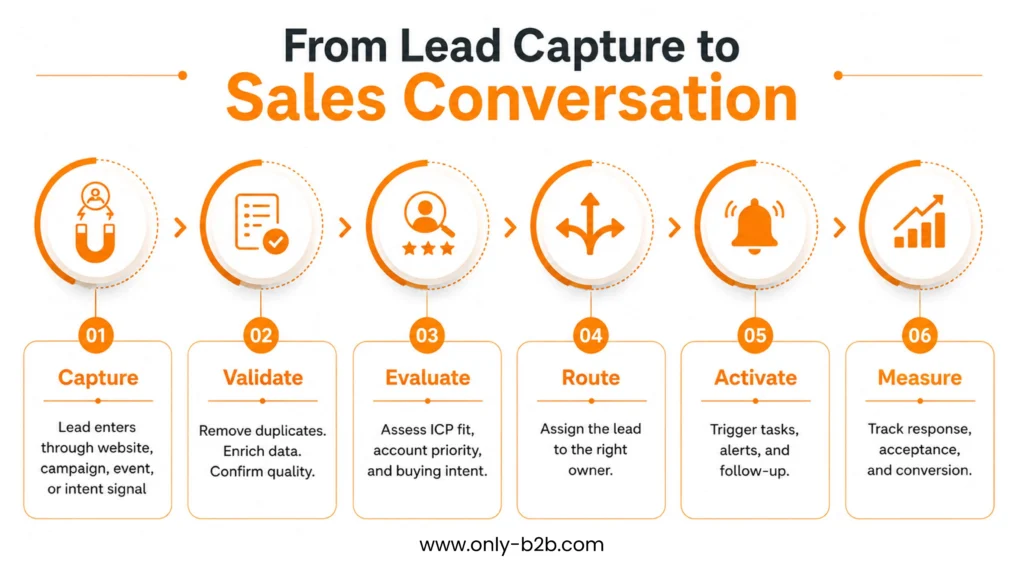
A typical sequence begins when a prospect enters the system through a website form, campaign response, webinar registration, or lead generation initiative.
The CRM validates the record, identifies duplicates, enriches company information, evaluates fit, and calculates intent based on predefined criteria.
Routing rules then determine the appropriate lead assignment using variables such as territory, account ownership, product interest, buying stage, and organizational priority.
Once ownership is confirmed, automation creates the required tasks.
The assigned representative receives immediate sales alerts, follow-up activities are scheduled, outreach sequences begin where appropriate, and managers gain visibility into response timelines.
Throughout the process, well-designed RevOps workflows ensure every operational step supports revenue goals rather than existing as disconnected automation.
The CRM is not making strategic decisions. It is executing them consistently at scale.
That distinction matters because automation only improves outcomes when the underlying logic reflects how the business actually sells.
Lead Routing Metrics to Track
The more useful question while measuring lead routing is whether routing improves outcomes. Here are a few metrics you can focus on while measuring the impact:
Sales response time:
Fast engagement demonstrates operational efficiency, but only when paired with appropriate ownership.
Acceptance rate:
This provides another valuable indicator. If representatives frequently reject routed opportunities, the issue often lies in qualification logic rather than sales performance.
Tracking movement from MQL to SQL:
Followed by SAL, helps identify where momentum slows after routing. These transition points reveal whether marketing qualification aligns with sales expectations or whether operational gaps continue after assignment.
Conversion rate:
This metric remains important, but it should be interpreted alongside routing quality rather than in isolation.
Ask the following questions while you follow the pipeline:
- How many qualified opportunities remain untouched?
- How many wait beyond SLA?
- How many are reassigned multiple times before meaningful engagement begins?
These questions expose process weaknesses that traditional dashboards often overlook.
Finally, examine routing decisions at the account level rather than only individual leads.
Modern buying involves multiple stakeholders entering the funnel at different times. Routing that treats every individual independently often fragments conversations across several sales representatives.
Account-level visibility keeps buying committees connected instead of scattered.
Lead routing metrics should help leaders understand whether the routing system accelerates qualified conversations or quietly introduces friction into the buying experience.
Turn Routed Leads Into Sales Conversations
A thoughtful B2B lead routing strategy ensures high-intent opportunities reach the right person with the right context while interest is still fresh. It reduces internal uncertainty, shortens response times, and creates a more consistent buying experience without asking teams to work harder.
Routing, however, is only one part of the system.
Qualification standards, ownership models, CRM workflows, and sales readiness all determine whether initial interest becomes pipeline or quietly disappears between teams.
At Only B2B, we believe revenue performance improves when every stage of that system works together. From qualification frameworks to sales-ready handoffs, the goal is not simply to move leads faster. It is to help marketing and sales operate with the clarity that turns intent into meaningful conversations, and conversations into predictable growth.

Vikas Bhatt is the Co-Founder of ONLY B2B, a premium B2B lead generation company that specializes in helping businesses achieve their growth objectives through targeted marketing & sales campaigns. With 10+ years of experience in the industry, Vikas has a deep understanding of the challenges faced by businesses today and has developed a unique approach to lead generation that has helped clients across a range of industries around the globe. As a thought leader in the B2B marketing community, ONLY B2B specializes in demand generation, content syndication, database services and more.