
Does ABM feel disciplined on paper and chaotic in execution?
Revenue teams agree on the target account list. Campaigns launch. Sales outreach begins. Content is personalized. Yet six months later, effort feels disproportionate to outcome. Some accounts receive heavy attention without meaningful movement. Others quietly progress with minimal investment.
Gartner notes that the typical B2B buying group now includes 6–10 stakeholders, each influencing the decision independently. When multiple decision-makers are involved, equal effort across all accounts stops making sense.
This is why ABM tiers matter.
Tiering introduces structural clarity into an account-based marketing strategy. It aligns personalization depth, sales involvement, and resource allocation with actual revenue potential.
Without tiering, ABM drifts. With it, execution becomes intentional.
What Are ABM Tiers? (1:1, 1:Few, 1:Many)
ABM tiers structure effort around account value and strategic importance.
The model is simple. The execution is not.
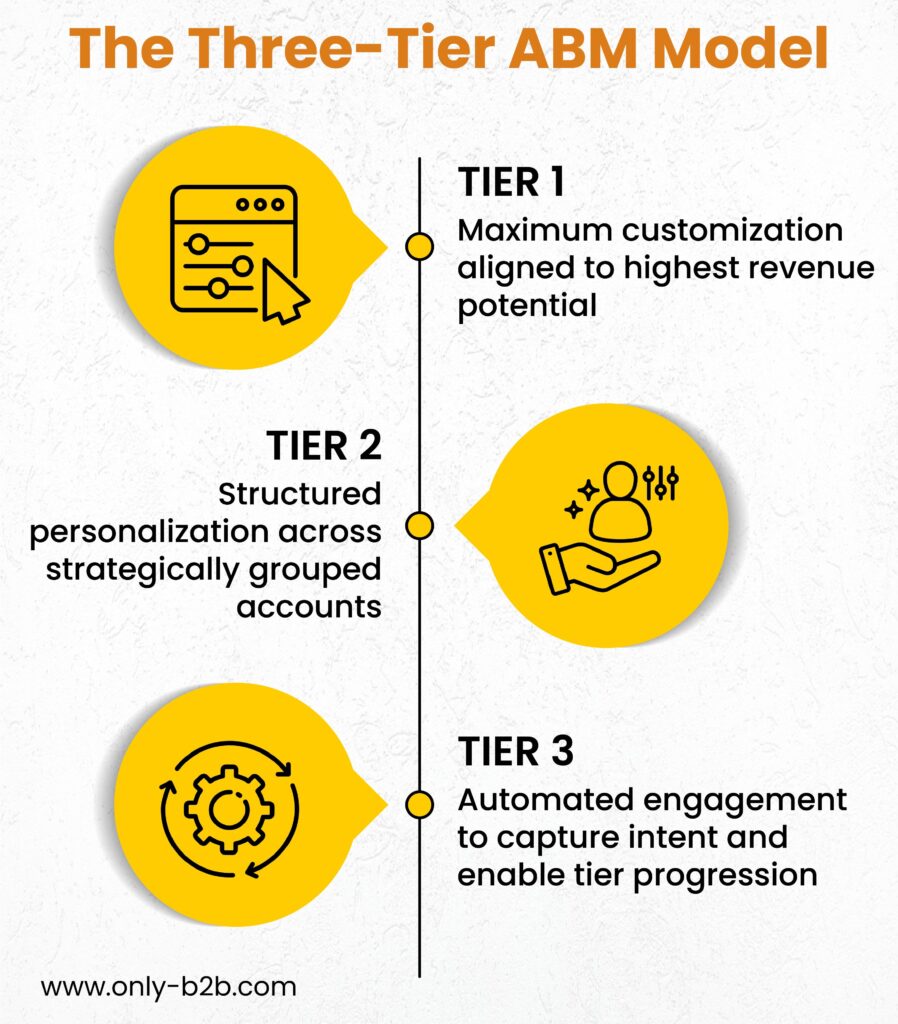
1:1 ABM focuses on a single strategic account at a time. Highly personalized. Deep collaboration between sales and marketing. Often tied to enterprise deals.
1:Few ABM clusters similar accounts together. Personalization is tailored to industry, use case, or shared challenges. Messaging is semi-custom, not bespoke.
1:Many ABM uses programmatic targeting across a broader total addressable market. Automation, intent signals, and scalable content drive engagement.
These tiers are not hierarchical in importance. They are differentiated by personalization depth and resource intensity.
An effective ABM strategy does not choose one tier. It orchestrates all three intentionally.
Tier 1 ABM: High-Value, High-Touch
Tier 1 ABM is reserved for accounts that can materially influence revenue trajectory, market positioning, or long-term strategic expansion.
These are typically high-ACV opportunities with extended sales cycles, complex stakeholder environments, and significant implementation scope.
They often involve executive scrutiny on both sides of the table, which means the margin for generic engagement is effectively zero.
In tier 1 ABM, personalization is structural. The messaging is not lightly adjusted; it is built around the account’s operating model, competitive landscape, strategic priorities, and internal initiatives.
Marketing develops custom content aligned to the organization’s specific growth agenda, while sales begins building executive relationships early in the process to establish credibility and trust.
Buying groups within these accounts are mapped deliberately. Influence is assessed across functions, and communication is sequenced to move consensus forward rather than simply generate isolated engagement. This level of orchestration requires tight marketing-sales alignment, shared account plans, and clear executive sponsorship.
The objective in 1:1 ABM is not volume or short-term lead creation. It is deal progression, stakeholder expansion, and strategic positioning that increase the probability of closing enterprise deals.
When executed well, Tier 1 becomes a coordinated revenue motion rather than a marketing campaign layered on top of sales activity.
Tier 2 ABM: Cluster-Based Personalization
Tier 2 ABM occupies the middle ground between bespoke engagement and scaled outreach. Instead of treating every account as entirely unique, organizations group accounts by vertical segmentation, regulatory pressures, technology maturity, or use-case targeting. These clusters are defined through observable patterns rather than assumptions.
In tier 2 ABM, the value proposition remains consistent within each segment, but examples, proof points, and contextual framing are adapted to reflect shared realities.
Content may include industry-focused webinars, semi-custom landing pages, tailored email sequences, and targeted social engagement that speaks directly to the cluster’s priorities.
This 1:few ABM approach allows marketing and sales teams to extend relevance without replicating Tier 1 intensity across every account. Sales involvement remains structured, though not as deeply embedded as in strategic accounts.
The focus is on building engagement depth and advancing opportunities efficiently across multiple accounts that share similar buying triggers.
When executed thoughtfully, Tier 2 balances efficiency with meaningful personalization. When treated superficially, it risks becoming traditional segmentation labeled as ABM. The distinction lies in whether the clusters are operationalized with shared account plans and coordinated outreach or simply grouped for messaging convenience.
Tier 3 ABM: Scalable Programmatic Outreach
Tier 3 ABM is designed for scale, but scale does not mean dilution. Accounts are still predefined, and targeting remains account-specific. The difference lies in the execution model and the level of personalization applied.
In tier 3 ABM, automation infrastructure plays a central role. Paid media, coordinated display and social campaigns, marketing automation workflows, and intent data signals work together to identify early-stage interest across a broader portion of the total addressable market. Content is modular and broadly relevant to defined industries or roles, ensuring consistency without heavy customization.
Sales involvement is typically triggered by engagement thresholds rather than embedded from the outset. The objective is to create reach, capture signals, and surface accounts that demonstrate meaningful activity. In this sense, 1:many ABM acts as both a visibility engine and a qualification layer that feeds higher tiers with emerging opportunities.
When integrated into a tiered ABM strategy, Tier 3 prevents over-investment in accounts that are not yet ready for high-touch engagement while still maintaining account-level precision.
Tier 1 vs. Tier 2 vs. Tier 3: Key Differences
Below is a simplified comparison framework often used to clarify internal alignment.
| Dimension | Tier 1 ABM | Tier 2 ABM | Tier 3 ABM |
|---|---|---|---|
| Personalization Level | Fully bespoke | Segment-level customization | Programmatic relevance |
| Budget Intensity | Very high | Moderate | Lower per account |
| Sales Involvement | Dedicated + executive | Shared ownership | Trigger-based |
| Timeline | 9–18+ months | 6–12 months | Ongoing cycles |
| Typical ACV | Enterprise-level | Mid-to-high | Mid-market / emerging |
The discussion around tier 1 vs. tier 2 vs. tier 3 ABM should not center on superiority but on structural alignment. Each tier exists to match effort with opportunity size and complexity.
How to Choose the Right ABM Tier
Choosing the correct ABM tier for an account should not be subjective. But
It should be anchored to four variables:
1. Annual Contract Value (ACV) Potential
ACV potential directly influences the level of investment that can be justified. Higher contract value supports deeper personalization and greater executive involvement.
2. Sales Cycle Length
Longer cycles often require sustained relationship-building and structured consensus development across buying groups.
3. Total Addressable Market (TAM) Size
Total Addressable Market size shapes scalability requirements. A smaller TAM with large enterprise targets favors Tier 1 and Tier 2 focus. A broader market demands Tier 3 scalability.
4. Internal Capacity
Content production capability, cross-functional alignment, and data infrastructure determine what is operationally sustainable.
An effective account-based marketing strategy maps accounts into tiers based on objective scoring criteria rather than sales preference alone.
The clarity this creates reduces misalignment and wasted budget.
It also prevents the common mistake of over-personalizing low-value accounts while under-investing in strategic opportunities.
Budget & Team Structure by ABM Tier
Each tier implies a different operational model.
Tier 1 allocates a concentrated budget to a small set of strategic accounts, often absorbing a disproportionate share of ABM spending. Dedicated cross-functional teams of account executives, marketers, content leads, and executive sponsors work in tight coordination to justify high resource intensity.
Tier 2 distributes a moderate budget across defined account clusters. Investment supports segment-specific campaigns, adapted content, and targeted media. Teams are shared across verticals, with marketing and sales aligned by segment rather than assigned to individual accounts.
Tier 3 prioritizes scalable media, automation platforms, and data infrastructure. Budget per account remains low, but technology investment is significant. Marketing operations lead execution, while sales engagement is activated based on predefined intent thresholds.
Measuring ABM Success by Tier
A strategy is only considered effective when it can be proven in numbers.
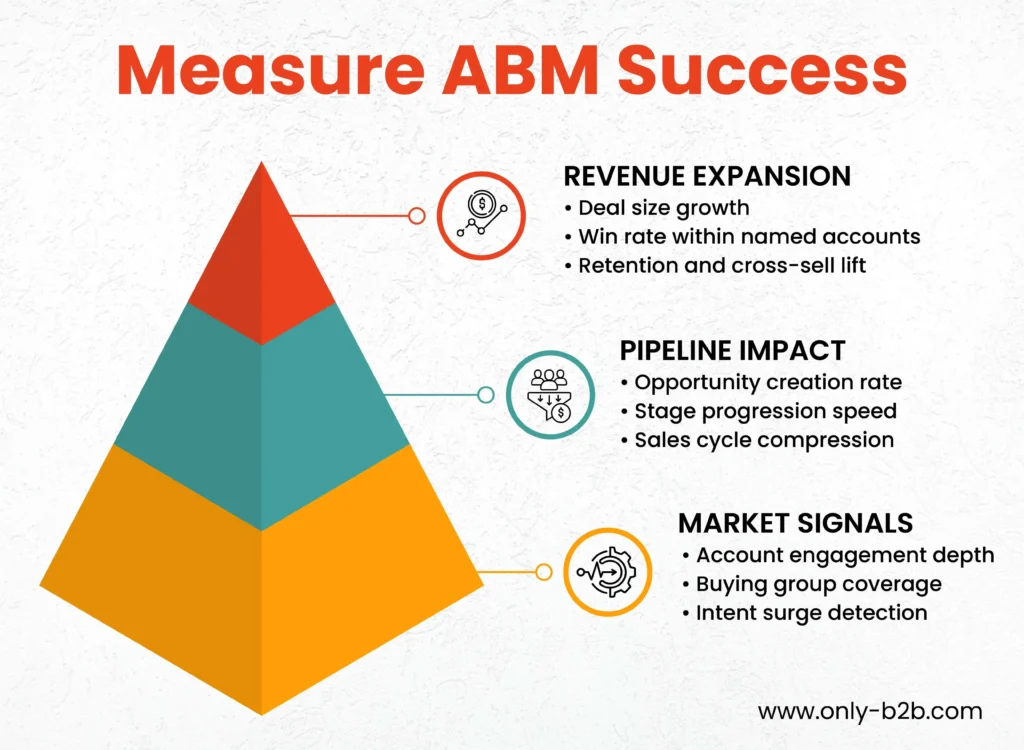
Using the same ABM metrics across tiers creates distorted expectations, which is why it is important that measuring KPI’s be different for each tier.
In Tier 1, success is measured by deal progression, stakeholder engagement within buying groups, meeting quality, and pipeline velocity.
In Tier 2, engagement depth matters. Multi-touch interaction, content consumption across roles, and sales-accepted opportunities indicate traction.
In Tier 3, reach and intent lift are primary. Account engagement trends, marketing-qualified accounts, and incremental pipeline creation show effectiveness.
According to HubSpot research, 20.3% of marketing sales teams said increased win rates is the benefit of sales and marketing alignment. Tiered measurement reinforces that alignment.
Common ABM Tiering Mistakes (And Fixes)
Most account tiering problems are predictable. The challenge is not identifying them — it is correcting them early enough to avoid wasted resources and misaligned outreach.
Over-personalizing low-impact accounts.
FixAlign personalization depth with ACV and strategic value before allocating resources.
Launching Tier 1 without sales buy-in.
FixSecure executive sponsorship and shared account plans before initiating high-touch engagement.
Failing to re-evaluate tiers.
FixReview tier assignments quarterly based on ACV shifts, engagement trends, and pipeline movement.
Confusing segmentation with strategy.
FixOperationalize clusters with coordinated outreach and defined ownership rather than static lists.
Ignoring data signals.
FixUse intent data and engagement depth to inform tier migration and resource reallocation decisions.
Conclusion
ABM becomes efficient when effort matches opportunity.
ABM tiers exist to ensure that you don’t waste your efforts on the wrong prospect. They ensure that enterprise deals receive the depth they require, mid-market clusters receive structured relevance, and broader segments receive scalable visibility.
When tiering is disciplined, growth becomes more predictable. Teams understand why resources are allocated the way they are. Sales understands marketing’s priorities. Marketing understands revenue impact.
The result is clearer execution and better results.

Vikas Bhatt is the Co-Founder of ONLY B2B, a premium B2B lead generation company that specializes in helping businesses achieve their growth objectives through targeted marketing & sales campaigns. With 10+ years of experience in the industry, Vikas has a deep understanding of the challenges faced by businesses today and has developed a unique approach to lead generation that has helped clients across a range of industries around the globe. As a thought leader in the B2B marketing community, ONLY B2B specializes in demand generation, content syndication, database services and more.