
Cold, warm, and hot calls differ according to the prospect’s prior engagement and current buying intent. A cold call begins without an established relationship, a warm call follows a meaningful signal such as a content interaction or referral, and a hot call responds to explicit intent such as a demo, pricing, or consultation request.
These terms describe the context of the conversation—not the effort used by the salesperson or a permanent label attached to the account. The same buyer can move from cold to warm to hot as awareness, engagement, and urgency develop.
Understanding the difference helps B2B sales teams choose the right opener, level of context, call objective, and follow-up. This guide compares cold calling vs. warm calling vs. hot calling through definitions, examples, scripts, use cases, and practical next steps.
Cold vs Warm vs Hot Calls
Cold, warm, and hot calls are distinguished by the amount and type of context available before the conversation begins:
- Cold Call: Outbound outreach to a prospect with no previous interaction or demonstrated interest.
- Warm Call: Outreach following a relevant engagement signal, such as a content download, webinar registration, referral, email response, or repeat website visit.
- Hot Call: A timely conversation prompted by explicit buying intent, such as a demo request, pricing inquiry, consultation request, or inbound form submission.
The practical difference is the salesperson’s starting point. Cold calls establish relevance, warm calls build on known engagement, and hot calls help the buyer advance an active evaluation.
What Is a Cold Call?
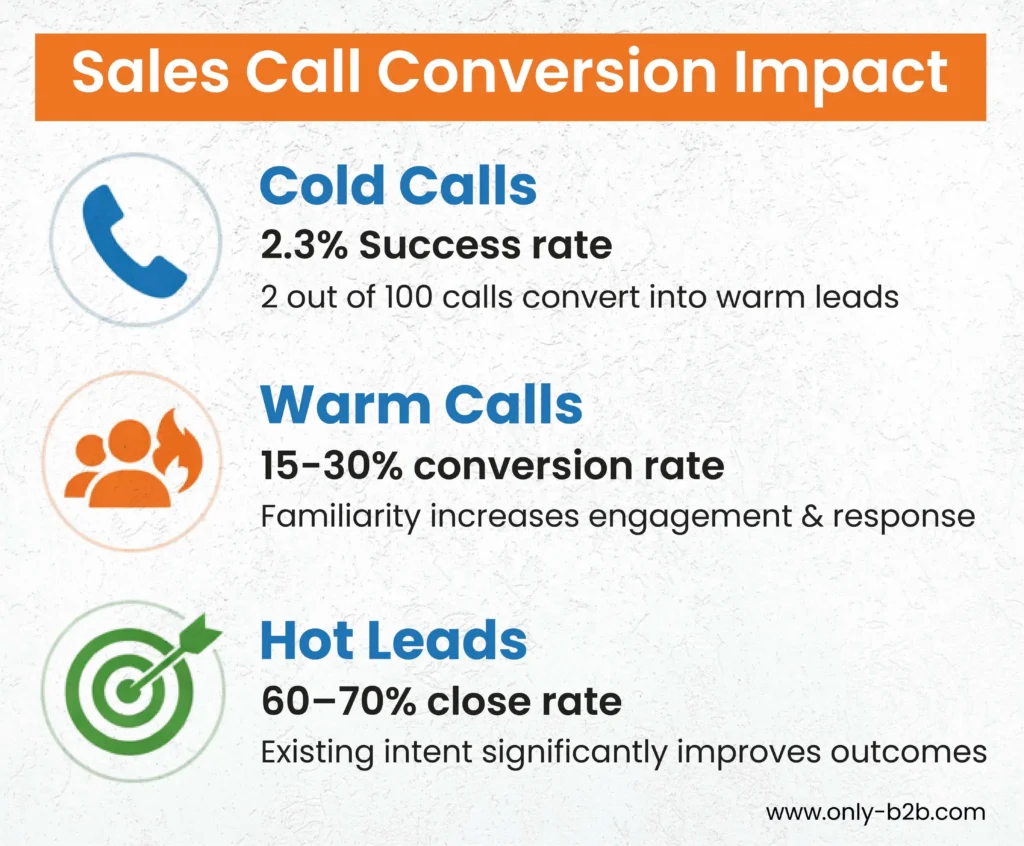
A cold call is an outbound conversation initiated without any prior engagement, relationship, or confirmed interest from the prospect. The salesperson reaches out based on ICP fit, role relevance, or market targeting rather than active buying signals.
Cold calls are characterized by:
- No prior interaction with the brand
- Limited knowledge of current priorities
- Low immediate expectation of engagement
- High dependence on relevance in the opening seconds
Examples include reaching out to a new account identified through market research or contacting a decision-maker who fits the ideal customer profile but has not interacted with marketing or sales assets.
Cold calling is typically used at the top of the funnel when expanding reach or entering new accounts. What makes it “cold” is not the absence of research but the absence of mutual awareness.
When done well, cold calling is not about closing deals. It is about opening conversations and testing relevance. When done poorly, it becomes an interruption rather than an introduction.
What Is Warm Calling?
Warm calling refers to outreach made after a prospect or account has shown a relevant engagement signal. The interaction provides useful context for the conversation, but it does not necessarily mean the buyer is ready to purchase.
Common warm-call signals include:
- Downloading relevant content or resources
- Visiting important website pages repeatedly
- Attending a webinar or industry event
- Replying to a previous sales or marketing email
- Receiving a referral or mutual introduction
- Showing increased account-level intent activity
- Engaging with relevant company content on LinkedIn
- Re-engaging after a previous customer relationship
A warm call should acknowledge the specific interaction without exaggerating its meaning. For example, downloading a guide may indicate interest in a topic, but it does not automatically prove that the prospect has an active project, budget, or buying timeline.
Compared with cold calling, warm calling begins with existing context rather than creating awareness from the beginning. Its purpose is to validate the prospect’s interest, understand their current need and timing, and agree on an appropriate next step.
What Is a Hot Call?
A hot call is a sales conversation prompted by clear and current buying intent. The salesperson is responding to a meaningful commercial action rather than trying to create awareness or determine whether the problem is relevant.
Common hot-call signals include:
- Requesting a demo, consultation, or sales conversation
- Asking about pricing, implementation, or contract terms
- Submitting an inbound form with a specific business requirement
- Requesting a proposal or evaluation
- Confirming an active project or implementation timeline
- Involving additional decision-makers in the conversation
- Returning repeatedly to high-intent solution or pricing pages and then contacting the company
A hot call does not automatically mean the opportunity is qualified or guaranteed to close. The salesperson should still confirm the account’s fit, business need, decision-making authority, buying process, stakeholders, and timing.
The main difference between a hot call and a cold call is the starting context. A cold call creates initial relevance, while a hot call responds to established intent and helps the buyer advance an active evaluation.
Cold vs Warm vs Hot Calls (Side-by-Side Comparison)
The table below compares cold, warm, and hot calls according to their starting context, available signals, conversation objective, and appropriate follow-up.
| Dimension | Cold Call | Warm Call | Hot Call |
|---|---|---|---|
| Relationship with prospect | No established interaction | Previous engagement exists | Active sales engagement |
| Available context | ICP, role and account fit | Behavioral or engagement signals | Stated needs and buying context |
| Opener approach | Establish relevance and earn permission | Acknowledge the relevant signal | Confirm the request and immediate priority |
| Primary objective | Start a relevant conversation | Validate interest and fit | Advance an active evaluation |
| Typical outcome | Follow-up or discovery | Qualified meeting or targeted nurture | Demo, proposal or decision step |
| Personalization basis | Account, role and likely problem | Recent engagement and topic of interest | Requirement, stakeholders and timeline |
| Appropriate follow-up | Relevant nurture or sales cadence | Signal-based follow-up | Mutually agreed action and date |
The comparison highlights that effectiveness is less about skill and more about matching approach to context.
When Should You Use a Cold Call vs Warm Call vs Hot Call?
Choosing between a cold, warm, or hot call depends on the strongest verified signal available when the outreach begins. The classification should reflect the prospect’s current context—not the salesperson’s preferred calling style.
Use a cold call when:
- The account matches your ideal customer profile but has shown no meaningful engagement.
- You are entering a new market, territory, or target account.
- You need to establish whether the problem is relevant before discussing a solution.
- No previous sales conversation or relationship exists.
Use a warm call when:
- The prospect has engaged with relevant content, an event, an email, or your website.
- A referral or mutual introduction provides context.
- The account is researching a relevant topic, but its buying intent is still unclear.
- A previous conversation occurred, but no active opportunity was confirmed.
Use a hot call when:
- The prospect requests a demo, consultation, pricing information, or proposal.
- The account confirms an active project, requirement, or implementation timeline.
- A direct inbound inquiry identifies a specific business need.
- Multiple stakeholders begin participating in the evaluation.
Do not classify a prospect using one email open, page visit, or isolated interaction. Consider account fit, engagement quality, buying intent, recency, and timing together before selecting the call approach.
How to Turn Cold Calls Into Warm Conversations- A Mini Playbook
Turning a cold call into a warm conversation does not require pretending that a relationship already exists. The objective is to establish relevance, earn permission to continue, and create a reason for a useful follow-up.
1. Confirm account fit
Verify the prospect’s industry, company size, role, likely need, and commercial relevance before calling.
2. Lead with a specific reason
Explain why you selected the prospect or account without claiming to know more about their situation than you actually do.
3. Ask a diagnostic question
Use one focused question to determine whether the business problem is relevant, current, and important to the prospect.
4. Agree on a small next step
Suggest an appropriate action, such as sharing a relevant resource, arranging a short discovery call, or speaking with the correct stakeholder.
5. Follow up with context
Reference the conversation and provide information related to the prospect’s stated priority. Review subsequent engagement before deciding whether the account has become warm.
A cold call becomes a warm conversation when the prospect shares meaningful context, agrees to continue, or takes a relevant follow-up action—not simply because another sales touchpoint occurred.
Cold vs Warm vs Hot Call Scripts You Can Follow
A call script should match the context available before the conversation. Cold-call openers establish relevance, warm-call openers acknowledge a verified interaction, and hot-call openers respond to a direct request or active buying need. Use these scripts as flexible frameworks rather than reading them word for word.
Opener for Cold Call
“Hi [Name], this is [Your Name] from [Company]. We help [role or type of company] address [specific business challenge]. I’m calling because [brief and relevant reason for selecting the account]. Is this something you are currently responsible for, or am I off base?”
Opener for Warm Call
“Hi [Name], this is [Your Name] from [Company]. I noticed that you recently [downloaded our resource, attended our webinar, replied to our email, or spoke with our team]. I’m calling to understand what prompted your interest in [topic], without assuming that you are currently evaluating a solution. Is this an area your team is working on?”
Opener for Hot Call
“Hi [Name], this is [Your Name] from [Company]. Thank you for requesting [a demo, pricing information, a consultation, or a proposal]. I wanted to understand what prompted the request and what you would like to evaluate. Could you briefly tell me about your current requirement and expected timeline?”
Gatekeeper-Friendly Option
“Could you help me identify the person responsible for [specific business area]? I’m trying to determine whether a conversation about [relevant challenge or outcome] would be useful to the appropriate person.”
Each opener should earn the next part of the conversation rather than immediately forcing a meeting. Listen to the response, confirm relevance, and agree on a next step that matches the prospect’s actual interest and timing.
Common Mistakes That Kill Your Call Conversion
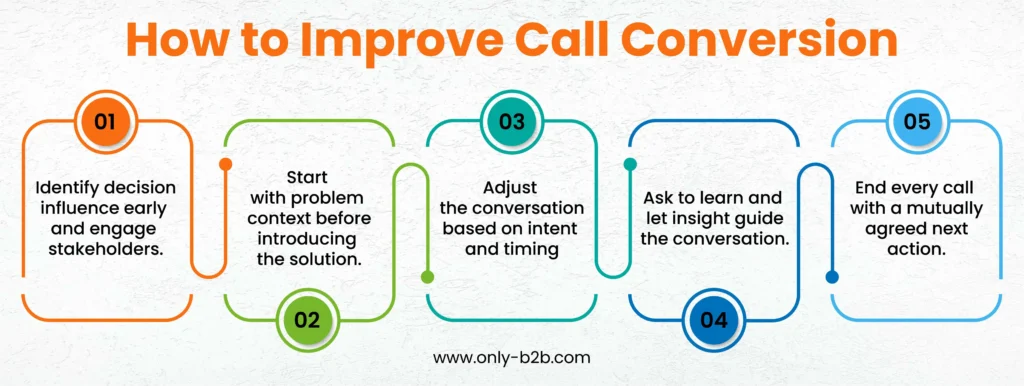
Calls rarely fail because of objection handling. They fail because context is misread. Here are a few common mistakes that are made, and how you can fix them.
Review these five mistakes before beginning outreach to create more relevant conversations and establish clear next steps.
Contacting the wrong stakeholder
Fix: Identify the people involved in researching, influencing, approving, and using the solution before beginning outreach.
Starting with a product explanation
Fix: Begin with a relevant business problem or outcome instead of immediately describing your product or company.
Treating engagement as buying intent
Fix: Validate the prospect’s need, priority, authority, and timing before treating the conversation as an active opportunity.
Turning discovery into a sales pitch
Fix: Ask focused questions and understand the prospect’s situation before recommending a solution.
Ending without an agreed next step
Fix: Conclude the conversation with a mutually agreed action, responsible person, and follow-up date.
FAQs
What is the difference between cold calling and warm calling?
Cold calling begins without previous interaction or demonstrated interest. Warm calling follows a relevant signal, such as a referral, content download, webinar registration, email response, or previous conversation. The cold-call opener must establish relevance, while the warm-call opener can acknowledge verified context.
What is a hot call in sales?
A hot call is a sales conversation prompted by clear and current buying intent. Examples include a demo request, pricing inquiry, consultation request, proposal request, or direct question about implementation.
What is the difference between a hot call and a cold call?
A cold call attempts to determine whether a business problem is relevant to the prospect. A hot call responds to an existing need or request and focuses on qualification, evaluation, and the appropriate next step.
Is warm calling more effective than cold calling?
Warm calling generally begins with more context, which can make it easier to start a relevant conversation. However, effectiveness still depends on account fit, the quality and recency of the engagement signal, the salesperson’s approach, and the prospect’s current priorities.
When should sales teams prioritize hot calls?
Hot calls should receive prompt attention when the prospect has expressed a specific need or requested a sales interaction. The salesperson should respond quickly while still confirming fit, authority, stakeholders, requirements, and timing.
Can a cold call become a warm call?
Yes. A cold call can become a warm conversation when the prospect shares meaningful information, agrees to continue, or takes a relevant follow-up action. The classification should change only when new engagement or buying signals appear.
Conclusion
Cold calling, warm calling, and hot calling are not competing tactics. Each serves a different purpose according to the prospect’s existing engagement and buying intent.
Cold calls create new conversations where no previous interaction exists. Warm calls use verified context to explore interest and fit. Hot calls respond to an active requirement and help the buyer progress through evaluation and decision-making.
These classifications are not permanent. A prospect can move from cold to warm or hot as engagement, need, urgency, and timing change. Sales teams should therefore review current signals instead of relying on an old lead label.
The most effective approach is to match the opener, personalization, objective, and follow-up with the evidence available at that moment. Only-B2B helps B2B organizations connect marketing signals with sales outreach so teams can prioritize relevant accounts and create better-timed conversations.

Vikas Bhatt is the Co-Founder of ONLY B2B, a premium B2B lead generation company that specializes in helping businesses achieve their growth objectives through targeted marketing & sales campaigns. With 10+ years of experience in the industry, Vikas has a deep understanding of the challenges faced by businesses today and has developed a unique approach to lead generation that has helped clients across a range of industries around the globe. As a thought leader in the B2B marketing community, ONLY B2B specializes in demand generation, content syndication, database services and more.