B2B marketers invest heavily in intent data because it promises clarity. Clarity into what buyers want, which accounts are actively researching, and where sales teams should focus next.
But the real problem is that intent data is often easy to buy and hard to justify.
You can prove engagement. You can show increased clicks, traffic spikes, or higher email opens. But when leadership asks, “How much pipeline did this generate?”, most teams hesitate. Because pipeline impact is harder to track than surface-level performance.
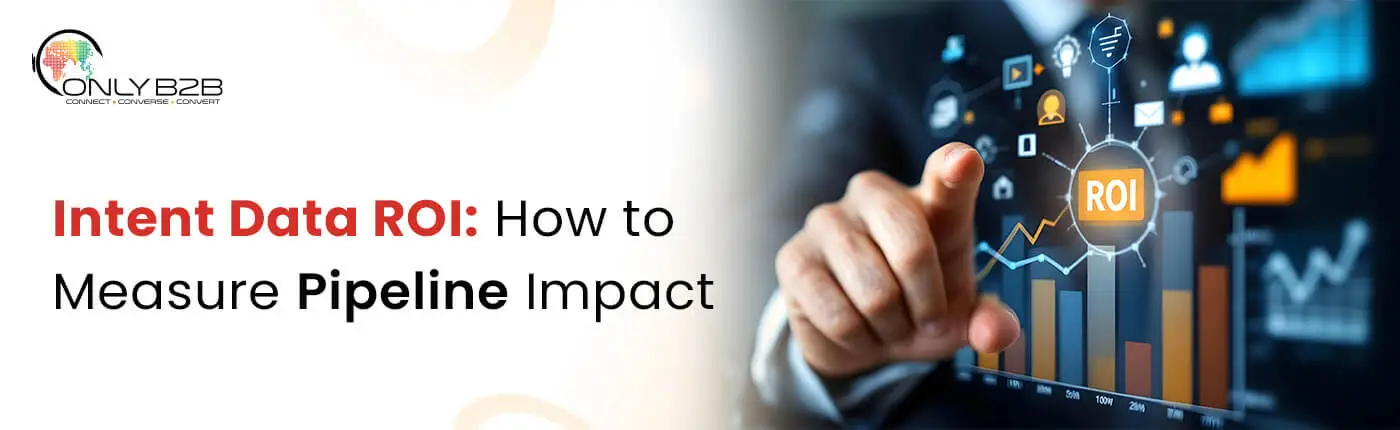
This is where intent data ROI becomes a business necessity. In tight budget cycles, if you can’t connect intent signals to pipeline growth and revenue acceleration, intent data gets treated as an expense, not an investment.
Context Matters. ROI measurement depends on your funnel model, CRM discipline, and how your sales and marketing teams operationalize intent data. Without clear measurement, you’ll never see intent driven value on paper.
So let’s fix that.
What Is Intent Data ROI—Really?
Intent data ROI is not simply measured by lead volume. Instead, intent ROI is the ability to track how intent data drives outcomes like:
- Pipeline created from high-intent accounts
- Opportunity conversion rate improvement
- Shorter sales cycles
- Higher win rates
- More efficient outbound performance (higher reply rates + better meeting rates)
- Revenue influenced or sourced by intent signals
According to Forrester’s Q1 2023 Global B2B Intent Data Survey, over 85% of B2B organizations using intent data report business benefits, with the biggest wins tied to improved outbound performance and prospecting effectiveness.
But here’s the catch: many teams still struggle to connect intent to pipeline outcomes because they don’t track it consistently across the buyer journey.
Why Pipeline Impact Is the Most Important ROI Metric
Pipeline is where leadership looks when evaluating marketing efficiency. It’s also the metric that aligns marketing, sales, and revenue teams.
A recent pipeline generation survey from Insight Partners found that marketing contributes close to 50% of pipeline at most companies, making pipeline impact the most important performance story marketers can tell.
And that’s why measuring pipeline impact matters more than measuring lead engagement.
Here’s the truth: Intent data can improve pipeline even if it doesn’t produce more leads. It can increase conversion rates, reduce wasted outreach, and accelerate opportunity creation. But only if you measure ROI correctly.
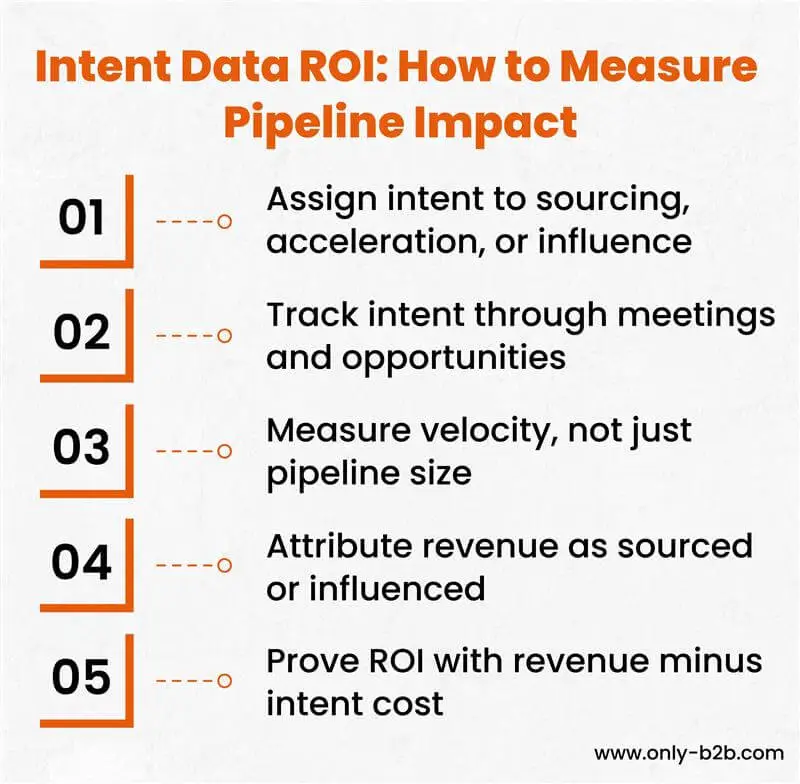
Step 1: Start With a Clear Assignment (What You’re Measuring & Why)
To measure intent data ROI properly, you need a Clear Assignment meaning:
- What is the goal of your intent program?
- Is it pipeline sourcing, acceleration, or deal expansion?
- Which teams are activating it marketing, SDRs, sales, RevOps?
- What stage of the funnel are you measuring?
Intent data can impact pipeline in different ways:
1) Pipeline Sourcing
Intent data helps you identify accounts showing buying signals and push them into meetings and opportunities.
2) Pipeline Acceleration
Intent signals help sales teams prioritize accounts already in motion, improving conversion velocity.
3) Deal Influence
Intent data helps shape conversations, messaging, and timing, increasing win rates.
If you don’t define which outcome matters most, your ROI tracking will be fragmented.
Step 2: Define the Right Intent-to-Pipeline Metrics
Intent data ROI becomes measurable when you track it through a set of pipeline-linked metrics.
Here are the essential KPIs:
A. Intent Activation Metrics
These show if the data is being used.
Intent Activation Rate = (# of intent signals acted upon) / (total intent signals received)
Sales Engagement Rate for High-Intent Accounts = (# of outbound touches to high-intent accounts) / (high-intent accounts)
These metrics answer: Is intent data operationalized or sitting unused?
B. Pipeline Conversion Metrics
These prove whether intent improves funnel performance.
- Meeting Rate (Intent Accounts) = meetings booked / high-intent accounts targeted
- Opportunity Creation Rate = opportunities created / intent-qualified accounts
- Sales Acceptance Rate (Intent Leads) = SQLs accepted / intent-qualified leads
- If these numbers rise after intent deployment, your pipeline influence is already visible.
C. Pipeline Velocity Metrics
Pipeline isn’t only about volume. It’s also about speed.
Intent-driven velocity metrics include:
- Time from intent surge → first sales touch
- Time from first touch → meeting
- Time from meeting → opportunity
- Sales cycle length (intent vs non-intent opportunities)
If intent-influenced opportunities close faster, your ROI is real even without increased pipeline volume.
D. Revenue Metrics
This is where leadership listens.
- Win Rate (Intent vs Non-Intent Deals)
- Average Deal Size (Intent vs Non-Intent)
- Revenue Influenced by Intent
- Revenue Sourced by Intent
You can define intent attribution as:
- Sourced = intent was first-touch driver
- Influenced = intent appeared at any stage of the journey and accelerated outcome
Step 3: Use a Simple ROI Formula (That Finance Teams Accept)
Intent ROI should connect revenue outcomes with cost.
Core ROI Formula
Intent ROI (%) = (Revenue attributable to intent – intent investment) ÷ intent investment × 100
Example:
If you spent $40,000 on intent + activation and it influenced $300,000 in closed-won revenue:
ROI = (300,000 – 40,000) ÷ 40,000 × 100 ROI = 650%
This is strong enough to justify expanding your intent program especially if pipeline velocity improves too.
Step 4: Attribution Models That Actually Work for Intent
Traditional attribution models fail because intent data impacts multiple stages.
Here are the most practical models to apply:
1) Control Group vs Intent Group
Split your target accounts into two groups:
- Group A: Uses intent for targeting
- Group B: Uses traditional targeting
Compare:
- meeting rates
- opportunity creation
- conversion velocity
- win rates
This is the cleanest way to prove ROI.
2) Time-Based Attribution
Track intent surges (topic + account) and measure outcomes within a defined window:
- 7 days
- 14 days
- 30 days
Example: If an account surges on “Sales Enablement Platforms” and enters pipeline within 14 days, intent influenced the pipeline event.
Intent is often one of many influences. So instead of forcing single-touch attribution, use influence tracking such as:
3) Multi-Touch Influence Reporting
- “Intent touched before opportunity creation”
- “Intent present in opportunity stage progression”
- “Intent engagement correlated with deal acceleration”
Forrester notes that teams often struggle with measuring deeper-funnel outcomes not because intent doesn’t work but because reporting frameworks aren’t built to connect intent signals to revenue stages.
Step 5: Build the Intent ROI Dashboard Leadership Wants
Once your tracking is ready, show intent ROI in a dashboard that answers executive questions.
Your dashboard should include:
Funnel View
- intent-qualified accounts targeted
- engaged
- meetings booked
- opportunities created
- pipeline value generated
- revenue influenced/closed
· average days from intent to meeting
Velocity View
- average days from meeting to opportunity
- average sales cycle reduction
Revenue View
- intent-influenced win rate
- intent-influenced deal size
- intent pipeline ROI
This approach makes intent ROI simple and visible.
Turn Intent Signals Into Pipeline You Can Prove
Connect™ helps revenue teams activate intent data across targeting, outreach, and reporting—so intent isn’t just visible, it’s accountable.
- Identify and prioritize in-market accounts
- Activate SDR and marketing plays at the right time
- Track sourced and influenced pipeline impact
Common Mistakes That Destroy Intent ROI Visibility
Even strong intent programs fail ROI measurement due to operational mistakes.
Mistake 1: Measuring only top-of-funnel engagement
Clicks don’t equal revenue. Pipeline does.
Mistake 2: Not tagging intent-influenced accounts in CRM
If you don’t mark them, you can’t report them.
Mistake 3: Using intent without activation
Intent is not a magic dataset it needs playbooks, messaging, and follow-up workflows.
Mistake 4: Not aligning sales + marketing reporting
Intent ROI fails when marketing tracks engagement and sales tracks closed-won but no one tracks pipeline progression.
A Simple Checklist to Measure Intent Data ROI Like a Pro
Use this checklist before you report ROI:
- Define if intent is used for sourcing or acceleration
- Set baseline metrics before intent rollout
- Track activation rate + meeting rate
- Tag accounts + opportunities influenced by intent
- Compare intent vs non-intent pipeline conversion and velocity
- Present ROI via pipeline value and influenced revenue
Conclusion: Intent ROI Is a Pipeline Story, Not a Lead Story
Intent data is powerful. But its real value doesn’t live in dashboards of engagement it lives in revenue outcomes. When intent ROI is measured properly, teams stop defending spend based on activity and start proving value through pipeline impact, conversion, and revenue growth.
And that shift matters more than ever as pipeline strategies get leaner and focus tightens on what actually moves deals forward.
When intent data is tied directly to business outcomes, it stops being a line item to justify and becomes a defensible investment leaders trust.
Before you scale your intent data spend, ask one thing:
Can you tie intent signals to pipeline value, deal velocity, and wins?
If you can, ROI proves itself.

Vikas Bhatt is the Co-Founder of ONLY B2B, a premium B2B lead generation company that specializes in helping businesses achieve their growth objectives through targeted marketing & sales campaigns. With 10+ years of experience in the industry, Vikas has a deep understanding of the challenges faced by businesses today and has developed a unique approach to lead generation that has helped clients across a range of industries around the globe. As a thought leader in the B2B marketing community, ONLY B2B specializes in demand generation, content syndication, database services and more.