In B2B appointment setting, the hardest part is not booking the meeting. It is getting the prospect to actually show up.
No show up is no less than a nightmare:
No-shows don’t just waste time. They silently drain your pipeline. They break SDR rhythm. They disrupt forecasting. And worst of all, they give you false hope of progression, but revenue stays flat.
And it’s only getting harder.
Again, only 17% of their time meeting with potential suppliers during a purchase journey- [Gartner]. That is 17% of their time meeting with potential suppliers during a purchase journey.
That means most of the decision-making happens without you, and you get a tiny window to earn trust and value. [Gartner].
This implies if your meeting does not feel worth that limited time, it gets skipped.
So the question is not “How do we send more reminders?”
The real question is: How do we make meetings feel valuable enough to attend?
What is the root cause of no shows in b2b appointment? We will go step by step to reduce them using proven strategies that combine qualification, buyer psychology, timing, and a process that actually works.
What Is a No-Show Rate in B2B Appointment Setting? (And Why It’s a Bigger Problem Than You Think)
A no-show happens when a prospect agrees to a meeting and then fails to attend without canceling or rescheduling in advance.
In simple words, its the percentage of scheduled meetings where the prospect does not show up.
Do you know what most teams miss?
No-show rates are not just a calendar problem. They are a signal problem.
They signal one of three things:
- The prospect did not have enough intent.
- The prospect did not see enough value.
- The prospect faced too much friction.
And in modern B2B selling, friction is everywhere.
Salesforce research shows sales reps spend just 28% of their week actually selling, with the rest eaten up by admin work, internal coordination, and deal management. Salesforce
Every no-show hurts more because selling time is already limited. When a rep loses a 30-minute slot, they do not just lose time. They lose momentum.
Meeting attendance is directly tied to revenue. here’s a simple model based on 100 meetings booked per month.
We’re using the same assumptions across both scenarios so the impact of show-up rate is clear:
- Meeting → SQL conversion rate (Q): 25%
- SQL → Closed-Won rate (W): 20%
- Average Contract Value (ACV): $20,000
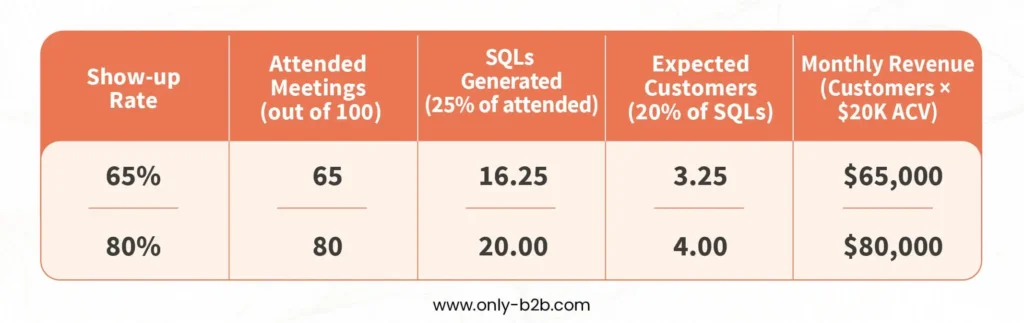
Improving attendance from 65% to 80% = +$15,000/month revenue uplift .
That’s +$180,000 per year, without increasing meeting bookings, headcount, or campaign spend.
Reducing no-shows is the fastest way to improve SDR efficiency and pipeline velocity without hiring more people.
Why B2B Prospects Don’t Show Up (Root Causes You Can Fix)
No-shows often feel random. But that’s rarely so
Here are the most common reasons B2B prospects disappear, and what each one really means.
1) The meeting was booked too early in the buyer’s journey
Many B2B meetings are booked when the prospect is still exploring, not committed. They are curious, but not ready.
This is why buyers ghosts without guilt. They are never mentally committed.
As one sales enablement leader puts it:
“Prospects don’t skip meetings because they’re rude. They skip meetings because the meeting feels optional.”
When the meeting feels optional, it becomes the first thing to drop when their calendar gets chaotic.
2) The prospect doesn’t see enough value
Even if intent is decent, the prospect might not show up because the meeting promise feels vague.
If the calendar invite says “Quick call” or “Intro meeting,” it does not give the buyer a reason to protect the time.
In B2B, people show up when there is a clear outcome.
3) Buying committees create delays and decision paralysis
A big reason no-shows happen is not that the prospect is disinterested. It is that they are stuck internally.
Forrester’s research shows 86% of B2B purchases stall during the buying process, and 81% of buyers are dissatisfied with the provider they choose. Stock Titan
If buying journeys stall this often, it’s normal for meetings to stall too. So, your job is to reduce uncertainty and make the next steps easy.
4) The wrong person booked the meeting
Sometimes the attendee is not a decision-maker. It might be someone tasked with “checking it out,” and they deprioritize the meeting.
This is common when meetings are set without verifying role,relevance or authority.
5) Friction kills attendance
Friction looks small but it compounds.
Time zone confusion. A missing meeting link. A long agenda with no clarity. A meeting that feels too long. A calendar invite that lands as “optional.”
Small friction leads to “I’ll reschedule later,” and later never happens.
How to Reduce No-Show Rates in B2B Appointment Setting (A Practical Playbook)
If you want fewer no-shows, you need to treat appointment setting like pipeline building, not calendar filling.
The best teams reduce no-shows using a simple principle:
Show-up is created before the meeting is booked.
Let’s break down the playbook.
1) Start with Better Qualification Before Scheduling
Most no-shows are not caused by reminders. They are caused by poor qualification.
When a prospect has weak intent, no follow-up sequence can fix it. You can only chase it.
Before confirming a meeting, ensure you know:
- What they are evaluating
- Why now
- Who else is involved
- What outcome they want from the conversation
You don’t need a full discovery. But you do need to confirm relevance.
This is where many appointment setting workflows fail. They assume that if someone agrees, the meeting is solid.
But in reality, agreement is not commitment.
Keep in mind :
“A meeting is not booked when they say yes. It’s booked when they see value.”
2) Send the Confirmation Fast (Within 5 Minutes)
Once the meeting is scheduled, the next 5 minutes matter more than the next 5 days.
If your confirmation email arrives late, you lose psychological momentum.
The confirmation should do one thing very clearly:
make the prospect feel like they are about to gain something.
That means your confirmation should include:
- What the meeting is about (clear and specific)
- What outcome they can expect
- What they should bring or prepare
- A simple reschedule option
A strong confirmation message feels like a preview of value. And a weak confirmation feels like admin.
3) Make the Meeting Feel Like a Win, Not a Call
When prospects no-show, it’s usually because the meeting feels like a sales pitch. So, your job is to position it as a problem-solving session.
Instead of this:
“Quick intro call to discuss your needs.”
Use this:
“15-minute strategy session to identify where pipeline drop-offs are happening and how to fix them.”
Surely the shift is subtle, but powerful.
It changes the meeting from “something I have to attend” to “something I can gain from.”
4) Use a Reminder Workflow That Builds Value, Not Pressure
Don’t forget reminders, they work.
But not because they remind.
They work because they reinforce relevance.
A reminder email that simply says “Looking forward to meeting” does not reduce no-shows. It just fills inbox space.
A reminder that includes context does:
- “Here’s what we’ll cover”
- “Here’s a 1-minute recap of why this matters”
- “Here’s a quick example from another company like yours”
The reminder becomes a micro-nurture touchpoint. Buyers give you a very limited slice of their attention. And every touchpoint needs to earn attention. Otherwise, it gets ignored.
5) Reduce Friction in Scheduling and Joining
Why would people attend a meeting when it feels difficult? So, make sure your process makes it feel effortless.
That means:
- Meeting link is visible and easy to access
- Calendar invite includes time zone clarity
- The meeting duration is reasonable (15 to 25 minutes often works best for first calls)
- The invite title clearly communicates value
In B2B, people don’t miss meetings because they’re irresponsible. They miss meetings because they’re overloaded.
When overloaded, they attend what feels important and skip what feels unclear.
6) Use Pre-Meeting Assets to Increase Commitment
One of the easiest ways to improve show-up rates is to send a simple pre-meeting asset. Not a long deck. Not a 12-page case study. Something short that makes the prospect feel informed.
It can be:
- A one-page summary
- A short relevant customer story
- A “what to expect” outline
- A quick checklist relevant to their role
This makes the meeting feel real and increases commitment.
A strong line you can include:
“If something changes, feel free to reschedule. But if you attend, you’ll leave with a clear next-step plan.”
It removes pressure but reinforces value.
7) Don’t Ignore the Human Psychology Behind No-Shows
No-show reduction is as much psychology as it is workflow.
Two psychological triggers matter most:
Commitment: People are more likely to follow through when they confirm details.
Ask for a reply that confirms the meeting, even if it’s simple.
Consistency: When someone takes a small action before a meeting, like answering one question or reviewing a short agenda, they are more likely to show up.
As a behavioral principle suggests:
“The moment a buyer confirms the agenda, they are more likely to show up because commitment creates consistency.”
This is why confirmation questions outperform passive scheduling.
8) Build a No-Show Recovery System That Works
Even with a strong process, no-shows happen.
What matters is how quickly you recover.
The biggest mistake teams make is waiting too long to follow up.
A good no-show follow-up should be sent within 30 minutes, while the meeting is still fresh.
It should:
- Assume good intent
- Offer a reschedule option
- Reconfirm value
- Avoid sounding frustrated
The tone should feel like:
“Totally understand things come up. Want to grab a quick slot later this week?”
No guilt. No pressure. Just value and momentum.
What to Track If You’re Serious About Reducing No-Shows
If you don’t measure it, you can’t fix it.
To improve attendance, track:
- Show-up rate
- No-show rate
- Reschedule rate
- Meeting-to-SQL conversion
- Meeting-to-opportunity conversion
But one metric stands out as the most useful:
Cost per attended meeting.
Because a booked meeting has no value if it doesn’t happen.
This metric helps you evaluate campaigns properly and compare channels accurately.

If you do these consistently, you’ll see show-up rates improve without needing more follow-ups or longer sequences.
Conclusion: No-Show Reduction Is Not About Reminders. It’s About Relevance.
Reducing no-show rates in B2B appointment setting comes down to one thing: making the meeting feel like the best use of the buyer’s limited time.
Buyer’s time is limited. Their attention and commitment are fragile. That’s why no-show reduction is not an operational fix. It’s a buyer-experience fix.
When you qualify with intent, confirm with value, reduce friction, and reinforce relevance at every touchpoint; prospects will definitely show up. When prospects show up, SDR productivity improves, pipeline forecasting becomes more reliable, and meeting-to-SQL conversion becomes predictable.
If you’re tired of calendars that look full but pipelines that stay quiet, it’s time to rewire appointment setting. Build a system that qualifies and nurtures prospects before the meeting happens, or else partner with an appointment setting team that delivers high-intent meetings that actually convert into pipeline.
and the data proves it. Gartner found buyers spend only 17% of their journey meeting with suppliers. Gartner
And with Forrester reporting that 86% of B2B purchases stall, it’s clear that attention and commitment are fragile in today’s buying process. Stock Titan
That’s why no-show reduction is not an operational fix. It’s a buyer-experience fix.
When you qualify with intent, confirm with value, reduce friction, and reinforce relevance at every touchpoint, prospects show up.
And when prospects show up, SDR productivity improves, pipeline forecasting becomes more reliable, and meeting-to-SQL conversion becomes predictable.
Busy calendars don’t build pipeline. Qualified meetings do.
If you’re tired of calendars that look full but pipelines that stay quiet, it’s time to rethink appointment setting. Build a system that qualifies and nurtures prospects before the meeting happens — or partner with an appointment setting team that delivers high-intent meetings that actually convert into pipeline.
Talk to Only B2B →

Vikas Bhatt is the Co-Founder of ONLY B2B, a premium B2B lead generation company that specializes in helping businesses achieve their growth objectives through targeted marketing & sales campaigns. With 10+ years of experience in the industry, Vikas has a deep understanding of the challenges faced by businesses today and has developed a unique approach to lead generation that has helped clients across a range of industries around the globe. As a thought leader in the B2B marketing community, ONLY B2B specializes in demand generation, content syndication, database services and more.