
Most B2B marketers already know the uncomfortable truth about MQLs.
Lead volume is rarely the issue. Campaigns perform, dashboards look healthy, and forms continue to fill. Yet when those MQLs reach sales, the response is often muted. Follow-ups are delayed. Rejection rates rise. Pipeline contribution falls short of expectations.
This disconnect is not new. It has simply become more visible as buying behavior has changed.
MQL qualification was designed for a time when buyers raised their hands earlier, research happened on vendor websites, and individual actions clearly signaled intent.
That world no longer exists. Today’s buyers move quietly, research independently, and involve multiple stakeholders long before speaking to sales.
Qualifying MQLs effectively now requires rethinking what “qualified” really means and aligning it with how buyers actually behave.
Why MQL Qualification Feels Broken for Many B2B Teams
For most marketing teams, MQL qualification still follows a familiar pattern. A lead meets basic firmographic criteria and engages with content. Points are added. A threshold is crossed. The lead is passed to sales.
On paper, the logic still makes sense. In practice, it often fails.
Hubspot reports that nearly 70% of B2B marketers say lead quality is their biggest challenge, even as lead generation performance improves. This suggests that the problem is not attracting interest, but interpreting it correctly. (Source: Hubspot State of Marketing Report)
Buyers now consume content anonymously across dozens of channels. A single download may reflect casual research rather than buying intent.
Multiple stakeholders may be involved, each engaging separately. When MQL qualification treats these fragmented signals as readiness, sales teams inherit the risk.
What Most Marketers Already Get Right About MQLs
Despite these challenges, many assumptions behind MQLs are still correct.
Not every lead should be sent to sales. Some level of qualification is essential to protect sales time and focus effort. Engagement still matters. Account fit still matters. The goal has always been to identify leads more likely to convert.
Where things break down is not strategy, but execution.
HubSpot research shows that only 27% of marketing-generated leads are considered sales-ready once reviewed by sales teams. The gap is rarely caused by lack of effort. It is caused by qualification criteria that no longer reflect buying readiness.
Source: HubSpot, State of Marketing Report
To move forward, MQL qualification needs to evolve without abandoning its original purpose.
How to Qualify MQLs Around Buying Readiness
At its core, MQL qualification should answer one question: Is this lead likely to engage in a meaningful sales conversation now or in the near future?
That question is more nuanced than it appears. A modern MQL definition balances three signals that marketers already recognize, but often evaluate separately.
- Account fit aligned with the Ideal Customer Profile
- Engagement that reflects evaluation rather than early awareness
- Intent signals that indicate active problem exploration
When these signals converge, confidence in qualification increases. When they do not, passing the lead to sales prematurely creates friction.
This shift reframes MQLs from activity milestones to indicators of buying readiness.
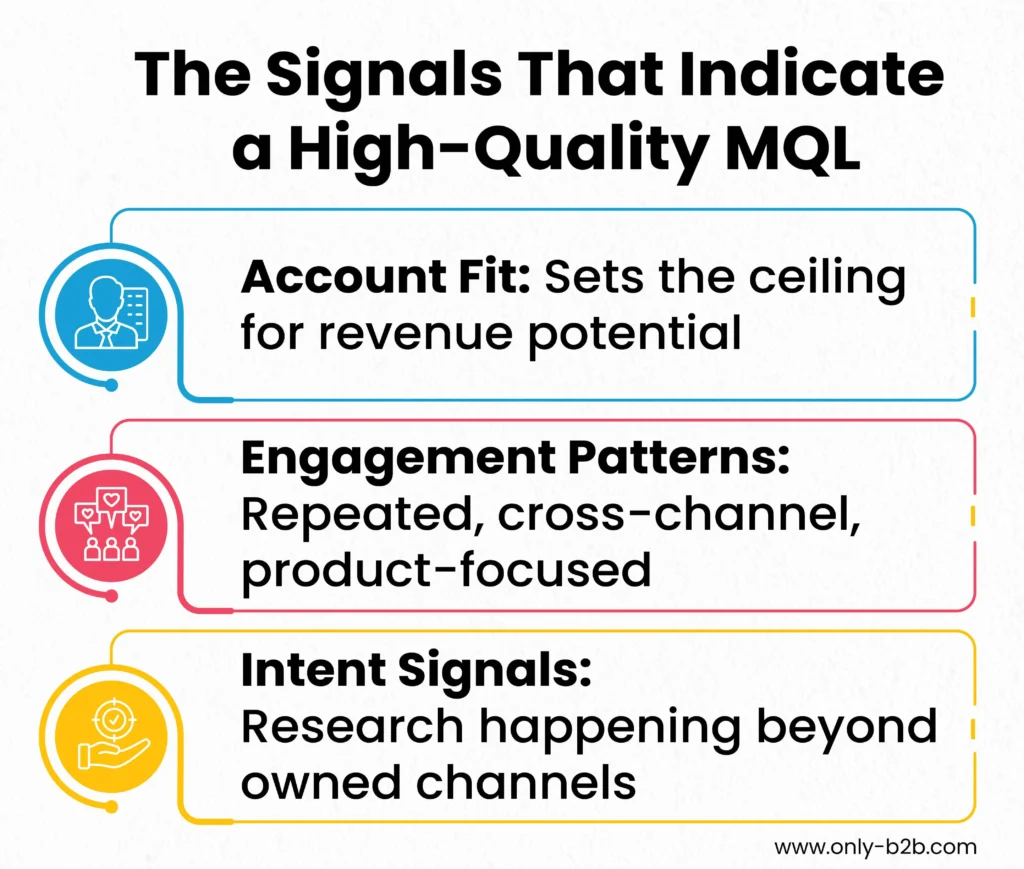
The Signals That Indicate a High-Quality MQL
Account Fit Sets the Ceiling for Value
Most marketing teams agree that fit matters. Where qualification often falls short is prioritization.
An engaged lead from a low-fit account still represents limited revenue potential. Meanwhile, moderate engagement from a high-fit account may be far more meaningful when viewed in context.
Strong MQL qualification treats account fit as a gate, not a score multiplier. Leads outside the Ideal Customer Profile are nurtured rather than escalated.
Engagement Patterns Matter More Than Individual Actions
Engagement is not binary. A single interaction rarely tells the full story.
Repeated visits, cross-channel engagement, and movement toward product-focused content signal a different level of interest than one-off downloads. These patterns often reflect internal discussion rather than individual curiosity.
Qualification improves when engagement is evaluated as a journey rather than a point event.
Intent Signals Fill the Visibility Gap
Much of today’s buyer research happens outside vendor websites.
Third-party intent data reveals what topics accounts are researching across publisher networks, review platforms, and comparison sites. When this external research aligns with internal engagement, buying readiness becomes clearer.
Gartner found that B2B organizations using intent data to support lead qualification reduce wasted sales outreach by over 25%, largely by engaging fewer leads at the right time.
Source: Gartner, Intent Data for B2B Marketing (Source: Gartner, Intent Data for B2B Marketing)
How to Build an MQL Qualification Framework Sales Will Trust
Effective MQL qualification cannot be owned by marketing alone.
High-performing teams co-create qualification frameworks that consider fit, engagement depth, intent strength, role relevance, and timing. This shared structure ensures that MQLs reflect sales reality rather than marketing activity.
Timing plays a critical role. Not every qualified lead is ready for immediate outreach. Some belong in accelerated nurture paths, while others warrant prompt sales engagement.
When sales understands why a lead is qualified and marketing understands why leads are rejected, alignment improves naturally.
Advanced Ways to Improve MQL Qualification Without Overcomplicating It
As buying journeys become more complex, advanced qualification techniques help reduce ambiguity.
Shift From Lead-Level to Account-Level Evaluation
Individual engagement rarely captures the full buying picture.
Account-level evaluation aggregates signals across stakeholders, revealing whether interest is isolated or collective. When multiple contacts engage while account-level intent increases, qualification confidence rises.
This approach reflects how B2B decisions are actually made.
Track Intent Momentum, Not Just Presence
Intent is dynamic. Sudden increases in research activity often signal urgency, while steady low-level interest may indicate early exploration.
Tracking intent velocity helps teams engage when interest peaks rather than reacting after momentum fades. B2B organizations using advanced buyer intent insights consistently outperform peers in revenue growth due to better timing and relevance.
Segment MQLs by Readiness Stage
Not all MQLs require the same response.
Segmenting qualified leads by readiness allows teams to balance speed with buyer experience. High-intent leads move quickly to sales, while others receive targeted nurture that builds confidence over time.
This approach reduces premature handoffs without slowing momentum.
Use Sales Outcomes to Refine Qualification
The most reliable feedback comes from what happens after handoff.
Organizations that continuously refine lead qualification based on sales outcomes see improved pipeline efficiency and forecasting accuracy. Engagement volume alone does not predict success.
Making MQLs a Reliable Revenue Signal Again
MQLs were never meant to measure marketing activity. They were designed to signal opportunity.
As buyer behavior continues to evolve, qualification must evolve with it. Account-level thinking, intent-informed insights, and continuous refinement are no longer optional.
The most effective B2B teams are not those generating the highest number of MQLs. They are the teams most disciplined about deciding which leads deserve sales attention.
Strong MQL qualification restores that discipline and turns demand generation into a predictable driver of pipeline growth.

Vikas Bhatt is the Co-Founder of ONLY B2B, a premium B2B lead generation company that specializes in helping businesses achieve their growth objectives through targeted marketing & sales campaigns. With 10+ years of experience in the industry, Vikas has a deep understanding of the challenges faced by businesses today and has developed a unique approach to lead generation that has helped clients across a range of industries around the globe. As a thought leader in the B2B marketing community, ONLY B2B specializes in demand generation, content syndication, database services and more.